

CVE-2026-33814 is a Go HTTP/2 denial-of-service flaw disclosed in May 2026, fixed in Go 1.26.3 and 1.25.10, where a malicious server can make a Go client loop endlessly after receiving an invalid SETTINGS_MAX_FRAME_SIZE value of zero. It is not a remote-code-execution bug, and it does not hand an attacker credentials or data. Its importance is narrower and more operational: a malformed HTTP/2 setting can turn a routine outbound request into a stuck client-side workload. For Windows shops that run Go-based services, agents, CLIs, proxies, updaters, or observability tools, that distinction matters because the vulnerable component may sit far from the public edge.
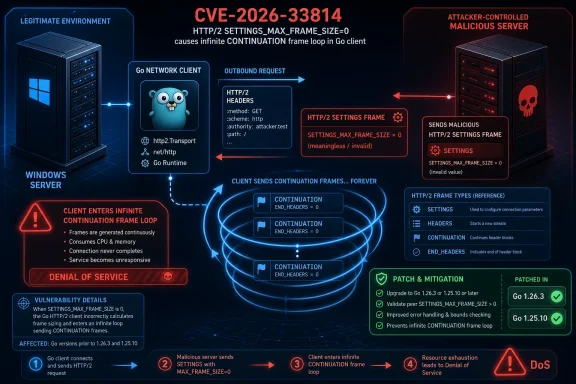
The core of CVE-2026-33814 is almost comically compact: an HTTP/2 peer sends a SETTINGS frame containing
That client-side angle is the part administrators should not skim past. Many vulnerability write-ups train readers to ask whether their servers are exposed to hostile clients. Here, the more interesting question is whether Go-based clients in your estate connect to endpoints that are attacker-controlled, compromised, redirected, or insufficiently trusted.
This is why the bug is more than a language-runtime curiosity. Modern infrastructure is full of software that behaves like a client: package managers, telemetry collectors, cloud agents, service discovery clients, API gateways, webhook processors, scanners, and internal automation. If any of those components uses an affected Go HTTP/2 transport and can be induced to talk to a malicious HTTP/2 endpoint, availability becomes the security boundary.
The vulnerability is also a reminder that denial of service is not always a volumetric event. No flood is required in the classic sense. A single protocol-state mistake can be enough to strand a process, consume CPU, fill logs, or exhaust worker pools depending on how the affected program is built around the transport.
That machinery is powerful precisely because it shifts work into the protocol layer. The application does not usually parse every frame itself. It trusts the HTTP stack to enforce the rules, reject nonsense, and keep the connection state coherent. CVE-2026-33814 sits in that trust seam.
CONTINUATION frames are not exotic by themselves. They are part of how HTTP/2 carries header blocks that span multiple frames. The danger here is not the existence of CONTINUATION frames but the loop: the transport becomes trapped in protocol work that should never have been allowed to start from an invalid setting.
The lesson for defenders is familiar but uncomfortable. Protocol correctness is a security control. Bounds checks, state-machine validation, and “that value should be impossible” branches are not academic hygiene; they decide whether a hostile peer can turn a parser into a resource sink.
Client-side network exposure has widened. Build systems fetch modules. Endpoint tools phone home. SaaS integrations follow redirects. Internal services call third-party APIs. Developers run Go CLIs against cloud, Kubernetes, Git, package, and artifact systems all day. A “client” in 2026 may be a production service dependency, not a human opening a browser.
The more automated the client, the more serious the availability risk becomes. A developer CLI that hangs is irritating. A fleet agent that hangs during update checks is operationally painful. A backend service whose workers stall when calling a malicious or compromised upstream can become an outage multiplier.
The bug also creates awkward blast-radius questions. If a Go-based component is embedded inside a larger Windows application or management agent, administrators may not know Go is involved at all. SBOMs, vendor advisories, and executable inventory become more useful than banner strings and service names.
That is one reason MSRC visibility matters. Microsoft tracking a Go vulnerability does not mean Windows itself is necessarily the vulnerable component in the simplistic sense. It means the Windows ecosystem includes enough Go-derived or Go-consuming software that the issue belongs in Microsoft’s security-update orbit.
For source-built Go applications, the prescription is simple in theory. Rebuild with a fixed Go toolchain or update affected
Go binaries are commonly statically linked. That is excellent for deployment simplicity and awkward for vulnerability response. A server, agent, or command-line tool may carry the vulnerable code inside a single executable with no shared library on disk for an administrator to update centrally.
That is different from patching a DLL across a Windows fleet. If the affected code is compiled into ten vendor tools and four internal services, the fix comes through ten vendor updates and four rebuilds. The runtime version installed on a machine may be less important than the compiler and module versions used when the binary was produced.
This is where Windows administrators and Go developers sometimes talk past each other. The admin asks, “Do we have Go installed?” The developer answers, “Not on the production host.” Both can be correct, and neither answer proves that the production host is free of Go code.
Many Go programs never import an HTTP/2 package directly. They use
That means grepping for
The Windows angle is especially relevant for cross-platform tooling. A Go program built on Linux and shipped to Windows can carry the same vulnerable transport behavior. The operating system is not the source of the bug; it is the place where the affected executable runs, integrates, logs, restarts, and sometimes fails silently.
For defenders, the best question is not “Is this a Windows vulnerability?” It is “Which Windows-hosted workloads run Go-built HTTP clients that talk to endpoints outside our control?”
This is where severity language can mislead. CVSS-style availability impact terms describe the potential loss to the impacted component, but they cannot know whether that component is a trivial helper or a business-critical control plane. An attacker who can deny access to a resource through a stuck client may not need to knock over the whole machine to create a serious incident.
Consider a service that fans out to upstream APIs and uses Go HTTP clients for those calls. If the service has sane timeouts, worker isolation, retry limits, and circuit breakers, the impact may be contained. If it has unbounded retries, shared connection pools, and poor cancellation discipline, a protocol-level loop can become a system-level availability failure.
That is why patching should not be the only response. A bug like this rewards teams that already engineered for hostile networks. Timeouts, context cancellation, concurrency caps, health checks, and process supervision are not substitutes for a fixed transport, but they reduce the odds that one malformed peer becomes an outage.
The irony is that Go is popular partly because it makes network services easy to write. The same ease can hide assumptions. A few lines of
For WindowsForum readers, this is the broader story: Windows security is no longer bounded by Windows components. A Windows server running a vendor appliance agent, a Kubernetes node helper, a backup connector, or a cloud telemetry component may inherit vulnerabilities from Go, Rust, OpenSSL, zlib, npm packages, Python wheels, and container images. The operating system remains the platform, but the attack surface is a supply-chain stack.
That makes vendor communication crucial. If a Microsoft product incorporates affected Go code, Microsoft’s update channels and advisories should eventually say so. If a third-party product does, the fix may arrive through that vendor’s updater, not Windows Update. If an internal team owns the code, the fix depends on build pipelines and dependency governance.
The risk is that organizations patch what their tooling can see. Traditional Windows patch dashboards may show green while statically linked Go executables remain unchanged. Conversely, vulnerability scanners may flag
The answer is not to treat every Go CVE as a five-alarm Windows event. The answer is to build enough software inventory fidelity to know when a Go CVE touches production behavior.
This matters for internal environments. Many organizations maintain private artifact repositories, internal APIs, proxy layers, and service meshes. If attackers gain control over one of those upstreams, client-side parser bugs become lateral-movement helpers for disruption. They may not grant code execution, but they can degrade the tools defenders and operators rely on.
The same is true in developer workstations. Developers routinely run tools that fetch data from preview environments, pull requests, self-hosted services, and temporary endpoints. A malicious server that can wedge a Go-based client may be able to interrupt builds, tests, scanners, or deployment utilities. That is not a cinematic breach, but it is a real operational attack.
The mitigation pattern is partly technical and partly cultural. Technical teams should restrict where privileged automation can connect, enforce timeouts, and keep build images current. Culturally, teams should stop treating outbound client behavior as inherently safe just because the port is ephemeral and the process is “only fetching data.”
A malformed response is still input. If that input reaches a state machine with a bad exit condition, the client becomes the victim.
Internal software owners should identify Go services and tools that make outbound HTTP/2 connections. They should rebuild high-value binaries with a fixed toolchain, update module dependencies where
Vendor-managed software requires a different motion. Ask vendors whether their Windows agents, appliances, scanners, backup tools, EDR components, cloud connectors, or management utilities include affected Go HTTP/2 transport code. If they do, ask for fixed build versions and release dates. If they do not, ask whether they verified by build metadata, SBOM, or source review.
Operational mitigations can buy time. Egress controls can reduce exposure to arbitrary HTTP/2 servers. Process watchdogs can restart wedged agents. Timeouts and circuit breakers can contain stalled calls. Monitoring can look for unusual CPU activity, stuck goroutines in debug profiles, repeated failed health checks, or client processes that stop making progress after connecting to a specific upstream.
None of those controls should be mistaken for the patch. They are guardrails around the vulnerable behavior. The actual fix is validation in the HTTP/2 transport so an invalid
A Go-based updater calling home is a client. A Windows-hosted observability collector exporting telemetry is a client. A CI worker pulling from a module proxy is a client. A backup orchestrator checking cloud metadata is a client. Any of them can sit on a privileged host, run unattended, and become availability-sensitive.
That is the uncomfortable part of this CVE. It asks administrators to inventory behavior rather than just packages. Which processes initiate HTTP/2 connections? Which of those processes are written in Go or bundle Go libraries? Which upstreams are trusted by policy rather than by assumption? Which failures would block deployments, monitoring, backups, or incident response?
The answers will vary dramatically by environment. A small shop with little Go tooling may have minimal exposure. A cloud-native enterprise with Go-heavy agents, proxies, CLIs, and microservices may have a significant rebuild and vendor-validation task. The CVE number is the same in both cases; the operational meaning is not.
This is why security teams should not outsource prioritization entirely to generic severity labels. A denial-of-service bug in a client transport can be low drama in one estate and high leverage in another.
That makes CVE-2026-33814 a governance problem as much as a patch problem. You need to know which teams can rebuild binaries, which vendors own which agents, which scanners can identify Go build information, and which change windows can accommodate redeployment. Without that machinery, every statically linked ecosystem vulnerability becomes a manual hunt.
There is also a logging challenge. A process stuck in a transport loop may not produce a neat security event. It may look like high CPU, failed health probes, timeouts downstream, or an agent that stopped reporting. Unless defenders correlate those symptoms with recent connections to suspicious endpoints, exploitation may look like ordinary instability.
The Windows event log will not magically explain an HTTP/2 frame-state bug buried in a Go transport. Application telemetry, network flow records, EDR process metrics, and service supervision logs become the evidence trail. Mature environments will combine those signals; less mature ones will reboot the box and move on.
That is not a criticism of Windows. It is the price of running a heterogeneous software supply chain on any operating system.
For enterprises, the toolchain checksum issue in the same release set may attract more attention because it touches trust in downloaded toolchains. The HTTP/2 infinite-loop bug is less sweeping but more directly tied to runtime availability. Both illustrate the same broader point: language updates are now infrastructure updates.
The old model treated compiler upgrades as developer preference unless a product team requested them. That model is increasingly untenable. If the compiler and standard library carry security fixes that are compiled into production binaries, then toolchain currency becomes part of vulnerability management.
Organizations do not need reckless automatic upgrades to every new Go version. They do need a practiced route for security point releases. That route should include compatibility testing, rebuild automation, artifact signing, deployment tracking, and rollback plans. Without it, “fixed upstream” remains a phrase in an advisory rather than a reduction in exposure.
The best teams will use CVE-2026-33814 as a drill. Can they identify affected Go programs? Can they rebuild them quickly? Can they prove which version is deployed? Can they distinguish vendor responsibility from internal ownership? Those questions will recur.
 The Bug Is Small, but the Failure Mode Is Not
The core of CVE-2026-33814 is almost comically compact: an HTTP/2 peer sends a SETTINGS frame containing SETTINGS_MAX_FRAME_SIZE=0, and Go’s HTTP/2 transport can respond by entering an infinite loop writing CONTINUATION frames. The Go security announcement describes the impact as a potential denial of service against a client by a malicious server. Microsoft’s Security Response Center tracks the same vulnerability because Microsoft products and developer ecosystems routinely consume Go components, either directly or through bundled tooling.That client-side angle is the part administrators should not skim past. Many vulnerability write-ups train readers to ask whether their servers are exposed to hostile clients. Here, the more interesting question is whether Go-based clients in your estate connect to endpoints that are attacker-controlled, compromised, redirected, or insufficiently trusted.
This is why the bug is more than a language-runtime curiosity. Modern infrastructure is full of software that behaves like a client: package managers, telemetry collectors, cloud agents, service discovery clients, API gateways, webhook processors, scanners, and internal automation. If any of those components uses an affected Go HTTP/2 transport and can be induced to talk to a malicious HTTP/2 endpoint, availability becomes the security boundary.
The vulnerability is also a reminder that denial of service is not always a volumetric event. No flood is required in the classic sense. A single protocol-state mistake can be enough to strand a process, consume CPU, fill logs, or exhaust worker pools depending on how the affected program is built around the transport.
HTTP/2’s Performance Machinery Becomes the Attack Surface
HTTP/2 was designed to make web traffic more efficient, not more fragile. It multiplexes streams, compresses headers, and coordinates connection behavior through SETTINGS frames. Those SETTINGS frames are part of the normal protocol conversation: peers use them to announce limits and preferences such as frame size, concurrent streams, and flow-control behavior.That machinery is powerful precisely because it shifts work into the protocol layer. The application does not usually parse every frame itself. It trusts the HTTP stack to enforce the rules, reject nonsense, and keep the connection state coherent. CVE-2026-33814 sits in that trust seam.
SETTINGS_MAX_FRAME_SIZE is supposed to describe the maximum size of a frame payload a peer is willing to receive, within protocol-defined bounds. A value of zero is invalid. The fixed Go transport now checks that the received value is valid, but the vulnerable path failed badly enough that the transport could keep writing CONTINUATION frames instead of exiting the condition cleanly.CONTINUATION frames are not exotic by themselves. They are part of how HTTP/2 carries header blocks that span multiple frames. The danger here is not the existence of CONTINUATION frames but the loop: the transport becomes trapped in protocol work that should never have been allowed to start from an invalid setting.
The lesson for defenders is familiar but uncomfortable. Protocol correctness is a security control. Bounds checks, state-machine validation, and “that value should be impossible” branches are not academic hygiene; they decide whether a hostile peer can turn a parser into a resource sink.
This Is a Client DoS, Which Makes It Easy to Misprioritize
The phrase “malicious server” often causes enterprise triage teams to relax. If an attacker must control the server, the thinking goes, then the bug is less urgent than a public-facing listener vulnerability. That instinct is understandable, but it is increasingly dated.Client-side network exposure has widened. Build systems fetch modules. Endpoint tools phone home. SaaS integrations follow redirects. Internal services call third-party APIs. Developers run Go CLIs against cloud, Kubernetes, Git, package, and artifact systems all day. A “client” in 2026 may be a production service dependency, not a human opening a browser.
The more automated the client, the more serious the availability risk becomes. A developer CLI that hangs is irritating. A fleet agent that hangs during update checks is operationally painful. A backend service whose workers stall when calling a malicious or compromised upstream can become an outage multiplier.
The bug also creates awkward blast-radius questions. If a Go-based component is embedded inside a larger Windows application or management agent, administrators may not know Go is involved at all. SBOMs, vendor advisories, and executable inventory become more useful than banner strings and service names.
That is one reason MSRC visibility matters. Microsoft tracking a Go vulnerability does not mean Windows itself is necessarily the vulnerable component in the simplistic sense. It means the Windows ecosystem includes enough Go-derived or Go-consuming software that the issue belongs in Microsoft’s security-update orbit.
The Patch Story Is Straightforward; the Inventory Story Is Not
The Go team fixed CVE-2026-33814 in the May 7, 2026 security releases, Go 1.26.3 and Go 1.25.10. Those releases included multiple security fixes across the toolchain and standard library, but the HTTP/2 transport bug is among the most operationally legible: invalid frame-size setting, infinite loop, client denial of service, fixed validation.For source-built Go applications, the prescription is simple in theory. Rebuild with a fixed Go toolchain or update affected
golang.org/x/net usage where applicable. In practice, that simplicity depends on how disciplined the software supply chain already is.Go binaries are commonly statically linked. That is excellent for deployment simplicity and awkward for vulnerability response. A server, agent, or command-line tool may carry the vulnerable code inside a single executable with no shared library on disk for an administrator to update centrally.
That is different from patching a DLL across a Windows fleet. If the affected code is compiled into ten vendor tools and four internal services, the fix comes through ten vendor updates and four rebuilds. The runtime version installed on a machine may be less important than the compiler and module versions used when the binary was produced.
This is where Windows administrators and Go developers sometimes talk past each other. The admin asks, “Do we have Go installed?” The developer answers, “Not on the production host.” Both can be correct, and neither answer proves that the production host is free of Go code.
x/net Is the Shadow Standard Library Many Teams Forget
The submitted advisory namesgolang.org/x/net and net/http/internal/http2, which can look confusing if you do not live in Go’s HTTP stack. Go’s HTTP/2 implementation has had a long relationship with the extended x/net/http2 package and the standard library’s internalized HTTP/2 code. The practical point is simpler than the package names: affected applications may depend on Go’s HTTP/2 transport through ordinary HTTP client behavior.Many Go programs never import an HTTP/2 package directly. They use
net/http, configure a client, and let the runtime negotiate HTTP/2 over TLS when appropriate. Others use golang.org/x/net/http2 explicitly for advanced transport configuration, h2c support, proxies, or integration with framework code.That means grepping for
http2 is a useful start but not a complete audit. Dependency scanning should look at compiled build metadata where available, module manifests, vendored dependencies, and vendor advisories. Internal teams should also check whether rebuild pipelines pin an older Go toolchain even when module dependencies look fresh.The Windows angle is especially relevant for cross-platform tooling. A Go program built on Linux and shipped to Windows can carry the same vulnerable transport behavior. The operating system is not the source of the bug; it is the place where the affected executable runs, integrates, logs, restarts, and sometimes fails silently.
For defenders, the best question is not “Is this a Windows vulnerability?” It is “Which Windows-hosted workloads run Go-built HTTP clients that talk to endpoints outside our control?”
Availability Bugs Hit Differently in Automation-Heavy Estates
CVE-2026-33814 has the shape of a denial-of-service vulnerability, but the consequence depends on application architecture. An infinite loop in a disposable command may be a stuck process. An infinite loop in a long-lived service may degrade a worker pool. An infinite loop in a privileged management agent may create cascading reliability problems that are hard to attribute to a network peer.This is where severity language can mislead. CVSS-style availability impact terms describe the potential loss to the impacted component, but they cannot know whether that component is a trivial helper or a business-critical control plane. An attacker who can deny access to a resource through a stuck client may not need to knock over the whole machine to create a serious incident.
Consider a service that fans out to upstream APIs and uses Go HTTP clients for those calls. If the service has sane timeouts, worker isolation, retry limits, and circuit breakers, the impact may be contained. If it has unbounded retries, shared connection pools, and poor cancellation discipline, a protocol-level loop can become a system-level availability failure.
That is why patching should not be the only response. A bug like this rewards teams that already engineered for hostile networks. Timeouts, context cancellation, concurrency caps, health checks, and process supervision are not substitutes for a fixed transport, but they reduce the odds that one malformed peer becomes an outage.
The irony is that Go is popular partly because it makes network services easy to write. The same ease can hide assumptions. A few lines of
http.Get can become production infrastructure faster than the surrounding operational controls catch up.Microsoft’s Presence in the Advisory Is a Supply-Chain Signal
MSRC listing CVE-2026-33814 is not merely a bureaucratic echo of the Go announcement. It reflects the reality that Microsoft’s ecosystem now spans Windows, Azure, developer tooling, containers, package flows, GitHub-centered workflows, and third-party components. Go is part of that world whether or not a given administrator writes Go code.For WindowsForum readers, this is the broader story: Windows security is no longer bounded by Windows components. A Windows server running a vendor appliance agent, a Kubernetes node helper, a backup connector, or a cloud telemetry component may inherit vulnerabilities from Go, Rust, OpenSSL, zlib, npm packages, Python wheels, and container images. The operating system remains the platform, but the attack surface is a supply-chain stack.
That makes vendor communication crucial. If a Microsoft product incorporates affected Go code, Microsoft’s update channels and advisories should eventually say so. If a third-party product does, the fix may arrive through that vendor’s updater, not Windows Update. If an internal team owns the code, the fix depends on build pipelines and dependency governance.
The risk is that organizations patch what their tooling can see. Traditional Windows patch dashboards may show green while statically linked Go executables remain unchanged. Conversely, vulnerability scanners may flag
golang.org/x/net in source repositories that never ship an HTTP/2 client path. Both false reassurance and false panic are possible.The answer is not to treat every Go CVE as a five-alarm Windows event. The answer is to build enough software inventory fidelity to know when a Go CVE touches production behavior.
The Real Exploit Path Runs Through Trust Boundaries
The most plausible exploit scenarios involve a Go client connecting to a malicious or compromised HTTP/2 server. That could be an intentionally hostile endpoint, a hijacked service, a development dependency mirror, a poisoned internal test service, or a redirection path the client should not have trusted. The vulnerability does not require the attacker to break TLS if the client willingly connects to the attacker’s endpoint.This matters for internal environments. Many organizations maintain private artifact repositories, internal APIs, proxy layers, and service meshes. If attackers gain control over one of those upstreams, client-side parser bugs become lateral-movement helpers for disruption. They may not grant code execution, but they can degrade the tools defenders and operators rely on.
The same is true in developer workstations. Developers routinely run tools that fetch data from preview environments, pull requests, self-hosted services, and temporary endpoints. A malicious server that can wedge a Go-based client may be able to interrupt builds, tests, scanners, or deployment utilities. That is not a cinematic breach, but it is a real operational attack.
The mitigation pattern is partly technical and partly cultural. Technical teams should restrict where privileged automation can connect, enforce timeouts, and keep build images current. Culturally, teams should stop treating outbound client behavior as inherently safe just because the port is ephemeral and the process is “only fetching data.”
A malformed response is still input. If that input reaches a state machine with a bad exit condition, the client becomes the victim.
Patch the Toolchain, Then Rebuild the World That Matters
For Go maintainers, the fix path begins with Go 1.26.3 or Go 1.25.10. But organizations should resist the temptation to declare victory after updating developer workstations. The vulnerable code is relevant where binaries were built, not merely where Go is installed today.Internal software owners should identify Go services and tools that make outbound HTTP/2 connections. They should rebuild high-value binaries with a fixed toolchain, update module dependencies where
golang.org/x/net is explicitly used, and redeploy artifacts rather than assuming a runtime patch will reach statically linked code. Container images deserve special attention because old build layers and pinned base images can quietly preserve vulnerable builds.Vendor-managed software requires a different motion. Ask vendors whether their Windows agents, appliances, scanners, backup tools, EDR components, cloud connectors, or management utilities include affected Go HTTP/2 transport code. If they do, ask for fixed build versions and release dates. If they do not, ask whether they verified by build metadata, SBOM, or source review.
Operational mitigations can buy time. Egress controls can reduce exposure to arbitrary HTTP/2 servers. Process watchdogs can restart wedged agents. Timeouts and circuit breakers can contain stalled calls. Monitoring can look for unusual CPU activity, stuck goroutines in debug profiles, repeated failed health checks, or client processes that stop making progress after connecting to a specific upstream.
None of those controls should be mistaken for the patch. They are guardrails around the vulnerable behavior. The actual fix is validation in the HTTP/2 transport so an invalid
SETTINGS_MAX_FRAME_SIZE value is rejected instead of becoming an infinite loop.The Practical Lesson Is Hidden in the Direction of the Connection
CVE-2026-33814 is a useful test of whether an organization’s vulnerability program understands modern software directionality. Old triage habits prioritize inbound listeners, exposed ports, and server banners. Those still matter, but they miss a large part of today’s risk: trusted clients that continuously fetch, sync, poll, scan, and report.A Go-based updater calling home is a client. A Windows-hosted observability collector exporting telemetry is a client. A CI worker pulling from a module proxy is a client. A backup orchestrator checking cloud metadata is a client. Any of them can sit on a privileged host, run unattended, and become availability-sensitive.
That is the uncomfortable part of this CVE. It asks administrators to inventory behavior rather than just packages. Which processes initiate HTTP/2 connections? Which of those processes are written in Go or bundle Go libraries? Which upstreams are trusted by policy rather than by assumption? Which failures would block deployments, monitoring, backups, or incident response?
The answers will vary dramatically by environment. A small shop with little Go tooling may have minimal exposure. A cloud-native enterprise with Go-heavy agents, proxies, CLIs, and microservices may have a significant rebuild and vendor-validation task. The CVE number is the same in both cases; the operational meaning is not.
This is why security teams should not outsource prioritization entirely to generic severity labels. A denial-of-service bug in a client transport can be low drama in one estate and high leverage in another.
A Go HTTP/2 Bug Becomes a Windows Admin Problem
Windows administrators are increasingly asked to manage software that does not look like traditional Windows software. It may be a single EXE with no installer database entry. It may run as a service underLocalSystem but originate from a Linux-centric project. It may ship inside an appliance image, a container, or a vendor-controlled updater. Go’s deployment model fits that pattern perfectly.That makes CVE-2026-33814 a governance problem as much as a patch problem. You need to know which teams can rebuild binaries, which vendors own which agents, which scanners can identify Go build information, and which change windows can accommodate redeployment. Without that machinery, every statically linked ecosystem vulnerability becomes a manual hunt.
There is also a logging challenge. A process stuck in a transport loop may not produce a neat security event. It may look like high CPU, failed health probes, timeouts downstream, or an agent that stopped reporting. Unless defenders correlate those symptoms with recent connections to suspicious endpoints, exploitation may look like ordinary instability.
The Windows event log will not magically explain an HTTP/2 frame-state bug buried in a Go transport. Application telemetry, network flow records, EDR process metrics, and service supervision logs become the evidence trail. Mature environments will combine those signals; less mature ones will reboot the box and move on.
That is not a criticism of Windows. It is the price of running a heterogeneous software supply chain on any operating system.
The May 2026 Go Releases Deserve More Than a Routine Bump
Go 1.26.3 and 1.25.10 were not single-issue releases. The Go announcement bundled eleven security fixes, including issues in the module toolchain, reverse proxy handling, Windows-specific networking behavior, mail parsing, template escaping, archive extraction, DNS handling, and HTTP/2 transport. That breadth is normal for a mature platform, but it also makes the releases harder to triage casually.For enterprises, the toolchain checksum issue in the same release set may attract more attention because it touches trust in downloaded toolchains. The HTTP/2 infinite-loop bug is less sweeping but more directly tied to runtime availability. Both illustrate the same broader point: language updates are now infrastructure updates.
The old model treated compiler upgrades as developer preference unless a product team requested them. That model is increasingly untenable. If the compiler and standard library carry security fixes that are compiled into production binaries, then toolchain currency becomes part of vulnerability management.
Organizations do not need reckless automatic upgrades to every new Go version. They do need a practiced route for security point releases. That route should include compatibility testing, rebuild automation, artifact signing, deployment tracking, and rollback plans. Without it, “fixed upstream” remains a phrase in an advisory rather than a reduction in exposure.
The best teams will use CVE-2026-33814 as a drill. Can they identify affected Go programs? Can they rebuild them quickly? Can they prove which version is deployed? Can they distinguish vendor responsibility from internal ownership? Those questions will recur.
The Admin’s Short List for This Specific CVE
The useful response to CVE-2026-33814 is not panic; it is disciplined narrowing. The vulnerability is specific enough that organizations can focus their effort, but only if they understand where Go HTTP/2 clients live in their environment.- Identify Go-built applications, services, agents, CLIs, and containers that initiate outbound HTTP or HTTP/2 connections from Windows hosts or Windows-managed environments.
- Prioritize components that connect to untrusted, semi-trusted, internet-facing, user-supplied, redirected, or easily compromised upstream servers.
- Rebuild internally maintained Go software with Go 1.26.3, Go 1.25.10, or later fixed releases, and update explicit
golang.org/x/netdependencies where they are used. - Ask vendors for fixed versions of Go-based Windows agents, scanners, proxies, backup components, cloud connectors, and management tools rather than assuming Windows Update covers the exposure.
- Use egress policy, timeouts, circuit breakers, process supervision, and telemetry as temporary containment, not as a replacement for patched transport code.
- Treat unexplained hangs, high CPU loops, stalled HTTP clients, and agent silence after outbound HTTP/2 connections as symptoms worth investigating during the remediation window.
References
- Primary source: MSRC
Published: 2026-05-26T01:38:14-07:00
Security Update Guide - Microsoft Security Response Center
 msrc.microsoft.com
- Related coverage: datacomm.com
- Related coverage: resolvedsecurity.com
- Related coverage: securityvulnerability.io
CVE-2026-33814 : HTTP/2 Transport Vulnerability in Go Programming Language
Learn about a vulnerability in Go affecting HTTP/2, which may cause infinite loops in transport processing. Explore CVE-2026-33814 now.securityvulnerability.io - Related coverage: radar.offseq.com
CVE-2026-33814: CWE-835: Loop with Unreachable Exit Condition ('Infinite Loop') in golang.org/x/net golang.org/x/net/http2 - Live Threat Intelligence - Threat Radar | OffSeq.com
Detailed information about CVE-2026-33814: CWE-835: Loop with Unreachable Exit Condition ('Infinite Loop') in golang.org/x/net golang.org/x/net/http2 affectingradar.offseq.com - Related coverage: mondoo.com
CVE-2026-33814 | Mondoo Vulnerability Intelligence
CVE-2026-33814 - HIGH severity: Infinite loop in HTTP/2 transport when given bad SETTINGS_MAX_FRAME_SIZE in net/http/internal/http2 in golang.org/x/netmondoo.com
- Related coverage: tip.golang.org
- The Go Programming Language
 tip.golang.org
- Related coverage: mycve.com

CVE-2026-33814 - Infinite loop in HTTP/2 transport when given bad SETTINGS_MAX_FRAME_SIZE in net/http/internal/http2 in golang.org/x/net
a site where you can track your CVE.
mycve.com
- Related coverage: thehackerwire.com
CVE-2026-33814 - High Vulnerability - TheHackerWire
TheHackerWire - Your daily source for cybersecurity news, CVE alerts, hacking tutorials, and security tool reviews. Stay ahead of cyber threats.www.thehackerwire.com
