

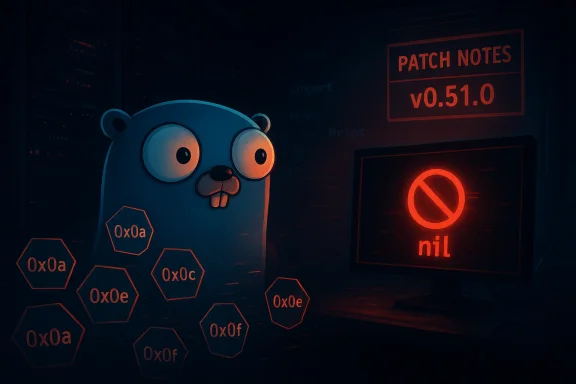
A newly disclosed vulnerability in the golang.org/x/net HTTP/2 implementation can be triggered by sending a narrow range of HTTP/2 frame types (0x0a–0x0f), causing a nil-pointer panic that crashes servers using affected module versions — a denial-of-service vector that is easy to trigger from the network and requires immediate attention from Go developers and operators. (go.dev)
The golang.org/x/net module contains the reference HTTP/2 implementation widely used by Go projects that either import it directly or rely on libraries that do. HTTP/2 frames are the low-level wire units for control and data; the protocol defines a set of standard frame types and leaves room for future extensions. When the module's internal dispatch logic was changed to add support for a new frame type, a gap was unintentionally created: a small array used to select a parser function for each frame type now contains nil entries for a handful of indices. When the code returns and immediately calls the returned parser without confirming it is non-nil, the runtime will attempt to call a nil function pointer and the process will panic. (go.dev)
This is not an off-by-one or subtle memory-corruption bug — it is a basic missing-nil-check that becomes exploitable on the network because unassigned or IANA-registered frame types (for example, ALTSVC at 0x0a and ORIGIN at 0x0c) can be sent by peers in real-world interop scenarios. The end result: a network attacker who can open an HTTP/2 connection to a vulnerable server can provoke a panic and crash the process. (go.dev)
Example conceptual fix (pseudocode):
After applying the fix, add unit tests and an integration test that attempts to parse frames with the unassigned types (0x0a–0x0f) and asserts that the parser returns an UnknownFrame rather than causing a panic. Fuzzing the frame header type and payload size is a cheap and effective follow-up.
Upstream reviewers implemented the same pattern and released the fix in the module update. Reproducing their guard and tests will keep your tree safe even if you pin or vendor a specific module snapshot.
Practical steps to manage this:
However, the broader operational risk is non-trivial. The vulnerability is:
In the short term: prioritize the upgrade to the fixed module version and verify deployments. In the medium term: bake-in defensive parsing checks, broaden test coverage, and tighten supply-chain visibility so the next small internal change can't produce another high-impact outage.
Source: MSRC Security Update Guide - Microsoft Security Response Center
 Background
The golang.org/x/net module contains the reference HTTP/2 implementation widely used by Go projects that either import it directly or rely on libraries that do. HTTP/2 frames are the low-level wire units for control and data; the protocol defines a set of standard frame types and leaves room for future extensions. When the module's internal dispatch logic was changed to add support for a new frame type, a gap was unintentionally created: a small array used to select a parser function for each frame type now contains nil entries for a handful of indices. When the code returns and immediately calls the returned parser without confirming it is non-nil, the runtime will attempt to call a nil function pointer and the process will panic. (go.dev)This is not an off-by-one or subtle memory-corruption bug — it is a basic missing-nil-check that becomes exploitable on the network because unassigned or IANA-registered frame types (for example, ALTSVC at 0x0a and ORIGIN at 0x0c) can be sent by peers in real-world interop scenarios. The end result: a network attacker who can open an HTTP/2 connection to a vulnerable server can provoke a panic and crash the process. (go.dev)
What exactly went wrong: a technical breakdown
How the parser dispatch worked
Inside the package that parses HTTP/2 frames, maintainers used a fixed-size array of parser function pointers indexed by frame type. Conceptually:- The array maps FrameType → parser function.
- When code reads a frame header, it calls a selector function to return the parser and then invokes that parser to decode the payload.
- Historically, the array had explicit entries for the defined set of frame types and any unknown type fell through to a generic parser.
Minimal repro pattern
The crash follows a simple pattern:- Client opens a valid HTTP/2 connection to the server.
- Client sends a frame whose Type field equals any value in the range 0x0a..0x0f (including certain IANA-registered types in that range).
- Server's frame-reading code indexes into the parser table, receives a nil function value, and attempts to invoke it.
- Go runtime triggers a panic for an invalid memory access (nil function call), which typically terminates the goroutine, and depending on server code and panic handling, can stop the entire process.
Scope and affected components
Affected versions
The defect was introduced in the golang.org/x/net module at version v0.50.0 and resolved in v0.51.0. Any project that imports golang.org/x/net (directly or transitively) with a version in the inclusive range v0.50.0 .. (but not including) v0.51.0 is vulnerable. The OSV and package-vulnerability databases list the introduced/fixed versions and enumerate the symbols and functions that may be implicated. (osv.dev)Which binaries and services are likely impacted
- Servers that explicitly import and run golang.org/x/net/http2 (for example, when using the package’s Server.ServeConn or configuring a net/http server with advanced HTTP/2 features).
- Applications that vendor or transitively include a vulnerable x/net version in their build.
- Proxies, ingress controllers, sidecars, and service meshes written in Go that use x/net/http2 (directly or via libraries).
- Some gRPC-related code paths: while the main grpc-go server heavily relies on the Go standard library and internal transport code, various grpc-related toolchains and integrations use x/net/http2 or h2c helpers; transitive usage should be audited in your dependency graph. (osv.dev)
Realistic attack scenario and risk assessment
- Attack vector: Network. An unauthenticated remote attacker who can establish an HTTP/2 connection to the target can trigger the crash. No special privileges or crafted TLS certificates are needed beyond whatever the service normally requires to establish an HTTP/2 session. (nvd.nist.gov)
- Complexity: Low. Sending a single malformed or unassigned frame type in the 0x0a..0x0f range is sufficient to trigger the nil call.
- Impact: Denial-of-Service (process crash). The most likely effect is a service outage or degraded availability. Operators who run single-process servers without robust restart or supervisor logic will experience sustained downtime.
- Exploitability: High in exposed deployments. Any service that accepts HTTP/2 connections from potentially hostile networks (public or shared networks) should treat this as easily exploitable.
Detection, indicators, and triage steps
Log signatures and panic traces
Look for typical Go nil-pointer panic traces in your logs that include functions from the x/net/http2 package and frame-parsing code. Example indicators:- "panic: runtime error: invalid memory address or nil pointer dereference"
- Stack frames referencing frame parser functions, Framer.ReadFrame, FrameHeader.String or typeFrameParser (these symbols were specifically flagged in the vulnerability database metadata).
- Abrupt process or container restarts concurrent with inbound HTTP/2 activity from an external peer.
Inventory and dependency checks
- Audit your codebase and build pipeline for any references to golang.org/x/net in go.mod or vendor/ directories.
- Check transitive dependencies with:
- go list -m all
- go mod graph
- Tools like
go list -json -m allor supply-chain scanners that report exact module versions. - Identify services in production that were built with a vulnerable module version and prioritize those exposed to untrusted networks.
Remediation and mitigation (recommended)
The preferred and complete remediation is to update the golang.org/x/net module to the fixed version and rebuild/redeploy the affected services.- Upgrade the dependency in your module:
- go get golang.org/x/[email protected]
- go mod tidy
- Rebuild and redeploy your binaries or container images, then verify no remaining references to the vulnerable version exist in the deployed artifact.
- Disable HTTP/2 on the exposed listener. For many services, forcing HTTP/1.1 at the ingress point (load balancer, reverse proxy, or server configuration) prevents the attacker from sending the offending HTTP/2 frame types entirely.
- Add an upstream reverse proxy (NGINX/Envoy/HAProxy) that normalizes or drops unknown HTTP/2 frame types. Note that many proxies support configurable frame/extension filters and may protect downstream services.
- If your architecture uses orchestrators or process supervisors, ensure automatic, rapid restarts to limit downtime while you patch; but be mindful that naive restarts without rate-limiting can lead to crash loops under attack.
- Use network controls to restrict which peers may open HTTP/2 connections to critical backends (e.g., deny public access to internal service ports, or restrict to known IP ranges).
Step-by-step emergency playbook for operators
- Identify services:
- Search for golang.org/x/net in go.mod, vendor/, and compiled binaries.
- Use supply-chain scanners to map module versions in images.
- Prioritize exposed services:
- Public web servers, API endpoints, proxies, ingress controllers, gRPC frontends.
- Rapid remediation:
- Update module to v0.51.0.
- Rebuild images, run tests, and redeploy behind rolling updates.
- Short-term hardening if rebuild is delayed:
- Disable HTTP/2 at the frontend or add a proxy that drops or rewrites HTTP/2 traffic.
- Apply network ACLs to limit incoming HTTP/2-capable sources.
- Post-remediation validation:
- Confirm crashes no longer occur under the same test vectors.
- Run integration tests that exercise HTTP/2 frames (including sending ALTSVC/ORIGIN frames) to ensure parsing behavior is resilient.
- Lessons-learned and CI changes:
- Add fuzzing and frame-type coverage to CI tests for any internal HTTP/2 usage.
- Consider adding runtime watchdogs and graceful restart patterns to reduce outage impact.
Why this class of bug matters and how to avoid repeats
This vulnerability is a textbook example of how small API or protocol extensions can create holes when internal dispatch tables are adjusted without defensive checks. Two lessons stand out:- Defensive dispatch: When selecting a function pointer from a table indexed by protocol-defined values, code must treat absent entries as "unknown" and route them to a safe generic handler. Returning nil and invoking a function is always risky — a simple nil check converts a crash into predictable, logged behavior.
- Test and coverage discipline: Protocol implementations need test harnesses that exercise the entire numeric space of frame types (including reserved, unassigned, and future values). Fuzzing that explores frame-type boundaries and table-indexing behavior should be part of the CI pipeline.
- Change reviews for protocol changes: RFC-driven additions (like new frame types) should include explicit reasoning about compatibility and the table layout used by code so that accidental index gaps are caught in code review.
Developer guidance: how to patch code and test
If you maintain code that embeds or adapts the vulnerable parser, apply the same defensive fix used in the upstream change: when selecting a parser from the array, verify the entry is non-nil and fall back to the generic unknown-frame parser.Example conceptual fix (pseudocode):
Code:
func typeFrameParser(t FrameType) frameParser {
    if int(t) < len(frameParsers) {
        if f := frameParsers[t]; f != nil {
            return f
        }
    }
    return parseUnknownFrame
}Upstream reviewers implemented the same pattern and released the fix in the module update. Reproducing their guard and tests will keep your tree safe even if you pin or vendor a specific module snapshot.
Supply chain and ecosystem considerations
Because Go projects frequently vendor dependencies or include modules in container images, operators must track not only the top-level modules they declare but also transitive inclusions. A container may include a vulnerable version of x/net embedded via a dependency chain and still be at risk even if maintainers think they do not directly import http2.Practical steps to manage this:
- Rebuild production images from source after updating the dependency to ensure the fixed code is present in final artifacts.
- Use SBOMs and module-scanning tools to validate the exact contents of images before promoting into production.
- For large fleets, prioritize patching services whose ingress configurations permit arbitrary HTTP/2 peers (public endpoints, multi-tenant frontends, etc.).
Closing analysis: strengths, risk tradeoffs, and final recommendations
The good news is that the bug is a clear, straightforward programming error with a clean fix and a narrow version window. The maintainers responded with a targeted change and a version bump; the vulnerability record identifies the introduced and fixed versions so operators can act decisively. The fix itself is small and safe: add a nil check and route unknown frame types to the existing generic handler. (go.dev)However, the broader operational risk is non-trivial. The vulnerability is:
- Easy to weaponize (network attacker can trigger it with minimal effort).
- Likely to affect many deployments due to x/net’s pervasiveness and vendoring practices.
- Capable of producing immediate service outages in single-process deployments without robust restart supervision.
- Immediately identify and patch any service built with golang.org/x/net in the fuzzy range v0.50.0 .. <v0.51.0. Upgrade to v0.51.0 and redeploy.
- If you cannot patch quickly, disable HTTP/2 at publicly reachable endpoints or front them with a hardened proxy that drops unknown frame types.
- Add CI tests and lightweight fuzzing for any HTTP/2 handling code to ensure future RFC-based or numeric-type changes don’t introduce similar gaps.
- Audit and harden logging/monitoring so that nil-pointer panics in core libraries are detected and escalated automatically.
In the short term: prioritize the upgrade to the fixed module version and verify deployments. In the medium term: bake-in defensive parsing checks, broaden test coverage, and tighten supply-chain visibility so the next small internal change can't produce another high-impact outage.
Source: MSRC Security Update Guide - Microsoft Security Response Center
