

The short, practical answer is: Microsoft’s public advisory names Azure Linux as the product it has inspected and confirmed contains the vulnerable Go component, but that statement is a scoped inventory attestation — it does not prove Azure Linux is the only Microsoft product that could include the vulnerable code. Until Microsoft publishes attestations for additional product families or you perform artifact-level inspection (SBOMs, image/package scans, or binary analysis) you must treat other Microsoft-supplied images and artifacts as unverified, not proved clean. / Overview
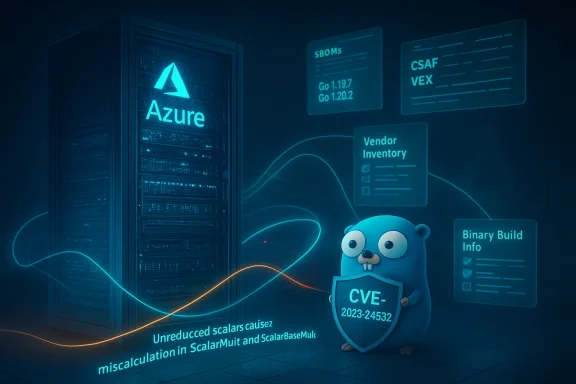
CVE-2023-24532 is a correctness bug in the Go language implementation of the P-256 elliptic-curve operations housed in the package path crypto/internal/nistec. The flaw causes ScalarMult and ScalarBaseMult on the P-256 curve to sometimes return incorrect results when invoked with unreduced scalars — that is, scalars larger than the curve order. Importantly, public advisories and vulnerability analyses note this defect does not affect typical uses of crypto/ecdsa or crypto/ecdh; it specifically affects lower-level scalar multiplication entry points.
The Go project released fixes in the 1.19 and 1.20 maintenance lines (the fix appears in versions such as 1.19.7 and 1.20.2), so the primary remediation is to upgrade Go and rebuild any artifacts compiled with vulnerable toolchains or to update OS/distribution packages that ship the Go runtime.
Microsoft’s MSRC entry for the CVE contains a concise product-level statement that is common across a number of Linux and third-party component CVE mappings: “Azure Linux includes this open-source library and is therefore potentially affected by this vulnerability.” That sentence confirms Microsoft inspected Azure Linux artifacts and found the implicated upstream component; it is an authoritative signal for Azure Linux customers that the product is in scope. Microsoft has also committed to publish machine-readable CSAF/VEX attestations and to update CVE mappings if other Microsoft productarrying the same upstream component.
What the phrasing explicitly does not do is declare that no other Microsoft product contains the same vulnerable component. Microsoft’s wording is intentionally scoped: absence of a public attestation for other Microsoft products is absence of attestation, not evidence of absence. Microsoft’s public road map to publish CSAF/VEX attestations over more product families is itself an acknowledgement that the company has not exhaustively inventory-checked every MicroWhy that distinction matters operationally
Large environments rarely run a single Microsoft-supplied image. Examples of places the same upstream Go runtime or the same kernel source could appear include:
Until those attestations are present for other Microsoft artifacts, defenders should not assume anything beyond what is use MSRC attestation as authoritative where it exists; treat the absence of attestations elsewhere as a prompt for artifact-level verification, not for complacency.
Source: MSRC Security Update Guide - Microsoft Security Response Center
CVE-2023-24532 is a correctness bug in the Go language implementation of the P-256 elliptic-curve operations housed in the package path crypto/internal/nistec. The flaw causes ScalarMult and ScalarBaseMult on the P-256 curve to sometimes return incorrect results when invoked with unreduced scalars — that is, scalars larger than the curve order. Importantly, public advisories and vulnerability analyses note this defect does not affect typical uses of crypto/ecdsa or crypto/ecdh; it specifically affects lower-level scalar multiplication entry points.
The Go project released fixes in the 1.19 and 1.20 maintenance lines (the fix appears in versions such as 1.19.7 and 1.20.2), so the primary remediation is to upgrade Go and rebuild any artifacts compiled with vulnerable toolchains or to update OS/distribution packages that ship the Go runtime.
Microsoft’s MSRC entry for the CVE contains a concise product-level statement that is common across a number of Linux and third-party component CVE mappings: “Azure Linux includes this open-source library and is therefore potentially affected by this vulnerability.” That sentence confirms Microsoft inspected Azure Linux artifacts and found the implicated upstream component; it is an authoritative signal for Azure Linux customers that the product is in scope. Microsoft has also committed to publish machine-readable CSAF/VEX attestations and to update CVE mappings if other Microsoft productarrying the same upstream component.
 What the MSRC phrasing actually means (and what it does not)
Product-scoped attestation, not exclusivity
When MSRC says a product “includes this open-source library and is therefore potentially affected,” that is an inventory statement about the specific product family named. It means Microsoft completed an inspection of that product’s composed artifacts (for example, a kernel build or a distribution package set) and mapped the upstream component to this CVE. This gives Azure Linux operators a cliation signal.What the phrasing explicitly does not do is declare that no other Microsoft product contains the same vulnerable component. Microsoft’s wording is intentionally scoped: absence of a public attestation for other Microsoft products is absence of attestation, not evidence of absence. Microsoft’s public road map to publish CSAF/VEX attestations over more product families is itself an acknowledgement that the company has not exhaustively inventory-checked every MicroWhy that distinction matters operationally
Large environments rarely run a single Microsoft-supplied image. Examples of places the same upstream Go runtime or the same kernel source could appear include:
- Azure Marketplace VM images and appliance images.
- Custom Azure Marketplace images and snapshots derived from Microsoft-supplied images.
- The WSL2 kernel shipped by Microsoft for Windows, or OEM images that embed Microsoft-published kernels.
- Containers or tooling on Microsoft-managed services that bundle a Go runtime (for example, telemetry/agent binaries, sidecars, or cloud-init-like tooling).
- SDKs and tooling distributed by Microsoft that embed a specific Go toolchain or runtime version.
The technical reality of CVE-2023-24532
What the bug is, in plain terms
Elliptic-curve scalar multiplication computes k·P where k is a scalar and P is a point. Implementations rely on correct modular arithmetic reduced modulo the curve order. If a scalar is not reduced before some internal operations, implementation assumptions can be violated and results can be incorrect. The Go crypto/internal/nistec implementation had a codepath where specific unreduced scalars could produce wrong outputs in the P-256 ScalarMult and ScalarBaseMult functions. This is a correctness problem that can be important to cryptographic protocols depending on how the low-level primitive is used.What this CVE does and does not affect
- Does affect: Direct calls to the low-level P-256 ScalarMult and ScalarBaseMult methods in the Go crypto/internal/nistec implementation when those methods are passed unreduced scalars.
- Does not affect: Common higher-level usages such as crypto/ecdsa and crypto/ecdh under typical calling patterns, because those higher-level packages perform scalar reductions and other checks that avoid the specific corner case. However, specialized code that calls the low-level functions directly or libraries that bypass safeguards could be impacted.
Fix and versions to use
Upgrading to the patched Go releases is the canonical fix. Public advisories note fixes landed in Go 1.19.7 and Go 1.20.2; projects built with older toolchains should rebuild with an updated toolchain and redeploy. For downstream OS packages (distributions that ship Go or compile Go-based binaries), apply the vendor distribution updates that include the patched Go or patched binaries.Cross-checking Microsoft’s public statement: what we can verify
Two separate classes of evidence bear on the original user question:- Upstream technical facts about the CVE — who discovered it, where it lives (Go standard library), scope, and fixed releases. These facts are documented in multiple independent vulnerability databases and the Go project’s own issue/patch history. Cross-checks include public CVE listings, OSV/packaging advisories, and vulnerability databases that capture the Go project fix. These consistently point to the same fix releases and the same functional scope of the bug.
- Microsoft’s inventory statement and its meaning — the wording used by MSRC is consistent with the style used across many Linux/kernel or third-party component advisories: it names the one product Microsoft has inspected and confirmed. Independent analysis and commentary, and Microsoft’s own public commitment to publish CSAF/VEX attestations, corroborate that the wording is an attestation of what Microsoft has checked so far rather than a categorical exclusivity claim. Multiple internal analyses and community posts reviewing Microsoft CVE mappings reach the same interpretation.
Practical impact and risk scenarios for organizations
Risk profile: where this CVE can matter
- Rebuilt or custom software that calls low-level P-256 scalar functions. Code that deliberately or accidentally calls the low-level scalar multiplication routines without prior scalar reduction could be miscomputing cryptographic operations; if that code is used in signing, key agreement, or protocol-specific math the consequences depend on context.
- Binaries compiled with a vulnerable Go toolchain. Even if the runtime library bug is not exercised at runtime in common code paths, a conservative posture is to rebuild with a patched toolchain to eliminate the risk.
- Packaged or embedded runtimes in images and appliances. If a Microsoft image or appliance shipped an older Go runtime that includes the vulnerable code and that runtime is used in production services, that image is in-scope until updated. Azure Linux is the product Microsoft has already confirmed in-scope.
Scenarios where the practical impact is low
- Systems relying only on higher-level crypto/ecdsa or crypto/ecdh APIs, where those APIs do their own checks and reductions, will typically not be affected by the CVE in normal usage.
- Binaries compiled with patched Go releases or rebuilt after the patch is applied are not vulnerable.
Triage checklist for defenders (step-by-step)
inux images- Apply Microsoft’s guidance and update Azure Linux images to the vendor-published, patched packages. Microsoft’s attestation gives Azure Linux customers the highest-priority signal to patch.
- Inventory Microsoft-supplied artifacts in your estate
- Enumerate Azure Marketplace images, WSL2 kernel usage, telemetry agents, and any Microsoft-published binaries in your environment.
- Collect SBOMs where available or generate them for critical images and containers.
- Detect vulnerable builds and binaries
- For distribution packages: query package metadata for Go runtime versions or check distro release notes.
- For compiled Go binaries: detect the Go toolchain version via strings or symbol inspection (look for the embedded "go1.x" version string or use tools that parse Go build info in binaries).
- For container images: scan with software composition analysis and look for Go versions or the presence of the crypto/internal/nistec package in source layers.
- Rebuild and redeploy
- Rebuild Go-based artifacts with patched toolchains (Go ≥ fixed release) and deploy them as soon as practical.
- For images or packages you cannot rebuild immediately, follow vendor mitigations or compensating controls (isolate, restrict access, or rotate keys if the cry for keying material).
- Verify and document
- Record artifact-level attestations internally and match them against Microsoft’s published VEX/CSAF records as those become available.
How to detect the vulnerable component in practice
- Linux distribution packages: query your package manager for installed go/golang versions; check package changelogs for CVE-2023-24532 entries.
- Container images: use software composition scanners (SCA) to flag Go versions prior to the fixed releases. Where image layers include compiled Go application source, search for the package path crypto/internal/nistec in sources.
- Compiled Go binaries: modern Go embeds build info that you can extract with tools such as the go tool itself (via buildinfo), or by scanning for "go1." version strings in the binary. If a binary was compiled with a vulnerable toolchain, the safe action is to rebuild with a patched toolchain. (Note: static linking is common in Go; simply upgrading a system package without rebuilding the binary will not fix statically-linked older binaries.)
- Kernel/OS images: for kernel-level carriers (not directly relevant for this Go CVE, but a common pattern for other MSRC attestations), verify kernel version, build configuration, and distribution SKUs.
What Microsoft’s VEX/CSAF commitment changes
Microsoft’s commitment to publish CSAF/VEX machine-readable attestations (a program announced in its advisory cadence) improves transparency by documenting which products and artifacts Microsoft has checked and what the outcome was. That process reduces the uncertainty window: as more Microsoft product families are inventory-checked and added to the VEX feed, customers will see explicit “Affected / Not Affected / Fixed” machine-readable statements for more products.Until those attestations are present for other Microsoft artifacts, defenders should not assume anything beyond what is use MSRC attestation as authoritative where it exists; treat the absence of attestations elsewhere as a prompt for artifact-level verification, not for complacency.
Strengths and potential risks in Microsoft’s current approach
Strengths
- The Azure Linux attestation is clear and actionable for Azure Linux operators — it tells them to treat the product as in-scope and prioritize remediation.
SAF commitment is a positive step toward machine-readable transparency and will reduce ambiguous natural-language advisory statements over time.
Risks and blind spots
- A single-line product attestation can be misread as a claim of exclusivity by customers who do not perform broader artifact discovery. That misreading can leave non-Azure-Linux artifacts uninspected and vulnerable.
- Microsoft’s inventorying cadence matters. Until VEX/CSAF coverage ex where other Microsoft artifacts remain “not yet checked” is a real operational risk for large multi-product environments.
Recommended wording for security teams communicating this internally
- “Microsoft has confirmed Azure Linux images include the vulnerable Go component; we must prioritize patching those images immediately. We have not yet found public attestations for other Microsoft product families, so we will inventory our Microsoft-supplied artifacts (images, kernels, SDKs, binaries) and treat unverified artifacts as potentially affected until proven otherwise.”
- This phrasing preserves Microsoft’s attestation value while stressing the need for artifact-level verification.
Final takeaways
- CVE-2023-24532 is a correctness bug in the Go crypto/internal/nistec P-256 scalar-multiplication routines. Upgrading to patched Go versions and rebuilding affected artifacts is the direct technical fix.
- Microsoft’s MSRC line that “Azure Linux includes this open-source library and is therefore potentially affected” is an authoritative, product-scoped attestation: it confirms Azure Linux has the implicated upstream component and must be remediated. It is not an exclusivity statement that rules out other Microsoft products from being carriers.
- Operators should treat the attestation as their highest-priority remediation signal for Azure Linux, while simultaneously performing artifact-level inventory and mitigation across all Microsoft-supplied images and binaries they run. Use SBOMs, image scans, and rebuilds with patched Go toolchains to close blind spots.
Source: MSRC Security Update Guide - Microsoft Security Response Center
