

A heap‑based buffer overflow in libjpeg‑turbo’s merged upsampling code — tracked as CVE‑2023‑2804 — remains a practical reminder that long‑tail, niche JPEG features can produce high‑impact crashes and information‑security headaches across desktop, server and embedded ecosystems. The flaw is specific to 12‑bit JPEG support and stems from unchecked sample values in the h2v2_merged_upsample_internal() path of jdmrgext.c; when an attacker supplies a specially crafted 12‑bit lossless JPEG, the code can index past allocated heap buffers and trigger crashes or memory corruption.
libjpeg‑turbo is one of the most widely deployed JPEG libraries, used by image viewers, web servers, graphics toolchains and many cross‑platform applications. The project supports multiple data precisions, including 8‑bit (the common consumer case) and 12‑bit (used primarily in specialized imaging contexts such as high‑precision capture or some medical/scientific workflows). The vulnerability CVE‑2023‑2804 affects only the 12‑bit processing code paths; ordinary 8‑bit JPEGs are not impacted.
Multiple vulnerability trackers and vendor advisories recorded the bug following upstream disclosure in May 2023 and categorized it as a heap‑based buffer overflow that can lead to application crashes (denial‑of‑service) and, under certain conditions, can be a stepping stone for more advanced attacks. The National Vulnerability Database and several Linux distributors assigned medium‑to‑high impact vectors and gave the issue a CVSS v3.x score in the mid‑6 range depending on their exposure model.
This article explains the technical root cause, the realistic attacker models, which products are in scope, how vendors and packagers responded, and a practical remediation checklist for system owners and developers.
It’s worth noting the general principle: the urgency of a CVE is a function not only of the raw code flaw but of its real‑world exposure in a particular environment. A vulnerability limited to a rarely used mode (12‑bit) can still be severe for services that accept arbitrary image uploads. The degree of confidence in exploitability (and how vendors map CVSS vectors) varies with contextual knowledge about how packages are built and deployed.
If you operate any service that decodes, converts or thumbnails images, assume exposure until you confirm the libjpeg‑turbo version in your runtime and patch promptly. For developers, the broader lesson persists: defensive programming around array indexes, explicit bounds checks for unusual precisions, and better CI coverage for edge feature sets materially reduce the attack surface of ubiquitous libraries like libjpeg‑turbo.
Source: MSRC Security Update Guide - Microsoft Security Response Center
 Background / Overview
libjpeg‑turbo is one of the most widely deployed JPEG libraries, used by image viewers, web servers, graphics toolchains and many cross‑platform applications. The project supports multiple data precisions, including 8‑bit (the common consumer case) and 12‑bit (used primarily in specialized imaging contexts such as high‑precision capture or some medical/scientific workflows). The vulnerability CVE‑2023‑2804 affects only the 12‑bit processing code paths; ordinary 8‑bit JPEGs are not impacted. Multiple vulnerability trackers and vendor advisories recorded the bug following upstream disclosure in May 2023 and categorized it as a heap‑based buffer overflow that can lead to application crashes (denial‑of‑service) and, under certain conditions, can be a stepping stone for more advanced attacks. The National Vulnerability Database and several Linux distributors assigned medium‑to‑high impact vectors and gave the issue a CVSS v3.x score in the mid‑6 range depending on their exposure model.
This article explains the technical root cause, the realistic attacker models, which products are in scope, how vendors and packagers responded, and a practical remediation checklist for system owners and developers.
Technical anatomy: what exactly went wrong
The vulnerable function and the narrow trigger
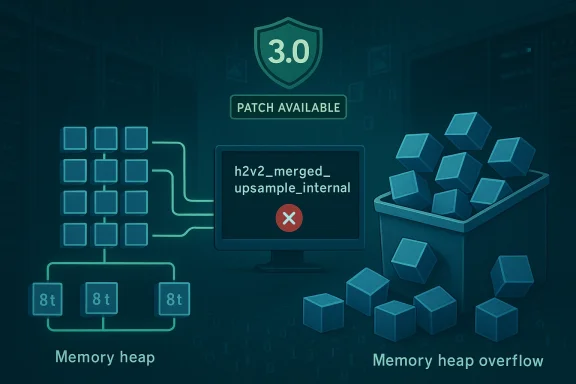
At the heart of CVE‑2023‑2804 is the function h2v2_merged_upsample_internal() in jdmrgext.c. That function participates in merged chroma upsampling — the performance‑optimized step that reconstructs full‑resolution color channels from subsampled components during JPEG decompression. In the 12‑bit code path, sample values have a larger numeric range than the code originally assumed. An attacker can craft a 12‑bit lossless JPEG where one or more sample values lie outside the expected bounds; those out‑of‑range values are subsequently used as indexes or offsets into internal lookup/working arrays without adequate bounds checking. The result is out‑of‑bounds heap access and a classic heap buffer overflow.Why 12‑bit matters (and why this bug slipped through)
Most consumer JPEGs are 8‑bit, so many test suites and production paths emphasize the 8‑bit handling code. The 12‑bit feature set is rarer and exercised less in continuous integration and fuzzing pipelines, which means structural gaps in 12‑bit logic can survive long enough to ship into many products. In this case, the numeric range for 12‑bit samples meant code assumed a smaller, safe index range that didn’t hold for the larger precision; without defensive clamps or explicit range validation the code used raw sample values directly.Observable outcomes
- Immediate and reliable: Process crash (SIGSEGV or similar) when an out‑of‑bounds access touches unmapped memory — a straightforward denial‑of‑service for any process that decodes the crafted image.
- Plausible but environment‑dependent: Heap corruption that could be exploited further. Converting heap overflows into remote code execution (RCE) is nontrivial on modern systems due to ASLR, DEP/NX and allocator hardening, but the overflow reduces the attacker’s cost for follow‑on exploitation if other weak primitives or misconfigured builds exist. Treat RCE claims cautiously and require exploit artifacts for validation.
Affected versions and packaging status
What libjpeg‑turbo versions are impacted
Public trackers and vendor notes identify libjpeg‑turbo builds that include the vulnerable 12‑bit upsampling implementation as affected. Several sources mark the vuln as present in the 2.1.90 series and earlier release trees that contained the jdmrgext.c implementation for 12‑bit support. Upstream released fixes in the 3.0 release line (the project’s release notes specifically mention fixes for segfaults and buffer overruns including CVE‑2023‑2804).How different vendors mapped the fix
Distributors and OS vendors re‑scored or reclassified the threat according to packaging context. For example:- NVD and several vendors listed a CVSS v3.1 vector supporting network‑exposed attack scenarios when a service performs unattended JPEG decoding and the user must interact minimally.
- SUSE, Amazon and other vendors produced distro‑specific notes where the assessed vector or attack complexity could differ slightly because of packaging, default features and how services expose image processing.
Practical takeaway on versions
If your systems or applications include any libjpeg‑turbo build predating the upstream fix in the 3.0 series (or equivalent vendor backport), treat them as vulnerable when they support 12‑bit JPEG decoding. This includes both dynamic and static link scenarios: static linking inside a closed‑source application requires rebuilding the binary with the fixed libjpeg‑turbo, while dynamic cases need the updated shared library plus process restarts.Exploitability and real‑world attack scenarios
Who can realistically attack?
The pure root cause is in a decompression routine, which means the attacker needs the target process to run that decompression code on attacker‑controlled input. The attack surface therefore includes:- Public upload endpoints that automatically decompress or analyze uploaded images (thumbnailers, preview services, image CDNs). An unauthenticated uploader can trigger a crash simply by submitting a malicious 12‑bit JPEG.
- Client applications and viewers that open untrusted images (email clients, chat apps, document viewers) if they expose 12‑bit decoding or allow library features that route through the vulnerable path.
- Embedded devices and vendor appliances that include libjpeg‑turbo statically and support 12‑bit images (medical imaging devices, specialized cameras, legacy firmware) — these tend to be long‑tail risk items that rarely get timely updates.
Attack complexity and prerequisites
- The attack complexity is low to moderate in the sense that crafting a 12‑bit JPEG with out‑of‑range samples is feasible for attackers with knowledge of the format. However, practical exploitation into RCE requires additional conditions (weak mitigations, predictable heap layouts, or other memory weaknesses) and is therefore environment‑specific.
- For a pure denial‑of‑service, the prerequisites are minimal: an attacker who can cause an application to parse a malicious file is sufficient. For privilege escalation or RCE, you should only assume those are possible if you have evidence of missing mitigations or additional exploitable primitives.
Why this matters even if 12‑bit is rare
Attackers often pivot toward low‑tested code paths and niche features because defenders test them less. A server that debugs, indexes or converts many image types is a high‑value target — a single vulnerable worker can be repeatedly crashed by many uploaded files, causing availability loss, resource exhaustion and remediation churn. The risk is therefore operational as much as purely technical.Detection, indicators, and forensics
Immediate indicators of exploitation or attempted exploitation
- Repeated crashes of processes that handle images (image processors, preview generators, cjpeg/djpeg utilities) with backtraces pointing into libjpeg‑turbo routines or to jdmrgext.c/h2v2_merged_upsample_internal.
- Core dumps or sanitizer logs (ASan, Valgrind) showing heap out‑of‑bounds writes originating from the upsampling code path.
- Spike in upload traffic that correlates with worker crashes — collect the offending upload artifacts for offline analysis.
Triage checklist
- Capture the crashing binary, core dump and the exact uploaded image that triggered the failure.
- Reproduce the crash in an isolated lab with the same libjpeg‑turbo version to confirm CVE‑2023‑2804 is the cause.
- If available, enable AddressSanitizer or run the test case under a memory debugger to confirm heap overflow semantics.
- Inspect logs for other anomalous activity (timing of uploads, source IPs, user accounts).
Remediation and mitigation
Apply patches — the definitive fix
- Upgrade libjpeg‑turbo to the patched release from upstream (the 3.0 series contains the fix) or apply your vendor’s packaged update. Upstream release notes explicitly list fixes for segfaults and buffer overruns tied to CVE‑2023‑2804.
- For static linking: rebuild the application or vendor binary with the fixed libjpeg‑turbo and redeploy. Static linkage is the common cause of lingering exposures in closed‑source or cross‑platform apps.
Temporary mitigations when immediate patching isn’t possible
- Disable automatic decoding or thumbnailing of uploaded images on public endpoints until the library is patched. Route uploads into a sandbox or queue that avoids direct decompression.
- Enforce strict content‑type and magic‑number checks; block or restrict less common JPEG varieties (e.g., 12‑bit lossless) if your service does not require them.
- Implement process‑level hardening: run image processing workers in containers or unprivileged sandboxes with resource limits and automatic restart policies. These don’t fix the overflow but reduce blast radius.
Developer hardening (longer term)
- Add explicit bounds checks and defensive clamps in any code that interfaces with sample values or lookup tables. Treat external stream content as un
- Increase unit‑test coverage for uncommon features (12‑bit, unusual subsampling patterns) and add targeted fuzzing for image decoders. The niche code that is seldom exercised is often the source of latent memory bugs.
- Prefer dynamic linking of shared libraries where possible to make security updates easier to deploy; when static linking is necessary, include update plans and rebuild automation.
Vendor response, timeline and scoring nuance
Upstream fixed the bug in the 3.0 release line and documented the remediation in release notes. Distributors and OS vendors issued advisories and backports on their own timelines, with some re‑scoring the CVSS vector depending on packaging context (for example, whether the default distro build exposed 12‑bit decoding by default or whether the package was shipped to server‑side image processors). ﹙Vendor re‑scoring and packaging context can cause numeric CVSS differences across vendors.﹚It’s worth noting the general principle: the urgency of a CVE is a function not only of the raw code flaw but of its real‑world exposure in a particular environment. A vulnerability limited to a rarely used mode (12‑bit) can still be severe for services that accept arbitrary image uploads. The degree of confidence in exploitability (and how vendors map CVSS vectors) varies with contextual knowledge about how packages are built and deployed.
Risk assessment for WindowsForum readers
- Desktop users: If you run consumer apps on Windows that bundle libjpeg‑turbo dynamically from an upstream installer, your exposure is low unless those apps accept or render 12‑bit lossless JPEGs (rare). Still, check vendor update channels — many cross‑platform apps bundle libjpeg‑turbo and will publish updates if they shipped an affected version.
- Server operators: High priority. Any wway, chat server or content‑management system that decodes or generates thumbnails for user‑uploaded images should prioritize patching. Unpatched image processing workers are an easy avenue for denial‑of‑service and a potential foothold for attackers.
- Embedded and vendor appliances: Medium to high long‑tail risk. Devices that rarely receive firmware updates and that handle high‑precision images (medical imaging appliances, camera firmware) deserve special attention. These tend to be the slowest to get patched and the hardest to remediate operationally.
- Inventory: locate all installations that include libjpeg‑turbo (dynamic or static). Search packages, container base images, and third‑party binaries.
- Prioritize: prioritize internet‑facing image ingestion and automated thumbnailing services for patching.
- Patch: upgrade to the fixed libjpeg‑turbo release from upstream or apply vendor updates and restart consumer processes. For static binaries, coordinate rebuilds and redeployments.
- Mitigate: if patching will take time, disable or sandbox image decoding, block rare JPEG types, and add upload filtering.
- Monitor: watch for crash patterns, anomalous upload activity, and exploit proof‑of‑concept code in public repositories. Capture offending artifacts for forensic triage.
- Hardening: add tests for 12‑bit processing in CI, implement fuzzing for image code paths, and adopt process isolation for image handling workers.
Strengths, limitations and cautionary notes
- Strengths: The vulnerability is narrow and well‑documented; upstream released a concise fix and vendors mapped the issue into their packaging channels. That clarity reduces the risk of false positives and helps defenders implement targeted mitigation.
- Limitations: The attack surface is a function of deployment. Some vendors or static builds may lag behind in applying the fix; static linking remains a stubborn vehicle for lingering vulnerabilities. Additionally, numeric CVSS scores vary by vendor because the decisive factors (attack vector, user interaction required, packaging differences) are context‑dependent — treat those scores as guidance, not absolutes.
- Caution: Claims that CVE‑2023‑2804 immediately yields reliable remote code execution should be treated skeptically unless backed by a public exploit demonstrating such a primitive. The canonical public record emphasizes crashes and heap corruption; escalation to RCE requires additional environment‑specific weaknesses. Flag any RCE claims that lack exploit artifacts as unverified and prioritize mitigation based on exposure and operational risk.
Conclusion
CVE‑2023‑2804 is a textbook example of how less‑used features — here 12‑bit JPEG decoding and merged chroma upsampling — can become high‑impact attack vectors when they’re not continuously exercised by test suites and fuzzers. The flaw is fixed upstream, but the real operational risk is in unpatched systems, static builds and services that accept untrusted image inputs.If you operate any service that decodes, converts or thumbnails images, assume exposure until you confirm the libjpeg‑turbo version in your runtime and patch promptly. For developers, the broader lesson persists: defensive programming around array indexes, explicit bounds checks for unusual precisions, and better CI coverage for edge feature sets materially reduce the attack surface of ubiquitous libraries like libjpeg‑turbo.
Source: MSRC Security Update Guide - Microsoft Security Response Center
