

CVE‑2023‑3301 is a QEMU vulnerability that lets a malicious guest reliably trigger an assertion during a hot‑unplug operation — a race between asynchronous device teardown steps — and in practice can drop the hosting QEMU process, producing a high‑impact denial‑of‑service for affected virtualization hosts and tenants.
Hot‑plug and hot‑unplug are foundational features for modern virtualization: they let administrators add and remove virtual devices (NICs, disks, virtual PCI functions) from a running guest without rebooting the VM. The operation is naturally asynchronous: the management layer issues a remove request, guest-facing frontend devices are torn down, and the backend host-side resources are freed. That asynchronicity, however, opens subtle timing windows where one side assumes another has completed cleanup when it has not — classic race condition territory.
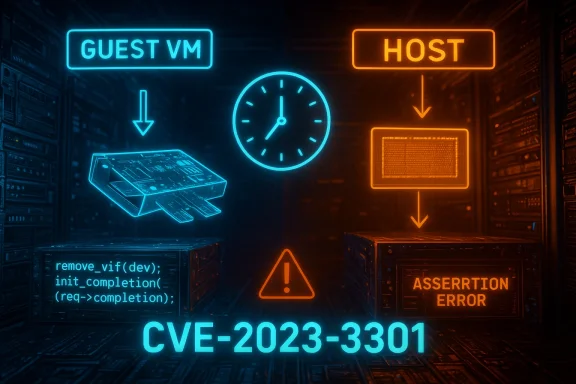
CVE‑2023‑3301 lives exactly in such a timing window inside QEMU’s virtio networking stack: the net device backend may be cleared on the host before the virtio‑net PCI frontend has completed unplug on the guest side. Attackers that control the guest can manipulate timing and trigger an assertion inside QEMU’s code path, crashing the process and denying availability for the affected VM (and potentially other services on the host). Multiple vendor trackers and advisories document this behavior and its impact.
Why this matters now: virtualization is everywhere — from developer workstations to large cloud providers — and host process crashes in hypervisor components are not merely a nuisance. They can (1) disrupt tenant workloads, (2) trigger failover and orchestration churn, and (3) in multi‑tenant environments create a reliability and safety hazard for co‑located workloads.
Vendor and distribution trackers (Debian, Ubuntu, Oracle, Red Hat) catalog the issue under QEMU releases and list the affected package versions as well as fixed package releases — the specific internal function names are not necessary to understand the operational risk, but the consistent narrative across vendors confirms the root cause: an async hot‑unplug race.
Distribution notes at the time of disclosure showed a mixed landscape: some distro versions were never affected (packaged QEMU already past the vulnerable code), while other supported releases received fixes and backports. Operators should consult their specific distro advisory for the exact fixed package name and version, but the generic advice applies: patch QEMU and any upstream virtualization management components that ship or control QEMU instances (libvirt, OpenStack, Kubernetes CRI‑based VM controllers, etc.).
There are recurring root causes:
If you run QEMU—whether directly on a host, inside libvirt, or as part of a larger cloud stack—treat this vulnerability as an availability emergency: inventory, patch, and apply mitigations immediately. The vulnerability highlights a persistent engineering lesson: asynchronous features must be designed and tested to survive adversarial timing, and platform operators must maintain robust defense‑in‑depth to protect availability in multi‑tenant environments.
Source: MSRC Security Update Guide - Microsoft Security Response Center
 Background / Overview
Hot‑plug and hot‑unplug are foundational features for modern virtualization: they let administrators add and remove virtual devices (NICs, disks, virtual PCI functions) from a running guest without rebooting the VM. The operation is naturally asynchronous: the management layer issues a remove request, guest-facing frontend devices are torn down, and the backend host-side resources are freed. That asynchronicity, however, opens subtle timing windows where one side assumes another has completed cleanup when it has not — classic race condition territory.CVE‑2023‑3301 lives exactly in such a timing window inside QEMU’s virtio networking stack: the net device backend may be cleared on the host before the virtio‑net PCI frontend has completed unplug on the guest side. Attackers that control the guest can manipulate timing and trigger an assertion inside QEMU’s code path, crashing the process and denying availability for the affected VM (and potentially other services on the host). Multiple vendor trackers and advisories document this behavior and its impact.
Why this matters now: virtualization is everywhere — from developer workstations to large cloud providers — and host process crashes in hypervisor components are not merely a nuisance. They can (1) disrupt tenant workloads, (2) trigger failover and orchestration churn, and (3) in multi‑tenant environments create a reliability and safety hazard for co‑located workloads.
Technical details: what the code gets wrong
The short, practical description
At heart this is a time‑of‑check / time‑of‑use (TOCTOU) and ordering problem in QEMU’s hot‑unplug path for virtio networking devices. The sequence of events looks like this in simplified form:- Management issues a hot‑unplug for a virtio‑net device (administrator or orchestration).
- The host begins clearing the net backend (internal structures, callbacks, references).
- The virtio‑net PCI frontend still has outstanding operations (or a small window before it notices the detach).
- Guest code, intentionally or accidentally, causes a code path in QEMU to hit an assertion that assumes the backend remains present — but because the backend was cleared, the assertion fires and QEMU aborts.
Attack model and preconditions
- Attack vector: local (a malicious or compromised guest). The attacker must control guest execution. This is not a remote, unauthenticated internet exploit against a service exposed to the world.
- Privileges required: low within the guest context (an attacker need not be hypervisor‑level; unprivileged guest code that can exercise network operations and influence unplug timing is sufficient in many practical tests).
- Complexity: moderate to high. The attacker needs to manipulate timing to hit the race window; however, in many lab and cloud environments this is trivially achievable with tight loops and repeated operations.
- Impact: availability — a crashed QEMU process, which for most deployments equates to VM termination or host instability. CVSS consensus and vendor trackers rate the availability impact as high while confidentiality and integrity are not affected.
Where the assertion lives
Vulnerabilities of this type are typically rooted in defensive checks and debug assertions intended to catch impossible states during normal operation. Those assertions, however, are only safe if the code's synchronization guarantees hold under concurrent execution. When they don’t, the very guardrails intended to make QEMU robust become the trigger for deterministic failure.Vendor and distribution trackers (Debian, Ubuntu, Oracle, Red Hat) catalog the issue under QEMU releases and list the affected package versions as well as fixed package releases — the specific internal function names are not necessary to understand the operational risk, but the consistent narrative across vendors confirms the root cause: an async hot‑unplug race.
Affected products, scope and patch status
Multiple OS vendors and tracking databases record CVE‑2023‑3301 as a QEMU bug introduced in relevant 5.x through early 8.x ranges (distribution packaging differences matter). The NVD/CVE entry summarizes the issue and points to vendor advisories; Ubuntu and Oracle publish their distribution‑specific status and fixed package versions. These sources converge on the same core facts: QEMU’s async hot‑unplug path can be raced to an assertion and denial‑of‑service, and patches have been, or were, made available in distribution package updates.Distribution notes at the time of disclosure showed a mixed landscape: some distro versions were never affected (packaged QEMU already past the vulnerable code), while other supported releases received fixes and backports. Operators should consult their specific distro advisory for the exact fixed package name and version, but the generic advice applies: patch QEMU and any upstream virtualization management components that ship or control QEMU instances (libvirt, OpenStack, Kubernetes CRI‑based VM controllers, etc.).
Practical impact for administrators and cloud operators
This vulnerability is a potency point for availability attacks originating from a guest. Consider the following operational realities:- Single‑VM hosts or hosts running critical infra VMs will see immediate impact if the QEMU process for the struck VM crashes.
- On hypervisor hosts running many VMs, a QEMU process crash per‑VM is typically isolated to the affected VM; however, orchestration systems (libvirt, virt‑manager, cloud controllers) may react unpredictably if crash loops or rapid state changes occur.
- Multi‑tenant clouds are particularly sensitive: a noisy or malicious tenant can repeatedly trigger the race and cause repeated QEMU process failures, creating constant churn and increasing risk for the host and co‑tenants.
- Automated incident response systems — e.g., auto‑restart policies, orchestration rescheduling — can mask the real problem but increase platform instability and could cause cascading failures under heavy exploitation. Similar virtualization DoS issues have historically led to crash or restart cycles that degrade cluster health unless the underlying bug is corrected.
Mitigation and remediation — immediate steps
If you run virtual infrastructure that includes QEMU, treat this as a priority patching event. Use the following checklist as an operational playbook:- Inventory: identify hosts and images that run QEMU and the specific QEMU package and version. Check both native QEMU on bare‑metal and QEMU embedded as part of platform stacks (e.g., libvirt, OpenStack, container‑VM frameworks).
- Patch: apply vendor/supplier updates that include the QEMU fix. Vendors published packages and backports; follow your distro advisory to install the correct fixed package. Reboot or restart the QEMU processes per your change control.
- If you cannot patch immediately, apply mitigations:
- Disable hot‑unplug where operationally feasible. Prevent automated or manual hot‑unplug until patched to eliminate the timing window.
- Restrict guest abilities to trigger device‑removal sequences. Harden guest controls and avoid giving guests interfaces that allow device management beyond what they need.
- Increase monitoring: watch for QEMU process crashes, repeated VM terminations, or orchestration churn that could indicate attempted exploitation.
- Apply policy controls in multi‑tenant environments:
- Rate‑limit or isolate tenants that show aggressive unplug/attach sequences.
- Use scheduler policies to migrate at‑risk VMs to patched hosts.
- Verify: after patching, validate by exercising the hot‑unplug sequence in a controlled lab to ensure the fixed behavior is observed (no assertion, clean teardown, no process termination).
Detection, hunting, and indicators of exploitation
Because CVE‑2023‑3301 requires guest‑side involvement, hunting for exploitation should focus on:- Logs and telemetry showing repeated device detach/attach operations or unusual sequences of virtio‑net ioctl/feature negotiation from a guest.
- QEMU process exit codes and core dumps: assertions produce core dumps or logged stack traces; correlate timestamps with guest activity.
- Orchestration events: repeated crash/restart cycles for VMs, increased scheduling or migration events, and unexpected VM terminations.
- Host kernel oopses or related dmesg lines if the crash propagates beyond userland QEMU to kernel issues (less likely but possible in complex integrations).
Why race conditions keep happening in virtualization stacks
Virtualization software like QEMU is complex: it implements device emulation, bridges to host devices, and handles asynchronous events from multiple layers (guest drivers, host management, device hotplug, etc.). Race conditions often appear where code assumes a specific ordering of events that, under concurrency, cannot be guaranteed.There are recurring root causes:
- Incomplete locking or coarse locking that doesn’t cover all state transitions.
- Assumptions baked into assertions that were never stress‑tested for high concurrency or pathological timing.
- Features added incrementally (hotplug is a later addition to some code paths) where new async operations are integrated with older synchronous assumptions.
- Limited fuzzing and concurrency testing for management operations that are rare in typical CI runs but reproducible under adversarial conditions.
Wider context: similar virtualization availability bugs
CVE‑2023‑3301 joins a long list of virtualization‑layer availability vulnerabilities where a guest can induce a host process crash via malformed inputs or unexpected sequences. Past incidents — such as assertion failures in QEMU VNC TLS handshakes or libvirt races that left objects unlocked — show the operational cost of these correctness bugs and the importance of patching and defense in depth. These related cases have been tracked and discussed by vulnerability writers and host‑operating vendors, reinforcing the message that hypervisor correctness is central to infrastructure reliability.Critical analysis: strengths of the fix and remaining risks
- Strengths
- Vendor responses were typical and timely: distributors documented affected versions and shipped fixes/backports. That practical remediability is good for enterprise operators who rely on distro packaging and backports for safe rollouts.
- The fix domain is narrow: this is an availability bug, not a code‑execution or information disclosure bug. That reduces the long‑term catastrophic risk profile (no chain to remote RCE has been documented as part of this CVE).
- Remaining risks
- Attackers with guest control and an ability to run tight timing loops can make this a sustained availability nuisance until operators patch. In multi‑tenant contexts, the attacker's amplification is operationally significant.
- Patching mechanics: environments that repackage QEMU or run custom, outdated builds may lag in receiving fixes. Complex stacks (cloud controllers, third‑party virtualization layers) sometimes require coordinated updates; delays increase risk windows.
- Assertions are brittle: fixing an assertion by removing it without addressing the underlying race can hide the problem rather than fix it. The most reliable remedy is eliminating the TOCTOU window through ordering guarantees, locking, or explicit state transitions.
Long‑term lessons for virtualization security
- Build more concurrency‑aware tests: unit and integration tests should explicitly fuzz hotplug/hotunplug sequences and race windows.
- Treat assertions as engineering aids, not security boundaries: reliance on assertions for correctness should be paired with formal state transitions and unit-tested ordering constraints.
- Harden multi‑tenant environments with policy and behavioral controls so malformed or noisy guests cannot trivially cause platform churn.
- Improved telemetry: hypervisor projects should log and export fine‑grained events around state transitions (hotplug, unplug, backend clear) to enable quicker detection and root cause analysis.
Action checklist for the next 24–72 hours
- Inventory QEMU hosts, versions and packaging (distribution packages vs. baked into platform images).
- Apply vendor QEMU patches and restart QEMU processes per vendor directions. Validate with your staging tests.
- If you cannot patch immediately:
- Disable hot‑unplug operations.
- Restrict guest capabilities that permit aggressive device detach/attach.
- Increase monitoring for QEMU crashes and VM termination patterns.
- For cloud operators: enforce scheduling or placement policies to move untrusted workloads away from critical service hosts until patches are applied.
- Run controlled validation: attempt a hot‑unplug sequence in an isolated test environment to confirm the fix eliminates the assertion failure. If an otherwise patched host still fails, collect core dumps and vendor bug IDs for escalation.
Conclusion
CVE‑2023‑3301 is a classic but consequential virtualization race condition: a timing window during hot‑unplug that turns an otherwise benign operator action into a guest‑triggerable denial‑of‑service. The problem is not exotic; the fix is straightforward for most vendors, but the operational reality of distributed, multi‑layer virtualization means many organizations will be exposed until they complete patching and mitigation steps.If you run QEMU—whether directly on a host, inside libvirt, or as part of a larger cloud stack—treat this vulnerability as an availability emergency: inventory, patch, and apply mitigations immediately. The vulnerability highlights a persistent engineering lesson: asynchronous features must be designed and tested to survive adversarial timing, and platform operators must maintain robust defense‑in‑depth to protect availability in multi‑tenant environments.
Source: MSRC Security Update Guide - Microsoft Security Response Center
