

Security teams and RabbitMQ operators should treat CVE-2023-46118 as a clear operational availability risk: an attacker with publish credentials can push oversized HTTP requests through the RabbitMQ Management HTTP API, exhaust node memory, and cause process termination or sustained service outage unless the broker is patched or properly constrained.
RabbitMQ is a widely used open‑source message broker that exposes both AMQP clients and a Management HTTP API for administrative tasks and message publishing. The HTTP API is convenient for automation, integrations, and administrative tooling, but that convenience also expands the attack surface: HTTP endpoints receive arbitrary-sized request bodies from authenticated clients, and until the fixes described below RabbitMQ did not enforce a hard limit on the size of those bodies.
The defect tracked as CVE-2023-46118 was published on October 25, 2023 and is classified as a resource‑exhaustion (CWE‑400) denial‑of‑service (DoS) vulnerability. Multiple independent vulnerability databases and distribution advisories confirm the same root cause and remediation path: very large HTTP request bodies sent to the Management HTTP API can force RabbitMQ to load or buffer the payload in memory, leading to an out‑of‑memory condition and the node’s termination by the host’s OOM killer or by process failure.
Key technical points to understand:
Important caveats:
At the same time, community forums and vulnerability feeds underscore that DoS‑style vulnerabilities continue to be a significant portion of real‑world incidents for middleware components; defenders should maintain focused observability on resource consumption and management API access.
Beyond the immediate patch, operators should treat this incident as a prompt to:
Take action now: inventory RabbitMQ instances, confirm versions, and either patch or place a proxy in front of the HTTP API to enforce request‑size limits. The cost of inaction is simple: a small set of scripts and the right credentials can produce a full loss of availability in minutes.
Source: MSRC Security Update Guide - Microsoft Security Response Center
 Background
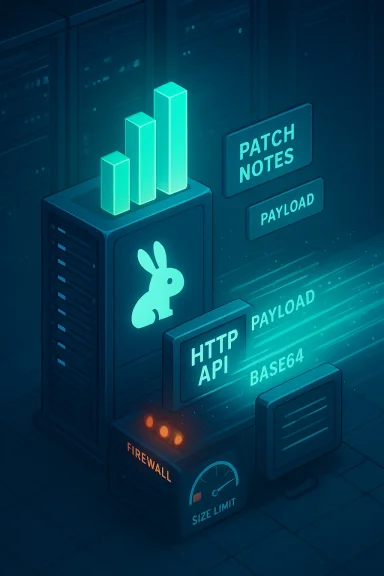
RabbitMQ is a widely used open‑source message broker that exposes both AMQP clients and a Management HTTP API for administrative tasks and message publishing. The HTTP API is convenient for automation, integrations, and administrative tooling, but that convenience also expands the attack surface: HTTP endpoints receive arbitrary-sized request bodies from authenticated clients, and until the fixes described below RabbitMQ did not enforce a hard limit on the size of those bodies.The defect tracked as CVE-2023-46118 was published on October 25, 2023 and is classified as a resource‑exhaustion (CWE‑400) denial‑of‑service (DoS) vulnerability. Multiple independent vulnerability databases and distribution advisories confirm the same root cause and remediation path: very large HTTP request bodies sent to the Management HTTP API can force RabbitMQ to load or buffer the payload in memory, leading to an out‑of‑memory condition and the node’s termination by the host’s OOM killer or by process failure.
What exactly went wrong? Technical overview
At a code and architecture level, the vulnerability is straightforward and entirely pragmatic: the HTTP API handlers that accept publish and related endpoints did not impose a maximum request body size in all code paths. When an authenticated client performs a publish operation through the HTTP API, the published payload is accepted and handled in a way that allows arbitrarily large data to be held in memory while the broker processes the request. If the supplied message body is large enough, the broker process’s memory consumption grows until the operating system’s memory management intervenes or the process exhausts available memory and crashes.Key technical points to understand:
- The attack requires authentication and appropriate publish permissions on the HTTP API; it is not a completely unauthenticated remote exploit. However, many environments implicitly trust clients, or expose the management interface to automation systems and service accounts, increasing real‑world exposure.
- The vulnerability is an example of uncontrolled resource consumption: not a memory corruption or remote code execution flaw, but a reliability and availability weakness with real operational consequences. That class of vulnerability is common in messaging stacks where message size limits or streaming/stream‑backpressure semantics are not enforced.
- The observable outcome is often the target node being terminated by the environment (e.g., Linux OOM killer) or the broker process crashing, which may cascade in clustered deployments if the cluster must rebalance or elect new leaders.
Why this matters operationally
Message brokers like RabbitMQ are central infrastructure: they mediate asynchronous workflows, telemetry ingestion, job queues, and event streams. When a single node or a majority of nodes are rendered unavailable, service backlogs accumulate, producers block, and downstream consumers are starved. In highly available topologies this may be recoverable, but in practice operators report significant operational pain:- Cluster rebalancing and leader elections add latency and pressure during recovery.
- Persistent message backpressure may lead producers to fail or to buffer messages in application memory, amplifying customer impaeven limited credentials can repeatedly trigger attacks, making availability loss sustained rather than transient.
Affected versions and vendor response
Multiple authoritative sources and distribution advisories converge on the same fixed releases:- Fixed upstream in RabbitMQ 3.11.24 and 3.12.7.
- Linux distributors and downstream packages (Debian, Ubuntu, Red Hat variants) issued security updates and advisories referencing CVE‑2023‑46118, and backported fixes into their RabbitMQ packages. System administrators should consult their distribution’s package status to confirm whether the fix has been applied.
- The vulnerability is generally rated medium by NVD and several distros (CVSS ~4.8–4.9), reflecting that the attack is limited by the need for authenticated publish privileges but still produces complete loss of availability for the targeted node. Different vendors and trackers may display slightly different scores depending on their scoring inputs.
Exploitability — how easy is it to weaponize?
From an attacker model perspective the steps are simple:- Obtain credentials that allow publishing to the HTTP Management API or otherwise have access to an account/service that can call the publish HTTP endpoint.
- Issue a publish request where the message payload is extremely large (many hundreds of megabytes to multi‑gigabyte sizes). The HTTP handler will accept the body and cause the broker process to allocate memory to handle it.
- Repeat if necessary to ensure OOM and node termination.
Important caveats:
- The attack is not a remote code execution vector; it does not yield arbitrary code execution on the server under normal circumstances.
- The need for authentication reduces the blast radius relative to fully unauthenticated remote exploits, but in many operational deployments authentication boundaries are porous or designed for automation, making credential misuse a realistic threat.
Detection and Indicators of Compromise
Operators should look for the following signs to detect attempted or successful exploitation:- Sudden, sustained growth in RabbitMQ process memory usage coincident with HTTP API POST requests to publish endpoints.
- Repeated calls from a single user or service account to the /api/exchanges/.../publish endpoint carrying unusually large payloads or base64‑encoded bodies.
- Kernel messages and logs indicating the operating system invoked the OOM killer for the RabbitMQ process; RabbitMQ process exit and restart logs (supervisor, systemd) immediately prior to loss of service.
- Instrument web server/access logs and management API access logs to alert on requests with Content-Length beyond an operator‑defined threshold (for example, > 10 MB by default).
- Create an alert that triggers when RabbitMQ memory usage exceeds expected operational baselines or when the broker is restarted more than N times in a short window.
- Enforce multi‑factor authentication and rotation for automation/service accounts authorized to publish via the management API, and monitor for unusual geographic or temporal access patterns.
Mitigation and remediation steps (practical playbook)
If you operate RabbitMQ, treat this as a patch‑now vulnerability and follow these prioritized steps:- Patch first (highest priority)
- Upgrade RabbitMQ to 3.11.24 or later in the 3.11 line, or 3.12.7 or later in the 3.12 line. This is the definitive fix from the upstream project.
- Apply compensating controls (if you cannot patch immediately)
- Restrict access to the Management HTTP API to a small set of trusted hosts and networks using firewalls, security groups, or SSH tunnels.
- Limit service and automation accounts that have publish privileges; rotate credentials and use short‑lived tokens where possible.
- Implement reverse proxies or API gateways in front of the HTTP API that enforce an explicit request body size limit and rate limits. This reduces exposure by filtering oversized requests before they reach RabbitMQ.
- Harden configuration after patching
- Where available, enable and set a conservative HTTP request body limit in RabbitMQ’s configuration or in the management/plugin settings — double‑check the release notes and configuration docs for the exact option name in your patched version.
- Enforce principle of least privilege for user roles and service accounts used by automation tooling.
- Operational improvements
- Add alerting for abnormal publish traffic patterns and memory usage.
- Test cluster recovery procedures and validate how your architecture responds to single‑node failures to avoid cascading outages.
- Identify all nodes running RabbitMQ and the installed versions.
- Immediately schedule upgrade to the fixed releases; if upgrades require maintenance windows, implement proxy‑level blocks for the management API until the window.
- Rotate credentials used by automation and scan for any exposed management endpoints.
- Confirm successful upgrade and validate the presence of HTTP body‑limit settings (if present) and monitoring coverage.
Longer‑term risk and architectural considerations
CVE‑2023‑46118 is a reminder that message brokers and HTTP endpoints must be defended not only against code‑execution threats, but also against supply and abuse of resources. A few architectural hardening strategies to reduce future risk:- Enforce per‑message size limits at producer clients and on the broker (or at the HTTP gateway level). Reasonable upper bounds keep accidental or malicious large payloads from consuming memory.
- Prefer streaming and chunked semantics for very large payloads rather than loading entire messages into memory. For use cases that legitimately require large payloads (for example, binary blobs), use an object store and send pointers in messages instead of embedding the blob itself.
- Adopt an API gateway or WAF in front of management and publish endpoints to centralize request size, rate, and authentication controls.
- Reduce reliance on the Management HTTP API for automated publishing in production. Use authenticated AMQP clients designed for production workloads where backpressure and streaming semantics are more explicit.
Practical examples: what defenders reported
Community write‑ups and distribution advisories documented straightforward exploit patterns using the standard publish endpoint and base64‑encoded payloads. Security trackers and distribution notices consistently show the same remediation versions and the operational impact described above. These independent confirmations make the technical story reproducible and credible across vendors and downstream distributions.At the same time, community forums and vulnerability feeds underscore that DoS‑style vulnerabilities continue to be a significant portion of real‑world incidents for middleware components; defenders should maintain focused observability on resource consumption and management API access.
False positives, unverifiable claims, and cautionary notes
- Unverifiable claim flag: some early blog posts and automated feeds included proof‑of‑concept snippets that suggested extremely large sizes (for example, tens of gigabytes) as necessary to trigger OOM. In real environments the exact threshold depends on available memory, broker configuration, and clustering topology; therefore you should not assume a fixed size is required — smaller payloads may be sufficient in memory‑constrained or highly loaded nodes. Treat reported payload sizes as illustrative rather than definitive.
- Scoring variance: CVSS values reported by different sources (NVD, Ubuntu, Snyk, distribution trackers) can vary slightly. This is normal — it reflects different weighting for prerequisites such as authentication and required privileges. Use your organization’s threat model to determine local severity rather than relying on a single numeric score.
Quick reference: detection queries and mitigation snippets
- Detection rule examples
- Web server / proxy: alert when Content-Length > 10 MB (or your chosen threshold) to the Management API.
- RabbitMQ monitoring: alert when process memory > X% of host memory or when restarts > 3 times in 10 minutes.
- Audit logs: flag repeated publish calls from a single user/service account with large payloads.
- Short mitigation checklist
- Upgrade RabbitMQ to 3.11.24 or 3.12.7 (or later).
- Restrict access to the Management HTTP API via network controls.
- Front the API with a proxy that enforces body size and rate limits.
- Rotate and restrict publish credentials used by automation.
Conclusion
CVE‑2023‑46118 is a textbook example of how resource exhaustion can become a severe operational hazard in messaging infrastructure. The vulnerability is not an esoteric memory corruption — it is a practical availability problem with a simple exploitation path for anyone who has or can obtain publish‑capable credentials to RabbitMQ’s HTTP API. The good news is the fix is straightforward and available: upgrade to RabbitMQ 3.11.24 or 3.12.7 (or later), and apply compensating network or proxy controls if you cannot patch immediately.Beyond the immediate patch, operators should treat this incident as a prompt to:
- Harden management interfaces,
- Enforce message‑size limits and streaming patterns,
- Improve telemetry around resource usage and management API access.
Take action now: inventory RabbitMQ instances, confirm versions, and either patch or place a proxy in front of the HTTP API to enforce request‑size limits. The cost of inaction is simple: a small set of scripts and the right credentials can produce a full loss of availability in minutes.
Source: MSRC Security Update Guide - Microsoft Security Response Center
