

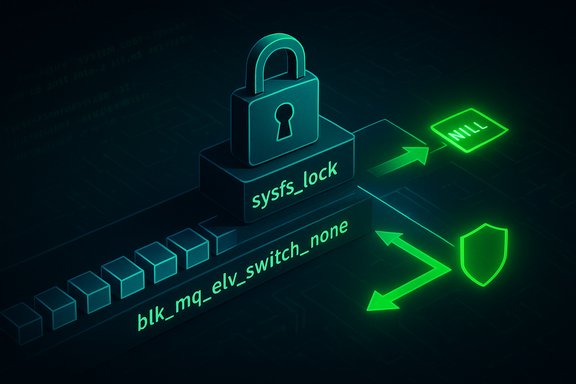
A subtle race in the Linux block multi-queue (blk‑mq) subsystem that could cause a kernel NULL‑pointer dereference has been fixed upstream and catalogued as CVE‑2023‑53292 — a local, availability‑impacting defect that requires kernel updates or vendor-supplied backports to fully remediate.
Overview
This vulnerability concerns the blk‑mq elevator handling code: after taking q->sysfs_lock the code path in blk_mq_elv_switch_none could observe q->elevator become NULL because the elevator can be switched concurrently, and the subsequent dereference led to a kernel NULL‑pointer fault. The underlying fix is straightforward and conservative: validate q->elevator while holding the appropriate lock (or otherwise protect the pointer’s lifetime) so the code never dereferences a now‑missing elevator pointer. The report and advisories around CVE‑2023‑53292 uniformly emphasize the primary impact: availability. A kernel NULL dereference commonly causes an oops, driver failure, or panic that can crash a host or render services unavailable until recovery actions (reboot or kernel reload) are taken. Multiple distro and vulnerability feeds published the CVE entry and link to the upstream commits that implement the defensive check.Background: blk‑mq, elevators and why this matters
What is blk‑mq and the elevator abstraction
- blk‑mq (block multi‑queue) is the modern Linux block layer designed to handle high I/O parallelism and reduce locking contention.
- The elevator abstraction implements I/O scheduling (for example noop, deadline, bfq, mq-deadline), and each request queue (q) maintains a pointer to its current elevator in q->elevator.
- The elevator pointer is mutable: the kernel supports switching I/O schedulers (elevators) at runtime, and code that touches q->elevator must use proper synchronization to avoid races.
Why a NULL dereference in kernel space is different from userland faults
A userland NULL dereference typically terminates a single process. In kernel space, a NULL dereference can generate an oops that affects the whole system: device drivers may crash, subsystems may fail, services can abort, and some configurations may even panic the machine. The operational consequence is denial of service rather than data disclosure or privilege escalation (unless later chained into something worse). Many recent kernel CVEs share this pattern: minimal code fixes (a few lines) that dramatically reduce crash risk by converting uncontrolled faults into predictable error paths.Technical analysis — what went wrong and how it was fixed
The root cause (in plain terms)
- The code in blk_mq_elv_switch_none takes q->sysfs_lock to protect a region that reads q->elevator.
- Between acquiring that lock and using the elevator pointer, another code path can switch or clear q->elevator.
- If q->elevator becomes NULL, the next dereference fails and the kernel faults.
The actual patch approach (high level)
Upstream applied a targeted, low‑risk fix: verify that q->elevator is still non‑NULL while holding the sysfs_lock and bail out gracefully if it is NULL, rather than proceeding to dereference a NULL pointer. This converts a crash into a controlled error path and makes the code safe to execute concurrently with elevator switches. The kernel stable commits referenced by multiple trackers contain the small change.Verification of the change
- The CVE listing and multiple vendor trackers reference the upstream stable commits that implement the defensive check (commit references are listed in public vulnerability entries). Those commit IDs are the authoritative record of what changed. Where kernel.org pages are available, they show the small guarded check added around q->elevator access. If a vendor or distribution kernel tree contains the commit ID(s) referenced by the CVE, the host is effectively remediated.
Severity, exploitability and impact
Attack vector and privileges
- Attack vector: Local. The vulnerable code runs in kernel context; a local actor or software that can trigger the blk‑mq code path is required to exploit this to cause a fault. Remote, unauthenticated exploitation via network alone is not described in public advisories.
- Privileges required: Low in some configurations. Several trackers note the vulnerability can be triggered with low privilege depending on how block devices and sysfs are exposed.
Core impact
- Availability: High. A kernel NULL dereference can crash the driver or the kernel and cause denial of service for local workloads and hosted services. SUSE and other trackers list Availability as the principal affected security property.
Scores and vendor disagreement
- Different vendors and feeds report different numeric scores and severity labels. SUSE’s page records a moderate‑severity posture with CVSS variants (example values shown in their advisory), while other trackers list medium or up to high scores depending on scoring assumptions; Red Hat and other vendor trackers have also assigned scores in their advisories. These variations reflect differing assumptions about attack complexity and environment, not a disagreement about the underlying technical facts. Administrators should prioritize remediation based on exposure and operational impact rather than a single numeric score.
Who should be most concerned?
- Multi‑tenant hosts, cloud hypervisors, CI/CD runners and developer workstations that allow untrusted local code execution are highest priority.
- Storage servers and hosts that perform heavy block I/O or expose block device management to less‑trusted users (lab boxes, build hosts) are also at elevated risk.
- Embedded devices, vendor kernels, and appliances (routers, NAS, IoT) where kernel updates are slow or vendor‑managed are particularly vulnerable because upstream fixes may not be backported promptly. Many kernel robustness CVEs linger on embedded forks until vendors ship patched images.
Detection and hunting: practical signs to look for
- Kernel logs: search dmesg and journalctl for typical oops signatures and stack traces that reference blk‑mq, elevator code, or blk_mq_elv_switch_none. Common phrases to hunt for:
- "NULL pointer dereference"
- Stack frames naming blk_mq_elv_switch_none, blk_mq, or elevator-related symbols
- Repeated oopses occurring during device configuration, sysfs operations, or scheduler interaction
- Example SIEM / grep patterns (adapt to your environment):
- journalctl -k | grep -i "NULL pointer dereference"
- dmesg | grep -E "blk_mq|elv|elevator|blk_mq_elv_switch_none"
- Search for repeated reboots, kernel crashes or tainted kernel entries correlated with block device operations
- Testing in lab: reproduce elevator switches (change I/O scheduler via sysfs or tools) while exercising the block layer to see whether any oops is generated on unpatched kernels. After applying a vendor/distribution patch, validate the test no longer produces oops traces.
Remediation and mitigation steps (actionable checklist)
- Inventory
- Identify hosts running kernels built from trees that may contain the vulnerable blk‑mq code. Use uname -r and package metadata to map kernels to upstream commits.
- For vendor images and embedded devices, consult vendor advisories and support channels.
- Patch
- Install vendor/distribution kernel updates that include the upstream stable commit which guards q->elevator access.
- If you build kernels from source, merge the stable kernel commits referenced by the CVE into your branch and rebuild.
- Reboot
- Kernel fixes require a reboot (or a livepatch solution supported by your vendor) to take effect. Schedule reboots with standard maintenance windows and staged rollouts.
- Validate
- On patched systems, reproduce elevator switch scenarios and check dmesg/journalctl for oops traces; confirm no NULL dereference is reported.
- Compensating controls (if patching is delayed)
- Limit local untrusted code execution (restrict shell access, enforce least privilege).
- Isolate high‑risk hosts from untrusted user networks.
- Harden monitoring to flag kernel oopses quickly and raise remediation tickets for affected hosts.
- Vendor coordination
- For appliances, cloud images, or vendor-supplied kernels, open a support ticket if you do not see a security advisory or patched image; request explicit confirmation that the fix has been applied or backported.
Operational recommendations and prioritization
- High priority: multi‑tenant hosts, build agents, developer CI runners, and storage hosts that could be disrupted by a local kernel crash.
- Medium priority: single‑tenant desktops and servers where local code execution is tightly controlled.
- Low priority: systems that do not build or load the blk‑mq elevator code (rare).
Why small patches like this deserve attention
Kernel robustness fixes often look tiny in diffs — one or two checks, a reorder, or a lock change — but they remove a single fragile point that, when triggered, can crash a host. The kernel community intentionally prefers these surgical fixes to minimize regression risk and make backporting easier for distributions and vendors. Operational experience shows that the fix footprint is not the right metric for urgency; exposure and blast radius are. If hosts are exposed to untrusted local workloads or are critical infrastructure nodes, even a one‑line defensive check is worth fast deployment.Cross‑verification of facts (what was checked)
- The CVE summary and technical description were confirmed via the NVD CVE entry for CVE‑2023‑53292 which describes the q->sysfs_lock / q->elevator race and the defensive check mitigation.
- Multiple independent trackers (SUSE advisory, CVE aggregation feeds and vendor trackers) list the same root cause and note the fix has been committed to stable kernel trees; these sources were used to cross‑check severity and remediation guidance.
- Distribution and security tooling pages (Snyk, cvedetails, Wiz) reference the upstream commit IDs and summarize vendor scoring differences; these corroborate that the fix is a minimal defensive change and that exposure depends on kernel packaging and vendor backports.
Detection playbook and quick commands
- Identify kernel versions and map to upstream commits:
- uname -r
- rpm -q --changelog kernel | grep -i "CVE-2023-53292" (or apt/changelog equivalents)
- For custom kernels, search your kernel source: git log --grep="blk_mq_elv_switch_none" or search for the commit IDs listed in CVE trackers.
- Search kernel logs:
- journalctl -k | grep -i "NULL pointer dereference"
- dmesg | grep -E "blk_mq|elevator|elv_switch_none"
- Validate patch presence (source-built kernels):
- grep -R "blk_mq_elv_switch_none" -n <kernel-tree> and inspect code around q->elevator usage for the new guard.
- If an unpatched host presents a kernel oops trace referencing the elevator code, treat it as high priority for patching and containment.
Conclusion — the practical bottom line
CVE‑2023‑53292 is a robustness bug: a small concurrency hole in blk‑mq that could let q->elevator be observed as NULL and be dereferenced, causing kernel faults and denial of service. The upstream remedy is similarly small: check q->elevator while holding the appropriate lock or otherwise ensure the elevator pointer cannot be switched out of existence during the read/use window. Operators should treat this as a priority for systems exposed to untrusted local workloads or where availability is critical — apply vendor or distribution kernel updates, reboot to the patched kernel, and validate with the detection steps above. Multiple independent vendor and vulnerability trackers reflect the same technical facts and link to the upstream commit(s), so inventory → patch → reboot → validate remains the definitive, low‑risk remediation path.Source: MSRC Security Update Guide - Microsoft Security Response Center
