

A subtle annotation error in the x86 user‑memory clearing helper has been cataloged as CVE‑2023‑54061 — a correctness/availability bug that could convert a recoverable user‑space fault into a kernel oops by pointing an x86 exception-table fixup at the wrong instruction and thereby preventing the kernel from returning -EFAULT as intended.
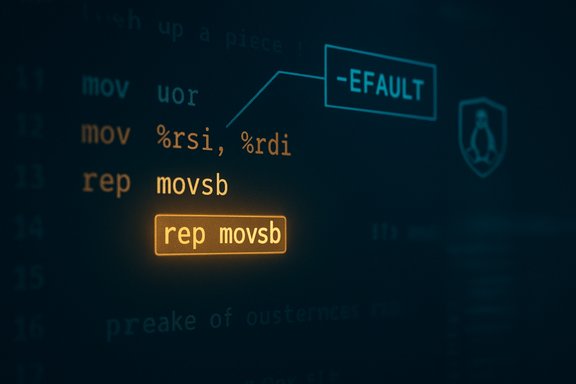
The Linux kernel uses small architecture-specific helpers to safely copy and clear user‑space memory from kernel context. Those helpers must annotate any instruction that may fault during user memory access (for example, a rep movsb that writes into user space) into the kernel’s exception/fixup table. At runtime, if a page fault or similar exception occurs while executing an annotated instruction, the kernel consults the exception table and performs a controlled recovery action — typically returning -EFAULT to the failing syscall — instead of crashing the kernel. This convention underpins many user-copy and user-clear helpers and is central to keeping bad user pointers from becoming host‑wide crashes. CVE‑2023‑54061 describes a case where the exception‑table entry attached to the final rep movsb inside the x86 helper clear_user_rep_good was incorrectly placed. Instead of pointing at the actual memory-writing instruction, the annotation targeted the register‑move immediately preceding it. That off‑by‑instruction annotation meant that when the rep movsb faulted while writing to user memory, the kernel’s fixup lookup failed to find the match, and the kernel followed its default “unable to handle page fault” path — producing a page‑fault oops rather than returning -EFAULT. The result is an availability fault: otherwise recoverable user or guest errors could produce host instability and misleading crash traces.
For system administrators the operational priorities are clear: inventory kernels, apply vendor updates (or validated backports), reboot hosts in a controlled rollout, and strengthen monitoring for the specific oops signatures described above. In multi‑tenant or cloud contexts, prioritize patching and scheduling controls aggressively because the availability impact — not a remote code execution threat — makes this an effective denial‑of‑service primitive for local or guest‑adjacent actors. The technical community’s response has been pragmatic: small, testable fixes to restore intended behavior now, and a gradual, well‑tested modernization of the underlying user‑copy/clear logic over time to remove the brittle assembly patterns that produced the error in the first place.
Source: MSRC Security Update Guide - Microsoft Security Response Center
 Background / Overview
The Linux kernel uses small architecture-specific helpers to safely copy and clear user‑space memory from kernel context. Those helpers must annotate any instruction that may fault during user memory access (for example, a rep movsb that writes into user space) into the kernel’s exception/fixup table. At runtime, if a page fault or similar exception occurs while executing an annotated instruction, the kernel consults the exception table and performs a controlled recovery action — typically returning -EFAULT to the failing syscall — instead of crashing the kernel. This convention underpins many user-copy and user-clear helpers and is central to keeping bad user pointers from becoming host‑wide crashes. CVE‑2023‑54061 describes a case where the exception‑table entry attached to the final rep movsb inside the x86 helper clear_user_rep_good was incorrectly placed. Instead of pointing at the actual memory-writing instruction, the annotation targeted the register‑move immediately preceding it. That off‑by‑instruction annotation meant that when the rep movsb faulted while writing to user memory, the kernel’s fixup lookup failed to find the match, and the kernel followed its default “unable to handle page fault” path — producing a page‑fault oops rather than returning -EFAULT. The result is an availability fault: otherwise recoverable user or guest errors could produce host instability and misleading crash traces. Why the annotation matters — technical context
How x86 exception fixups work (brief)
Exception-table fixups are a tiny but critical mechanism. During build time, assembler macros record the address ranges of instructions that may fault while accessing user memory. At runtime, if a #PF or similar exception arises, the kernel inspects the instruction pointer (RIP) and looks up the right entry to perform the prescribed recovery (for example: set errno, return -EFAULT, skip the instruction). If the RIP does not match any exception-table entry — for instance because the annotation points at the wrong address — the kernel escalates to its default fault path and may generate an oops or panic. This is not theoretical: the annotation placement is the difference between graceful syscall failure and an entire host traceback.The clear_user_rep_good case
clear_user_rep_good is an x86 assembly helper used in optimized paths to zero user memory. Its implementation contains several small assembly sequences; instruction alignment and short-register moves make it tempting to attach an exception-table entry to a nearby non‑memory instruction. In the reported case, the final rep movsb that performs the write was annotated at the preceding register-move instruction instead of the rep movsb itself. When a write to user memory triggered a page fault, the kernel could not resolve the faulting RIP to a fixup entry, and the system generated an oops instead of returning -EFAULT to the caller. The visible symptoms often mislead triage because stack traces climb through high‑level IO and filesystem code (for example, direct‑IO/DIO read paths), obscuring the low‑level misannotation as the root cause.What changed (the patches and commit traces)
Upstream maintainers applied a surgical correction: move the exception-table annotation so it points directly at the memory‑accessing instruction (the rep movsb). That minimal change allows the kernel to find the correct fixup entry when the rep movsb faults, so the kernel performs the expected recovery and returns -EFAULT instead of oopsing. The change was intentionally narrow to ease backporting into stable branches where a full rewrite of user-copy/clear helpers would be too invasive. It’s also important to note that, upstream, the entire REP_GOOD/ERMS user-copy and clear area was later reworked and many of the old helpers (including clear_user_rep_good) were removed as part of a broader cleanup (one referenced commit: d2c95f9d6802 — “x86: don't use REP_GOOD or ERMS for user memory clearing”). In mainline kernels the specific assembly helper addressed by CVE‑2023‑54061 no longer exists, but numerous distributions and long‑term stable branches still required small backports that either applied the narrow annotation fix or adopted the larger cleanup series. Operators must therefore check vendor changelogs to determine whether their kernel package contains the one‑line annotation fix or the upstream rewrite.Impact, attack model and exploitability
Primary impact: Availability / Correctness
CVE‑2023‑54061 is primarily an availability and correctness defect. In affected kernels, a user or guest action that triggered the vulnerable clear_user code path could convert a recoverable fault into a kernel oops or crash. This behavior might manifest as sudden host instability, process crashes, misattributed filesystem errors, or repeated kernel oops traces. The bug does not directly grant code execution or privilege escalation — it does not in itself expose a confidentiality breach — but an attacker who can reliably provoke kernel oopses may cause denial‑of‑service at the host level.Who can trigger it?
- Local processes with the ability to exercise clear_user paths (for instance, by issuing certain IO patterns) can reach the vulnerability.
- Guests in virtualized environments may also exercise the vulnerable code via IO patterns such as direct I/O, zeroing operations, or other file operations that funnel into the clear_user helper. In multi‑tenant cloud environments, an untrusted tenant could therefore provoke a host oops as a denial‑of‑service primitive.
Exploitability and real‑world risk
Public trackers and vendor advisories that mapped the CVE mark exploitability as low for remote actors and emphasize local or host‑adjacent vectors. There were no authoritative reports of active exploitation or a public proof‑of‑concept at disclosure. However, deterministic host oopses are operationally valuable to attackers targeting availability in multi‑tenant or shared infrastructure; that makes this bug significant in cloud hosts and other high‑concurrency deployments. Multiple vendors translated the impact to a CVSSv3 score in the medium range (commonly around 5.5) depending on interpretation of attack complexity, privileges, and scope. These numeric values should be taken as triage signals — verify exposure in your environment rather than relying purely on scores.Detection and forensic signals
When hunting for this bug or triaging strange kernel oopses, these telemetry patterns are high‑value indicators:- Kernel oops traces with messages like “BUG: unable to handle page fault for address …” or “#PF: supervisor write access in kernel mode” where RIP points to clear_user helper code in arch/x86/lib/clear_page_64.S.
- Reproducible crashes during read or zeroing operations that involve iov_iter_zero, direct‑IO paths (for example iomap_dio_rw or ext4_dio_read_iter), or other code that invokes clear_user helpers.
- Oops traces that present at higher levels as filesystem or IO problems but where the RIP maps to the low‑level assembler helper — this misattribution is a telling sign because the symptom stack often suggests a filesystem bug when the real fault is the misannotated assembly fixup.
Remediation and operational guidance
- Inventory first. Use uname -r and package manager tooling to identify kernels running across your estate. For cloud images and appliances, inspect image manifests or boot representative test instances to confirm kernel versions and changelogs. Verify whether vendor packages explicitly reference CVE‑2023‑54061 or the relevant stable commit(s).
- Apply vendor patches. Install the kernel update or stable backport provided by your distribution that lists the annotation fix — or the broader upstream cleanup series — in its changelog. Because vendors may choose different backport strategies (the narrow annotation fix vs. the upstream rewrite), confirm the package content either by reviewing the vendor changelog or by inspecting the kernel source used to build the package.
- Reboot or livepatch. Kernel fixes require a reboot to take effect unless a verified livepatch is available that includes the exact fix. Schedule reboots in a staged rollout with representative validation testing to detect any regressions.
- Tactical mitigations if patching is delayed:
- Reduce scheduling of untrusted guests onto susceptible hosts.
- Restrict local process privileges to reduce opportunities to exercise risky code paths.
- Tighten monitoring and automated remediation for repeated kernel oops patterns to detect exploitation attempts early.
- Validate. After patching, re-run the workload or test vector that previously triggered the oops to confirm correct behavior (the kernel should now return -EFAULT instead of oopsing). Preserve logs and diffs that demonstrate the change for compliance and audit trails.
Vendor handling and backport strategies
Distribution maintainers and vendors typically took one of two approaches:- Apply the minimal annotation fix into stable kernel branches. This conservative approach provides a near‑zero regression risk and is straightforward to backport into long‑lived maintenance trees.
- Pick up the larger upstream rewrite series that removes REP_GOOD/ERMS usage and replaces or simplifies user copy/clear helpers. This approach is cleaner long term but requires more invasive changes and more extensive testing before backporting into stable vendor kernels.
Code provenance and verification
The upstream commit history includes both the minimal stable fixes (annotation adjustments) and the later cleanup series that rewrote user‑copy/clear logic (commit id examples include d2c95f9d6802 and related patches). For absolute certainty that a particular kernel build contains the fix, operators should:- Inspect vendor package changelogs for the explicit stable commit hash or CVE reference.
- If building from source, grep the kernel tree for the corrected exception‑table annotation or for the absence/presence of the old clear_user_rep_good assembly helper.
- Use commit IDs to cross‑reference stable backports in your distribution’s kernel packages rather than relying solely on version numbers. This is the most reliable way to confirm remediation in long‑tail or vendor‑patched kernels.
Strengths of the fix and remaining operational risks
Strengths
- The deployed fix is surgical and low risk. Simply moving an exception‑table entry to the correct instruction is a small, testable change and thus a good candidate for stable backporting with minimal regression exposure.
- Upstream documented both the minimal fix and the larger modernization route. That documentation provides vendors with clear remediation choices and reduces ambiguity during triage and patching.
Residual concerns
- Vendor heterogeneity means that not all distributions will apply the same backport. Some may mark systems “Not affected” if the downstream code diverged, while others explicitly ship a backport. Operators must verify per‑package changelogs to be certain.
- Misattribution during triage is common: because oops traces propagate through IO stacks, initial incident classification can blame the wrong subsystem (filesystem or driver) instead of the low‑level clear_user helper.
- Multi‑tenant cloud environments remain the most critical exposure: even though the bug is local/host‑adjacent, an untrusted guest that can reliably trigger the vulnerable code path can cause host‑level instability. This makes the issue operationally severe even if the CVE does not enable RCE.
Practical checklist for administrators
- Inventory all kernels: uname -r and package manager queries. Confirm whether your vendor package changelog references CVE‑2023‑54061 or the stable commit that corrects the annotation.
- Patch and reboot: apply vendor kernel updates that explicitly mention the fix, and reboot hosts in a staged fashion.
- Harden scheduling: avoid hosting untrusted guests on vulnerable nodes until patched.
- Add detection: build alerts for repeated “unable to handle page fault” oops patterns and for RIPs that map to clear_user helpers.
- Validate: reproduce the previously observed oops in a controlled environment (if safe) and confirm that the patched kernel returns -EFAULT as expected.
A note on identifier confusion and public advisory availability
Public trackers sometimes assign adjacent CVE numbers to closely related kernel fixes in the same area of code (x86 user‑copy/clear helpers), which can create confusion when mapping vendor advisories to upstream commits. Additionally, vendor pages and some third‑party aggregators may use different CVE identifiers to describe the same underlying patch sets or backport bundles. For accurate triage, prefer commit hashes and vendor package changelogs over a single CVE number when mapping remediation status. Finally, if a vendor page (for example a vendor’s public MSRC entry) is unavailable or reports “page not found,” that typically indicates the vendor’s public tracker does not currently host a product mapping for that CVE — not that the underlying technical facts are in doubt. In such cases, cross‑reference other authoritative databases and distribution advisories to confirm whether your specific product or image is affected.Conclusion
CVE‑2023‑54061 is a classic example of how a tiny low‑level mismatch — an exception-table annotation pointing to the wrong instruction — can amplify into host instability and confusing crash diagnostics. The fix is straightforward and conservative: correct the annotation so the rep movsb instruction is properly identified for exception fixups, allowing a page fault during user access to be converted into the expected -EFAULT return instead of a kernel oops. Where feasible, vendors also pushed a long‑term cleanup that removed the old helper entirely, but many stable trees required the narrow annotation backport because it minimizes regression risk.For system administrators the operational priorities are clear: inventory kernels, apply vendor updates (or validated backports), reboot hosts in a controlled rollout, and strengthen monitoring for the specific oops signatures described above. In multi‑tenant or cloud contexts, prioritize patching and scheduling controls aggressively because the availability impact — not a remote code execution threat — makes this an effective denial‑of‑service primitive for local or guest‑adjacent actors. The technical community’s response has been pragmatic: small, testable fixes to restore intended behavior now, and a gradual, well‑tested modernization of the underlying user‑copy/clear logic over time to remove the brittle assembly patterns that produced the error in the first place.
Source: MSRC Security Update Guide - Microsoft Security Response Center
