

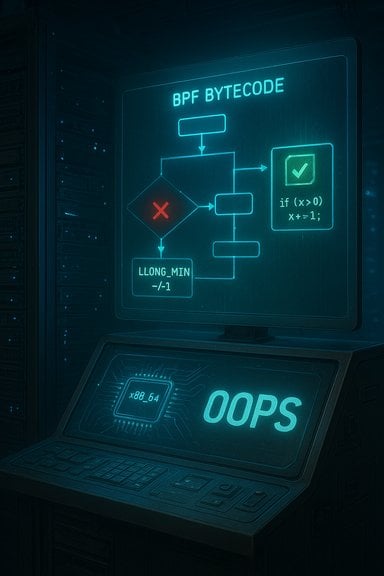
A carefully crafted signed-division bug in the Linux kernel’s BPF implementation — tracked as CVE-2024-49888 — can cause a kernel crash (an OOPS) on x86_64 systems when a BPF program triggers specific signed divide or modulo operations with minimum-integer operands, and the upstream fix now prevents that availability-impacting failure by avoiding the sdiv/smod overflow condition.
The Linux kernel’s extended BPF (eBPF/BPF) subsystem runs user-supplied programs inside the kernel after verification and, where enabled, just-in-time (JIT) compilation. BPF is used widely for networking, observability, and security tooling; consequently, correctness bugs inside the BPF interpreter/JIT can have outsized operational impact. CVE-2024-49888 describes an arithmetic edge-case in the BPF signed-division implementation: when the minimum representable signed integer is divided by -1 (for example, LLONG_MIN / -1 on 64-bit), the mathematical result is not representable in the signed integer domain, which on x86_64 triggers a hardware exception and a kernel fault. Multiple vendor trackers and advisories document the flaw and the fix: NVD summarizes the underlying arithmetic failure (LLONG_MIN/-1) and lists the BPF sdiv/smod variants that may trigger exceptions on x86_64, while distribution advisories (Debian, Ubuntu, SUSE, Red Hat families) have issued kernel updates mapped to the upstream patch that corrects the behavior.
Factors that influence real-world risk:
If immediate patching is not possible, apply these compensating controls:
(Verification notes: technical and mapping claims in this article were cross-checked against the NVD CVE entry for CVE-2024-49888 and vendor security trackers including Ubuntu and distribution advisories; where relevant vendor package mappings differ by distribution or kernel stream the vendor advisories are the authoritative source for exact package versions and backport status.
Source: MSRC Security Update Guide - Microsoft Security Response Center
 Background
The Linux kernel’s extended BPF (eBPF/BPF) subsystem runs user-supplied programs inside the kernel after verification and, where enabled, just-in-time (JIT) compilation. BPF is used widely for networking, observability, and security tooling; consequently, correctness bugs inside the BPF interpreter/JIT can have outsized operational impact. CVE-2024-49888 describes an arithmetic edge-case in the BPF signed-division implementation: when the minimum representable signed integer is divided by -1 (for example, LLONG_MIN / -1 on 64-bit), the mathematical result is not representable in the signed integer domain, which on x86_64 triggers a hardware exception and a kernel fault. Multiple vendor trackers and advisories document the flaw and the fix: NVD summarizes the underlying arithmetic failure (LLONG_MIN/-1) and lists the BPF sdiv/smod variants that may trigger exceptions on x86_64, while distribution advisories (Debian, Ubuntu, SUSE, Red Hat families) have issued kernel updates mapped to the upstream patch that corrects the behavior. What exactly went wrong (technical overview)
At the heart of CVE-2024-49888 is the classic signed-integer overflow edge case:- The minimum value for a signed integer type (e.g., LLONG_MIN on 64-bit) has no symmetric positive counterpart — negating LLONG_MIN cannot be represented.
- A signed divide or modulo operation by -1 is a mathematical negation in many cases (for integers), and performing LLONG_MIN / -1 would require representing LLONG_MAX + 1.
- On x86_64 hardware, attempting the signed divide LLONG_MIN / -1 causes a CPU divide exception; the kernel, executing the BPF instruction as part of a JITed or interpreted program, suffers an OOPS (kernel fault) as a result.
- 64-bit LLONG_MIN / -1
- 32-bit INT_MIN / -1
- 64-bit LLONG_MIN % -1
- 32-bit INT_MIN % -1
Why this matters: availability and attack model
This is an availability-first vulnerability. A local actor capable of loading or triggering a BPF program on a vulnerable host can induce a kernel fault that crashes or destabilizes the kernel, creating a denial-of-service (DoS) condition for the entire host or for affected kernel subsystems. The public advisories assign a Medium severity (CVSS ≈ 5.5) in part because the attack vector is local and because the bug does not directly enable data disclosure or privilege escalation in itself. However, kernel OOPS/panic primitives are valuable in multi-stage exploit chains and are high-risk on multi-tenant or shared infrastructure (CI runners, developer hosts, container nodes, or cloud hypervisors). Who is exposed?- Systems that allow loading of BPF programs and run kernels prior to the fix.
- Hosts where unprivileged BPF program loading is permitted (many distributions provide sysctl knobs for this).
- Multi-tenant servers or cloud images that enable or accept BPF workloads from less-trusted code paths.
The upstream fix and rationale
The kernel community addressed the fault by changing the BPF runtime/compiler to avoid generating operations that would provoke an x86_64 divide exception for the problematic operand combinations. The upstream patch resolves the sdiv/smod handling so that the BPF execution path either:- avoids executing the native hardware division when operands match the problematic pattern (for example, by emitting guarded code that checks for the INT_MIN/LLONG_MIN case and handles it safely), or
- performs a safe, defined fallback that does not rely on an instruction sequence that would trap.
How vendors and distributions responded
Major distributors and vendors incorporated the upstream patch into their kernel security updates and released advisories in October 2024 and during subsequent backport rounds. Examples of vendor responses:- NVD and multiple distribution trackers list the CVE and summarize the flaw and fix.
- Ubuntu classified the vulnerability as Medium (CVSS 5.5) and published kernel package updates mapped to the fix.
- Debian, SUSE, Oracle Linux, Red Hat families and AlmaLinux mirrored or repackaged the fix in their kernel update streams and documented their package mappings.
Exploitability and real-world risk
Public reporting at disclosure did not show widespread in-the-wild exploitation of CVE-2024-49888. That absence is not proof of safety; attackers who already have local access may weaponize kernel faults as stepping stones, and some threat actors with access to private exploit development resources could craft reliable PoCs.Factors that influence real-world risk:
- Policy hardening: hosts with unprivileged BPF disabled are harder to exploit.
- Multi-tenant context: a crashed host impacts all tenants and operational workloads.
- Attack complexity: constructing a BPF program to reliably trigger the specific arithmetic pattern is moderately simple for a local attacker; many of the vulnerable forms depend only on feeding the BPF VM a particular operand pattern.
Detection and triage: how to tell if you’re affected
Short triage checklist:- Check kernel version: run uname -r and compare with your distribution’s security advisory to determine if your installed kernel package predates the fixed commit. Vendors document package-level fixes that map to the upstream change.
- Inspect policy knobs: confirm whether unprivileged BPF loading is permitted on the host (sysctl -a | grep unprivileged_bpf or check /proc/sys/kernel/unprivileged_bpf_disabled). If unprivileged loading is enabled, exposure increases.
- Search kernel logs: look for OOPS traces mentioning "divide error" or BPF-related call traces around kernel faults; journalctl -k and dmesg are the primary local sources. Repeated BPF-related OOPS entries are a sign that the vulnerable path was triggered.
- For fleets: correlate crash logs and reboot events with BPF program deployment windows. If you run agents that load BPF programs (observability, security, or network dataplane tooling), prioritize those hosts for patching and monitoring.
Mitigations and compensating controls
The single reliable remediation is to install a vendor-provided kernel update that contains the upstream fix and reboot the host into the patched kernel. Because the vulnerability is in kernel arithmetic for BPF operations, the fix requires patched kernel code and cannot be fully mitigated at the userland agent level.If immediate patching is not possible, apply these compensating controls:
- Disable unprivileged BPF: set kernel.unprivileged_bpf_disabled=1 to prevent non-privileged processes from loading BPF programs. Persist this change in your configuration management.
- Restrict capabilities: ensure only trusted accounts and containers hold CAP_BPF or CAP_SYS_ADMIN. Audit and reduce capability grants.
- Limit deployment of untrusted eBPF toolchains: avoid installing or running third-party BPF programs from unverified sources on production systems until patches are applied.
- Monitor telemetry: set alerts for repeated kernel oops, bpf verifier warnings, or sudden process restarts/tombstones in services that load BPF programs. Rapid detection reduces dwell time and speeds remediation.
Patch guidance and deployment playbook
- Inventory: identify hosts that run BPF-enabled kernels and note their kernel package versions. Use uname -r on each host and map kernel packages to vendor advisories.
- Prioritize: give top priority to multi-tenant hosts, cloud hypervisors, CI runners, containers with elevated privileges, and any host running eBPF-based network dataplanes or security agents.
- Acquire vendor updates: fetch the kernel security updates from your distribution channel (APT/YUM/zypper). Confirm the changelog mentions CVE-2024-49888 or the upstream commit ID.
- Pilot: test the patched kernel in a small pilot ring which exercises representative BPF workloads and high-load scenarios for several days.
- Deploy: stage the patch rollout in waves (pilot → expanded → production) and schedule reboots for the kernel swap. Monitor for regressions.
- Verify: confirm systems boot into the patched kernel (uname -r), check kernel package changelog entries, and search logs for absence of the previous OOPS patterns.
Developer and maintainer advice
For kernel contributors and BPF maintainers:- Guard arithmetic operations: ensure the compiler/JIT emits explicit checks or guarded code for division and modulo operations where machine semantics can trap.
- Test edge cases: add unit and integration tests that cover INT_MIN/-1 and LLONG_MIN/-1 patterns across architectures.
- Cross-architecture validation: the different semantics between x86_64 and arm64 are a reminder to test architecture-specific code paths and to avoid assumptions about trap behavior.
- Validate inputs you place into BPF registers if those values can be controlled by untrusted users.
- Prefer safe arithmetic patterns in userland that avoid emitting problematic instruction sequences into BPF bytecode when possible.
Strengths of the fix and remaining risks
Strengths:- The upstream change is narrow and targeted: it eliminates a single, well-understood arithmetic corner case without broad behavioral changes, minimizing regression risk.
- The patch is easy to backport and distributors have widely adopted it in stable kernel updates.
- Vendor lag: embedded vendors, appliance maintainers, and some cloud images may take longer to ship backported fixes; those images must be inventoried and tested.
- Policy exposure: permissive unprivileged BPF policies increase attack surface and should be re-evaluated where security posture demands it.
- Unknown exploitation: the lack of public exploit reports does not preclude private exploitation; operators must treat kernel OOPS primitives as high-value for adversaries with local access.
Practical recommendations — checklist
- Confirm whether your kernel package is patched for CVE-2024-49888: check vendor security trackers and package changelogs.
- If unprivileged BPF loading is not required, set kernel.unprivileged_bpf_disabled=1 and persist the change.
- Restrict CAP_BPF/CAP_SYS_ADMIN assignment and review which services are permitted to load BPF programs.
- Stage the kernel update in a pilot ring and exercise representative BPF workloads before a mass rollout.
- For vendors and embedded maintainers, rebuild images with the patched kernel and apply firmware-level updates where necessary. Inventory custom kernels carefully.
Conclusion
CVE-2024-49888 is a textbook kernel arithmetic correctness problem with tangible operational consequences: a simple signed divide or modulo in a BPF program can provoke a hardware exception on x86_64, producing a kernel OOPS and causing a denial-of-service. The kernel community’s fix is surgical and appropriate, and most mainstream distributions have released patches and backports. Operational response should be decisive: identify BPF-exposed systems, deploy vendor kernel updates, and apply immediate policy mitigations (disable unprivileged BPF and tighten capability grants) where necessary. Given the potential impact on multi-tenant systems and developer workstations, treating this as an availability-first priority is the correct defensive posture.(Verification notes: technical and mapping claims in this article were cross-checked against the NVD CVE entry for CVE-2024-49888 and vendor security trackers including Ubuntu and distribution advisories; where relevant vendor package mappings differ by distribution or kernel stream the vendor advisories are the authoritative source for exact package versions and backport status.
Source: MSRC Security Update Guide - Microsoft Security Response Center
