

The Linux kernel vulnerability CVE-2024-1151 is a stack‑overflow defect in the Open vSwitch (OVS) kernel module that can be triggered by recursive action operations and yields a reliable denial‑of‑service (DoS) — an attacker who can reach the OVS control path can cause the kernel to crash or the networking subsystem to fail until a reboot or a patched kernel is installed.
Open vSwitch (OVS) is widely used in virtualized and software‑defined networking environments to manage flows and advanced switching functions. The OVS kernel module implements a set of action parsing and execution routines that must be robust against malformed control input because management interfaces (netlink / ovs‑vsctl / ovsdb clients) can carry complex, nested action descriptions. CVE‑2024‑1151 stems from a recursive action-handling path that does not cap or validate recursion depth, allowing the kernel module to push too many frames onto the kernel stack and overflow it under crafted input conditions. This results in a kernel crash or an OOPS — an immediate availability impact for the host. The vulnerability was publicly disclosed in February 2024 and has been cataloged by major vulnerability databases and vendor advisories, which uniformly classify the flaw as an availability‑first defect with a CVSS v3.1 base score of 5.5 (Medium) and a local attack vector (AV:L). Vendors and distribution maintainers published kernel package updates and backports to remediate the problem.
Source: MSRC Security Update Guide - Microsoft Security Response Center
 Background
Open vSwitch (OVS) is widely used in virtualized and software‑defined networking environments to manage flows and advanced switching functions. The OVS kernel module implements a set of action parsing and execution routines that must be robust against malformed control input because management interfaces (netlink / ovs‑vsctl / ovsdb clients) can carry complex, nested action descriptions. CVE‑2024‑1151 stems from a recursive action-handling path that does not cap or validate recursion depth, allowing the kernel module to push too many frames onto the kernel stack and overflow it under crafted input conditions. This results in a kernel crash or an OOPS — an immediate availability impact for the host. The vulnerability was publicly disclosed in February 2024 and has been cataloged by major vulnerability databases and vendor advisories, which uniformly classify the flaw as an availability‑first defect with a CVSS v3.1 base score of 5.5 (Medium) and a local attack vector (AV:L). Vendors and distribution maintainers published kernel package updates and backports to remediate the problem. Technical overview — what went wrong
Root cause: unchecked recursion and stack frame growth
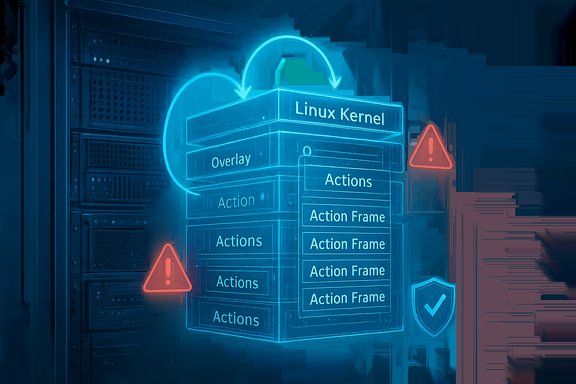
At its core, CVE‑2024‑1151 is a classic stack overflow caused by uncontrolled recursion inside the OVS kernel action pipeline. The kernel code that parses and pushes actions onto the stack assumes a bounded recursion depth or that callers will ensure reasonable nesting. Under specific crafted netlink or control payloads the code will repeatedly push action frames without verifying stack depth or available stack space. The result is either immediate corrupt return addresses or a protected stack boundary breach that produces a kernel OOPS. Authoritative vulnerability summaries describe this as a recursive "push" path that lacks stack-depth validation.Where it manifests
The failing path is inside the kernel‑space routines that parse OVS actions sent via the control plane (genetlink/netlink) — the same surface used by tools such as ovs‑vsctl and by OVS management components. The crash often shows as a trace that can be correlated to OVS action parsing functions and the kernel stack frames consumed by nested action processing. This places emphasis on hosts that expose or erroneously relax access to OVS controls, particularly multi‑tenant NFV platforms, cloud hypervisor hosts, or misconfigured management endpoints.Exploitability model
- Attack vector: Local or tenant‑adjacent (an untrusted guest or local user/process with access to OVS control operations).
- Privileges required: Low — vendors report that the ability to submit netlink/genetlink action payloads or to run management operations that insert flows is sufficient in many setups. This means that a malicious tenant in a cloud environment, or a compromised management host, could trigger the condition.
- Complexity: Low — the recursion pattern is deterministic once the crafted action payload reaches the parsing routine. Successful exploitation leads to a reproducible kernel crash (availability loss) rather than a reliable code‑execution primitive.
Affected systems and scope
Kernel and distribution exposure
Multiple distribution security trackers and vendor advisories mapped the vulnerable kernel ranges and published patched package versions. Canonical and major Linux distributors (Ubuntu, Debian, Red Hat derivatives) and vendor kernels included fixes and backports following upstream kernel commits; cloud vendors and appliance vendors likewise issued updates for affected images. Amazon Linux maintains ALAS entries that list fixed kernel packages for the relevant kernel series. Administrators must consult their vendor-specific advisories and package changelogs to determine whether their running kernel includes the upstream fix.High‑risk deployment profiles
The following host types should be prioritized for triage and patching:- Multi‑tenant hypervisors and NFV platforms that run OVS and expose control interfaces to tenant or management networks.
- Cloud or hosting images that embed OVS and accept management-plane calls from less‑trusted networks or automation.
- CI/CD runners, build hosts, and developer workstations where containers or untrusted processes can interact with OVS control paths.
Operational impact: why availability matters here
A kernel‑level crash is not a graceful userland process failure — it often forces a reboot or leaves subsystems unusable until manual remediation. In networking hosts the consequences are amplified: control plane crashes can disrupt all virtual networks and VMs that rely on the host, leading to cascading outages, failed failovers, or loss of ephemeral in‑memory state for running VMs. The Microsoft Security Response Center framing supplied with the vulnerability stresses total loss of availability as the defining operational consequence — either sustained while the attack persists or persistent until reboot/patch. This framing aligns with public advisories that classify the primary impact as Availability: High while confidentiality and integrity remain unaffected.Detection, indicators, and incident response
What to look for (high‑signal indicators)
- Kernel OOPS traces referencing OVS action parsing routines or showing large stack usage during netlink/genetlink operations. Logs often contain function names or backtrace frames tied to the OVS module.
- Repeated failure patterns when attempting to install flows via ovs‑vsctl or when management tools perform complex action insertions.
- Unexpected reboots, kernel panic messages, or sudden loss of network forwarding across VMs after flow insertion operations.
Short incident playbook
- Isolate the affected host from production resource pools to limit collateral impact.
- Capture kernel logs, dmesg output, and, where available, a memory dump (vmcore).
- Correlate management-plane activity and identify which user/tenant/process issued the flow or action insertion that preceded the crash.
- Avoid repeated attempts to reinsert the problematic kernel module or rerun the same flow insert pipeline on production hosts — a reboot into a patched kernel is the most reliable recovery.
- Apply the vendor/distribution kernel update that includes the upstream fix, then validate the host in an isolated environment before returning to service.
Remediation and mitigation — prioritized checklist
Definitive fix: apply the patch and reboot
- Apply vendor-supplied kernel updates or distribution kernel packages that explicitly list CVE‑2024‑1151 or the upstream stable commit IDs. Reboot hosts into the updated kernel. Confirm the kernel package changelog references the stable commits where possible.
Immediate mitigations when patching is delayed
- Restrict OVS control-plane access (netlink, ovs‑vsctl, management APIs) to a trusted administrator group and management network only. Implement network ACLs and control-plane segmentation to reduce the attack surface.
- Harden tenant isolation: avoid granting tenant VMs or containers permissions that allow them to submit complex netlink/genetlink messages or to modify OVS flows directly. Consider adding orchestration-level policy controls that validate flow insertion requests before they reach OVS.
- Monitor kernel logs centrally and alert on OOPS traces and repeated flow‑insertion failures; capture any suspicious netlink payloads for testbed reproduction.
Validation steps after patching
- Reproduce representative management-plane workflows to confirm that the patched kernel no longer crashes under the previously problematic action insert sequences.
- Run regression tests for OVS flow insertion and management operations across typical control-plane paths.
- Monitor for residual anomalies for a defined observation window (recommended 7–14 days in production-critical hosts).
Risk analysis and attacker motivation
Strengths of the public fixes
- Upstream kernel maintainers took a defensive approach: fixes for stack‑depth or recursive‑push defects are straightforward, small, and low‑risk to backport. Multiple vendors have backported the stable commits into distribution kernels and published advisories. This means a consistent remediation path exists and can be consumed via routine kernel updates.
- The vulnerability’s attack vector is local or tenant‑adjacent, not directly wormable across networks; that containment helps prioritize remediation where exposure is realistic (multi‑tenant hosts and misconfigured management surfaces).
Persistent risks and operational caveats
- Long‑tail exposure: embedded appliances, vendor kernels, and custom vendor images can lag upstream patches for months. Hosts that freeze kernel versions for stability reasons may remain vulnerable until vendors supply backports. Inventory rigor is essential.
- Misleading indicators from low‑quality trackers: some aggregation feeds or automated scanners may misclassify the vector or overstate remote exploitability. For example, a few third‑party summaries that lack upstream confirmation incorrectly claim a remote vector; authoritative sources (NVD, Ubuntu security advisory, ALAS) indicate the vector is local and the primary effect is DoS. Treat uncorroborated claims of remote exploitability as unverified unless supported by a reliable technical write‑up or PoC.
- The DoS primitive remains valuable in attacker playbooks for disruptive operations: targeted crashes against hypervisors, CI runners, or control hosts can force failovers or escalate operational overhead. Even if the bug does not yield RCE, the operational cost to recover and diagnose can be high.
Recommended detection and hunting queries
- Search for kernel OOPS text that references OVS action parsing or netlink activity in dmesg and journalctl -k. Capture any backtrace and correlate with timestamps of control‑plane activity.
- Monitor process and service restarts of ovs‑vswitchd, ovs‑db, and qemu/libvirt services around times of OOPS or reboots. Unexpected service churn after flow modifications is a red flag.
- Create SIEM rules to flag netlink/genetlink payloads that attempt deeply nested actions or unusually long action chains originating from tenant subnets or untrusted hosts. Buffer, capture and replay suspicious payloads into an isolated testbed for triage.
Practical guidance for sysadmins (a compact checklist)
- Inventory: Identify hosts running OVS (packages, kernel modules) and list kernel versions (uname -r).
- Verify: Check vendor/distro advisories and package changelogs for CVE‑2024‑1151 fixes for your kernel series.
- Patch: Apply vendor kernel updates or upstream stable backports where available. Reboot into patched kernels.
- Isolate: Limit access to OVS control-plane interfaces and only allow management traffic from trusted networks.
- Monitor: Enable central logging for kernel OOPS, and set alerts for the specific call‑stack signatures or repeated flow insertion errors.
- Test: Validate management-plane workflows and run regression tests in a staging environment before mass rollout.
Conclusion — what matters most
CVE‑2024‑1151 is not a subtle encryption or authentication bypass; it is a practical operational hazard — a kernel stack overflow in a widely deployed networking component that enables deterministic denial‑of‑service when reachable through OVS management paths. The pragmatic response is straightforward: inventory affected hosts, apply vendor kernel patches or upstream backports, and harden the OVS control plane to reduce exposure while updates are rolled out. Public advisories and distribution trackers provide the fixed package versions and stable commit references needed to remediate; administrators should treat this as a high‑priority availability patch for multi‑tenant hosts and any system that exposes OVS control interfaces to less‑trusted code. Cautionary note: some secondary sources have made uncorroborated claims extending the vector beyond what upstream and vendor advisories report. Those claims should be treated as unverified until demonstrated with reliable technical evidence. Meanwhile, operational teams must act on the confirmed availability risk and prioritize patching, segmentation, and monitoring to prevent disruption.Source: MSRC Security Update Guide - Microsoft Security Response Center
