

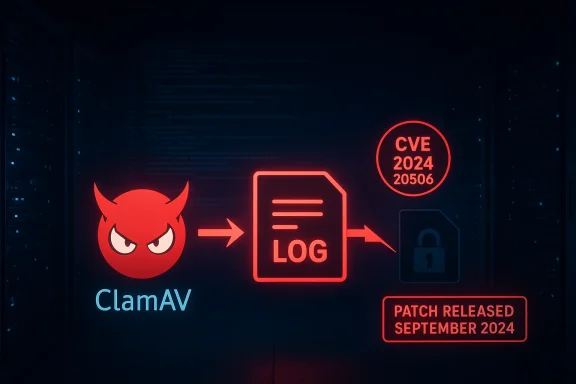
ClamAV’s core daemon contains a deceptively simple bug that, when chained with local access and the ability to restart services, can let an attacker overwrite critical system files by abusing log handling — a privilege-handling flaw tracked as CVE-2024-20506 that was patched by the ClamAV project in September 2024 but continued to require rapid distribution and vendor updates across Linux distributions and embedded systems.
ClamAV is an open-source antivirus engine widely used on Unix-like systems, mail servers, container images, and many distro-provided scanning stacks. The vulnerable component here is the ClamD service (the ClamAV scanning daemon), which historically runs with elevated privileges to perform system-wide scanning tasks and write logs to centralized files. The vulnerability arises from how ClamD opens and writes to its configured log file: it did not adequately check whether the path it was about to write to had been replaced by a symbolic link (symlink), and it followed that symlink while running with elevated rights. An attacker with local, authenticated access could replace the log file with a symlink that points to a critical system file, and then provoke or wait for a ClamD restart — causing ClamD to append log text into that critical target and potentially corrupt the file.
The issue was disclosed publicly on 4 September 2024 and assigned CVE-2024-20506. ClamAV issued immediate patch releases (notably
What changed in the upstream fix is simple and surgical: ensure that any re-open of the logfile uses safe open semantics that do not follow symlinks (for example, using O_NOFOLLOW on POSIX systems or validating file type information after open). That approach both eliminates the symlink vector and preserves normal logging functionality.
This vulnerability has a comparatively modest CVSS score but a real-world capacity to cause high availability disruption when exploited. That combination — easy local exploitation prerequisites and potentially severe operational consequences — means the issue deserves expedient attention from sysadmins and security teams. If you run ClamAV anywhere in your estate, treat this CVE as an immediate action item: verify versions, apply patches, and tighten file permissions on logging paths today.
Source: MSRC Security Update Guide - Microsoft Security Response Center
 Background
ClamAV is an open-source antivirus engine widely used on Unix-like systems, mail servers, container images, and many distro-provided scanning stacks. The vulnerable component here is the ClamD service (the ClamAV scanning daemon), which historically runs with elevated privileges to perform system-wide scanning tasks and write logs to centralized files. The vulnerability arises from how ClamD opens and writes to its configured log file: it did not adequately check whether the path it was about to write to had been replaced by a symbolic link (symlink), and it followed that symlink while running with elevated rights. An attacker with local, authenticated access could replace the log file with a symlink that points to a critical system file, and then provoke or wait for a ClamD restart — causing ClamD to append log text into that critical target and potentially corrupt the file.The issue was disclosed publicly on 4 September 2024 and assigned CVE-2024-20506. ClamAV issued immediate patch releases (notably
1.4.1, 1.3.2, 1.0.7, and 0.103.12) that alter the logging behavior to avoid following symlinks on Unix-like systems. Major Linux vendors and downstream packagers subsequently issued security advisories and package updates.Overview of the technical flaw
What goes wrong: logfile handling and symlink race conditions
At a high level, the bug is an improper check for symlinks when opening/writing logs while privileged. The daemon assumed that the logfile path it was configured to use remained a regular file; it opened (or re-opened) that path and appended logs without verifying that the file descriptor referred to an ordinary file and not a symlink to another filesystem path. This opens a classic symlink-based privilege escalation / integrity corruption vector:- An attacker with write access to the directory that contains the ClamD logfile can delete or rename the original logfile and replace it with a symbolic link that points at a sensitive system file (for example, a configuration file, system binary, or other protected resource).
- When ClamD starts or re-opens its logfile during normal rotation/restart, it follows that symlink (as ordinary file semantics would allow) and appends its log messages to whatever file lies at the symlink target.
- Those appended messages can corrupt the target file content (even small changes to certain system files can render a service or the system inoperative), creating a path to deny availability or escalate local privileges depending on the target file and system configuration.
Why this matters in practice
A successful exploitation is not simply theoretical: writing arbitrary content into critical files — even as append operations — can break system integrity or availability in surprising ways. The vulnerability was categorized with an Availability impact of High and an overall CVSS v3.1 base score of 6.1 (Medium) in canonical records, reflecting the modest attacker prerequisites (local presence and low complexity) combined with potentially severe operational consequences. Distribution packagers flagged the impact as substantial enough to push updates across LTS releases, and vendors advised patching or applying mitigations quickly.Affected versions and scope
Which ClamAV releases are affected
The upstream advisories and vulnerability records list the affected releases broadly: ClamAV versions1.4.0, 1.3.2 and prior within those series, all 1.2.x versions, 1.0.6 and prior releases, and multiple 0.1xx family versions up through 0.103.11 were identified as vulnerable. The vendor released fixes in 1.4.1, 1.3.2, 1.0.7, and 0.103.12 to address the flaw across supported branches.Downstream distributions and devices
Major Linux distributions (Ubuntu, Debian, SUSE, Alpine, CBL-Mariner and others) and their security teams treated the issue as a packaging-and-deployment concern, issuing distribution-specific package updates and security notices (for example, Ubuntu released fixes for multiple LTS releases). Embedded systems, container images, mail gateway appliances, or vendor distributions that rely on older ClamAV packages could remain vulnerable until vendors issued or pushed their updates. Security scanners and vulnerability databases reflect this broad downstream impact.Exploitation model and real-world feasibility
Attacker prerequisites
To exploit CVE-2024-20506 an attacker must:- Have local authenticated access to the machine or at least write access to the directory containing the ClamD logfile (this may be satisfied by a low-privilege user account or by temporary code execution under that user).
- Be able to delete/replace the logfile with a symlink that points at the intended target.
- Cause or wait for ClamD to restart or to re-open its log file (log rotation, a service restart, or an administrative restart).
Exploit complexity and impact
The exploit is technically straightforward once local write access exists — create a symlink and then trigger a restart — which is why NVD and several vulnerability trackers classify the attack complexity as low. The power of the attack stems from where the log writes are redirected: appending to certain files (e.g., shell scripts, systemd unit files, configuration snippets, or other text-based resources) can break services or, in some chainable cases, provide privilege escalation when the appended content is later executed by a higher-privilege process. In practice, the most immediate and reliable consequences are file corruption and denial of availability for components that rely on the corrupted artifacts.Public exploit activity and PoC status
During our research for this feature, canonical vulnerability databases and tracking sources did not show widely circulated public proof-of-concept (PoC) exploit code or clear in-the-wild exploitation campaigns specifically for CVE-2024-20506. Multiple authoritative trackers list the vulnerability and the fix without linking to active exploitation cases. That said, the absence of public PoC does not imply low risk: privileged-local vectors like symlink-based rewrite have a short path to practical exploitation in many environments, and private/targeted abuse could occur without public disclosure. Treat claims about the lack of exploitation as tentative and subject to change.Vendor response and patching timeline
ClamAV released coordinated patch versions on 4 September 2024. The fix changed the logging module to disable following symlinks on Linux and Unix systems, effectively preventing the daemon from writing to symlink targets when re-opening its logfile — a direct correction of the underlying bug. Distribution vendors (Ubuntu, Debian, SUSE, Alpine, CBL-Mariner, etc.) packaged those changes and issued distribution-specific updates, often providing patches for several LTS releases to ensure broad remediation. Security advisories urging prompt upgrades appeared within days to weeks of the upstream release.What changed in the upstream fix is simple and surgical: ensure that any re-open of the logfile uses safe open semantics that do not follow symlinks (for example, using O_NOFOLLOW on POSIX systems or validating file type information after open). That approach both eliminates the symlink vector and preserves normal logging functionality.
Detection, mitigation and hardening — practical steps for sysadmins
If you run ClamAV or manage systems that includeclamd, follow these prioritized steps immediately:- Patch: Upgrade to a fixed upstream or distribution package:
- Upstream ClamAV patched releases:
1.4.1,1.3.2,1.0.7,0.103.12(and later). - Apply your distro’s security update (Ubuntu, Debian, SUSE, Alpine, etc.). Distributors published updated package versions across supported releases.
- Reduce attack surface:
- Ensure log directories and log file ownership/permissions are restricted so unprivileged users cannot delete or create files there. Typical practice: log files owned by the service user or root with permissions such that unprivileged users cannot replace them (e.g.,
chmod 640with ownerroot:clamavwhere appropriate). - Avoid running
clamdprocesses as root unless required; follow least-privilege principles and use dedicated service accounts. - Monitor and detect suspicious symlink activity:
- Add file integrity monitoring or periodic checks that verify the logfile path is a regular file (not a symlink) and that ownerships and permissions are unchanged.
- Watch system logs and audit records for events that indicate deleted/created log files or unexpected service restarts around the same timeframe.
- Harden restart patterns:
- Where possible, avoid automatic restarts of
clamdtriggered by externally controllable events. Use controlled maintenance windows to restart scanning daemons so you reduce the chance a local adversary can time a manipulation. - If using managed orchestration (containers, systemd templates), ensure logrotate and service management operations are constrained and authenticated.
- Compensating controls for legacy/unpatchable systems:
- If you cannot immediately patch a system (e.g., vendor appliance with delayed updates), consider restricting local user access, applying filesystem ACLs to the log directory, or placing the log file on a mount with stricter ownership semantics.
- Consider temporarily disabling or isolating ClamAV scanning on systems where the logging path is writable by untrusted users, and replace with other scanning mechanisms until patched. Use caution: disabling AV increases exposure to malware, so only take this as a controlled step with compensating controls.
Risk analysis — strengths of the fix and remaining concerns
Why the fix is sound
- The upstream patch directly addresses the root cause by preventing the daemon from following symlink paths when writing logs. This is a focused, minimal-change fix that closes the attack vector without drastic architectural changes to ClamAV. Distro-level backports implemented the same logic into maintained branches, which is the standard and appropriate remediation for a filesystem symlink-based issue.
- The fix is platform-appropriate: POSIX systems provide O_NOFOLLOW and related mechanisms that are precisely designed for this class of vulnerability, and using them is widely considered best practice for privileged daemons that write to filesystem paths.
What remains concerning
- Distribution lag and appliance vendors: Many organizations do not run the upstream release immediately; they rely on distribution packages or vendor-supplied appliances. Delays between upstream fixes and applied patches at scale mean that exploitable instances can persist in the wild. Security notices from major distributions show efforts to ship fixes across multiple LTS releases — but administrators must confirm their own patch levels.
- Local access makes it an attractive lateral move: Although the attack is local-only, symlink-based attacks are a common lateral tool. In multi-tenant shared hosting, email processing, web hosting environments, or containerized deployments with weaker filesystem isolation, the prerequisite (write access to the log directory) is not hard to obtain. That materially increases the practical attack surface beyond the strict “authenticated user” label.
- Potential for chained escalation: The immediate effect is file corruption (integrity/availability). Depending on the target file, that corruption can be escalated into more serious outcomes if the corrupted file is later parsed or executed by privileged services. Detecting and preventing such chains requires holistic system hardening beyond simply patching ClamAV.
Recommended detection rules and audit points
System owners should add specific checks to their detection pipelines:- File type verification: periodic script that confirms the ClamAV logfile path is a regular file (not a symlink) and has expected uid/gid and permission bits. Alert and remediate when mismatches occur.
- Service restart correlation: correlate
systemdor init restarts ofclamdwith filesystem modifications in its logfile directory within a short time window. Flag any restart preceded by deletion/creation events of the logfile. - IDS/Host-based rules: file integrity tools (Tripwire, AIDE) or auditd rules can be configured to generate events on logfile inode replacements or symlink creations in monitored directories.
- Package version inventory: maintain an asset inventory to ensure
clamdinstances are running versions at or above the patched releases; alerts for out-of-date packages should be high priority.
Timeline and disclosure — what happened and when
- 4 September 2024: CVE-2024-20506 publicly disclosed; ClamAV announces security patch releases across supported branches (
1.4.1,1.3.2,1.0.7,0.103.12). The upstream note specifically calls out changes to the logging module to disable following symlinks. - Early September 2024 onward: Linux distributors prepared and released packaged updates and advisories (for example, Ubuntu USN and other vendor advisories), urging admins to upgrade. Security scanners and vulnerability trackers assimilated the CVE into their databases, issuing guidance and scores.
- Post-disclosure monitoring: vulnerability databases list the flaw across many package trees; as of the time of this reporting there were no widely-circulated public exploit PoCs or active exploitation reports tied to this CVE, but the potential for local abuse remained a recognized operational risk.
Practical checklist for administrators (quick action plan)
- Verify: identify all systems with
clamdinstalled and note package versions. - Patch: update to patched package versions or upstream releases immediately.
- Lockdown: set strict permissions on the log directory; ensure only the service user (or root) can create or delete the logfile.
- Monitor: deploy quick detection scripts to check for symlinks at the logfile path and alert on changes.
- Audit: review service restart policies and logrotate behavior to reduce accidental restarts that an attacker could induce.
- Vendor follow-up: if using vendor appliances or lightweight distro images (containers) that embed ClamAV, confirm vendor patch schedules and apply updates when available.
- Document: record mitigation and patch evidence for compliance and incident response readiness.
Conclusion
CVE-2024-20506 is a reminder that seemingly mundane programs — logging code paths in long-lived privileged daemons — are dangerous when they make unsafe assumptions. The fix is straightforward and effective: avoid following symlinks when reopening log files in privileged contexts. But the operational work required to fully mitigate the risk extends beyond a single patch: organizations must ensure updates are applied across fleet, vendor appliances and images are protected, filesystem permissions are hardened, and monitoring is in place to detect attempts to manipulate log files.This vulnerability has a comparatively modest CVSS score but a real-world capacity to cause high availability disruption when exploited. That combination — easy local exploitation prerequisites and potentially severe operational consequences — means the issue deserves expedient attention from sysadmins and security teams. If you run ClamAV anywhere in your estate, treat this CVE as an immediate action item: verify versions, apply patches, and tighten file permissions on logging paths today.
Source: MSRC Security Update Guide - Microsoft Security Response Center
