

Oracle's MySQL Server contains a stability flaw in its query optimizer that can be triggered by a low‑privileged, network‑accessible account to hang or repeatedly crash the server process—producing a reliable denial‑of‑service condition tracked as CVE‑2024‑20961.
MySQL remains one of the most widely deployed relational database engines in the world, powering everything from small web applications to large cloud services. In mid‑January 2024 Oracle included a fix for an optimizer‑related stability vulnerability in its standard Critical Patch Update, and public vulnerability trackers subsequently cataloged the issue under CVE‑2024‑20961. The vulnerability affects the Server: Optimizer component and is rated with a CVSS v3.1 Base Score of 6.5 (Medium) with an impact solely on availability.
At a high level, the bug is an uncontrolled resource‑consumption / optimizer crash condition: crafted queries or sequences of requests processed by the optimizer can force the mysqld process into a hang or a frequently repeatable crash state. Because the attack requires only low privileges but network access, operators should treat exposed administrative or client endpoints as high‑risk attack surfaces until instances are patched.
However, community reports are not a substitute for vendor advisories or distro security trackers. Always confirm community guidance against the vendor or official package changelogs before applying it in production.
Source: MSRC Security Update Guide - Microsoft Security Response Center
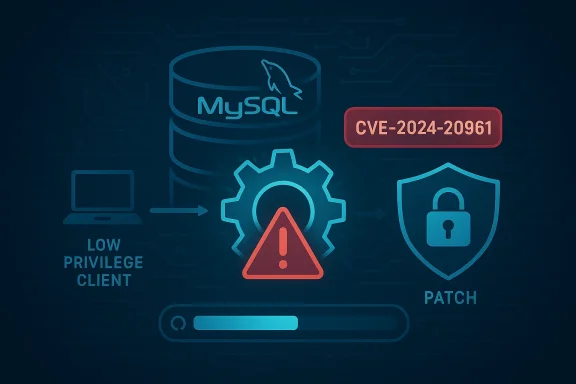 Background / Overview
MySQL remains one of the most widely deployed relational database engines in the world, powering everything from small web applications to large cloud services. In mid‑January 2024 Oracle included a fix for an optimizer‑related stability vulnerability in its standard Critical Patch Update, and public vulnerability trackers subsequently cataloged the issue under CVE‑2024‑20961. The vulnerability affects the Server: Optimizer component and is rated with a CVSS v3.1 Base Score of 6.5 (Medium) with an impact solely on availability.At a high level, the bug is an uncontrolled resource‑consumption / optimizer crash condition: crafted queries or sequences of requests processed by the optimizer can force the mysqld process into a hang or a frequently repeatable crash state. Because the attack requires only low privileges but network access, operators should treat exposed administrative or client endpoints as high‑risk attack surfaces until instances are patched.
What the record shows: details and verification
The core technical facts (verified)
- Vulnerable component: MySQL Server — Server: Optimizer.
- Affected releases: MySQL 8.0.35 and earlier and the corresponding 8.2.0 and earlier release lines as published in the CVE records.
- Exploitability: Easily exploitable by a remote, low‑privileged account over the network; no user interaction required.
- Impact: Availability only — exploitation can cause mysqld to hang or repeatedly crash (complete DoS). CVSS vector: CVSS:3.1/AV:N/AC:L/PR:L/UI:N/S:U/C:N/I:N/A:H.
- Vendor response: Oracle included the fix in the January 2024 Critical Patch Update and operators are advised to upgrade to patched MySQL releases; downstream distributions (Debian, Ubuntu, cloud providers) tracked the issue and published fixed package versions.
Cross‑checks that matter
- National vulnerability databases (NVD/OSV) and major distro trackers (Debian/Ubuntu) all describe the same vulnerability class and agree on the CVSS vector and affected version boundaries. This convergence across independent trackers reduces the chance of mischaracterization.
- Cloud and managed DB services began supporting patched MySQL minor releases around the same time the vendor fixed the issue; service providers explicitly recommend upgrading to the post‑patch minor versions. This is notable for operators running managed MySQL instances.
Why this matters: threat model and operational impact
Attack surface and prerequisites
- Attack vector: Network. The vulnerability can be reached via the MySQL protocol or other supported protocols exposed by the server.
- Privileges required: Low. An authenticated but low‑privileged database user is sufficient to trigger the condition. This makes the issue relevant even in environments where strict RBAC is enforced but connections are permitted.
- No user interaction needed: The attacker acts directly against the service.
Real‑world consequences
- Complete unavailability of MySQL instances until the server is restarted or the attack stops. In some cases the condition may persist or be retriggered by normal workloads, effectively creating cascading outages for dependent applications. This can be catastrophic for production services with tight SLOs (service‑level objectives).
Secondary risks
- While this CVE is availability‑only (no confidentiality or integrity impacts are stated), availability failures are often exploited as part of larger campaigns (e.g., cover for data exfiltration, distraction while attackers perform other actions). Treating DoS vulnerabilities as operational security incidents is best practice.
How to detect if you're affected
Quick inventory checks (actionable)
- Query the running server for its version:
- Execute: SELECT VERSION();
- If the version string reports 8.0.35 or earlier (or an 8.2.0 or earlier 8.2.x line) the instance falls within the published affected range.
- Check your distribution's security tracker / package metadata to see whether the distro shipped a patched package (for example, Debian and Ubuntu published fixed package versions mapped to MySQL 8.0.36).
- For managed instances (RDS, Cloud SQL, other managed services), inspect the instance maintenance history and minor version. Cloud providers have published guidance to move to the supported patched minor versions.
Runtime signs of exploitation
- Unexpected mysqld crashes with optimizer‑related stack traces or “internal optimizer” messages in the error log.
- Reproducible hangs when certain queries or workloads are executed.
- Frequent restarts of the MySQL service correlated with specific client sessions.
Mitigation and remediation: practical, prioritized guidance
When a stability or DoS bug affects a foundational component like MySQL, you should take steps across three tracks: immediate risk reduction, patching, and post‑patch validation.Immediate risk reduction (first 24–72 hours)
- Restrict network exposure:
- Remove any unnecessary external access to MySQL ports from untrusted networks.
- Use host‑level firewalls or network ACLs to limit allowed client addresses to a small, trusted set.
- Harden authentication and privilege scope:
- Ensure anonymous or over‑permissive accounts are disabled.
- Audit accounts that can connect remotely and reduce privileges where possible (e.g., remove write or admin roles from service accounts that do not need them).
- Apply connection and resource limits:
- Set max_connections, thread_cache_size and query timeouts (e.g., net_read_timeout, net_write_timeout) to reasonable values to reduce the blast radius of any resource‑exhausting queries.
- Use per‑user resource controls where supported (proxy or connection poolers) to limit the potential for a single user to exhaust resources.
- Add application‑level query whitelisting or rate limiting:
- For public APIs that hit the database, add throttling at the application or API gateway level to decrease the probability of rapid, repeated request sequences that could trigger the optimizer bug.
Patching (the definitive fix)
- Oracle’s January 2024 Critical Patch Update contains the fix for the optimizer crash tracked as CVE‑2024‑20961. Upgrade MySQL Server to the patched minor release recommended by Oracle and your distribution vendor (for many distros this was the MySQL 8.0.36 minor release or later). Confirm the exact patched version from vendor advisories and distribution trackers for your platform.
- For packaged distributions:
- Use your package manager to upgrade (apt/yum/dnf/zypper) and verify the package changelog includes the MySQL CPU fixes.
- If a distro is slow to ship the vendor patch, consider using the upstream MySQL packages provided by Oracle or a tested vendor backport.
- For managed DB services:
- Use the provider’s documented upgrade path to move to the patched minor version; schedule the upgrade during a maintenance window and validate post‑upgrade behavior. Managed providers started rolling out support for the patched minor versions soon after the vendor fix was published.
Validation and post‑patch checks
- After upgrading, verify that the mysqld error log no longer shows optimizer‑related crash signatures for queries that previously reproduced the issue.
- Run a representative query‑workload validation in staging before upgrading production to confirm the fix and to detect any regressions.
- Monitor SLOs and set alerting thresholds for increased mysqld restarts, slow query count, or client connection failures.
Incident response playbook (if you suspect active exploitation)
- Isolate the instance: block external access and remove unneeded client connections.
- Preserve evidence: collect mysqld error logs, binary logs, application logs, and any session activity correlated with the crash times. These artifacts help determine whether the crashes are accidental or maliciously triggered.
- Restart recovery: if the service is crashed, restart once to restore service while you investigate; avoid repeated restarts if the condition is persistent—some DoS bugs loop on recovery.
- Patch and validate: if patching is possible within your maintenance window, apply the fix and re‑validate.
- Communicate: inform stakeholders and downstream teams of expected downtime and the remediation steps being executed.
Special considerations for cloud and managed environments
Many organizations run MySQL as a managed service. The good news is managed providers typically coordinate with Oracle and distribution vendors to offer patched minor versions that include CPU fixes. However, two operational points are important:- Managed instances often inherit the provider’s maintenance schedule. Don’t assume your instance will be automatically patched at the earliest availability—verify the provider’s timeline and schedule any necessary upgrades yourself if the provider gives that option.
- If your managed provider advertises a patch but you still observe disruptions, treat the instance as compromised or unstable and follow the incident response playbook—sometimes upstream fixes require configuration changes or additional provider patches to fully mitigate the issue.
Hardening checklist and long‑term defenses
- Maintain a strict patch cadence: apply vendor critical patch updates within your defined SLA for security patches, and prioritize database servers in that cadence.
- Network segmentation: isolate database servers behind internal networks and VPNs; avoid exposing MySQL management ports to untrusted networks.
- Principle of least privilege: enforce minimal privileges for application accounts and separate monitoring/backup accounts from application accounts.
- Connection proxies and poolers: use a hardened proxy in front of MySQL to implement RBAC, query filtering, rate limits, and connection caps.
- Monitoring and alerting: instrument the database and the host to alert on high connection churn, repeated crashes, or unusual optimizer behavior.
- Disaster recovery: maintain tested backups and failover plans so availability incidents do not translate into permanent data loss.
Community signals and why forum chatter matters
WindowsForum and other operator communities quickly surface patterns and remediation experiences following a vendor CPU. Forum posts show multiple MySQL optimizer and UDF‑related DoS advisories clustered around the same timeframe, and administrators shared practical experiences with packaging, vendor patches, and distro backports. Those community threads are valuable for operational context and for learning about distribution packaging timelines or provider upgrade quirks.However, community reports are not a substitute for vendor advisories or distro security trackers. Always confirm community guidance against the vendor or official package changelogs before applying it in production.
Risk assessment: who should worry most?
- High risk: organizations exposing MySQL to untrusted networks (public endpoints, misconfigured cloud instances) and those with many low‑privileged accounts that can connect remotely. Such setups make it straightforward for an attacker to reach the vulnerability with minimal privilege.
- Medium risk: standard on‑premises deployments with restricted network controls but insufficient monitoring or slow patching windows. These are likely to survive random probing but are vulnerable to targeted abuse.
- Lower risk: tightly isolated instances behind strict firewalls with aggressive least‑privilege controls and rapid patch cadence. These environments still benefit from patching but have lower immediate exposure.
Caveats and unverifiable areas
- Oracle’s public advisories and the NVD entry summarize the vulnerability class, but the public records do not always include a full technical PoC or exploit details. That means precise triggering sequences (the exact query constructs that reliably reproduce the crash) are not always public. Operators should therefore treat reproduction attempts carefully in isolated test environments rather than attempting to reproduce on production. Treat any community‑posted proof‑of‑concepts with caution until validated in a controlled environment.
- Distribution backports can alter the version strings reported by package managers (a distro may backport a fix into a lower displayed version), so simply relying on the numeric server version string is sometimes insufficient—verify the package changelog and distributor security advisory for proof of fix.
Recommended immediate actions — a prioritized checklist
- Determine exposure: run SELECT VERSION(); and check whether instances are 8.0.35 (or earlier) or in the 8.2.x line that the advisory calls out.
- If exposed, within 24 hours: restrict network access to MySQL ports from untrusted networks and tighten connection rules.
- If possible within your maintenance window: upgrade to the patched MySQL minor release recommended by Oracle or your distro (for most vendors that was to move to 8.0.36 or later). Confirm with your distro’s security tracker before upgrading.
- Apply operational mitigations where patching is delayed: set stricter timeouts, limit per‑user connections, and add query throttling at the application/proxy level.
- Monitor logs and alert thresholds for repeated crashes or hangs; collect forensic logs if you suspect active exploitation.
Conclusion
CVE‑2024‑20961 is an availability‑focused vulnerability in the MySQL Server optimizer that demands operational attention because it can be triggered remotely by low‑privileged, authenticated users. The fix was published as part of Oracle’s January 2024 CPU and downstream distributions and cloud providers rolled out patched packages and minor releases; upgrading to the vendor‑recommended patched release is the definitive remediation. In the short term, operators should reduce network exposure, tighten privileges, apply resource limits, and plan for an immediate patch cycle to restore full resilience. Cross‑checking vendor advisories, national vulnerability databases, and distribution trackers will ensure you apply the correct patched package for your environment.Source: MSRC Security Update Guide - Microsoft Security Response Center
