

Oracle’s MySQL Server has a denial‑of‑service vulnerability in the Server: Optimizer component (tracked as CVE‑2025‑50091) that affects a wide swath of modern releases and can be triggered remotely by high‑privileged MySQL accounts to repeatedly crash or hang the server, producing a total loss of availability until the service is patched or otherwise remediated.
MySQL remains one of the most widely deployed relational database engines across on‑premises, cloud, and containerized environments. The July 2025 vendor patch cycle consolidated several MySQL fixes addressing instability and access‑control logic in core server components; one of those fixes addresses the optimizer/stored‑procedure related DoS condition that has been cataloged under the CVE number the vendor and downstream trackers use in their advisories. Multiple authoritative trackers and distribution advisories confirm the same affected release ranges and primary impact type: availability loss (DoS) rather than data disclosure or remote code execution.
Affected upstream version ranges reported by vendor and distribution trackers include:
The National Vulnerability Database and public vulnerability aggregators characterize the flaw with the CVSS v3.1 vector AV:N/AC:L/PR:H/UI:N/S:U/C:N/I:N/A:H and a base score in the mid‑range (commonly reported as 4.9), reflecting a network‑accessible issue that requires high‑privilege credentials to exploit and primarily affects availability.
Downstream maintainers also produced guidance for platform‑specific remediation — these vendor package builds are the authoritative remediation artifacts for most operators. If you rely on a managed database service, you must confirm whether your provider has applied the vendor fix to your instance, because cloud operators often coordinate patches on different schedules.
Key indicators to hunt for:
Recommended immediate steps:
Prioritize the following actions now: inventory all MySQL instances, verify versions, apply vendor or distro security updates (8.0.43+/8.4.6+/9.4.0+ or distro‑equivalent), rebuild container images, restrict administrative network access, and tighten stored‑procedure and admin privileges. Where immediate patching is delayed, implement strict network allow‑lists, rotate and harden admin credentials, and increase monitoring for restart loops and suspicious stored‑procedure activity. These steps will materially reduce the real‑world exposure to availability‑impacting exploitation while you complete remediation.
Administrators should treat this as an urgent operational remediation task: the vulnerability’s requirement for high privileges does not eliminate risk — it concentrates it. Environments with exposed or misconfigured administrative access, weak secrets practices, or rapidly redeployed container images are the most at risk and should move first.
Source: MSRC Security Update Guide - Microsoft Security Response Center
 Background / Overview
MySQL remains one of the most widely deployed relational database engines across on‑premises, cloud, and containerized environments. The July 2025 vendor patch cycle consolidated several MySQL fixes addressing instability and access‑control logic in core server components; one of those fixes addresses the optimizer/stored‑procedure related DoS condition that has been cataloged under the CVE number the vendor and downstream trackers use in their advisories. Multiple authoritative trackers and distribution advisories confirm the same affected release ranges and primary impact type: availability loss (DoS) rather than data disclosure or remote code execution.Affected upstream version ranges reported by vendor and distribution trackers include:
- MySQL Server 8.0.0 through 8.0.42 (inclusive)
- MySQL Server 8.4.0 through 8.4.5 (inclusive)
- MySQL Server 9.0.0 through 9.3.0 (inclusive)
The National Vulnerability Database and public vulnerability aggregators characterize the flaw with the CVSS v3.1 vector AV:N/AC:L/PR:H/UI:N/S:U/C:N/I:N/A:H and a base score in the mid‑range (commonly reported as 4.9), reflecting a network‑accessible issue that requires high‑privilege credentials to exploit and primarily affects availability.
What the vulnerability actually is
Component and root cause (high level)
Public advisories identify the vulnerable locus in the Server: Optimizer (and in parallel writeups, related stored‑procedure and InnoDB paths), with the underlying classes described as either incorrect authorization / access control logic (CWE‑863) or uncontrolled resource consumption (CWE‑400) depending on the tracker’s emphasis. In practice, crafted stored‑procedure calls or specific optimizer invocation sequences can lead to internal server states that exhaust resources or trigger unhandled error paths, causing mysqld to hang or crash.Exploit prerequisites and attacker model
A crucial operational detail: the vulnerability is not an unauthenticated remote code‑execution bug. Instead, exploitation requires an attacker to already have high‑privilege MySQL credentials (for example, an administrative account or a service account with stored‑procedure execution or SUPER privileges) and network access to the MySQL listener. That requirement shifts the primary threat model to:- insider misuse; or
- post‑compromise lateral movement where an attacker has acquired elevated database credentials; or
- misconfigured systems where admin accounts are reachable from less‑trusted networks.
Impact scope
- Confidentiality: No public evidence indicates data leakage from this flaw.
- Integrity: Public descriptions consistently show no broad arbitrary integrity compromise, though some trackers note the potential for limited DML in related issues — these are edge cases and not the primary concern for this CVE.
- Availability: High — sustained or repeatable total loss of service for mysqld is the expected impact.
Timeline and vendor response
Oracle included this family of optimizer/stored‑procedure fixes in the July 2025 Critical Patch Update; upstream fixed builds were released shortly thereafter and distribution vendors rebased or repackaged patched packages into their errata trees. Major Linux distributions (Debian, Ubuntu, RHEL/Oracle Linux, etc.) and vulnerability aggregators mapped the upstream releases to distro package names and issued security advisories and updated packages within the normal downstream cadence.Downstream maintainers also produced guidance for platform‑specific remediation — these vendor package builds are the authoritative remediation artifacts for most operators. If you rely on a managed database service, you must confirm whether your provider has applied the vendor fix to your instance, because cloud operators often coordinate patches on different schedules.
Detection, hunting and forensics
Even though the vulnerability requires high privileges, defenders should assume it can be used in both deliberate sabotage and noisy post‑compromise activity. Detection should therefore combine MySQL‑native logging with host and network telemetry.Key indicators to hunt for:
- Repeated mysqld crashes, core dumps, or long process restarts recorded in systemd/journald and MySQL error logs. Set alerts for "N restarts in M minutes" to capture crash loops.
- Correlation of crash timestamps with stored‑procedure creation or invocation events in MySQL general logs or audit logs. Look for the same administrative account or IP address conducting suspicious stored‑procedure calls immediately before crash times.
- Unexpected new admin users, changes to grants, or mass privilege changes around the time of observed crashes. These can indicate prior compromise enabling the attacker to obtain the privileges required to exploit the flaw.
- Network telemetry showing admin protocol connections from unexpected subnets, or large file movements that coincide with administrative automation — useful for ruling out accidental operator activity vs malicious intent.
Patching and remediation guidance
Patching is the definitive mitigation. Vendor and distribution advisories consistently recommend upgrading to a patched upstream family or installing corrected distribution packages.Recommended immediate steps:
- Inventory every MySQL instance, including containers and appliance images, and verify server version with SHOW VARIABLES LIKE 'version'; or mysql --version on the host.
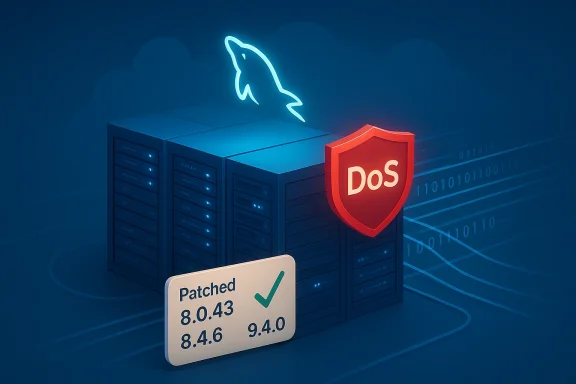
- If an instance is within the vulnerable ranges (8.0.0–8.0.42, 8.4.0–8.4.5, 9.0.0–9.3.0), schedule upgrades to the fixed releases: upstream targets include MySQL 8.0.43+, 8.4.6+, and 9.4.0+ (or the vendor package equivalent your distribution provides). Always consult your distro’s advisory to pick the exact package version for your platform.
- For package‑managed installs, apply vendor security updates via apt/yum/dnf from your distribution’s signed repositories; for binary/tarball installs, replace the binary after validating compatibility in a staging environment.
- For containerized or immutable‑image deployments, rebuild images from patched base images and redeploy using blue/green or canary rollouts — do not assume a host update will fix embedded binaries.
- When patching clustered or replicated topologies, follow a safe sequence: patch replicas first, promote a patched replica to primary, then patch the former primary to minimize downtime. Validate replication and run smoke tests after each stage.
- Restrict network access to MySQL listeners to administrative subnets and management bastions; block public or untrusted IP ranges.
- Rotate and tightly control administrative credentials; disable or remove unused admin accounts and remove unnecessary stored‑procedure execution privileges.
- Enforce least‑privilege for service accounts and remove SUPER or other high privileges where not explicitly required.
Operational playbook — prioritized checklist
- Identify and inventory — run queries and package checks to list all instances and confirm version strings.
- Isolate exposed instances — firewall or security‑group blocks for any admin ports reachable from untrusted zones.
- Rotate admin credentials and secrets stored in automation (CI/CD, backup jobs).
- Stage and test patched builds in a sandbox under representative load to ensure no regression in replication or query plans.
- Perform rolling patching: replicas → promote → patch former primary. Verify replication health and monitor logs.
- Rebuild container images and redeploy; update orchestration manifests to point to patched image tags.
- Monitor aggressively for crash signatures and unusual stored‑procedure invocations for at least one production‑level observation window after patching.
Cloud and container considerations
- Managed database services: don’t assume the provider has patched all instances. Confirm the provider’s advisory for the service tier you use and request explicit remediation timelines or schedule the minor version upgrade if available. Some cloud DBaaS offerings apply patches on behalf of customers but require an acceptance step or window for restarts.
- Containers and immutable images: these are a common operational pitfall. If the mysqld binary is baked into an image, updating the host kernel or OS packages will not remediate the embedded binary. You must rebuild and redeploy images that use patched MySQL base images. CI/CD pipelines should block deployment of images with vulnerable tags.
- Orchestrators: use readiness and liveness probes and gradual rollouts to avoid cluster‑wide outage if a patched node behaves unexpectedly. Test failover and recovery paths before mass rolling.
Critical analysis — strengths, ambiguities, and residual risk
Strengths in the public response
- Coordinated disclosure: Oracle published the fix in the scheduled July 2025 CPU and downstream distributors acted to repackage and publish vendor‑specific fixes. That coordination reduced fragmentation and made remediation accessible through standard OS channels.
- Clear, consistent core facts: independent trackers (NVD, Rapid7, Aqua, Debian security trackers) agree on the affected ranges, the network attack vector, the high privilege requirement, and availability as the primary impact — this consensus simplifies triage and prioritization.
Ambiguities and caveats
- CVSS numeric variance: some advisories show slight differences in numeric CVSS scoring (for example, 4.9 vs 5.5) due to differing judgments about potential low‑level integrity impact in related CVEs. Operators should prioritize the qualitative descriptors (PR:H, AV:N, A:H) over minor numeric variance when making remediation decisions.
- Public proof‑of‑concept status: at disclosure, public proof‑of‑concept exploitation beyond crash triggers was not broadly published; absence of PoCs reduces immediate wormability but is not a guarantee against targeted exploitation. Treat the presence of a reproducible crash in a widely deployed engine as a call to action, not comfort.
Residual risks after patching
- Supply‑chain and image drift: organizations that rely on immutable images, third‑party appliances, or appliance‑style bundles must track whether the mysqld binary within those images was updated. A patched host will not protect a redeployed, vulnerable container image; this remains a common operational trap.
- Privilege creep and credential exposure: because exploitation requires high privileges, environments with widespread privilege granting or unmanaged credential storage remain high risk even after code patches are available — follow‑through on least‑privilege and secrets management is critical.
Detection signatures and quick queries defenders can run
- Confirm version: SELECT VERSION(); and verify package metadata (rpm -q / dpkg -l) against your distribution advisory.
- Alerting rule examples:
- Alert if mysqld restarts > 3 times in 5 minutes.
- Alert on creation/invocation of stored procedures from non‑expected admin accounts.
- Alert on new grants to SUPER or similar high privileges outside scheduled maintenance windows.
Conclusion
CVE‑2025‑50091 represents a pragmatic but serious operational risk: a network‑accessible denial‑of‑service path in the MySQL Server optimizer that requires high‑privilege credentials and can produce sustained or repeatable crashes and hangs of mysqld. The remedy is straightforward in principle — apply vendor or distribution patches and rebuild any images that embed vulnerable binaries — but the operational work to find every instance (including containers, appliances, and cloud managed services) and to validate patch rollouts demands disciplined inventory, testing, and coordination.Prioritize the following actions now: inventory all MySQL instances, verify versions, apply vendor or distro security updates (8.0.43+/8.4.6+/9.4.0+ or distro‑equivalent), rebuild container images, restrict administrative network access, and tighten stored‑procedure and admin privileges. Where immediate patching is delayed, implement strict network allow‑lists, rotate and harden admin credentials, and increase monitoring for restart loops and suspicious stored‑procedure activity. These steps will materially reduce the real‑world exposure to availability‑impacting exploitation while you complete remediation.
Administrators should treat this as an urgent operational remediation task: the vulnerability’s requirement for high privileges does not eliminate risk — it concentrates it. Environments with exposed or misconfigured administrative access, weak secrets practices, or rapidly redeployed container images are the most at risk and should move first.
Source: MSRC Security Update Guide - Microsoft Security Response Center
