

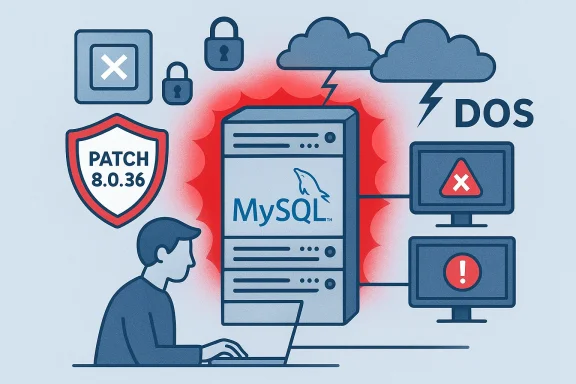
Oracle’s MySQL Server was assigned CVE‑2024‑20963 — a denial‑of‑service weakness in the Server: Security: Encryption component that affects MySQL Server releases up to and including 8.0.35 and the corresponding 8.2.0 line — and operators should treat it as an availability emergency until affected instances are patched. The vulnerability is rated CVSS 3.1 Base Score 6.5 with vector CVSS:3.1/AV:N/AC:L/PR:L/UI:N/S:U/C:N/I:N/A:H, and allows a low‑privileged, network‑connected actor to cause the server process to hang or crash repeatedly, producing a sustained or frequently repeatable outage for impacted services. (oracle.com)
MySQL remains one of the most widely deployed relational database engines powering web applications, SaaS platforms, internal business systems, and cloud services. Its ubiquity makes even medium‑severity stability and availability bugs potentially high‑impact when they can be triggered remotely. Oracle published the fixes for a broad set of MySQL issues in its January 2024 Critical Patch Update; the vendor lists CVE‑2024‑20963 among the vulnerabilities addressed in that CPU. (oracle.com)
Public vulnerability databases — including the NVD and distribution advisories — reproduce Oracle’s summary: the flaw is confined to the availability dimension (no confidentiality or integrity loss is indicated in the canonical descriptions), but that does not make it benign for production services. In real environments, availability failures in database servers cascade: web front ends queue requests, application workers block, and customer‑facing functions can be taken offline until the database is recovered or patched.
Community and vendor feeds tracked the issue as part of the January 2024 disclosures and the downstream distribution patches that followed; forum and operations teams subsequently discussed mitigation and prioritization approaches for MySQL DoS bugs in the months after the CPU. That pattern — rapid vendor statements followed by distro‑specific packages and community triage — recurred across MySQL CVEs in 2024 and 2025.
Action steps: immediate network isolation → apply vendor patch → validate and re‑open service only after verification.
Action steps: inventory accounts and host ACLs → patch during scheduled maintenance → monitor for anomalous usage.
Source: MSRC Security Update Guide - Microsoft Security Response Center
 Background / Overview
MySQL remains one of the most widely deployed relational database engines powering web applications, SaaS platforms, internal business systems, and cloud services. Its ubiquity makes even medium‑severity stability and availability bugs potentially high‑impact when they can be triggered remotely. Oracle published the fixes for a broad set of MySQL issues in its January 2024 Critical Patch Update; the vendor lists CVE‑2024‑20963 among the vulnerabilities addressed in that CPU. (oracle.com)Public vulnerability databases — including the NVD and distribution advisories — reproduce Oracle’s summary: the flaw is confined to the availability dimension (no confidentiality or integrity loss is indicated in the canonical descriptions), but that does not make it benign for production services. In real environments, availability failures in database servers cascade: web front ends queue requests, application workers block, and customer‑facing functions can be taken offline until the database is recovered or patched.
Community and vendor feeds tracked the issue as part of the January 2024 disclosures and the downstream distribution patches that followed; forum and operations teams subsequently discussed mitigation and prioritization approaches for MySQL DoS bugs in the months after the CPU. That pattern — rapid vendor statements followed by distro‑specific packages and community triage — recurred across MySQL CVEs in 2024 and 2025.
What the advisory and databases actually say
- Affected products: Oracle MySQL Server — Server: Security: Encryption component. Affected upstream versions: 8.0.35 and prior and 8.2.0 and prior. (oracle.com)
- Impact: Denial of Service (Availability) — successful exploitation can cause mysqld to hang or crash repeatedly, producing a complete loss of availability. No confidentiality or integrity impact is reported in the core advisories.
- Exploitability: Network attack vector (AV:N), Low attack complexity (AC:L), requires low privileges (PR:L) (i.e., a valid, low‑privilege database account or another position that provides a network connection), and no user interaction (UI:N). The CVSS breakdown positions the bug as an easily accessible availability attack rather than an escalation or data‑exfiltration vector.
- Vendor response: Oracle released patches in the January 2024 CPU and lists patch availability documents for MySQL server and related components. Downstream distributions (Ubuntu, Red Hat, Debian, Microsoft/Azure Linux) incorporated those fixes in their packages. Operators should upgrade to the vendor‑supplied patched builds as soon as practical. (oracle.com)
Technical analysis: how this DoS is positioned and why it matters
What “Server: Security: Encryption” implies
The vulnerability is categorized under the server’s encryption/security subsystem. While the advisories do not publish public PoC exploit code or detailed memory‑corruption mechanics, the classification suggests the bug lies in code paths that process cryptographic operations, handshake state, or encrypted packet handling — code paths that are reachable over normal MySQL protocol channels. Because encryption code runs in the hot path for connection handling, a logic flaw there can be triggered repeatedly and reliably, which lines up with the reported hang or crash behavior. (oracle.com)Exploitation model (derived from the CVSS vector)
- AV:N (Network): the attacker can trigger the bug remotely over the network, using the MySQL protocol (and possibly other protocols the server listens on).
- PR:L (Low privileges required): the attacker needs a valid MySQL account that holds only low privileges (for example, a read‑only user or an application user account). This is important because many application layers expose database endpoints to application tiers or internal services that hold low‑privilege credentials — and those credentials may be easier to obtain or guess than administrative accounts.
- AC:L/UI:N indicates the exploit does not require complex chaining nor user interaction once the attacker can connect.
Why this type of DoS is operationally severe despite “medium” CVSS
CVSS measures technical properties — attack vector, privileges, scope, and impact on CIA — but it does not fully capture operational context. For example:- A small MySQL fleet behind a load balancer with aggressive health checks will quickly failover to remaining nodes, but a clustered system where the primary is attacked can produce failover storms, stuck transactions, and longer recovery windows.
- A DoS against a database often causes application timeouts, user session loss and may trigger cascading alerts, automated restarts, or human‑resource escalations that impact business continuity even if no data is modified.
- Systems with limited maintenance windows (regulated, financial, healthcare) cannot easily apply emergency patches, so an unpatched availability bug presents both technical and compliance risk.
Verified facts and cross‑checks
We cross‑checked the vendor advisory against independent tracking databases and downstream package advisories:- Oracle’s January 2024 Critical Patch Update lists the MySQL fixes and the affected MySQL Server versions. The CPU is the authoritative vendor statement about impacted versions and patch availability. (oracle.com)
- The NVD entry reproduces the Oracle description and the CVSS vector assigned to the vulnerability. NVD’s page confirms the publication date (January 16, 2024) and restates the attack and impact characteristics.
- Linux distributions and security firms (Red Hat, Ubuntu, Snyk) recorded the issue and mapped vendor fixes to distribution package versions: many distributors recommend upgrading to MySQL 8.0.36 (or the distribution‑specific package release that includes the fix). This cross‑validation shows both that Oracle issued a fix and that downstream packaging completed in vendor‑timed advisory windows.
Immediate mitigation and remediation guidance
If you run MySQL instances, treat CVE‑2024‑20963 as a patch‑priority issue for availability‑critical systems. Follow this pragmatic checklist.Emergency triage (first 24–72 hours)
- Inventory: Determine every host, container image, VM, and managed instance running MySQL Server, and capture the output of SELECT VERSION(); or mysqld --version to identify affected builds. Prioritize internet‑exposed and application‑facing instances.
- Patch where possible: Apply vendor patches or upgrade to MySQL Server 8.0.36 or later, or a corresponding distribution package that includes the CSP fix. Oracle issued the January 2024 CPU containing the MySQL patches and numerous downstream vendors pushed fixes in the weeks after. If a patch is available from your distribution (Ubuntu, Red Hat, Debian, Azure Linux, etc.), schedule immediate rollout. (oracle.com)
- Restrict access: As a stopgap, isolate MySQL ports (default TCP/3306) from untrusted networks and services. Use firewall rules, network ACLs, or security groups to reduce the attack surface to only application tiers and trusted management hosts.
- Harden credentials: Audit low‑privilege accounts. If application users with network access are unnecessarily permissive, tighten grants. While CVE‑2024‑20963 targets availability rather than data access, reducing the number of accounts that can reach the server lowers practical exposure.
- Monitor and detect: Add or tune alerts for repeated mysqld crashes, core dumps, frequent restarts, and elevated error rates. Look for patterns of repeatable connection attempts from the same source that coincide with server restarts.
Patch rollout best practices
- Test patch in staging: Apply the vendor patch to a staging environment that mirrors production and run your critical application workflows to detect regressions.
- Coordinate with HA/replication: For clustered or replicated topologies, patch secondaries first, promote if required, then patch primaries during a planned maintenance window to avoid split‑brain or replication lag surprises.
- Verify version after restart: On patched servers, confirm the running version via SELECT VERSION(); and check mysqld logs for successful start and absence of new crash signatures.
- Communicate: Inform application owners, SRE teams, and downstream customers about scheduled maintenance and expected failover behavior.
Temporary workarounds if you cannot patch immediately
- Network fencing: Move affected MySQL instances behind internal only networks or ephemeral tunnels accessible only to application hosts.
- Rate‑limit and connection filtering: Where supported by fronting proxies or host‑based firewalls, limit the rate of inbound MySQL connections to prevent rapid, repeated trigger attempts.
- Service orchestration: Configure automated restarts with backoff to ensure crashing services don't produce continuous restart cycles that destabilize host processes; however, restarts are a stopgap and do not remove the underlying exploitability.
- Engage vendors: If you run managed MySQL services (RDS, Azure Database for MySQL, Cloud SQL), check the provider’s advisory and schedule any recommended maintenance windows; managed services frequently roll vendor patches centrally. (Always confirm the provider timeline.)
Detection: what to look for in logs and telemetry
- mysqld crash logs and core dumps (systemd/journalctl entries, /var/log/mysql/error.log).
- Repeated process crash/restart cycles or OOM‑killer activity correlated with MySQL service restarts.
- Spike in failed connection attempts or repeated session resets originating from a small set of IP addresses or accounts.
- Replication lag or failed replication events caused by repeated primary outages.
- Application‑level errors: cascading timeouts, queue growth, or HTTP 5xx errors that correlate temporally with DB restarts.
Operational risk scenarios and prioritized responses
Scenario A — Internet‑facing MySQL (highest priority)
If any MySQL instance accepts inbound connections from public networks (for example, misconfigured management endpoints or exposed developer instances), this is an operational emergency. Immediately isolate the endpoint, apply firewall rules, and prioritize patching.Action steps: immediate network isolation → apply vendor patch → validate and re‑open service only after verification.
Scenario B — Internal application tier with many low‑privilege accounts
These are realistic attack surfaces if attackers can pivot within the network or compromise an application node. Prioritize patching but also audit the application’s DB credentials and restrict which hosts can use them.Action steps: inventory accounts and host ACLs → patch during scheduled maintenance → monitor for anomalous usage.
Scenario C — Managed DBaaS / cloud instances
Check provider advisories. Many managed services have already applied vendor patches in their own maintenance windows; however, customer‑controlled parameters (like public accessibility or VPC peering) still matter. Confirm provider status and schedule any required customer actions.Critical perspective: strengths and weaknesses in the public response
- Strengths: Oracle published a consolidated Critical Patch Update and listed affected versions clearly. Major downstream vendors and distributions incorporated the fixes in their advisory timelines, and public trackers (NVD, Snyk, Red Hat) reproduced the vendor’s details so operators could map fixes to distro package versions. That coordinated cascade is visible in vendor and distro advisories. (oracle.com)
- Weaknesses and practical risks:
- The public advisories intentionally omit exploitation mechanics and PoC details — a standard practice to avoid accelerating weaponization — but that leaves operations teams to triage urgency using CVSS and impact descriptions alone, which can under‑represent real business risk for availability‑critical services.
- CVSS’s focus on CIA metrics can make availability‑only vulnerabilities appear less critical than they are in context; for example, a CVSS 6.5 medium rating may not spur the same emergency process as a “high” confidentiality flaw, yet repeated database outages can be far more damaging to business operations.
- Some organizations lack rapid patch pipelines for database services because of compatibility concerns, scheduled maintenance windows, or operational constraints. That gap leaves a window of exposure after disclosure even when vendor fixes exist.
Longer‑term recommendations for MySQL operators
- Adopt a vendor‑aligned patch cadence: treat database engine patches as higher priority than typical application dependencies; the blast radius for DB stability bugs is large.
- Harden access to DB endpoints: network segmentation, mutual TLS (where supported), and strict security group rules reduce exploitable surface area.
- Privilege hygiene: ensure application users have minimal required privileges and use separate accounts for management or analytics tasks.
- Resilience testing: rehearse failover and recovery for database outages, and include DoS-style outages in chaos engineering scenarios so the application stack can handle sudden primary losses gracefully.
- Observability: collect metrics for connection churn, process restarts, replication deadlines, and application error surfaces to detect availability attacks earlier.
- Vendor and distribution watch: subscribe to vendor CPUs and distribution advisories (Oracle CPU, Ubuntu/Red Hat security notices) so you get actionable mapping between upstream CVEs and your package versions. (oracle.com)
Summary and final verdict
CVE‑2024‑20963 is a remote, low‑privilege, availability‑impacting vulnerability in MySQL Server’s encryption/security component that Oracle fixed in the January 2024 Critical Patch Update. Although the advisory reports no confidentiality or integrity loss, the ability for a low‑privileged remote actor to hang or crash mysqld repeatedly means this vulnerability can produce real operational damage for unpatched systems. Operators should:- Inventory affected hosts and containers now.
- Patch to vendor packages that incorporate the January 2024 fixes (commonly mapped to MySQL 8.0.36 or the equivalent distro package).
- Apply immediate network and access mitigations where patching is delayed.
- Monitor for crash patterns and anomalous account activity, and prepare coordinated failover tests to ensure application resilience during patch windows.
Source: MSRC Security Update Guide - Microsoft Security Response Center
