

A small, defensive code fix in the AMDGPU DRM driver closed a kernel NULL‑dereference that could be trivially triggered in some environments, producing a denial‑of‑service; the vulnerability is tracked as CVE‑2024‑26672 and instructs operators to update kernels or apply vendor patches immediately to remove a reliable crash primitive.
The issue resides in the AMDGPU driver’s MCA (Machine Check Architecture) SMU handling: a pointer named mca_funcs was read before the code validated it, which means an attacker (or even benign user code) that can exercise the relevant DRM paths may be able to force a kernel oops or driver crash. This is a classic kernel NULL pointer dereference (CWE‑476) that manifests as an availability impact — the kernel or graphics subsystem can crash, sessions can drop, and hosts may require a reboot to recover. The vulnerability description and the minimal patch that fixes it were published in mainstream vulnerability trackers and distribution security advisories. In short:
Source: MSRC Security Update Guide - Microsoft Security Response Center
 Background / Overview
The issue resides in the AMDGPU driver’s MCA (Machine Check Architecture) SMU handling: a pointer named mca_funcs was read before the code validated it, which means an attacker (or even benign user code) that can exercise the relevant DRM paths may be able to force a kernel oops or driver crash. This is a classic kernel NULL pointer dereference (CWE‑476) that manifests as an availability impact — the kernel or graphics subsystem can crash, sessions can drop, and hosts may require a reboot to recover. The vulnerability description and the minimal patch that fixes it were published in mainstream vulnerability trackers and distribution security advisories. In short:- Vulnerable component: Linux kernel — drm/amdgpu (AMDGPU DRM driver).
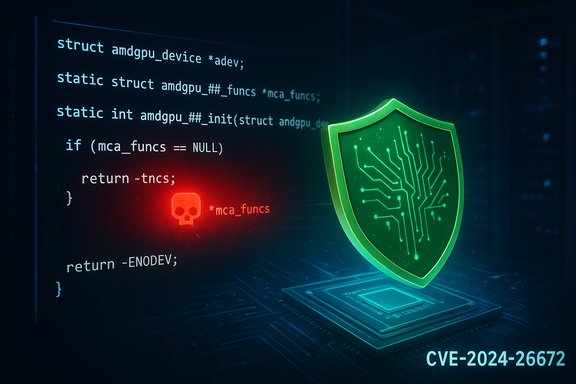
- Fault: variable mca_funcs dereferenced before a NULL check inside function amdgpu_mca_smu_get_mca_entry.
- Impact: Denial‑of‑Service (kernel oops / driver crash) — availability only; no evidence of confidentiality or integrity compromise from the bug itself.
- Attack vector: Local (a process with access to the relevant DRM device or driver interfaces).
- Fix: Add or reorder checks to ensure mca_funcs is validated before use, or use safe guard objects; merged into upstream kernel stable branches and propagated to distributions.
Technical anatomy — what the code did wrong
Where the dereference occurred
The function at issue reads a driver‑scoped function table pointer:- It assigns
mca_funcs = adev->mca.mca_funcs; - Later, it uses
mca_funcs->max_ue_countormca_funcs->max_ce_countinside a switch on error type — before checking whethermca_funcsis non‑NULL. - The code only checks
if (mca_funcs && mca_funcs->mca_get_mca_entry)after those dereferences, which is too late and results in a potential NULL dereference.
Why this matters in kernel drivers
User‑mode NULL dereferences typically abort the process; kernel‑mode NULL dereferences can crash or panic the whole OS or at least the affected driver, causing high operational impact. Graphics drivers are in privileged context and are often exercised by user processes (compositors, browser GPU code, test harnesses), so any local crash primitive in DRM code is an attractive DoS target in multi‑tenant or untrusted environments. Multiple vendor and distro trackers reflect these operational consequences when advising remediation.Scope and exposure — who should worry
Affected systems
- Any Linux kernel build that includes the affected AMDGPU code path prior to the upstream fix may be vulnerable.
- Desktop and workstation systems using AMD GPUs where DRM device nodes (/dev/dri/*) are accessible to user processes are principal candidates.
- Multi‑tenant servers, CI runners, or container hosts that expose GPU devices to untrusted workloads (via device passthrough or bind mounts) are high‑risk because an unprivileged process may be able to reach the offending code path.
- Embedded devices and vendor kernels (OEM Android kernels, SoC vendor trees) are a major practical concern because vendor trees sometimes lag upstream and may not receive backports promptly.
Attack prerequisites and complexity
- Attack vector: local. The attacker must execute code or trigger the driver function locally (for example, via an ioctl, a compositor interaction, or a GPU‑using process).
- Privileges: often low — many systems allow unprivileged access to DRM device nodes or enable compositor helpers that reach DRM ioctls.
- Complexity: low. The crash is deterministic once the code path is entered with the NULL pointer condition present.
- Practical exploitability: While no wide‑scale exploitation campaign was documented at disclosure, crash primitives are commonly weaponized in targeted or opportunistic DoS attacks; therefore, treat this as a high‑priority patch for exposed systems.
Detection and forensic signs
When the bug is triggered in the wild, it tends to leave clear kernel logs and traces:- Kernel oops/panic messages recorded by dmesg or journalctl that mention AMDGPU functions or name amdgpu_mca* frames.
- Stack traces that show dereferences of address 0x0 and call frames from the amdgpu MCA/SMU paths.
- Repeated compositor crashes (Wayland/Xwayland), sudden session terminations, or host reboots correlated with graphics workloads.
- On multi‑tenant hosts, repeated crashes linked to unprivileged container workloads that have /dev/dri mounted.
Remediation — concrete steps for administrators and engineers
- Inventory first
- Identify hosts with AMDGPU loaded: run lsmod | grep amdgpu or check kernel boot logs for amdgpu messages.
- List DRM device nodes and their permissions: ls -l /dev/dri/*.
- Identify containers, VMs, CI runners, or services that mount or expose /dev/dri or otherwise allow untrusted access to GPU devices.
- Patch
- Install vendor or distribution kernel updates that include the upstream fix. Most major distributions and the kernel stable trees merged the patch; check your distro security tracker or package changelog for the CVE or the upstream commit ID.
- Reboot into the updated kernel to activate the fix.
- For custom kernels
- Cherry‑pick the upstream stable commit that corrects the amdgpu code (the patch is intentionally minimal) into your tree, rebuild, test, and deploy.
- Validate fixes on representative hardware and run the GPU workloads that previously triggered oopses.
- Immediate mitigations if patching must be delayed
- Restrict access to DRM device nodes: enforce strict udev rules to bind device nodes to a trusted group and remove world access.
- Remove /dev/dri from untrusted containers and CI runners; avoid --device=/dev/dri unless necessary.
- Harden container capabilities (drop CAP_SYS_ADMIN and similar) to minimize the ability for untrusted containers to call driver ioctls.
- Improve logging/monitoring for kernel oops and crash telemetry.
- Vendor engagement for embedded devices
- For appliances and vendor kernels that cannot be rebuilt by you, open support tickets requesting backports or firmware/kernel updates that include the upstream fix. Vendor lag is the most persistent exposure vector.
Verification and cross‑checks
Multiple independent sources document the same root cause and the upstream fix:- The National Vulnerability Database entry summarizes the code location and the ordering bug in amdgpu_mca_smu_get_mca_entry.
- Distribution advisories (Ubuntu, Debian) and vendor trackers record the CVE and list affected/fixed package versions — useful for mapping your installed kernel package to patched versions.
- Commercial and open vulnerability feeds (Rapid7, Amazon ALAS mirror) provide additional CVSS and packaging guidance; note that CVSS scoring can vary slightly between trackers because of differing severity models.
- Community operational notes emphasize that the patch is small and conservative (reorder checks or add early returns) and that the greatest practical exposure is vendor kernels and device fleets that lag upstream.
- The technical diagnosis (NULL deref due to late check) is consistent.
- The remediation approach (early NULL check / small reorder) is the same across patches.
- The exposure model (local DoS, high availability impact, vendor lag as primary residual risk) is agreed upon.
CVSS and severity notes — why scores differ
Different trackers sometimes publish different base scores:- NVD and several trackers show a higher score driven by the Local vector with Low complexity and High availability impact.
- Some platform‑specific feeds (for example Amazon Linux advisories) map the operational context differently and present alternative scores.
Practical risk analysis and critical commentary
Strengths of the upstream response
- The fix is surgical and low risk: the change is narrowly focused on the check ordering and does not alter normal driver semantics for correct hardware.
- Small patches are easier to backport to stable kernels, which increases the likelihood of fast distribution packaging and vendor adoption.
- Multiple independent trackers and vendor advisories converged on the same diagnosis, increasing confidence that the fix addresses the root cause.
Residual and systemic risks
- Vendor and embedded‑device lag: the long tail of vendor kernels, Android OEM trees, and firmware images remains the biggest operational blind spot. Devices that do not receive backports continue to present practical exposure.
- Misconfiguration: systems that intentionally expose DRM devices to untrusted workloads (CI runners, shared workstations, containers with /dev/dri) are significantly more exploitable; hardening such configurations reduces risk even when patches are delayed.
- Detection blind spots: not all organizations capture full kernel ring logs or serial console output; missing oops traces makes incident detection and triage harder.
- Attack chaining: although this CVE is a DoS primitive, denial‑of‑service can be weaponized strategically (to disrupt monitoring, force failovers, or mask lateral movement), so treat availability defects with appropriate urgency in critical environments.
Recommended operational playbook (quick checklist)
- Inventory
- Identify kernels that load amdgpu: lsmod | grep amdgpu.
- Map installed kernel packages to distro advisories for CVE‑2024‑26672.
- Patch and reboot
- Install vendor/distribution kernel updates that include the upstream patch.
- Reboot hosts following standard maintenance windows; validate with representative GPU workloads.
- Compensate if immediate patching impossible
- Restrict DRM device node access via udev rules and group policies.
- Remove /dev/dri from untrusted containers; avoid passthrough in shared runners.
- Increase monitoring of kernel oops and maintain immediate log collection for forensic capture.
- Vendor escalation
- If responsible for embedded fleets, open vendor support tickets requesting backports or updated images.
- Test
- After applying patches, run the workload or test harness that previously reproduced the oops for at least 48–72 hours to be confident the issue is resolved.
Conclusion
CVE‑2024‑26672 is a textbook kernel robustness deficiency — a pointer validation that occurs too late, producing a NULL‑dereference in the AMDGPU MCA SMU path. The fix is minimal and low risk, and distributions and upstream kernels have incorporated the change. Nonetheless, the practical danger lies in unpatched devices and misconfigured systems that expose DRM interfaces to untrusted actors. Operators should prioritize patching exposed hosts, restrict access to /dev/dri where feasible, and engage vendors for embedded devices that cannot be rebuilt in‑house. The technical and operational lessons are familiar: defensive programming in kernel drivers prevents high‑impact availability failures, and a modest patch applied quickly shields large fleets from trivial DoS primitives.Source: MSRC Security Update Guide - Microsoft Security Response Center
