

A subtle but serious race-condition bug in the Linux kernel’s ATA over Ethernet (AoE) driver—tracked as CVE-2024-26898—has been fixed after researchers found a premature release of a network device reference that can produce a use-after-free condition. The flaw lives inside the aoecmd_cfg_pkts() path and, under race conditions, can allow the kernel to dereference freed memory in the AoE transmit path. The vulnerability can result in sustained or persistent loss of availability (kernel crashes or hangs) and, in the worst case, could be leveraged for arbitrary code execution in kernel context on affected systems that use the AoE stack. System administrators should treat this as urgent for hosts that run AoE or act as network-attached block-storage servers.
ATA over Ethernet (AoE) is a lightweight protocol for transporting block storage commands over Ethernet. It is commonly used in specialized storage networks and in some appliance and embedded environments where simple, low-overhead block access is required. AoE support is implemented as a kernel driver and network layer that interacts tightly with Linux kernel networking primitives—specifically with net_device structures and the kernel socket-buffer (skb) lifecycle.
CVE-2024-26898 is a follow-on fix addressing reference-counting mistakes in the AoE driver. The problematic code path calls dev_put(ifp) prematurely when preparing skb objects for transmission; later, a kernel thread may still access that same net_device via a global transmit queue. If the reference count on the net_device drops to zero and the structure is freed while the queued skb still references it, subsequent access produces a use-after-free. The upstream patch removes the premature dev_put() from the success path in aoecmd_cfg_pkts() and ensures the matching dev_put() is performed only after the skb is transmitted, preserving correct refcount semantics.
This class of bug—use-after-free (CWE-416)—is one of the most dangerous in kernel space because it can cause immediate instability (kernel oops/panic) and, when exploited cleverly, may enable arbitrary code execution with kernel privileges.
The risk here is not widespread on the Internet at large, but for affected storage infrastructures the consequences can be severe: repeated exploitation can sustain an availability loss or, in rare cases, a motivated attacker could chain the condition into deeper kernel compromise. Fix promptly, test carefully, and ensure your AoE hosts are patched or isolated.
Source: MSRC Security Update Guide - Microsoft Security Response Center
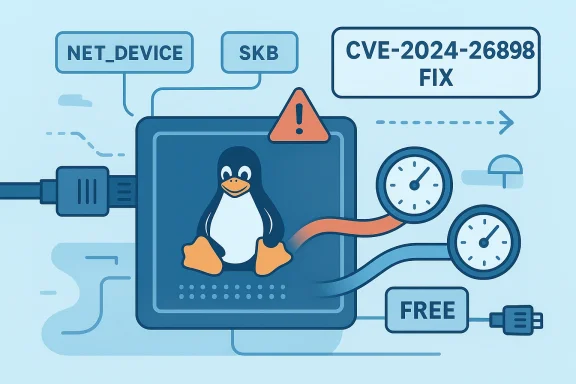 Background / Overview
ATA over Ethernet (AoE) is a lightweight protocol for transporting block storage commands over Ethernet. It is commonly used in specialized storage networks and in some appliance and embedded environments where simple, low-overhead block access is required. AoE support is implemented as a kernel driver and network layer that interacts tightly with Linux kernel networking primitives—specifically with net_device structures and the kernel socket-buffer (skb) lifecycle.CVE-2024-26898 is a follow-on fix addressing reference-counting mistakes in the AoE driver. The problematic code path calls dev_put(ifp) prematurely when preparing skb objects for transmission; later, a kernel thread may still access that same net_device via a global transmit queue. If the reference count on the net_device drops to zero and the structure is freed while the queued skb still references it, subsequent access produces a use-after-free. The upstream patch removes the premature dev_put() from the success path in aoecmd_cfg_pkts() and ensures the matching dev_put() is performed only after the skb is transmitted, preserving correct refcount semantics.
This class of bug—use-after-free (CWE-416)—is one of the most dangerous in kernel space because it can cause immediate instability (kernel oops/panic) and, when exploited cleverly, may enable arbitrary code execution with kernel privileges.
What the flaw is, in practical terms
The technical root cause
- The AoE driver constructs packets and queues them for transmit using kernel SKBs (socket buffers).
- When a packet is prepared, code in aoecmd_cfg_pkts() adjusts the reference count (refcnt) on the associated struct net_device via dev_put() after the initial skb setup completes.
- The transmit path that actually dequeues and sends SKBs runs in a different context (a kernel thread) and expects the net_device pointer to remain valid while the SKBs it references are still in flight.
- If dev_put() is called too early, the refcnt can reach zero and free the net_device while SKBs referencing it remain queued; the later tx() processing then dereferences freed memory—producing a use-after-free.
The practical consequences
- A local attacker or process that can interact with AoE endpoints could race the driver into freeing net_device structures, causing kernel crashes or hangs. That results in a complete denial of availability for the affected host or storage endpoint while the problem persists or the host is rebooting.
- Properly exploited, a use-after-free inside the kernel may also open paths to arbitrary code execution in kernel context; that requires additional exploitation steps and is more complex, but the risk is non-trivial for this class of vulnerability.
- The attack surface is narrow compared to network-facing kernel bugs because exploitation requires local or adjacent network access to AoE functionality (the CVSS vectors assigned by vendors reflect this), but systems that expose AoE to clients (e.g., storage nodes, appliances) are high-value targets.
Severity, scoring, and scope
- Public vulnerability databases and vendor advisories assign this issue as a high-impact kernel bug. Official CVSS assessments differ depending on the responder: some registries list a high score (around CVSS v3.1 ~ 7.8) while some vendor advisories assess a lower base score for their platforms (reflecting host-specific exposure and mitigation). The most important operational takeaway is that the vulnerability can cause loss of availability (denial of service) and potential code execution.
- Exploitation requires access to the AoE functionality; the attack vector is not a remote, unauthenticated Internet attack on a generic service—this is a kernel-level bug that primarily threatens systems that host or actively use AoE storage networks.
- Because AoE is not enabled on most general-purpose Linux servers by default, the real-world exposure is limited—but for hosts that do use AoE (storage appliances, embedded devices, some hyper-converged systems), the impact is severe.
Timeline and patch summary
- The fix removes the early dev_put(ifp) from aoecmd_cfg_pkts() and ensures dev_put() is invoked after skb transmission in the tx() path. This change prevents the reference count from being decremented while SKBs still reference the net_device.
- The patch is a targeted lifecycle management correction: the objective is to ensure that each dev_put() corresponds to a safe point at which no remaining code paths will dereference the device.
- The change was applied in the upstream kernel and has been rolled into vendor kernel builds and distro advisories. Multiple distributions and vendors published advisories and updated kernels. Administrators should consult their distribution’s security advisories to identify the exact package and kernel version that contains the patch for their platform.
Who should care most
- System administrators and storage engineers running Linux-based AoE storage servers or appliances.
- Operators of embedded devices or appliances that enable AoE for block storage access over Ethernet.
- Security teams tasked with kernel vulnerability management and patching in environments that use networked block storage.
Detection — how to check whether you are exposed
Perform these checks quickly and safely in your environment:- Confirm if the AoE kernel module is loaded:
- Run: lsmod | grep -i aoe
- If
aoeappears in lsmod output, the driver is loaded and the host could be affected. - Check for AoE utilities or configuration:
- Presence of aoetools or aoe-specific configuration often indicates AoE use; search package lists (e.g., rpm -qa | grep -i aoe, dpkg -l | grep -i aoe).
- Inspect network interfaces and storage targets:
- Look for network devices dedicated to storage traffic or for storage mappings that show AoE volumes.
- Kernel logs and crashes:
- Look for kernel oops, panics, or log entries around net_device dereferences, skb queue anomalies, or consistent crashes related to the network stack.
- Audit host roles:
- Determine whether the host functions as an AoE target or client (target hosts are highest risk because they accept inbound AoE requests).
Immediate mitigation steps (short-term, pre-patch)
If you confirm AoE is present and cannot immediately apply a kernel update, use these mitigations to reduce risk:- Unload and disable the AoE kernel module:
- Stop AoE userland services or unmount AoE-backed block devices cleanly.
- Remove the module: sudo modprobe -r aoe (or sudo rmmod aoe)
- Prevent loading at boot: echo "blacklist aoe" | sudo tee /etc/modprobe.d/disable-aoe.conf
- Note: Only unload aoe after ensuring no block devices or filesystems depend on it—unloading while in use will disrupt storage. Always stop services and unmount volumes first.
- Isolate affected hosts:
- Restrict network access to AoE LAN segments (apply access control lists or VLANs) so only trusted management hosts can reach AoE targets during the patch window.
- Limit local access:
- Restrict who can run code on hosts that provide AoE and enforce strict privilege separation (minimize the number of local accounts with rights to interact with AoE).
- Monitoring:
- Increase monitoring for kernel oops/panics and unexpected reboots on AoE hosts; configure alerts for such incidents.
Patching guidance — how to remediate safely
- Inventory and prioritize:
- Identify all hosts that load the AoE module or run AoE-based storage services. Prioritize production storage targets and any hosts in critical storage paths.
- Review vendor advisories:
- Check your Linux distribution’s security advisories for the kernel update that includes the AoE fix. Vendors have published patched kernel builds; consult your vendor for exact package names and versions.
- Test in staging:
- Before wide deployment, test the kernel update in a staging environment that mirrors production storage configurations—AoE hosts may have sensitive timing and I/O characteristics that benefit from validation before rolling updates.
- Schedule maintenance:
- Kernel upgrades typically require a reboot. Plan patch windows that minimize disruption to storage availability; apply the patch to standby nodes first if your storage cluster supports failover.
- Apply and verify:
- Install updated kernel packages and related modules, reboot hosts, and confirm:
- The new kernel version is active (uname -r).
- AoE devices come up cleanly where intended.
- No kernel errors appear in dmesg or syslog connected to net_device lifecycle.
- Post-patch monitoring:
- Monitor telemetry for I/O performance regressions and kernel logs for new warnings. If you disabled AoE via blacklisting as a mitigation, remove the blacklist only after confirming the kernel fix is successfully deployed and tested.
Hardening and longer-term risk reduction
- Evaluate whether AoE is required at all. Where possible, replace AoE deployments with more commonly maintained storage protocols (iSCSI, NVMe-oF, CIFS/NFS depending on use case), and retire AoE if it’s not necessary.
- Maintain a kernel upgrade cadence that includes testing and a mechanism for fast deployment of critical fixes for kernel-space vulnerabilities.
- Where specialized appliances rely on AoE, coordinate with appliance vendors for patched firmware or kernel builds; vendor-managed appliances may not be addressable by standard distro packages.
- Adopt immutable or ephemeral infrastructure patterns for critical storage nodes where possible; this reduces complexity and the risk that a kernel-level flaw remains unpatched for long.
Forensics and incident response considerations
If you suspect exploitation or have observed kernel instability consistent with a use-after-free:- Preserve volatile data:
- Capture kernel logs, dmesg, and crash dumps (kdump) if possible.
- Isolate affected hosts:
- Remove the host from production networks or block AoE traffic to prevent repeated exploitation while investigating.
- Look for exploitation artifacts:
- Though many use-after-free cases cause crashes rather than clean exploitation, a determined attacker may use kernel vulnerabilities as a stepping stone. Inspect for unexpected kernel modules, suspicious userland binaries, or new local accounts.
- Engage vendor support:
- For appliances or managed devices, open a support case with the vendor; they can help analyze kernel crashes tied to AoE.
Strengths of the fix and ongoing risks
- The upstream patch is surgical: it corrects lifecycle management by moving the release (dev_put) to a point after the skb transmission completes. Correct refcounting is the canonical fix for this class of bug, and applying it restores correct memory safety for the net_device lifecycle in AoE paths.
- Distribution vendors have incorporated the fix into kernel builds and published advisories; that means administrators can remediate using vendor-supplied packages without waiting for bespoke vendor kernels.
- Ongoing risk: subsequent reviews of AoE code revealed other places where dev_hold()/dev_put() semantics may be inconsistent. A later fixset expanded checks to additional code paths that use the transmit queue. Administrators should apply the full set of upstream and vendor fixes rather than relying on a single patch.
Risk assessment — who should be most aggressive about patching?
- Storage targets and appliances that expose AoE to clients: highest priority.
- Hosts in storage clusters (metadata or control nodes) that rely on AoE: high priority.
- Development or test hosts where AoE is enabled but not critical: medium priority; patch when convenient.
- Generic servers that do not load the aoe module: low priority; confirm AoE is not present, then maintain normal patch cadence.
Practical checklist for administrators
- Identify AoE hosts:
- lsmod | grep aoe
- rpm/dpkg queries for aoetools or AoE services
- If AoE is not needed:
- Unmount AoE storage, stop services, modprobe -r aoe, blacklist module.
- If AoE is required:
- Obtain vendor/distro kernel advisory for CVE-2024-26898 and schedule patching.
- Test the kernel update in staging.
- After patching:
- Reboot hosts, confirm uname -r, verify AoE functionality, and check dmesg for no regressions.
- Monitor and log:
- Watch for kernel oops/panic alerts, I/O failures, unexpected reboots.
- Document the change and update your configuration management records.
Final analysis and takeaways
CVE-2024-26898 is an important reminder that kernel-level reference counting errors can have outsized impact even when they occur inside relatively niche subsystems like AoE. The vulnerability itself is a classical use-after-free caused by premature dev_put() on a net_device while SKBs referencing that device remain queued for transmit. The upstream fix is straightforward and corrects the object lifecycle—moving the release to a safe point after transmission—however, the broader lesson is that similar refcounting issues can and do recur across related code paths. Administrators must therefore:- Inventory and understand where niche kernel drivers are used in their environment.
- Prioritize patching for hosts that serve as storage endpoints.
- Employ temporary mitigations (unload/blacklist the module, isolate network segments) when patching cannot occur immediately.
- Test kernel updates on storage hosts before broad rollout to avoid accidental service disruption.
The risk here is not widespread on the Internet at large, but for affected storage infrastructures the consequences can be severe: repeated exploitation can sustain an availability loss or, in rare cases, a motivated attacker could chain the condition into deeper kernel compromise. Fix promptly, test carefully, and ensure your AoE hosts are patched or isolated.
Source: MSRC Security Update Guide - Microsoft Security Response Center
