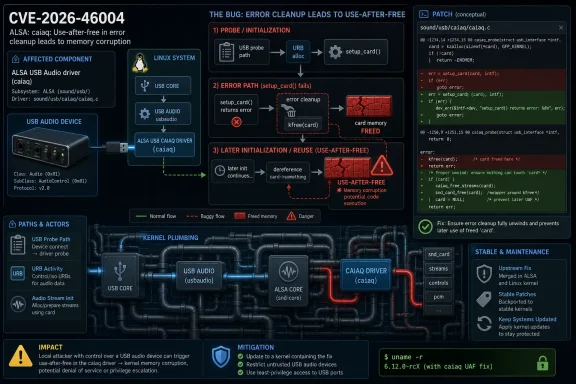
CVE-2026-46004, published by NVD on May 27, 2026, is a Linux kernel vulnerability in the ALSA caiaq USB audio driver where failed device probing could continue after cleanup and create a use-after-free condition in later initialization code. It is not the kind of bug that should send every WindowsForum reader sprinting toward a console at 3 a.m. But it is exactly the kind of kernel flaw that explains why Linux security work now looks less like dramatic exploit response and more like relentless plumbing maintenance. The danger is narrow; the lesson is broad.
The caiaq driver is not a household name, even among many Linux administrators. It supports a family of USB audio and MIDI devices, historically associated with Native Instruments hardware, and lives in the ALSA subsystem where Linux handles sound cards, mixers, MIDI endpoints, and related device plumbing. For most desktop users, that sentence alone is enough to make the vulnerability sound obscure.
Obscure, however, is not the same as irrelevant. Modern operating systems are sprawling federations of drivers, subsystems, compatibility shims, and legacy support paths. A bug in a USB audio driver may not matter to a headless cloud VM, but it can matter to a workstation, a kiosk, a production studio, a lab machine, or an embedded appliance that inherited a general-purpose kernel configuration.
The vulnerability’s core is brutally ordinary. During setup, the driver could encounter an error, free the sound card object, and then keep going as if the object were still valid. Later calls could touch memory that had already been released. In kernel land, that pattern is the classic setup for a use-after-free, a bug class that can range from a crash to a privilege boundary problem depending on reachability, timing, and attacker control.
The NVD record is still awaiting enrichment, which means no official NVD CVSS score or final vector has been assigned yet. That absence should not be confused with a finding of low severity. It means the public vulnerability metadata is lagging the patch reality, something Linux administrators have had to get used to as kernel CVEs have become more numerous, more granular, and more tightly coupled to upstream commits.
That is the kind of bug that hides in code for years because the happy path works. Plug in a supported device, initialization succeeds, the card registers, controls appear, and everyone moves on. The broken behavior lives in the unhappy path: registration fails, MIDI setup fails, audio setup fails, input setup fails, or a control transaction times out. Drivers often die by the paths their authors rarely exercise.
The fix is conceptually simple. Change
That simplicity is what makes the bug interesting. No cryptographic primitive was broken. No speculative execution side channel was uncovered. No elaborate protocol parser was tricked with a malicious network packet. A function did too much, reported too little, and violated ownership expectations around cleanup. In kernel development, those are not boring details. They are the thin membrane between robust failure and memory corruption.
But error handling is where kernel security often becomes real. Initialization code runs with high privilege and deals with partially constructed objects, hardware state, USB descriptors, memory allocations, work queues, URBs, and subsystem registration. If one branch frees a structure while another branch assumes it is alive, the kernel’s type system will not save you. C will do what C does: trust the programmer and let the machine keep moving.
The caiaq fix is therefore not merely about adding returns. It restores a single coherent ownership model. Either setup succeeds and the sound card becomes a registered kernel object, or setup fails and the probe machinery unwinds it. What the old code allowed was a half-failed, half-alive state, which is exactly the state attackers and fuzzers love.
For administrators, this is why “local” or “device-adjacent” kernel vulnerabilities deserve a more nuanced reading than the old internet shorthand suggests. A bug may require a physical USB device, a malicious peripheral, a particular kernel configuration, or a local user who can trigger module loading. Those constraints matter. They reduce exposure. They do not make the bug imaginary.
The Windows parallel is obvious. Windows administrators have spent years learning that driver quality is security quality. A vulnerable print driver, GPU driver, antivirus filter driver, or storage miniport can undermine the rest of the platform. Linux is different in governance and architecture, but not in the basic fact that kernel-mode driver mistakes carry system-level consequences.
A score would be useful, but it would not answer the most important operational questions. Is the affected driver built into your kernels? Is it available as a loadable module? Can unprivileged users cause the module to load? Are relevant USB devices present or allowed? Is USB access physically restricted? Are you running a distribution kernel that has already backported the fix under a different version number?
Those questions are more practical than arguing over whether the eventual score lands in medium or high territory. A use-after-free in kernel space is inherently serious as a class. The reachable attack surface, exploitability, and real-world deployment pattern determine whether it is urgent for a specific environment.
The current enrichment gap also reflects a larger shift in Linux vulnerability tracking. Since the kernel project began assigning many more CVEs to fixes, the number of records has increased and the average record has become more commit-shaped. That is good for traceability, but it means security teams cannot treat every new kernel CVE as a fully digested advisory. Often, the authoritative signal is the patch series and the distribution update, not the public database entry.
That is uncomfortable for organizations built around dashboard compliance. A scanner may flag CVE-2026-46004 before a vendor advisory has cleanly mapped it to every supported kernel build. Conversely, a distribution may ship a fixed kernel before the NVD page has a score. The responsible move is to track vendor kernel updates, not to wait for the CVSS machinery to catch up.
One follow-up addressed a leftover internal USB request block, or URB, in the error path. The original cleanup correction made setup failures fatal, but an internal
Another follow-up corrected behavior for models with no dedicated input device. After
That sequence is a useful corrective to the fantasy that secure software development is a straight line from bug to patch to victory. The first patch fixed a real memory-safety issue. The follow-ups made the fix operationally safe across hardware variants. Stable kernel work is often this iterative: close the dangerous hole, then sand down the compatibility splinters.
For sysadmins, this is also an argument against cherry-picking a single commit unless you have no alternative. The CVE references several stable commits, and the surrounding follow-ups matter. Distribution kernels usually absorb such patch stacks with testing and backport adjustments. Rolling your own “just enough” security patch can mean importing the first half of the solution and missing the second.
CVE-2026-46004 is unlikely to be a WSL headline. WSL 2 uses a Microsoft-provided Linux kernel, but it does not expose arbitrary host USB audio hardware to Linux in the same way a bare-metal Linux workstation does. That distinction matters. The presence of a Linux kernel alone does not mean every driver path is reachable.
The more relevant Windows-adjacent risk is the device and appliance ecosystem around Windows environments. Audio production machines dual-boot. Conference rooms use Linux-based AV hardware. Security labs attach strange USB devices to analysis boxes. Developers plug peripherals into Linux laptops that also hold corporate credentials. The vulnerable code path is narrow, but narrow paths still exist somewhere in a large fleet.
This is where inventory discipline beats panic. If you do not know which Linux kernels you run, which modules they build, and which hardware classes they expose, a small CVE becomes another fog machine. If you do know, this vulnerability becomes a straightforward patch-management item: update kernels through the distribution channel, reboot where required, and verify that affected modules are no longer at vulnerable revisions.
The useful mental model is not “audio bug equals low priority.” It is “kernel driver bug equals scope-dependent priority.” A data center full of minimal server kernels without USB audio support can rank this differently from a media workstation fleet or a lab with broad USB access. The same CVE can be a footnote in one environment and a weekend maintenance ticket in another.
The caiaq bug does not automatically imply that any USB audio device can exploit a Linux machine. Exploitability depends on details not established by the CVE record alone, including how the failure can be triggered and how much control an attacker has over freed memory reuse. But the class is familiar: a device-probe path parses and initializes state based on attached hardware, and bad error handling can turn a failed probe into a kernel memory-safety problem.
That is why hardened environments restrict USB even when the scary CVE of the week is not about USB. Device control policies, port blockers, allowlists, and endpoint protection rules are not merely about stopping thumb-drive malware. They also reduce the amount of kernel driver code that untrusted peripherals can exercise.
Linux has improved in many ways here, but the attack surface remains broad because hardware support is broad. A general-purpose distribution wants your audio interface, MIDI controller, webcam, capture card, printer, and game controller to work. Each success story is also code that can be reached when a device appears on the bus.
For everyday users, the practical advice is not to throw away USB audio gear. It is to avoid treating physical peripherals as harmless. Do not plug unknown devices into important systems. Do not use production machines as hardware testing sandboxes. Do not assume that a crash during device detection is merely annoying. In kernel space, a failed probe is still privileged code execution doing complicated work.
This is not necessarily a failure. The old model undercounted kernel security issues and forced downstream vendors to infer which bug fixes had security implications. The new model risks overwhelming teams with identifiers whose severity is not immediately obvious. Both models impose work; the new one at least gives defenders more hooks for tracking.
The tension is especially visible in subsystems like ALSA. Audio drivers are not the glamorous center of Linux security research, but they are real kernel code exposed to real hardware. When fixes in those drivers receive CVEs, some readers see inflation. Others see long-overdue labeling of memory safety risks that always existed.
The better interpretation is that Linux is becoming more explicit about uncertainty. Not every kernel CVE is a wormable disaster. Not every driver UAF is practically exploitable on your fleet. But the presence of a CVE tells maintainers, vendors, scanners, and administrators that a bug crossed a threshold where tracking matters.
That is where journalism and IT operations should resist both extremes. Dismissing the issue because it involves an obscure audio driver is lazy. Hyping it as an immediate catastrophe is worse. The real story is the kernel’s dependence on thousands of small correctness properties, any one of which can become security-relevant when error handling falls apart.
The important task is to map the vulnerability to shipped kernels rather than upstream version numbers alone. Stable trees can carry the fix in multiple branches. Enterprise distributions may backport it to older-looking kernels while preserving their own version schemes. A system can be fixed without running a bleeding-edge kernel, and a system can be vulnerable despite having a numerically new-looking kernel if the relevant patch is absent.
This is a recurring source of confusion for Windows administrators who only occasionally manage Linux. Windows update identity is heavily centralized. Linux update identity is federated. The CVE tells you the upstream problem; the distribution advisory tells you what that means for the package you actually run.
For managed environments, the cleanest response is boring. Ensure kernel updates are enabled from trusted repositories. Read the distribution’s security notice when it lands. Reboot into the updated kernel, because many kernel fixes do not protect a machine that is still running the old image. Remove unused hardware support where your platform allows it, but do not mistake module blacklisting for a substitute for patching.
There may be cases where mitigation is reasonable before a vendor kernel arrives. If the caiaq module is loadable and unused, disabling it may reduce exposure. If USB access is tightly controlled, the residual risk may already be low. But the long-term answer remains a patched kernel, not a growing garden of local exceptions that future administrators have to rediscover.
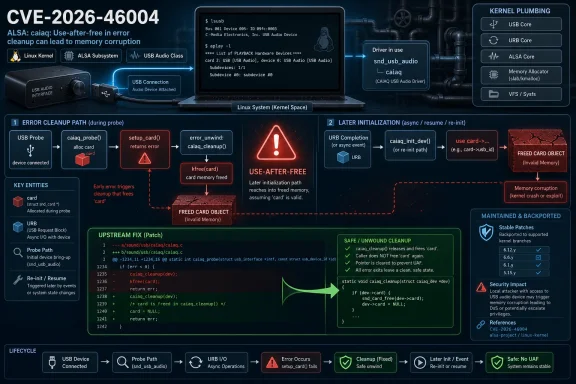 A Small Audio Driver Shows the Kernel’s Real Attack Surface
The caiaq driver is not a household name, even among many Linux administrators. It supports a family of USB audio and MIDI devices, historically associated with Native Instruments hardware, and lives in the ALSA subsystem where Linux handles sound cards, mixers, MIDI endpoints, and related device plumbing. For most desktop users, that sentence alone is enough to make the vulnerability sound obscure.Obscure, however, is not the same as irrelevant. Modern operating systems are sprawling federations of drivers, subsystems, compatibility shims, and legacy support paths. A bug in a USB audio driver may not matter to a headless cloud VM, but it can matter to a workstation, a kiosk, a production studio, a lab machine, or an embedded appliance that inherited a general-purpose kernel configuration.
The vulnerability’s core is brutally ordinary. During setup, the driver could encounter an error, free the sound card object, and then keep going as if the object were still valid. Later calls could touch memory that had already been released. In kernel land, that pattern is the classic setup for a use-after-free, a bug class that can range from a crash to a privilege boundary problem depending on reachability, timing, and attacker control.
The NVD record is still awaiting enrichment, which means no official NVD CVSS score or final vector has been assigned yet. That absence should not be confused with a finding of low severity. It means the public vulnerability metadata is lagging the patch reality, something Linux administrators have had to get used to as kernel CVEs have become more numerous, more granular, and more tightly coupled to upstream commits.
The Patch Says More Than the CVE Page
The most useful document here is not the NVD entry. It is the upstream patch description, which lays out the failure mode in plain engineering language:setup_card() was a void function even though it performed operations that could fail, and the caller was capable of propagating an error up to the probe path. Instead of letting the normal error path own cleanup, one failure branch called snd_card_free() and then continued execution.That is the kind of bug that hides in code for years because the happy path works. Plug in a supported device, initialization succeeds, the card registers, controls appear, and everyone moves on. The broken behavior lives in the unhappy path: registration fails, MIDI setup fails, audio setup fails, input setup fails, or a control transaction times out. Drivers often die by the paths their authors rarely exercise.
The fix is conceptually simple. Change
setup_card() so it returns an integer error code. When something fails, return immediately. Let the caller treat the failure as fatal and fall through the normal cleanup path. Remove the extra snd_card_free() call that created the possibility of freeing an object while the rest of the setup routine still expected it to exist.That simplicity is what makes the bug interesting. No cryptographic primitive was broken. No speculative execution side channel was uncovered. No elaborate protocol parser was tricked with a malicious network packet. A function did too much, reported too little, and violated ownership expectations around cleanup. In kernel development, those are not boring details. They are the thin membrane between robust failure and memory corruption.
Error Handling Is Security Engineering, Not Housekeeping
Security write-ups tend to reward spectacle. Remote code execution gets the headline. Sandbox escape gets the conference talk. A driver probe routine returningvoid when it should return int sounds like a footnote in a code review.But error handling is where kernel security often becomes real. Initialization code runs with high privilege and deals with partially constructed objects, hardware state, USB descriptors, memory allocations, work queues, URBs, and subsystem registration. If one branch frees a structure while another branch assumes it is alive, the kernel’s type system will not save you. C will do what C does: trust the programmer and let the machine keep moving.
The caiaq fix is therefore not merely about adding returns. It restores a single coherent ownership model. Either setup succeeds and the sound card becomes a registered kernel object, or setup fails and the probe machinery unwinds it. What the old code allowed was a half-failed, half-alive state, which is exactly the state attackers and fuzzers love.
For administrators, this is why “local” or “device-adjacent” kernel vulnerabilities deserve a more nuanced reading than the old internet shorthand suggests. A bug may require a physical USB device, a malicious peripheral, a particular kernel configuration, or a local user who can trigger module loading. Those constraints matter. They reduce exposure. They do not make the bug imaginary.
The Windows parallel is obvious. Windows administrators have spent years learning that driver quality is security quality. A vulnerable print driver, GPU driver, antivirus filter driver, or storage miniport can undermine the rest of the platform. Linux is different in governance and architecture, but not in the basic fact that kernel-mode driver mistakes carry system-level consequences.
The Missing Score Is Part of the Story
CVE-2026-46004 arrived in NVD without an NVD CVSS 4.0, 3.x, or 2.0 score. That is not unusual for newer Linux kernel CVEs, but it complicates the way many organizations triage. Vulnerability management tools love numbers. Kernel maintainers love patches. Administrators are left trying to translate one world into the other.A score would be useful, but it would not answer the most important operational questions. Is the affected driver built into your kernels? Is it available as a loadable module? Can unprivileged users cause the module to load? Are relevant USB devices present or allowed? Is USB access physically restricted? Are you running a distribution kernel that has already backported the fix under a different version number?
Those questions are more practical than arguing over whether the eventual score lands in medium or high territory. A use-after-free in kernel space is inherently serious as a class. The reachable attack surface, exploitability, and real-world deployment pattern determine whether it is urgent for a specific environment.
The current enrichment gap also reflects a larger shift in Linux vulnerability tracking. Since the kernel project began assigning many more CVEs to fixes, the number of records has increased and the average record has become more commit-shaped. That is good for traceability, but it means security teams cannot treat every new kernel CVE as a fully digested advisory. Often, the authoritative signal is the patch series and the distribution update, not the public database entry.
That is uncomfortable for organizations built around dashboard compliance. A scanner may flag CVE-2026-46004 before a vendor advisory has cleanly mapped it to every supported kernel build. Conversely, a distribution may ship a fixed kernel before the NVD page has a score. The responsible move is to track vendor kernel updates, not to wait for the CVSS machinery to catch up.
Stable Kernels Turned a Bug Fix Into a Regression Lesson
The caiaq story did not end with the first patch. Follow-up stable patches in early May 2026 show the other half of kernel maintenance: fixing a security-relevant error path can expose assumptions that old code had been accidentally tolerating.One follow-up addressed a leftover internal USB request block, or URB, in the error path. The original cleanup correction made setup failures fatal, but an internal
ep1_in_urb could already have been submitted before the failure. In the normal device-disconnect path, that URB would be killed. In the newly tightened error path, it needed explicit handling too.Another follow-up corrected behavior for models with no dedicated input device. After
setup_card() began treating initialization failures as fatal, snd_usb_caiaq_input_init() returning -EINVAL for “no input methods supported” became a problem. The fix changed that condition to -ENODEV and taught the caller to ignore it, allowing devices without that input feature to continue probing.That sequence is a useful corrective to the fantasy that secure software development is a straight line from bug to patch to victory. The first patch fixed a real memory-safety issue. The follow-ups made the fix operationally safe across hardware variants. Stable kernel work is often this iterative: close the dangerous hole, then sand down the compatibility splinters.
For sysadmins, this is also an argument against cherry-picking a single commit unless you have no alternative. The CVE references several stable commits, and the surrounding follow-ups matter. Distribution kernels usually absorb such patch stacks with testing and backport adjustments. Rolling your own “just enough” security patch can mean importing the first half of the solution and missing the second.
Windows Shops Should Still Care About a Linux USB Audio Bug
At first glance, this is Linux news for Linux people. But WindowsForum’s audience lives in a mixed-platform world. Windows desktops authenticate to Linux appliances. Hyper-V hosts run Linux guests. Developers use WSL. Security teams manage containers, NAS boxes, build workers, media systems, and embedded devices that may quietly run Linux under a vendor interface.CVE-2026-46004 is unlikely to be a WSL headline. WSL 2 uses a Microsoft-provided Linux kernel, but it does not expose arbitrary host USB audio hardware to Linux in the same way a bare-metal Linux workstation does. That distinction matters. The presence of a Linux kernel alone does not mean every driver path is reachable.
The more relevant Windows-adjacent risk is the device and appliance ecosystem around Windows environments. Audio production machines dual-boot. Conference rooms use Linux-based AV hardware. Security labs attach strange USB devices to analysis boxes. Developers plug peripherals into Linux laptops that also hold corporate credentials. The vulnerable code path is narrow, but narrow paths still exist somewhere in a large fleet.
This is where inventory discipline beats panic. If you do not know which Linux kernels you run, which modules they build, and which hardware classes they expose, a small CVE becomes another fog machine. If you do know, this vulnerability becomes a straightforward patch-management item: update kernels through the distribution channel, reboot where required, and verify that affected modules are no longer at vulnerable revisions.
The useful mental model is not “audio bug equals low priority.” It is “kernel driver bug equals scope-dependent priority.” A data center full of minimal server kernels without USB audio support can rank this differently from a media workstation fleet or a lab with broad USB access. The same CVE can be a footnote in one environment and a weekend maintenance ticket in another.
USB Remains the Awkward Boundary Between Physical and Logical Security
USB vulnerabilities are always awkward because they sit between physical access and software compromise. Security teams like clean categories: remote, local, physical, authenticated, unauthenticated. USB refuses to stay in its box. It is physical, but it carries data. It is local, but it can cross trust boundaries in offices, studios, factories, and test benches.The caiaq bug does not automatically imply that any USB audio device can exploit a Linux machine. Exploitability depends on details not established by the CVE record alone, including how the failure can be triggered and how much control an attacker has over freed memory reuse. But the class is familiar: a device-probe path parses and initializes state based on attached hardware, and bad error handling can turn a failed probe into a kernel memory-safety problem.
That is why hardened environments restrict USB even when the scary CVE of the week is not about USB. Device control policies, port blockers, allowlists, and endpoint protection rules are not merely about stopping thumb-drive malware. They also reduce the amount of kernel driver code that untrusted peripherals can exercise.
Linux has improved in many ways here, but the attack surface remains broad because hardware support is broad. A general-purpose distribution wants your audio interface, MIDI controller, webcam, capture card, printer, and game controller to work. Each success story is also code that can be reached when a device appears on the bus.
For everyday users, the practical advice is not to throw away USB audio gear. It is to avoid treating physical peripherals as harmless. Do not plug unknown devices into important systems. Do not use production machines as hardware testing sandboxes. Do not assume that a crash during device detection is merely annoying. In kernel space, a failed probe is still privileged code execution doing complicated work.
The Kernel CVE Machine Is Becoming More Honest and More Noisy
The Linux kernel’s recent CVE process has changed the texture of vulnerability news. More fixes are receiving CVE identifiers, including bugs that once might have appeared only as stable patches. That makes the ecosystem more transparent, but it also produces records like CVE-2026-46004: precise enough to name the bug, sparse enough to leave triage work unfinished.This is not necessarily a failure. The old model undercounted kernel security issues and forced downstream vendors to infer which bug fixes had security implications. The new model risks overwhelming teams with identifiers whose severity is not immediately obvious. Both models impose work; the new one at least gives defenders more hooks for tracking.
The tension is especially visible in subsystems like ALSA. Audio drivers are not the glamorous center of Linux security research, but they are real kernel code exposed to real hardware. When fixes in those drivers receive CVEs, some readers see inflation. Others see long-overdue labeling of memory safety risks that always existed.
The better interpretation is that Linux is becoming more explicit about uncertainty. Not every kernel CVE is a wormable disaster. Not every driver UAF is practically exploitable on your fleet. But the presence of a CVE tells maintainers, vendors, scanners, and administrators that a bug crossed a threshold where tracking matters.
That is where journalism and IT operations should resist both extremes. Dismissing the issue because it involves an obscure audio driver is lazy. Hyping it as an immediate catastrophe is worse. The real story is the kernel’s dependence on thousands of small correctness properties, any one of which can become security-relevant when error handling falls apart.
Distribution Updates Are the Security Boundary Users Actually Touch
Most users will never apply the upstream caiaq patch by commit hash. They will get the fix through Debian, Ubuntu, Fedora, Arch, openSUSE, Red Hat, SUSE, Alpine, or a vendor appliance update. That is as it should be. The distribution kernel is where upstream fixes meet configuration, ABI promises, regression testing, and support policy.The important task is to map the vulnerability to shipped kernels rather than upstream version numbers alone. Stable trees can carry the fix in multiple branches. Enterprise distributions may backport it to older-looking kernels while preserving their own version schemes. A system can be fixed without running a bleeding-edge kernel, and a system can be vulnerable despite having a numerically new-looking kernel if the relevant patch is absent.
This is a recurring source of confusion for Windows administrators who only occasionally manage Linux. Windows update identity is heavily centralized. Linux update identity is federated. The CVE tells you the upstream problem; the distribution advisory tells you what that means for the package you actually run.
For managed environments, the cleanest response is boring. Ensure kernel updates are enabled from trusted repositories. Read the distribution’s security notice when it lands. Reboot into the updated kernel, because many kernel fixes do not protect a machine that is still running the old image. Remove unused hardware support where your platform allows it, but do not mistake module blacklisting for a substitute for patching.
There may be cases where mitigation is reasonable before a vendor kernel arrives. If the caiaq module is loadable and unused, disabling it may reduce exposure. If USB access is tightly controlled, the residual risk may already be low. But the long-term answer remains a patched kernel, not a growing garden of local exceptions that future administrators have to rediscover.
The Practical Signal Hidden Inside CVE-2026-46004
CVE-2026-46004 is useful less because it names a spectacular exploit than because it shows how administrators should read modern kernel CVEs. The record is young, the NVD enrichment is incomplete, and the impact depends heavily on configuration and reachability. The patch trail, however, is concrete enough to support action.- The vulnerability affects the Linux kernel’s ALSA caiaq USB audio driver and involves improper error handling during device setup.
- The dangerous pattern is a possible use-after-free after
snd_card_free()is called on one failure path while setup continues into later initialization. - The upstream fix changes
setup_card()to return errors promptly and lets the normal probe failure path perform cleanup. - Follow-up stable patches matter because they address error-path fallout, including a leftover URB and devices that legitimately lack a dedicated input interface.
- NVD had not assigned an official severity score at publication time, so organizations should prioritize based on kernel exposure, module availability, USB access, and vendor kernel updates rather than waiting for a number.
- Windows-heavy shops should still check Linux workstations, appliances, dual-boot systems, developer machines, and specialized audio or lab hardware where USB audio support may be present.
References
- Primary source: NVD / Linux Kernel
Published: 2026-05-28T01:03:42-07:00
NVD - CVE-2026-46004
 nvd.nist.gov
- Security advisory: MSRC
Published: 2026-05-28T01:03:42-07:00
Original feed URL
Security Update Guide - Microsoft Security Response Center
 msrc.microsoft.com
- Official source: nist.gov
National Vulnerability Database
NIST maintains the National Vulnerability Database (NVD), a repository of information on software and hardware flaws that can compromise computer security. This is a key piece of the nation’s cybersecurity infrastructure.www.nist.gov - Related coverage: opennet.ru
- Related coverage: support.bull.com