

On May 27, 2026, NVD published CVE-2026-46048, a Linux kernel vulnerability in the ALSA
The vulnerability sits in the narrow seam between Linux’s sound subsystem, USB device handling, and the kernel’s reference-counting discipline. A driver takes ownership of an object, assumes a later cleanup hook will return it, and then discovers that several failure paths can exit before that hook is installed. That is the entire plot — and for administrators, embedded vendors, distro maintainers, and anyone running Linux on machines exposed to arbitrary peripherals, it is enough to matter.
CVE-2026-46048 affects the ALSA
In plain terms, the kernel starts to set up a USB audio device, bumps the device’s internal “someone is using me” counter, then trips over malformed or unexpected device state before it has registered the cleanup routine that would decrement that counter. The result is not an instant crash. It is retained kernel memory that should have been released.
That distinction matters because many vulnerability dashboards are built to reward spectacle. Memory corruption, privilege escalation, and remote code execution dominate attention. But reference leaks belong to a quieter family of kernel bugs: failures that become security-relevant because they can be triggered repeatedly, because they consume privileged resources, or because they reveal that a subsystem’s cleanup model is less robust than maintainers assumed.
Here, the reported reproducer involves a malformed UAC3 device where the only valid alternate setting is zero. The driver attempts to select alternate setting one with
That is a very specific trigger chain. It is also exactly the sort of chain that kernel fuzzers are built to find.
That delay creates the vulnerability window. Between the reference acquisition and the destructor assignment,
The probe routine then calls
This is one of the classic traps in C kernel code. Initialization functions are written as a sequence of increasingly specific setup steps, while cleanup is delegated to a destructor that is only wired in after some of those steps succeed. That pattern looks tidy when devices behave. It becomes fragile when a fuzzer, a broken peripheral, or a malicious gadget forces each intermediate step to fail in turn.
The fix is correspondingly surgical: move the
That is why the vulnerability is technically modest but conceptually important. The kernel is full of setup functions whose correctness depends on the exact ordering of “take reference,” “initialize fields,” “register cleanup,” and “start I/O.” CVE-2026-46048 is another datapoint in a long-running audit of those assumptions.
A human testing a USB audio driver usually plugs in supported hardware and checks whether audio streams. A distribution quality team may test suspend, resume, hotplug, sample-rate changes, and device removal. A fuzzer asks a different question: what happens if the descriptors are plausible enough to reach the driver, but wrong enough to break a branch halfway through initialization?
That style of testing is brutal on probe functions. Probe code often assumes that most devices are either clearly unsupported or broadly functional. Malformed hardware lives in the middle: accepted long enough for resources to be allocated, rejected late enough for cleanup ordering to matter.
In this case, the malformed UAC3 device is not merely “bad.” It is bad in a way that threads the needle. It presents only alternate setting zero as valid, while the driver asks for alternate setting one. The failure happens after the card object exists and after the USB reference has been taken, but before the destructor has been installed.
For defenders, this is the important lesson. The practical attacker model is not necessarily a remote adversary on the network. It is a local actor with USB access, a compromised USB device, a malicious gadget emulator, a lab environment, or a fuzzing harness that can cause repeated probe failures. Kernel bugs triggered by physical buses occupy an awkward middle ground: not internet-scale worms, but not harmless either.
A reference-count leak in a USB audio driver is not automatically a critical vulnerability. The exploitability depends on access to the affected subsystem, whether the driver is present and loadable, whether untrusted USB devices can be attached, whether the leak can be repeated reliably, and whether the accumulated retained memory can produce a denial of service or other security consequence.
The likely near-term classification from vendors may land somewhere in the low-to-medium range, but vendor scoring is not a substitute for local context. A locked-down server in a data center with no USB device exposure has a very different risk profile from a developer workstation, kiosk, lab bench, classroom machine, or embedded Linux appliance that accepts user-provided peripherals.
The absence of a score also reflects a larger mismatch between CVSS and kernel reality. Kernel vulnerabilities often begin life as commit messages: “fix leak,” “fix UAF,” “avoid NULL dereference,” “balance reference,” “do not access freed object.” Some are devastating. Some are nuisance-grade. Many require context that the first CVE record does not yet contain.
That is why patch management around Linux kernel CVEs cannot be reduced to staring at NVD alone. Distribution advisories, stable backports, exploit conditions, enabled kernel configuration, module availability, and physical access assumptions all matter. CVE-2026-46048 is a good example of a bug whose operational seriousness is less obvious than its code-level correctness.
The patch itself is small, but stable backports are rarely trivial in impact. Enterprise distributions, cloud images, appliance vendors, live distributions, and embedded products all need to decide whether their supported kernels carry the affected driver and whether the upstream fix maps cleanly onto their trees. For large vendors, the answer may emerge through normal kernel update channels. For smaller product teams, this is exactly the kind of CVE that can be missed because it does not look dramatic.
The audio angle may also cause some teams to underestimate exposure. “ALSA USB audio driver” sounds like desktop territory, and often it is. But Linux kernels are reused everywhere: test gear, media systems, industrial consoles, edge appliances, thin clients, music production workstations, classroom devices, and custom images built from general-purpose distribution kernels.
Even if the
That does not mean panic. It does mean that the phrase “only a driver bug” deserves less comfort than it often receives.
CVE-2026-46048 is unlikely to be the vulnerability that drives a board-level emergency meeting. But it is exactly the sort of issue that exposes whether an organization has visibility into the Linux kernels it casually depends on. The Windows estate may be well-managed through Intune, Configuration Manager, WSUS, Autopatch, or third-party endpoint tools, while Linux kernels sit in appliance firmware, lab systems, CI runners, or developer machines with a patch rhythm no one owns.
That gap matters most when the trigger surface is physical or peripheral-based. USB exposure is unevenly governed. Some organizations block removable storage but allow keyboards, audio devices, serial adapters, cameras, and lab hardware. Others rely on endpoint policy for Windows machines but have no equivalent controls on Linux hosts or embedded systems.
In that world, a USB audio driver leak is not simply a Linux trivia item. It is a test case for inventory hygiene. Do you know which Linux systems allow arbitrary USB attachment? Do you know which kernel modules can bind to those devices? Do you know whether your distribution has shipped the stable fix? Do you know who patches the Linux image in the “temporary” build box that has been under someone’s desk for three years?
Those are not glamorous questions. They are the questions that separate mature fleet management from accidental infrastructure.
This is not the same as saying that CVE-2026-46048 is a practical one-shot denial-of-service attack on every Linux laptop. The leak size, repeatability, permissions around USB device attachment, driver binding behavior, kernel configuration, and system memory all influence real-world impact. A bug can be legitimate and still require a contrived setup to hurt a normal user.
But “contrived” is not a synonym for irrelevant. Attackers with physical access have long abused USB trust assumptions. Researchers routinely use programmable USB gadgets to present unusual descriptors and device identities. Lab and production environments often connect unknown hardware to Linux machines because that is what the job requires.
The risk also changes for systems that must remain available for long periods. A desktop that reboots daily and rarely sees unknown peripherals has a lower exposure. A kiosk, audio workstation, control terminal, or embedded host that accepts devices from users and runs for weeks may care more about leaks that accumulate across repeated failures.
That is the uncomfortable middle ground of this CVE. It is not a five-alarm fire. It is not nothing.
The CVE text notes that the destructor’s callees already tolerate a partially initialized state. That is crucial. If
That is the sort of defensive coding kernel subsystems increasingly need. Cleanup functions should be idempotent or at least tolerant of partial construction. Initialization should be able to fail at every step without requiring a bespoke cleanup label for each previous allocation. The goal is not merely to fix one leak; it is to make the failure model boring.
There is a broader engineering debate here. C code often uses
CVE-2026-46048 is a tiny vote for earlier ownership registration. If a destructor is the canonical place to release a reference, install the destructor immediately after taking the reference. Anything else is an invitation for a future failure path to slip between the two.
Ubuntu’s public CVE tracking had already identified the issue as a medium-priority item needing evaluation across a wide range of kernel packages. That is a familiar early-stage state: the CVE exists, upstream references are known, but distro-specific status takes time to settle across releases and kernel flavors. Other vendors will make their own assessments depending on supported versions, configurations, and backport policies.
For administrators, the safest course is to treat this as part of the normal kernel update stream rather than as a standalone emergency change. If your Linux systems receive timely security kernel updates, this fix should arrive through that process. If your systems are pinned to old kernels, custom builds, or appliance firmware, you need to check whether the relevant stable patch has been applied.
There is also a mitigation angle, though it is less elegant than patching. Systems that do not need the affected driver can avoid loading it. Environments with strict USB control can reduce exposure by preventing untrusted peripherals from reaching Linux hosts. But mitigations of that kind are operationally uneven; kernel fixes are preferable because they correct the broken reference lifecycle at the source.
The usual warning applies: do not rip out audio drivers blindly on production systems without understanding dependencies. The right answer is to patch where possible, restrict untrusted USB where appropriate, and verify whether the affected module exists in images that accept physical devices.
The upside is better visibility. Bugs that once disappeared into a stable changelog now become trackable across distributions and vulnerability scanners. Security teams can ask whether a fix is present, vendors can map patches to CVE IDs, and fleet tools can reason about exposure more consistently.
The downside is alert fatigue. A steady stream of kernel CVEs, many with sparse initial descriptions and no immediate NVD score, can overwhelm teams that are trained to react to CVSS numbers rather than kernel context. Every “Linux kernel vulnerability” entry sounds ominous; not every one warrants the same response.
That puts more burden on analysis. Security teams need to distinguish remotely reachable privilege escalations from local-only crashes, data leaks from resource leaks, and default-enabled subsystems from obscure optional drivers. They also need to resist the opposite mistake: dismissing low-drama driver bugs simply because exploitation requires physical access or malformed hardware.
CVE-2026-46048 is best read in that middle register. It is a real kernel bug, fixed upstream, relevant to systems with affected USB audio driver exposure, and probably not the most urgent item in a typical enterprise patch queue. That is not a contradiction. It is what responsible vulnerability handling usually looks like.
caiaq USB audio driver where failed device probing can leak a referenced USB device object instead of releasing it. The bug is not the sort of headline-grabbing remote code execution flaw that sends patch teams into emergency mode. It is, however, a useful reminder that modern kernel security is increasingly shaped by small lifecycle mistakes in dusty driver paths — especially where malformed USB hardware can force code down paths few real devices ever take.The vulnerability sits in the narrow seam between Linux’s sound subsystem, USB device handling, and the kernel’s reference-counting discipline. A driver takes ownership of an object, assumes a later cleanup hook will return it, and then discovers that several failure paths can exit before that hook is installed. That is the entire plot — and for administrators, embedded vendors, distro maintainers, and anyone running Linux on machines exposed to arbitrary peripherals, it is enough to matter.
 A Small Audio Driver Bug Exposes a Larger Kernel Habit
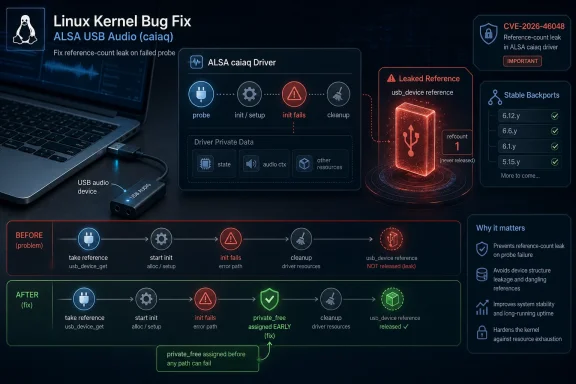
CVE-2026-46048 affects the ALSA caiaq driver, a USB audio driver used for certain Native Instruments-style audio devices. The immediate bug is a reference-count leak: the driver calls usb_get_dev() while setting up a sound card, but under some failed probe conditions the corresponding usb_put_dev() never runs. The leaked reference keeps the kernel’s struct usb_device and related allocations alive longer than intended.In plain terms, the kernel starts to set up a USB audio device, bumps the device’s internal “someone is using me” counter, then trips over malformed or unexpected device state before it has registered the cleanup routine that would decrement that counter. The result is not an instant crash. It is retained kernel memory that should have been released.
That distinction matters because many vulnerability dashboards are built to reward spectacle. Memory corruption, privilege escalation, and remote code execution dominate attention. But reference leaks belong to a quieter family of kernel bugs: failures that become security-relevant because they can be triggered repeatedly, because they consume privileged resources, or because they reveal that a subsystem’s cleanup model is less robust than maintainers assumed.
Here, the reported reproducer involves a malformed UAC3 device where the only valid alternate setting is zero. The driver attempts to select alternate setting one with
usb_set_interface(usb_dev, 0, 1), that call fails with -EIO, and the probe unwinds. Because the private cleanup hook is not yet installed, the card teardown path never reaches the function that releases the USB device reference.That is a very specific trigger chain. It is also exactly the sort of chain that kernel fuzzers are built to find.
The Bug Is Really About Time, Not Audio
The vulnerable code path is less about sound hardware than about when cleanup responsibility is attached to an object. In the broken sequence,create_card() takes a reference on the USB device and stores it in the driver’s private state. The cleanup function, card_free(), contains the matching usb_put_dev() call, but the sound card’s private_free destructor is assigned later in init_card().That delay creates the vulnerability window. Between the reference acquisition and the destructor assignment,
init_card() performs several operations that can fail: selecting a USB interface alternate setting, checking endpoint types, submitting a URB, issuing the EP1_CMD_GET_DEVICE_INFO exchange, and waiting for completion. Any failure before private_free is assigned returns an error to the probe routine.The probe routine then calls
snd_card_free(card), which is normally the right thing to do. But with private_free still null, the ALSA card cleanup cannot invoke the driver-specific destructor. The generic card object goes away; the USB device reference does not.This is one of the classic traps in C kernel code. Initialization functions are written as a sequence of increasingly specific setup steps, while cleanup is delegated to a destructor that is only wired in after some of those steps succeed. That pattern looks tidy when devices behave. It becomes fragile when a fuzzer, a broken peripheral, or a malicious gadget forces each intermediate step to fail in turn.
The fix is correspondingly surgical: move the
private_free assignment into create_card(), immediately after usb_get_dev(). Once the driver has taken the reference, the cleanup function is guaranteed to exist for any later path that reaches snd_card_free(). The patch does not need to invent a new cleanup scheme; it simply makes the existing ownership contract true earlier.That is why the vulnerability is technically modest but conceptually important. The kernel is full of setup functions whose correctness depends on the exact ordering of “take reference,” “initialize fields,” “register cleanup,” and “start I/O.” CVE-2026-46048 is another datapoint in a long-running audit of those assumptions.
Syzbot Keeps Finding the Paths Humans Do Not Exercise
The CVE description credits syzbot with reproducing the issue. That is not incidental. Syzbot, the automated bug-finding infrastructure built around syzkaller, is particularly good at generating odd device states, malformed descriptors, and failure combinations that ordinary hardware will never produce on a developer’s desk.A human testing a USB audio driver usually plugs in supported hardware and checks whether audio streams. A distribution quality team may test suspend, resume, hotplug, sample-rate changes, and device removal. A fuzzer asks a different question: what happens if the descriptors are plausible enough to reach the driver, but wrong enough to break a branch halfway through initialization?
That style of testing is brutal on probe functions. Probe code often assumes that most devices are either clearly unsupported or broadly functional. Malformed hardware lives in the middle: accepted long enough for resources to be allocated, rejected late enough for cleanup ordering to matter.
In this case, the malformed UAC3 device is not merely “bad.” It is bad in a way that threads the needle. It presents only alternate setting zero as valid, while the driver asks for alternate setting one. The failure happens after the card object exists and after the USB reference has been taken, but before the destructor has been installed.
For defenders, this is the important lesson. The practical attacker model is not necessarily a remote adversary on the network. It is a local actor with USB access, a compromised USB device, a malicious gadget emulator, a lab environment, or a fuzzing harness that can cause repeated probe failures. Kernel bugs triggered by physical buses occupy an awkward middle ground: not internet-scale worms, but not harmless either.
NVD Has Not Scored It Yet, and That Is the Right Kind of Unsatisfying
As of publication, the NVD record for CVE-2026-46048 is marked as awaiting enrichment, with no NIST CVSS 4.0, CVSS 3.x, or CVSS 2.0 score assigned. That absence is likely to annoy vulnerability managers who want a number to drop into a dashboard. It should also caution everyone else against overclaiming the severity.A reference-count leak in a USB audio driver is not automatically a critical vulnerability. The exploitability depends on access to the affected subsystem, whether the driver is present and loadable, whether untrusted USB devices can be attached, whether the leak can be repeated reliably, and whether the accumulated retained memory can produce a denial of service or other security consequence.
The likely near-term classification from vendors may land somewhere in the low-to-medium range, but vendor scoring is not a substitute for local context. A locked-down server in a data center with no USB device exposure has a very different risk profile from a developer workstation, kiosk, lab bench, classroom machine, or embedded Linux appliance that accepts user-provided peripherals.
The absence of a score also reflects a larger mismatch between CVSS and kernel reality. Kernel vulnerabilities often begin life as commit messages: “fix leak,” “fix UAF,” “avoid NULL dereference,” “balance reference,” “do not access freed object.” Some are devastating. Some are nuisance-grade. Many require context that the first CVE record does not yet contain.
That is why patch management around Linux kernel CVEs cannot be reduced to staring at NVD alone. Distribution advisories, stable backports, exploit conditions, enabled kernel configuration, module availability, and physical access assumptions all matter. CVE-2026-46048 is a good example of a bug whose operational seriousness is less obvious than its code-level correctness.
The Stable Backports Are the Real Security Signal
The CVE record lists multiple stable kernel references, which tells us the fix is not confined to a single development branch. That is the signal administrators should care about. A vulnerability that lands in stable trees is a vulnerability maintainers expect downstream distributions to absorb.The patch itself is small, but stable backports are rarely trivial in impact. Enterprise distributions, cloud images, appliance vendors, live distributions, and embedded products all need to decide whether their supported kernels carry the affected driver and whether the upstream fix maps cleanly onto their trees. For large vendors, the answer may emerge through normal kernel update channels. For smaller product teams, this is exactly the kind of CVE that can be missed because it does not look dramatic.
The audio angle may also cause some teams to underestimate exposure. “ALSA USB audio driver” sounds like desktop territory, and often it is. But Linux kernels are reused everywhere: test gear, media systems, industrial consoles, edge appliances, thin clients, music production workstations, classroom devices, and custom images built from general-purpose distribution kernels.
Even if the
snd-usb-caiaq module is not loaded by default, module autoloading can change the picture when a matching USB device appears. That is one of USB’s enduring security complications. The act of plugging in hardware is not passive; it can cause kernel code to parse descriptors, bind drivers, allocate resources, and start protocol exchanges before user space has much to say about it.That does not mean panic. It does mean that the phrase “only a driver bug” deserves less comfort than it often receives.
Windows Admins Should Care Because Mixed Fleets Make Kernel Bugs Everyone’s Problem
WindowsForum readers may reasonably ask why a Linux ALSA bug belongs in their feed. The answer is that modern Windows environments are rarely Windows-only anymore. WSL, Hyper-V labs, Linux build agents, container hosts, developer laptops, dual-boot workstations, NAS boxes, security appliances, Android-derived devices, and assorted edge systems all bring Linux kernels into Windows-centered organizations.CVE-2026-46048 is unlikely to be the vulnerability that drives a board-level emergency meeting. But it is exactly the sort of issue that exposes whether an organization has visibility into the Linux kernels it casually depends on. The Windows estate may be well-managed through Intune, Configuration Manager, WSUS, Autopatch, or third-party endpoint tools, while Linux kernels sit in appliance firmware, lab systems, CI runners, or developer machines with a patch rhythm no one owns.
That gap matters most when the trigger surface is physical or peripheral-based. USB exposure is unevenly governed. Some organizations block removable storage but allow keyboards, audio devices, serial adapters, cameras, and lab hardware. Others rely on endpoint policy for Windows machines but have no equivalent controls on Linux hosts or embedded systems.
In that world, a USB audio driver leak is not simply a Linux trivia item. It is a test case for inventory hygiene. Do you know which Linux systems allow arbitrary USB attachment? Do you know which kernel modules can bind to those devices? Do you know whether your distribution has shipped the stable fix? Do you know who patches the Linux image in the “temporary” build box that has been under someone’s desk for three years?
Those are not glamorous questions. They are the questions that separate mature fleet management from accidental infrastructure.
The Exploit Story Is Narrow, but the Denial-of-Service Angle Is Plausible
The most realistic security consequence here is resource exhaustion. If a malformed USB device can repeatedly trigger the failed probe path, and each attempt leaks astruct usb_device reference and associated allocations, then repeated cycles could gradually consume kernel memory. Depending on the environment, that may lead to degraded performance, failed device enumeration, or broader instability.This is not the same as saying that CVE-2026-46048 is a practical one-shot denial-of-service attack on every Linux laptop. The leak size, repeatability, permissions around USB device attachment, driver binding behavior, kernel configuration, and system memory all influence real-world impact. A bug can be legitimate and still require a contrived setup to hurt a normal user.
But “contrived” is not a synonym for irrelevant. Attackers with physical access have long abused USB trust assumptions. Researchers routinely use programmable USB gadgets to present unusual descriptors and device identities. Lab and production environments often connect unknown hardware to Linux machines because that is what the job requires.
The risk also changes for systems that must remain available for long periods. A desktop that reboots daily and rarely sees unknown peripherals has a lower exposure. A kiosk, audio workstation, control terminal, or embedded host that accepts devices from users and runs for weeks may care more about leaks that accumulate across repeated failures.
That is the uncomfortable middle ground of this CVE. It is not a five-alarm fire. It is not nothing.
The Patch Shows Why Early Destructors Beat Late Cleanup
The fix moves theprivate_free assignment closer to the acquisition of the USB device reference. That sounds like housekeeping, but it reflects a mature kernel design principle: once an object owns a resource, its destructor should know how to release that resource as early as possible.The CVE text notes that the destructor’s callees already tolerate a partially initialized state. That is crucial. If
card_free() assumed every later field had been initialized, installing it early could create a new crash path. But because the card’s private area is zero-initialized by snd_card_new(), functions such as input cleanup, URB freeing, and kfree() can safely handle missing or uninitialized pieces.That is the sort of defensive coding kernel subsystems increasingly need. Cleanup functions should be idempotent or at least tolerant of partial construction. Initialization should be able to fail at every step without requiring a bespoke cleanup label for each previous allocation. The goal is not merely to fix one leak; it is to make the failure model boring.
There is a broader engineering debate here. C code often uses
goto-based unwind paths, and in experienced hands that pattern is clear and efficient. But as setup functions grow and resources cross subsystem boundaries — ALSA card objects, USB references, URBs, endpoint metadata, input devices — it becomes easier for one cleanup action to sit on the wrong side of one failure branch.CVE-2026-46048 is a tiny vote for earlier ownership registration. If a destructor is the canonical place to release a reference, install the destructor immediately after taking the reference. Anything else is an invitation for a future failure path to slip between the two.
Distribution Timing Will Matter More Than Upstream Purity
Upstream has resolved the vulnerability, but most users do not run upstream kernel snapshots. They run distribution kernels, vendor kernels, Android-derived kernels, real-time kernels, cloud kernels, hardware enablement stacks, and appliance-maintained forks. The practical question is not whether the Linux kernel project has a fix; it is when that fix reaches the kernel you actually boot.Ubuntu’s public CVE tracking had already identified the issue as a medium-priority item needing evaluation across a wide range of kernel packages. That is a familiar early-stage state: the CVE exists, upstream references are known, but distro-specific status takes time to settle across releases and kernel flavors. Other vendors will make their own assessments depending on supported versions, configurations, and backport policies.
For administrators, the safest course is to treat this as part of the normal kernel update stream rather than as a standalone emergency change. If your Linux systems receive timely security kernel updates, this fix should arrive through that process. If your systems are pinned to old kernels, custom builds, or appliance firmware, you need to check whether the relevant stable patch has been applied.
There is also a mitigation angle, though it is less elegant than patching. Systems that do not need the affected driver can avoid loading it. Environments with strict USB control can reduce exposure by preventing untrusted peripherals from reaching Linux hosts. But mitigations of that kind are operationally uneven; kernel fixes are preferable because they correct the broken reference lifecycle at the source.
The usual warning applies: do not rip out audio drivers blindly on production systems without understanding dependencies. The right answer is to patch where possible, restrict untrusted USB where appropriate, and verify whether the affected module exists in images that accept physical devices.
Kernel CVEs Are Becoming More Numerous Because the Accounting Is Getting Better
One reason CVE-2026-46048 may feel strange is that it reads more like a bug-fix commit than a traditional vulnerability advisory. That is increasingly normal for Linux. The kernel project and CVE ecosystem have become more systematic about assigning CVEs to fixes that address memory safety, reference counting, bounds checking, race conditions, and other correctness issues with plausible security impact.The upside is better visibility. Bugs that once disappeared into a stable changelog now become trackable across distributions and vulnerability scanners. Security teams can ask whether a fix is present, vendors can map patches to CVE IDs, and fleet tools can reason about exposure more consistently.
The downside is alert fatigue. A steady stream of kernel CVEs, many with sparse initial descriptions and no immediate NVD score, can overwhelm teams that are trained to react to CVSS numbers rather than kernel context. Every “Linux kernel vulnerability” entry sounds ominous; not every one warrants the same response.
That puts more burden on analysis. Security teams need to distinguish remotely reachable privilege escalations from local-only crashes, data leaks from resource leaks, and default-enabled subsystems from obscure optional drivers. They also need to resist the opposite mistake: dismissing low-drama driver bugs simply because exploitation requires physical access or malformed hardware.
CVE-2026-46048 is best read in that middle register. It is a real kernel bug, fixed upstream, relevant to systems with affected USB audio driver exposure, and probably not the most urgent item in a typical enterprise patch queue. That is not a contradiction. It is what responsible vulnerability handling usually looks like.
The Practical Reading for CVE-2026-46048 Is Narrow but Concrete
The main lesson is not that Linux audio is suddenly dangerous. It is that kernel resource ownership bugs remain a live class of vulnerability, and USB probe paths are fertile ground for them. Teams that manage Linux systems should translate the CVE into a few concrete checks rather than treating it as either a crisis or background noise.- Systems running vendor-supported Linux kernels should receive the fix through normal kernel security updates once their distribution has completed evaluation and backporting.
- Machines that allow untrusted USB devices deserve more attention than headless systems with no practical physical peripheral exposure.
- Custom kernels and appliance firmware should be checked for the stable patch rather than assumed safe because the bug is in an audio driver.
- Environments that do not need the
snd-usb-caiaqdriver can reduce exposure by preventing the module from loading, provided that change is tested against real hardware requirements. - Vulnerability teams should avoid waiting only for an NVD score, because kernel CVE triage often requires distribution status, module exposure, and local device policy to understand real risk.
- The code fix is small, but the pattern it corrects — taking a reference before guaranteed cleanup is registered — is exactly the sort of defect fuzzers will continue to find across kernel drivers.
References
- Primary source: NVD / Linux Kernel
Published: 2026-05-28T01:01:21-07:00
NVD - CVE-2026-46048
 nvd.nist.gov
- Security advisory: MSRC
Published: 2026-05-28T01:01:21-07:00
Original feed URL
Security Update Guide - Microsoft Security Response Center
 msrc.microsoft.com
- Related coverage: alsa-project.org
Matrix:Module-usb-caiaq - AlsaProject
www.alsa-project.org
- Related coverage: cve.imfht.com
CVE-2022-48701: ALSA: usb-audio: Fix an out-of-bounds bug in __snd_usb_parse_audio_interface() - Vulnerability Platform
[-] Overview A buffer over-read vulnerability exists in the ALSA module of the Linux kernel, occurring during the parsing of specific USB audio device int cve.imfht.com
- Related coverage: spinics.net
[PATCH 1/2] ALSA: caiaq: fix use-after-free and double-free in setup_card() — Linux Kernel
Linux Kernel: [PATCH 1/2] ALSA: caiaq: fix use-after-free and double-free in setup_card() www.spinics.net
- Related coverage: git.alsa-project.org
- Related coverage: support.bull.com
