

CVE-2026-46018 is a Linux kernel flaw disclosed by kernel.org and published by NVD on May 27, 2026, affecting the ALSA USB-audio driver’s handling of malformed USB Audio Class 2 sample-rate range responses. It is not the sort of vulnerability that screams for emergency unplugging of every headset in the building, but it is exactly the kind of driver-edge bug that keeps reappearing in modern kernels. The practical risk is local and device-adjacent: a hostile or broken USB audio device can make the kernel do too much work, emit repeated errors, and hold a mutex longer than it should during probe. The larger story is that Linux’s attack surface is not only in network daemons and browser sandboxes; it is also in the little parsers that wake up every time hardware says, trust me, I am a microphone.
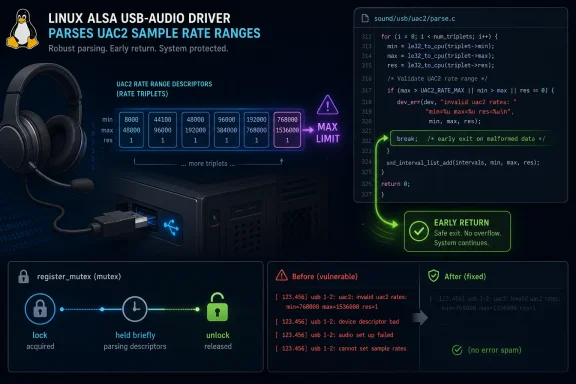
The patch behind CVE-2026-46018 is almost comically small: change a
That is the bug in plain English. The driver had a ceiling, but the ceiling did not end the conversation. A malicious or malformed device could keep feeding additional rate triplets, causing repeated “invalid uac2 rates” messages while the device probe path still held
This is not a classic memory-corruption headline, at least based on the available public description. There is no published NVD CVSS score yet, no NVD vector, and no enriched CWE assignment at the time of the record’s initial publication. The kernel-side description points instead toward a denial-of-service-shaped problem: excessive parsing, noisy logging, and lock hold time in a sensitive device-registration path.
That distinction matters for administrators. A bug that allows remote code execution over the network belongs in one category; a malformed USB descriptor that can stress a kernel path during device enumeration belongs in another. But the second category is still security-relevant because USB remains one of the most physically intimate interfaces a computer exposes.
ALSA’s
UAC2, short for USB Audio Class 2, lets a device describe supported sample rates using range information rather than only fixed lists. That makes sense for flexible hardware, but it also means the kernel has to walk through structured data supplied by the device. A range response can include triplets, and the kernel has to translate those into rates it can expose upward.
The CVE-2026-46018 fix lands at that translation boundary. The kernel already had
This is the kind of bug that makes kernel hardening feel like house maintenance. The roof is not collapsing. The wiring is not on fire. But a door that should latch does not quite latch, and the only reason anyone notices is because a fuzzer or a weird device keeps jiggling the handle.
That makes the bug less urgent than an unauthenticated network flaw, but not irrelevant. Security teams have spent years learning that “requires physical access” is not always a comforting phrase. BadUSB-style attacks, malicious charging stations, supply-chain-tainted peripherals, lab environments, kiosks, shared workstations, recording studios, and developer machines with constant device churn all complicate the old assumption that local hardware is trusted hardware.
For a WindowsForum.com audience, the Linux angle is also broader than desktop Linux. Linux kernels sit inside WSL2 utility VMs, ChromeOS devices, Android-derived systems, NAS boxes, embedded appliances, hypervisors, live forensic environments, audio workstations, and container hosts. Not every one of those environments exposes raw USB audio in the same way, but many enterprises now run Linux kernels in places where Windows administrators still own the operational risk.
The kernel description does not claim data theft, privilege escalation, or arbitrary code execution. That should restrain the panic. But it does describe a malformed response causing repeated error output while a mutex remains held during probe, and that is enough to justify patching through normal kernel update channels.
The better mental model is device-triggered kernel misbehavior. A hostile peripheral tells the kernel something absurd about supported audio rates. The kernel should stop listening when its internal cap is reached. Before the fix, it did not stop decisively enough.
During device probe, the kernel is building its representation of the audio device. If malformed data causes the parser to continue longer than intended, it can keep the registration path occupied. That may not crash a system, but it can delay or interfere with device setup, amplify logging, and create annoying failure modes that are difficult to diagnose from user space.
Anyone who has debugged Linux audio has seen the genre. The desktop reports no input device, PipeWire or PulseAudio appears confused,
Security classification often flattens these bugs into severity numbers. But operationally, kernel driver bugs live in the world of hangs, repeated probes, devices that vanish and reappear, and support tickets that sound like superstition. CVE-2026-46018 fits that world more than the world of exploit kits.
That does not make it benign. In shared or controlled environments, a malicious USB device that can degrade kernel behavior may be enough to matter. In individual desktop environments, the likelier impact is a strange audio device causing kernel log noise or probe-time disruption until a fixed kernel arrives.
The patch was authored by Cássio Gabriel, reported by syzbot, and sent to the stable kernel process. That provenance is important. Syzbot is part of the syzkaller fuzzing ecosystem, and its recurring appearance in kernel CVEs reflects a quiet shift in how Linux vulnerabilities are found. Many are not discovered because an attacker exploited them in the wild; they are discovered because automated systems relentlessly generate malformed inputs until parser assumptions crack.
That is good news and bad news. The good news is that fuzzing finds this class of bug before it becomes a field incident. The bad news is that modern kernels have so many parser surfaces that fuzzing keeps finding more.
The patch also references an older fix: “ALSA: usb-audio: fix possible hang and overflow in
In other words, CVE-2026-46018 is not a new subsystem melting down. It is a second-order hardening correction in code that was already known to need guardrails.
This is where Linux security differs from the neatness of a single Patch Tuesday. The fix may exist upstream, but exposure and remediation depend on kernel version, distribution policy, hardware access, and whether the system actually permits untrusted USB audio devices. A fully patched rolling-release desktop may receive the fix quickly. A long-term enterprise kernel may receive a backport with no obvious version-number leap. An embedded product may never expose the affected path to users, or it may sit unpatched until a vendor firmware release.
Administrators should therefore avoid version-number theater. The right question is not simply “am I on kernel 6.x?” but “has my vendor shipped the ALSA usb-audio fix for CVE-2026-46018 or the equivalent stable backport?” Enterprise distributions frequently backport individual fixes while retaining older kernel base versions, so a naïve comparison against upstream kernel numbers can mislead.
For Windows-heavy shops with Linux islands, the asset inventory question is sharper. Which systems allow arbitrary USB peripherals? Which Linux workstations are used in labs, recording rooms, classrooms, maker spaces, or help desks? Which hypervisors or developer systems pass USB devices through to guests? Which appliances are exposed to users who can plug things in?
Those answers determine whether this CVE is a routine patch note or a policy conversation about device trust.
That matters because USB audio devices are rarely treated as risky. Storage devices raise alarms. Rubber Ducky-style keystroke injectors are famous enough to appear in security-awareness decks. But a microphone or headset is still socially accepted as harmless. Plugging it in feels like enabling communication, not expanding kernel attack surface.
Linux does not have the monopoly on this problem. Windows, macOS, and Linux all parse hardware-supplied descriptors, and all three have had device-driver bugs. The Linux-specific lesson from CVE-2026-46018 is that open development makes the plumbing visible: we can see the exact parser, the cap, the mutex, the one-line change, and the stable backports.
That transparency is useful, but it can also make Linux look noisier than closed platforms. A CVE for a small parser correction may look alarming in a feed, while a comparable proprietary driver fix might appear as a vague “stability and security improvements” note. The visibility is a feature, provided readers do not mistake granularity for catastrophe.
The sensible response is neither panic nor dismissal. Treat USB audio as part of the hardware trust boundary. Patch kernels. Restrict unknown USB devices where policy already demands it. Do not let the absence of a CVSS score become an excuse for ignoring a fix that upstream has already sent to stable.
Neither shortcut is helpful. The known facts point to a malformed UAC2 range response, excessive continued parsing after a maximum-rate cap, repeated kernel error messages, and lock hold during probe. Those facts suggest denial-of-service or local disruption characteristics, not a confirmed path to code execution.
The absence of a public CVSS vector also means defenders should be careful about automated prioritization. Some vulnerability-management tools may temporarily show “N/A,” “unknown,” or vendor-derived severity. Others may not surface the CVE until NVD enrichment catches up. In a mature program, that should trigger triage, not paralysis.
Kernel CVEs especially need context. A bug in a network-facing filesystem parser and a bug in a USB-audio descriptor parser do not deserve the same operational response simply because both live under “Linux kernel.” Attack surface, privilege boundary, exploit preconditions, and vendor patch availability are the variables that matter.
For CVE-2026-46018, the immediate operational conclusion is modest but clear: if your Linux systems accept untrusted USB audio devices, the fix is worth taking promptly through normal kernel updates. If your Linux systems are headless servers in locked racks with USB disabled, this is probably not the vulnerability that changes your week.
That is how bugs like this surface. A human reviewer may see
There is a broader engineering lesson here for Windows and Linux developers alike. Limits are not just numbers; they are exits. A parser that reaches a safety threshold should usually stop consuming the suspect structure, not continue walking adjacent parts of it while logging complaints.
The kernel community has spent decades adding these guardrails. Maximum counts, sanity checks, descriptor length validation, overflow prevention, and early returns are the unglamorous mechanics of secure systems programming. CVE-2026-46018 is a small reminder that the exact placement of those mechanics matters.
It also shows why stable backports are essential. Fuzzing may discover the bug against one tree, but the affected logic can exist across several supported versions. The security value comes when the fix reaches the kernels people actually run.
USB policy is also increasingly cross-platform. If a company bans unknown USB mass-storage devices but allows any headset or microphone, it has made a device-class trust decision whether it admits it or not. CVE-2026-46018 does not prove that every headset is dangerous. It does prove that audio descriptors are executable in the looser, parser-driven sense: they cause privileged kernel code to make decisions.
For WSL users, the direct exposure depends on how USB devices are passed through and which kernel is running. The average WSL2 user is not automatically in the same position as a bare-metal Linux desktop plugging in arbitrary audio hardware. But developers who pass USB devices into Linux environments, run custom kernels, or use Linux VMs for hardware work should track upstream fixes with the same seriousness they apply to Windows driver updates.
For enterprise desktop teams, the right framing is policy consistency. If you would not let users plug unknown keyboards into secure workstations, why are unknown USB audio gadgets always exempt? The answer may be practical necessity, but it should be explicit rather than accidental.
Security hardening does not require banning every peripheral. It does require knowing which classes of devices are allowed, which machines are exposed, and how quickly kernel and driver fixes move through the fleet.
The old behavior was not irrational. Breaking out of a loop often looks like the correct local action. But local correctness is not enough in parser code. The broader function still had work to do, and the malformed response still had room to keep influencing control flow.
This is why security reviews obsess over exits. When input has crossed a threshold from large to unreasonable, the program should not merely complain; it should stop trusting the structure. The patch converts a warning condition into a terminal condition for that parse operation.
That change is also unlikely to be disruptive for legitimate devices. A valid USB audio device should not need to exceed the kernel’s maximum number of enumerated rates. If it does, truncating at the cap and returning the collected rates is a more stable behavior than continuing to churn through data the driver has already deemed excessive.
For users with exotic audio interfaces, the usual caution applies: kernel audio changes can expose firmware quirks. But this fix targets malformed excess, not normal high-end capability. Professional interfaces may support many modes; they should not require an effectively unbounded parser path to function.
Security teams should resist both extremes. This CVE does not justify breathless claims about remote Linux compromise through audio. It also should not be ignored simply because the exploit precondition likely involves USB device interaction.
The most concrete actions are straightforward:
But that is precisely why it is useful. Most security work is not cinematic. It is bounding loops, returning early, backporting fixes, rebooting into patched kernels, and refusing to let malformed input keep a privileged subsystem busy after the program already knows enough to stop.
For Windows professionals managing mixed environments, the lesson is portable: hardware is software’s oldest input source, and every descriptor parser is a tiny trust negotiation. CVE-2026-46018 closes one of those negotiations more decisively. The next one will almost certainly be found the same way — by a fuzzer, in an unglamorous driver, at the edge where convenience plugs into the kernel.
 A One-Line Fix Exposes a Familiar Kernel Weakness
The patch behind CVE-2026-46018 is almost comically small: change a break into a return when the USB-audio parser has already collected the maximum number of sample rates it is willing to track. That tiny difference matters because the old behavior stopped only the inner rate loop, while the parser kept processing the remaining triplets in a malformed UAC2 RANGE response.That is the bug in plain English. The driver had a ceiling, but the ceiling did not end the conversation. A malicious or malformed device could keep feeding additional rate triplets, causing repeated “invalid uac2 rates” messages while the device probe path still held
register_mutex.This is not a classic memory-corruption headline, at least based on the available public description. There is no published NVD CVSS score yet, no NVD vector, and no enriched CWE assignment at the time of the record’s initial publication. The kernel-side description points instead toward a denial-of-service-shaped problem: excessive parsing, noisy logging, and lock hold time in a sensitive device-registration path.
That distinction matters for administrators. A bug that allows remote code execution over the network belongs in one category; a malformed USB descriptor that can stress a kernel path during device enumeration belongs in another. But the second category is still security-relevant because USB remains one of the most physically intimate interfaces a computer exposes.
USB Audio Is More Parser Than Peripheral
USB audio looks boring when it works. Plug in a headset, mixer, microphone, DAC, webcam, docking station, or monitor, and the operating system discovers formats, channels, clocks, rates, and controls. Underneath that pleasant illusion is a dense negotiation between device descriptors and host-side parser code.ALSA’s
snd-usb-audio driver is the Linux kernel’s bridge into that world. It must accept descriptor data from a huge universe of devices, including expensive professional interfaces, no-name conference-room gear, firmware-updated headsets, USB-C hubs, and novelty gadgets that may have barely passed validation. The driver cannot assume that every device describes itself truthfully or sanely.UAC2, short for USB Audio Class 2, lets a device describe supported sample rates using range information rather than only fixed lists. That makes sense for flexible hardware, but it also means the kernel has to walk through structured data supplied by the device. A range response can include triplets, and the kernel has to translate those into rates it can expose upward.
The CVE-2026-46018 fix lands at that translation boundary. The kernel already had
MAX_NR_RATES, a hard limit meant to keep the enumeration from growing without bound. The problem was that reaching the cap did not stop the whole parser. The code yelled, stepped out of the current loop, and then continued dealing with the rest of the malformed response.This is the kind of bug that makes kernel hardening feel like house maintenance. The roof is not collapsing. The wiring is not on fire. But a door that should latch does not quite latch, and the only reason anyone notices is because a fuzzer or a weird device keeps jiggling the handle.
The Security Story Is Physical, Local, and Still Real
The first instinct with a USB-audio CVE is to ask whether it can be exploited remotely. Based on the disclosed details, the answer appears to be no in the ordinary sense. An attacker would need to influence what the kernel sees as a USB Audio Class 2 device, which usually means physical access, a malicious peripheral, a compromised USB device, or a virtualized/emulated device path.That makes the bug less urgent than an unauthenticated network flaw, but not irrelevant. Security teams have spent years learning that “requires physical access” is not always a comforting phrase. BadUSB-style attacks, malicious charging stations, supply-chain-tainted peripherals, lab environments, kiosks, shared workstations, recording studios, and developer machines with constant device churn all complicate the old assumption that local hardware is trusted hardware.
For a WindowsForum.com audience, the Linux angle is also broader than desktop Linux. Linux kernels sit inside WSL2 utility VMs, ChromeOS devices, Android-derived systems, NAS boxes, embedded appliances, hypervisors, live forensic environments, audio workstations, and container hosts. Not every one of those environments exposes raw USB audio in the same way, but many enterprises now run Linux kernels in places where Windows administrators still own the operational risk.
The kernel description does not claim data theft, privilege escalation, or arbitrary code execution. That should restrain the panic. But it does describe a malformed response causing repeated error output while a mutex remains held during probe, and that is enough to justify patching through normal kernel update channels.
The better mental model is device-triggered kernel misbehavior. A hostile peripheral tells the kernel something absurd about supported audio rates. The kernel should stop listening when its internal cap is reached. Before the fix, it did not stop decisively enough.
The Mutex Detail Is the Part Administrators Should Not Ignore
The phraseregister_mutex may look like implementation trivia, but it is the clue that turns this from a mere log-spam bug into a kernel-behavior concern. Mutexes serialize access to shared state. Holding one while parsing untrusted or semi-trusted device data is not automatically wrong, but it raises the cost of doing unnecessary work.During device probe, the kernel is building its representation of the audio device. If malformed data causes the parser to continue longer than intended, it can keep the registration path occupied. That may not crash a system, but it can delay or interfere with device setup, amplify logging, and create annoying failure modes that are difficult to diagnose from user space.
Anyone who has debugged Linux audio has seen the genre. The desktop reports no input device, PipeWire or PulseAudio appears confused,
dmesg fills with inscrutable ALSA messages, and the user swaps cables or blames the distribution. The root cause may be a firmware quirk, a regression, a descriptor oddity, or, in this case, a parser that should have returned earlier.Security classification often flattens these bugs into severity numbers. But operationally, kernel driver bugs live in the world of hangs, repeated probes, devices that vanish and reappear, and support tickets that sound like superstition. CVE-2026-46018 fits that world more than the world of exploit kits.
That does not make it benign. In shared or controlled environments, a malicious USB device that can degrade kernel behavior may be enough to matter. In individual desktop environments, the likelier impact is a strange audio device causing kernel log noise or probe-time disruption until a fixed kernel arrives.
The Patch Says More Than the CVE Record
NVD’s entry for CVE-2026-46018 was initially marked as awaiting enrichment, with no CVSS score from NIST and no completed metric vector. That is increasingly common for kernel CVEs in the early window after assignment. The CVE record tells users that a vulnerability exists; the kernel patch tells them what actually changed.The patch was authored by Cássio Gabriel, reported by syzbot, and sent to the stable kernel process. That provenance is important. Syzbot is part of the syzkaller fuzzing ecosystem, and its recurring appearance in kernel CVEs reflects a quiet shift in how Linux vulnerabilities are found. Many are not discovered because an attacker exploited them in the wild; they are discovered because automated systems relentlessly generate malformed inputs until parser assumptions crack.
That is good news and bad news. The good news is that fuzzing finds this class of bug before it becomes a field incident. The bad news is that modern kernels have so many parser surfaces that fuzzing keeps finding more.
The patch also references an older fix: “ALSA: usb-audio: fix possible hang and overflow in
parse_uac2_sample_rate_range().” That history matters because it shows this function has already been in the danger zone. A previous fix introduced or relied on a cap; the new fix ensures the cap actually terminates the whole parse path once reached.In other words, CVE-2026-46018 is not a new subsystem melting down. It is a second-order hardening correction in code that was already known to need guardrails.
The Stable Kernel Pipeline Is the Real Remediation Story
The references attached to the CVE point to multiple stable kernel commits, which indicates the fix is being propagated across supported Linux stable trees rather than living only in bleeding-edge mainline. That is the practical remediation path most users will actually see. They will not hand-editsound/usb/format.c; they will receive a kernel update from Debian, Ubuntu, Fedora, Arch, SUSE, Red Hat, Canonical, Microsoft’s WSL kernel channel, an appliance vendor, or another downstream maintainer.This is where Linux security differs from the neatness of a single Patch Tuesday. The fix may exist upstream, but exposure and remediation depend on kernel version, distribution policy, hardware access, and whether the system actually permits untrusted USB audio devices. A fully patched rolling-release desktop may receive the fix quickly. A long-term enterprise kernel may receive a backport with no obvious version-number leap. An embedded product may never expose the affected path to users, or it may sit unpatched until a vendor firmware release.
Administrators should therefore avoid version-number theater. The right question is not simply “am I on kernel 6.x?” but “has my vendor shipped the ALSA usb-audio fix for CVE-2026-46018 or the equivalent stable backport?” Enterprise distributions frequently backport individual fixes while retaining older kernel base versions, so a naïve comparison against upstream kernel numbers can mislead.
For Windows-heavy shops with Linux islands, the asset inventory question is sharper. Which systems allow arbitrary USB peripherals? Which Linux workstations are used in labs, recording rooms, classrooms, maker spaces, or help desks? Which hypervisors or developer systems pass USB devices through to guests? Which appliances are exposed to users who can plug things in?
Those answers determine whether this CVE is a routine patch note or a policy conversation about device trust.
Audio Bugs Have a Way of Crossing Administrative Boundaries
It is tempting to file ALSA vulnerabilities under “Linux desktop trivia,” but audio hardware has become infrastructure. Conference rooms depend on USB speakerphones. Developers rely on headsets. Streamers and trainers use mixers and capture devices. Hybrid-work fleets ship with docks and webcams that behave like composite USB devices. Security labs and support benches often accumulate mysterious peripherals faster than anyone can document them.That matters because USB audio devices are rarely treated as risky. Storage devices raise alarms. Rubber Ducky-style keystroke injectors are famous enough to appear in security-awareness decks. But a microphone or headset is still socially accepted as harmless. Plugging it in feels like enabling communication, not expanding kernel attack surface.
Linux does not have the monopoly on this problem. Windows, macOS, and Linux all parse hardware-supplied descriptors, and all three have had device-driver bugs. The Linux-specific lesson from CVE-2026-46018 is that open development makes the plumbing visible: we can see the exact parser, the cap, the mutex, the one-line change, and the stable backports.
That transparency is useful, but it can also make Linux look noisier than closed platforms. A CVE for a small parser correction may look alarming in a feed, while a comparable proprietary driver fix might appear as a vague “stability and security improvements” note. The visibility is a feature, provided readers do not mistake granularity for catastrophe.
The sensible response is neither panic nor dismissal. Treat USB audio as part of the hardware trust boundary. Patch kernels. Restrict unknown USB devices where policy already demands it. Do not let the absence of a CVSS score become an excuse for ignoring a fix that upstream has already sent to stable.
The NVD Delay Leaves Room for Bad Severity Theater
At publication, the NVD record for CVE-2026-46018 had not yet provided CVSS 4.0, CVSS 3.x, or CVSS 2.0 scoring. That vacuum is where low-quality vulnerability aggregation often thrives. One site may stamp a scary label on anything with “Linux kernel” in the title; another may underplay it because there is no remote vector.Neither shortcut is helpful. The known facts point to a malformed UAC2 range response, excessive continued parsing after a maximum-rate cap, repeated kernel error messages, and lock hold during probe. Those facts suggest denial-of-service or local disruption characteristics, not a confirmed path to code execution.
The absence of a public CVSS vector also means defenders should be careful about automated prioritization. Some vulnerability-management tools may temporarily show “N/A,” “unknown,” or vendor-derived severity. Others may not surface the CVE until NVD enrichment catches up. In a mature program, that should trigger triage, not paralysis.
Kernel CVEs especially need context. A bug in a network-facing filesystem parser and a bug in a USB-audio descriptor parser do not deserve the same operational response simply because both live under “Linux kernel.” Attack surface, privilege boundary, exploit preconditions, and vendor patch availability are the variables that matter.
For CVE-2026-46018, the immediate operational conclusion is modest but clear: if your Linux systems accept untrusted USB audio devices, the fix is worth taking promptly through normal kernel updates. If your Linux systems are headless servers in locked racks with USB disabled, this is probably not the vulnerability that changes your week.
Syzbot Keeps Finding the Edges Humans Stop Thinking About
The syzbot credit is more than a footnote. Automated kernel fuzzing has become one of the most important security forces in Linux because it attacks assumptions at machine speed. It does not care that USB audio is boring. It does not care that sample-rate parsing feels like solved plumbing. It simply asks what happens if structured input is weird enough for long enough.That is how bugs like this surface. A human reviewer may see
MAX_NR_RATES and understand that a cap exists. A fuzzer explores whether the cap ends the right control flow. In CVE-2026-46018, the distinction between breaking out of a loop and returning from the function is the entire story.There is a broader engineering lesson here for Windows and Linux developers alike. Limits are not just numbers; they are exits. A parser that reaches a safety threshold should usually stop consuming the suspect structure, not continue walking adjacent parts of it while logging complaints.
The kernel community has spent decades adding these guardrails. Maximum counts, sanity checks, descriptor length validation, overflow prevention, and early returns are the unglamorous mechanics of secure systems programming. CVE-2026-46018 is a small reminder that the exact placement of those mechanics matters.
It also shows why stable backports are essential. Fuzzing may discover the bug against one tree, but the affected logic can exist across several supported versions. The security value comes when the fix reaches the kernels people actually run.
Windows Administrators Should Read This as a USB Trust Boundary Story
WindowsForum.com readers may reasonably ask why a Linux ALSA CVE belongs on their radar. The answer is that very few real environments are single-platform anymore. Windows desktops coexist with Linux servers, WSL2 instances, developer workstations, security appliances, Android devices, NAS boxes, containers, and cloud images. The administrative boundary is not the OS logo on the taskbar; it is the set of devices and kernels your organization permits into its workflow.USB policy is also increasingly cross-platform. If a company bans unknown USB mass-storage devices but allows any headset or microphone, it has made a device-class trust decision whether it admits it or not. CVE-2026-46018 does not prove that every headset is dangerous. It does prove that audio descriptors are executable in the looser, parser-driven sense: they cause privileged kernel code to make decisions.
For WSL users, the direct exposure depends on how USB devices are passed through and which kernel is running. The average WSL2 user is not automatically in the same position as a bare-metal Linux desktop plugging in arbitrary audio hardware. But developers who pass USB devices into Linux environments, run custom kernels, or use Linux VMs for hardware work should track upstream fixes with the same seriousness they apply to Windows driver updates.
For enterprise desktop teams, the right framing is policy consistency. If you would not let users plug unknown keyboards into secure workstations, why are unknown USB audio gadgets always exempt? The answer may be practical necessity, but it should be explicit rather than accidental.
Security hardening does not require banning every peripheral. It does require knowing which classes of devices are allowed, which machines are exposed, and how quickly kernel and driver fixes move through the fleet.
The Patch Is Small Because the Boundary Is Clear
There is something satisfying about the fix itself. When the parser reachesMAX_NR_RATES, it now returns the number of rates collected so far. That is an elegant answer because it preserves useful data without rewarding the malformed tail of the response with more processing.The old behavior was not irrational. Breaking out of a loop often looks like the correct local action. But local correctness is not enough in parser code. The broader function still had work to do, and the malformed response still had room to keep influencing control flow.
This is why security reviews obsess over exits. When input has crossed a threshold from large to unreasonable, the program should not merely complain; it should stop trusting the structure. The patch converts a warning condition into a terminal condition for that parse operation.
That change is also unlikely to be disruptive for legitimate devices. A valid USB audio device should not need to exceed the kernel’s maximum number of enumerated rates. If it does, truncating at the cap and returning the collected rates is a more stable behavior than continuing to churn through data the driver has already deemed excessive.
For users with exotic audio interfaces, the usual caution applies: kernel audio changes can expose firmware quirks. But this fix targets malformed excess, not normal high-end capability. Professional interfaces may support many modes; they should not require an effectively unbounded parser path to function.
The Practical Response Is Smaller Than the Lesson
For most users, remediation will be uneventful. Install the kernel update when your distribution or vendor ships it, reboot into the fixed kernel, and move on. The interesting part is not the difficulty of the fix; it is the reminder that device enumeration remains a live security boundary.Security teams should resist both extremes. This CVE does not justify breathless claims about remote Linux compromise through audio. It also should not be ignored simply because the exploit precondition likely involves USB device interaction.
The most concrete actions are straightforward:
- Linux desktop and workstation users should apply the next vendor kernel update that includes the ALSA USB-audio fix for CVE-2026-46018.
- Administrators should prioritize systems where untrusted users can attach USB audio devices, including labs, classrooms, kiosks, shared workstations, and developer benches.
- Enterprise teams should verify vendor backports rather than relying only on upstream kernel version numbers.
- Security programs should treat USB audio devices as part of the peripheral trust model, not as automatically harmless accessories.
- Users seeing repeated ALSA USB-audio errors during device probe should consider testing with an updated kernel before assuming PipeWire, PulseAudio, or the desktop environment is at fault.
Small Kernel CVEs Are Where Maintenance Culture Shows
CVE-2026-46018 will probably not be remembered as a landmark Linux vulnerability. It has no public NVD severity score yet, no reported mass exploitation, and no dramatic payload in the disclosed description. Its fix is a one-line control-flow change in a USB audio parser.But that is precisely why it is useful. Most security work is not cinematic. It is bounding loops, returning early, backporting fixes, rebooting into patched kernels, and refusing to let malformed input keep a privileged subsystem busy after the program already knows enough to stop.
For Windows professionals managing mixed environments, the lesson is portable: hardware is software’s oldest input source, and every descriptor parser is a tiny trust negotiation. CVE-2026-46018 closes one of those negotiations more decisively. The next one will almost certainly be found the same way — by a fuzzer, in an unglamorous driver, at the edge where convenience plugs into the kernel.
References
- Primary source: NVD / Linux Kernel
Published: 2026-05-28T01:05:30-07:00
NVD - CVE-2026-46018
 nvd.nist.gov
- Security advisory: MSRC
Published: 2026-05-28T01:05:30-07:00
Original feed URL
Security Update Guide - Microsoft Security Response Center
 msrc.microsoft.com
- Related coverage: spinics.net
Re: [PATCH] ALSA: usb-audio: stop parsing UAC2 rates at MAX_NR_RATES — Linux Kernel
Linux Kernel: Re: [PATCH] ALSA: usb-audio: stop parsing UAC2 rates at MAX_NR_RATES www.spinics.net
- Related coverage: cve.imfht.com
CVE-2026-23318: ALSA: usb-audio: Use correct version for UAC3 header validation - Vulnerability Platform
[中危] Overview There is a logic error in the driver of the ALSA subsystem in the Linux kernel. In the validator table entry for the UAC3 (USB Audio Class 3) cve.imfht.com
- Related coverage: opennet.ru
- Related coverage: support.bull.com
