

The discovery that LLVM’s ARM backend could generate code that overwrites the Link Register (LR) without saving it to the stack — tracked as CVE‑2024‑31852 — is a sober reminder that compiler toolchains can introduce subtle, hard‑to‑detect integrity failures into otherwise secure software, and that vendor‑level product attestations (such as Microsoft’s statement that “Azure Linux includes this open‑source library and is therefore potentially affected”) must be read as product‑scoped inventory results, not categorical guarantees that no other company artifact is affected.
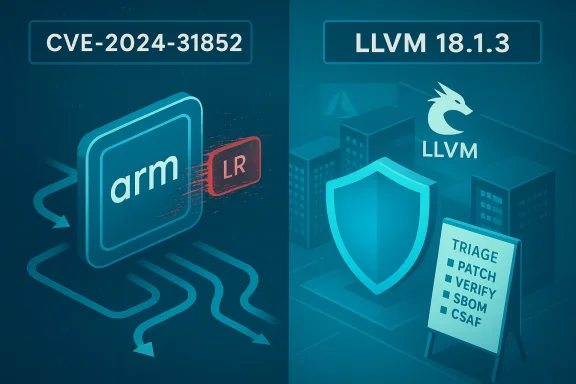
CVE‑2024‑31852 was assigned to a code‑generation bug in LLVM versions prior to 18.1.3 in which the ARM backend could produce sequences that clobber LR without first preserving its value onto the stack. That miscompilation can, in certain circumstances, convert a legitimate function into a subtle control‑flow corruption or a JOP‑like gadget, potentially enabling an exploit chain — though upstream maintainers and the original reporter have emphasized that the likelihood of a robust exploit is low because the miscompiled functions are likely to crash on ordinary inputs. The LLVM project released a targeted fix in LLVM 18.1.3 to address the bug.
Microsoft’s Security Response Center (MSRC) published a product‑level note mapping the vulnerable upstream component to Azure Linux (the Microsoft‑published Linux distribution/images) and included the standard FAQ language about Azure Linux being “potentially affected.” That wording is precise in one sense — it tells Azure Linux customers they should treat the Azure Linux images as in‑scope for triage and remediation — but it is not a proof that no other Microsoft product contains the same vulnerable upstream code. Large vendor inventories are assembled in phases; a single attestation usually reflects the artifacts the vendor has inspected so far. Microsoft has also committed to publishing machine‑readable CSAF/VEX attestations (and to updating CVE product mappings as they discover additional impacts), which helps automate triage for customers.
Why that matters in practice:
If you operate Azure Linux images, patch them now; if you consume Microsoft‑published kernel images or distributed images, verify the toolchain provenance and treat unverified artifacts as in‑scope for triage and remediation. The attestation is an important and actionable starting point — but good operational security requires you to validate and extend that work across your entire artifact landscape.
Source: MSRC Security Update Guide - Microsoft Security Response Center
 Background / Overview
CVE‑2024‑31852 was assigned to a code‑generation bug in LLVM versions prior to 18.1.3 in which the ARM backend could produce sequences that clobber LR without first preserving its value onto the stack. That miscompilation can, in certain circumstances, convert a legitimate function into a subtle control‑flow corruption or a JOP‑like gadget, potentially enabling an exploit chain — though upstream maintainers and the original reporter have emphasized that the likelihood of a robust exploit is low because the miscompiled functions are likely to crash on ordinary inputs. The LLVM project released a targeted fix in LLVM 18.1.3 to address the bug.Microsoft’s Security Response Center (MSRC) published a product‑level note mapping the vulnerable upstream component to Azure Linux (the Microsoft‑published Linux distribution/images) and included the standard FAQ language about Azure Linux being “potentially affected.” That wording is precise in one sense — it tells Azure Linux customers they should treat the Azure Linux images as in‑scope for triage and remediation — but it is not a proof that no other Microsoft product contains the same vulnerable upstream code. Large vendor inventories are assembled in phases; a single attestation usually reflects the artifacts the vendor has inspected so far. Microsoft has also committed to publishing machine‑readable CSAF/VEX attestations (and to updating CVE product mappings as they discover additional impacts), which helps automate triage for customers.
What CVE‑2024‑31852 actually is (technical summary)
How the bug appears in generated code
At a high level, the bug arises when the LLVM ARM code generator decides not to mark LR as restored or to omit the save/restore sequence across certain control‑flow patterns. On ARM (AArch32/AArch64 calling conventions differ, but the concept applies), LR commonly holds a return address. If code overwrites LR without saving it and later attempts to return, the program can resume at an unexpected address or execute corrupted control flow. In practice:- The compiler can generate a code path in which LR is clobbered prior to being pushed to the stack.
- If the clobbered LR is later used as a return address, control flow can jump to a controlled (or garbage) location.
- The resulting corrupted control flow may crash the process on most valid inputs, reducing exploitability, but there exist contrived patterns where a useful gadget is produced.
Exploitability: theory vs reality
Vendor and community commentary uniformly note that although a JOP gadget can be produced, practical exploitation is difficult. The reasons are:- The miscompiled function typically crashes on most valid inputs, making it liable to be detected during normal QA and testing.
- The gadget shapes are highly contextual: they depend on exact source patterns, optimization levels, and the target ARM sub‑architecture.
- Real‑world exploit chains require stable, predictable gadgets and reachable attacker control over inputs that steer execution into the gadget — a high bar.
Is Azure Linux the only Microsoft product that could be affected?
Short answer: No — not necessarily. Azure Linux is the only Microsoft product Microsoft has publicly attested to include the implicated upstream LLVM components for this CVE at the time of the advisory; that attestation is authoritative for Azure Linux but does not prove exclusivity. Absence of a public MSRC attestation for another Microsoft product is absence of evidence, not evidence of absence. Microsoft’s public guidance makes this distinction explicit: the wording explains Azure Linux is potentially affected and commits to updating product mappings if additional Microsoft artifacts are identified.Why that matters in practice:
- Microsoft distributes or publishes many artifacts that can embed or ship Linux binaries and libraries: Azure Marketplace images, AKS node images, linux‑azure kernel builds, the WSL2 kernel, CBL‑Mariner derived images, container base images, and engineering‑managed distributions used in cloud services.
- Any of these artifacts may carry upstream components — including compiler toolchains or runtimes — depending on how they were built, what packages were included, and the build timelines.
- Microsoft’s attestation about Azure Linux is a product inventory result that tells you which Microsoft product to treat as in‑scope for remediation right now; it doesn’t assert that other Microsoft products were exhaustively scanned, nor that they are definitely unaffected.
What to inspect inside your estate (practical triage steps)
If you operate systems or images that involve Microsoft‑published Linux artifacts, or you consume Microsoft images/VMs/containers, follow this prioritized checklist.1) Patch Azure Linux images immediately (if you run them)
- Apply the Azure Linux updates Microsoft issued for the relevant packages (clang/llvm/libcxx/rust toolchain packages).
- Confirm package versions: e.g., verify that installed LLVM toolchain packages are at 18.1.3 or later (upstream versioning) or at the fixed distributed package version supplied by Microsoft. Security‑scanner rules (Nessus, Snyk, distribution advisories) commonly flag older llvm‑toolchain packages.
2) Inventory Microsoft‑distributed kernels and images
- Identify any Microsoft artifacts you run that embed kernels or native libraries: WSL2 kernel images, linux‑azure / linux‑cloud kernels, AKS node images, Marketplace images, and any CBL‑Mariner‑derived components. These are the most probable places a vulnerable LLVM‑compiled binary might appear.
- For kernel artifacts: extract the kernel binary and check its build provenance (commit IDs, config, modules). For packaged distributions: list installed packages, e.g.:
- rpm -qa | grep -E 'llvm|clang|libcxx|rust'
- dpkg -l | grep -E 'llvm|clang|libcxx|rust'
- For container images: run a quick container scan that enumerates installed packages and their versions.
3) Search for suspicious compiled code patterns
- If you have the source and build logs, re‑build critical components with a fixed compiler or with a reproducible build process and compare outputs.
- When you can’t rebuild, use binary inspection to find evidence that vulnerable compilers were used (build IDs, .note.gnu.build-id, or vendor strings in ELF notes) and check package metadata.
4) Use SBOMs, VEX/CSAF data feeds and vendor attestations
- Ingest machine‑readable CSAF/VEX feeds where available and configure triage rules to map CVEs to product/artifact lists. Microsoft has committed to CS/AF VEX publishing (see MSRC guidance) to help automate this process. Do not treat the presence of a single attestation as exhaustive.
5) Apply the minimal mitigations until you can patch
- For exposed services: apply least‑privilege controls and runtime mitigations (W^X, control‑flow integrity, address space layout randomization) to raise the exploitation bar.
- For build environments: pin compilers to fixed versions that are known‑good and re‑build high‑value artifacts.
How to verify whether a given Microsoft artifact includes the vulnerable LLVM
Below are concrete verification steps you can run on a system or image. These are practical operational checks, not formal proofs, but they materially reduce uncertainty.- Check the package inventory for LLVM/Clang:
- On RPM systems: rpm -qa | grep -i llvm
- On DEB systems: dpkg-query -W | grep -i llvm
- Note installed version strings and validate upstream version numbers (look for 18.1.3 or later).
- For kernel modules and statically linked binaries:
- Use readelf or strings to search for build notes or toolchain markers.
- Inspect /proc/kallsyms or module directories to map modules to package names.
- For WSL2:
- If you use the Microsoft‑published WSL2 kernel, check the shipped kernel version and the kernel image metadata Microsoft publishes with each WSL kernel update.
- If you deploy custom WSL kernels, verify the toolchain used to build them.
- For containers and Marketplace images:
- Pull the image locally and enumerate installed packages; for container layers where package managers are stripped, look for package manifests or embedded rpm/deb metadata.
- Use vendor SBOMs where available; when not present, require image publishers to provide build metadata.
- Cross‑reference with vendor attestations:
- If Microsoft publishes a CSAF/VEX entry mapping the CVE to a product (e.g., Azure Linux), treat that product as in‑scope and follow the remediation guidance. If other Microsoft products are not listed, add them to an “unverified” slate and perform the checks above.
Corporate attestation vs artifact reality — reading Microsoft’s statement correctly
Microsoft’s MSRC phrasing — repeatedly used across many Linux CVE advisories — foregrounds transparency: “Azure Linux includes this open‑source library and is therefore potentially affected.” That wording does three things:- It tells Azure Linux customers that the product has been inventoried and found to include the upstream component mapped to the CVE.
- It commits Microsoft to update the CVE product mapping if further Microsoft artifacts are identified as affected.
- It does not assert that Microsoft surveyed every possible product or image — nor should readers infer exclusivity.
Risk analysis: strengths, weaknesses, and what defenders should watch for
Strengths (what reduces systemic risk)
- The bug is a compiler miscompilation; that inherently reduces the adversary surface compared with a remotely invoked memory corruption in a widely used service.
- The LLVM project fixed the issue promptly in a patch release (18.1.3), and downstream distribution maintainers (Debian, Red Hat, Microsoft image teams) have issued updates for packaged toolchains and images.
- Testing and QA traditionally reveal miscompilations (many miscompiles crash on valid inputs), and continuous integration pipelines that compile and run unit tests will likely catch many affected functions before deployment.
Weaknesses and remaining risks
- The vulnerability is supply‑chain in nature: if an attacker or a negligent build pipeline results in vulnerable LLVM binaries being used to build high‑value software, the resulting artifacts could carry the flaw to production across many platforms.
- Microsoft’s attestation for Azure Linux addresses one important set of images, but other Microsoft artifacts (custom kernels shipped to customers, Marketplace images, WSL kernels, container base images) can carry the same problem until explicitly inventoried and attested or patched.
- Automated detection of miscompilations is difficult; binary analysis rarely reveals a miscompile unless the original source or build logs are available. That makes artifact provenance and SBOMs crucial.
Operational recommendations
- Prioritize patching of Azure Linux images and any Microsoft‑distributed images you run. Azure Linux attestation is authoritative for those images and thus carries immediate remediation priority.
- For each Microsoft artifact you consume that could plausibly contain native code (kernel images, OS images, containers), perform the inventory checks outlined above and demand SBOMs or CSAF/VEX attestations where possible.
- Bake compiler version checks into your CI pipelines: treat compiler versions as first‑class build inputs, pin and verify them, and rebuild critical binaries using confirmed, fixed compilers if possible.
Practical detection and mitigation playbook (concise)
- If you run Azure Linux: update the llvm/clang/libcxx packages to Microsoft’s fixed package versions or to upstream LLVM 18.1.3+ equivalents. Confirm with your package manager that the target packages are installed and updated.
- If you run WSL2 or other Microsoft‑distributed kernels/images:
- Identify the kernel package and its version.
- Check the build provenance (commit IDs, vendor build notes).
- If you find evidence the kernel was built with an affected LLVM toolchain, plan a rebuild with a patched compiler or replace the image with a patched vendor artifact.
- For CI/CD build farms: ensure all build agents use fixed, approved compiler images; record build IDs and retain artifacts needed for forensic rebuilds.
- For binary‑only supply chains: request SBOMs and build metadata from third‑party vendors. If they cannot provide proof of a fixed toolchain, treat their binaries as unverified and demand recompilation.
Why this matters beyond a single CVE
Miscompilations are one of the more pernicious supply‑chain threats because they silently change semantics between source and binary. Unlike a vulnerable function in source that can be spotted by code review, a miscompiled binary can appear functionally correct under most paths yet introduce subtle control‑flow issues exploitable only in narrow circumstances. CVE‑2024‑31852 shows three broader lessons:- Vendor attestations are useful but must be operationalized. The presence of a single product mapping (Azure Linux) is an important remediation cue, but defenders must validate other artifacts.
- SBOMs, machine‑readable VEX/CSAF attestations, and reproducible builds materially reduce uncertainty and accelerate triage. Microsoft’s public commitment to CSAF/VEX publishing is a positive step for customers that adopt those feeds.
- Toolchain hygiene belongs in the same threat model category as patching runtime libraries: fix your compilers, pin your build agents, and treat build infrastructure as high‑value assets.
Conclusion
CVE‑2024‑31852 is a genuine miscompilation bug in LLVM’s ARM backend that was fixed in LLVM 18.1.3; Microsoft’s public notice that Azure Linux includes the implicated open‑source library and is therefore potentially affected is an authoritative, product‑scoped attestation that tells Azure Linux operators to act promptly. However, it is not proof that Azure Linux is the only Microsoft product that could contain the vulnerable component. Security teams should treat the MSRC attestation as high‑priority operational guidance for Azure Linux while simultaneously inventorying and verifying other Microsoft‑distributed artifacts (WSL2 kernels, Marketplace/AKS images, linux‑azure kernels, CBL‑Mariner derivatives and so on) using the concrete package and artifact checks described above. Demand SBOMs and CSAF/VEX feeds where possible, pin compiler versions in build pipelines, and re‑build or replace any artifacts that cannot be proven free of the vulnerable toolchain.If you operate Azure Linux images, patch them now; if you consume Microsoft‑published kernel images or distributed images, verify the toolchain provenance and treat unverified artifacts as in‑scope for triage and remediation. The attestation is an important and actionable starting point — but good operational security requires you to validate and extend that work across your entire artifact landscape.
Source: MSRC Security Update Guide - Microsoft Security Response Center
