

A subtle bug in the GNU C Library’s Name Service Cache Daemon (nscd) — tracked as CVE-2024-33601 — can cause nscd to abort when the netgroup cache hits a memory-allocation failure, producing a local denial‑of‑service that can ripple into authentication and name‑lookup failures for dependent services. Microsoft’s public advisory for this CVE states that Azure Linux includes the open‑source library and is therefore potentially affected, but that product-scoped attestation should not be read as a categorical guarantee that no other Microsoft product contains the same vulnerable component. Administrators must treat the statement as an authoritative inventory for Azure Linux while still verifying other Microsoft-supplied artifacts and images in their environment. s://nvd.nist.gov/vuln/detail/cve-2024-33601)
This wording has two important operational implications:
Key technical delta to note:
Source: MSRC Security Update Guide - Microsoft Security Response Center
 Background / Overview
What the bug is, technically
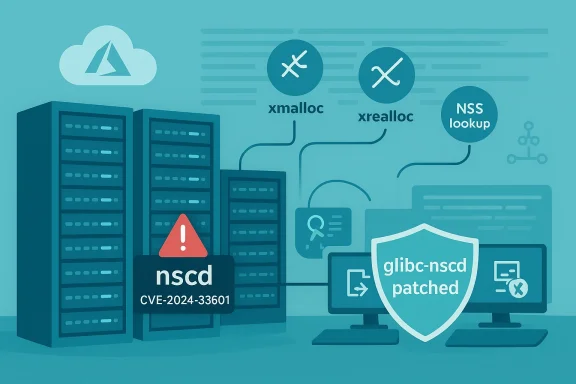
CVE-2024-33601 is a robustness flaw in the nscd binary (the Name Service Cache Daemon) that arises from the way the netgroup cache calls allocation helpers such asxmalloc and xrealloc. Those helpers will abort the process on allocation failure rather than returning a failure indication that nscd could handle gracefully. The result: under low-memory conditions a legitimate or crafted netgroup lookup can cause nscd to terminate, which creates a denial‑of‑service for clients that depend on cached name/group/host lookups. The vulnerability was introduced when the netgroup cache was added to nscd in glibc 2.15 and affects distributions shipping affected glibc/nscd binaries.Why this matters in operations
nscd is commonly used on multi‑user and networked Linux systems to accelerate name, user and group lookups. When nscd dies:- login and authentication operations that query NSS backends can stall or fail;
- services relying on group/netgroup-based access control (for NFS mounts, sudoers rules, or cluster membership) may behave incorrectly;
- automated tooling and orchestration that expect stable name resolution can see transient service failures.
What Microsoft’s advisory actually says — and what it does not
Microsoft’s update guidance for this CVE contains a short, factual FAQ line: “Azure Linux includes this open‑source library and is therefore potentially affected.” That is a product‑level inventory attestation: Microsoft has inspected and mapped the component into its Azure Linux product family and therefore identifies Azure Linux as a confirmed carrier for the upstream component implicated by the CVE. Microsoft also states it will publish CSAFe attestations) and update the CVE mapping should additional Microsoft products be found to ship the same component.This wording has two important operational implications:
- Strength: Microsoft’s attestation is actionable for Azure Linux customers — it removes ambiguity for defenders using the product and enables prioritized patching and remediation for the named product family.
- Limit: The attestation is scoped to Azure Linux. It is not a technical proof that other Microsoft artifacts, images, or products do not include the same vulnerable binary; absence of an attestation is not proof of absence. Customers running other Microsoft-supplied Linux artifactat those artifacts as potentially impacted until they are explicitly inventoried and attested.
Evidence Microsoft (and its Linux lineage) ships nscd
Two fact patterns are relevant to the question “Is Azure Linux the only Microsoft product that includes this library?”- Microsoft’s own CBL‑Mariner project (now rebranded as Azure Linux) historically provided and continues to provide a glibc subpackage for nscd. Microsoft’s package repository for the Mariner/Azure Linux lineage publicly lists
glibc-nscdRPMs in its package index, confirming that Microsoft’s distro supply chain includes the nscd binary. This makes Azure Linux an authoritative, confirmed carrier for the affected component. - Azure Linux is the successor / rebranding of the CBL‑Mariner distribution: Microsoft documents and public coverage confirm that the in‑house base distribution formerly called CBL‑Mariner is now distributed as Azure Linux and used as the optimized container host for AKS and other Azure services. Because Azure Linux originates from the CBL‑Mariner lineage, Microsoft-maintained CBL/Mariner packages (including glibc‑nscd) are a strong signal that Microsoft’s own base images and some Azure‑provided artifacts can carry nscd.
Cross‑vendor confirmations and patch status
This CVE is broadly tracked across Linux vendors and third‑party advisories. The NVD, Ubuntu, SUSE and multiple vendor security bulletins describe the same nscd netgroup cache issue and list affected glibc versions and vendor-specific package updates. Ubuntu has published fixes for the glibc/nscd packages across supported releases; SUSE, Oracle Linux and vendor ecosystems similarly treat nscd as the single affected binary within glibc and have pushed updates. Administrators should therefore treat the issue as widely relevant to any Linux distribution shipping an nscd subpackage compiled from glibc versions that introduced the netgroup cache.Key technical delta to note:
- The flaw was introduced in glibc 2.15 when the netgroup caching code was added to nscd.
- Vendor tracking and CVE metadata commonly list the affected range as glibc >= 2.15 up to the patched versions (many vendors mark < 2.40 as vulnerable, with the exact upper bound depending on the upstream release that incorporated the fix).
- Only the nscd binary is implicated; the rest of glibc and unrelated NSS consumers are not directly vulnerable in the same way, though operational impacts can be broader.
Practical threat model for Azure customers and Microsoft‑supplied images
Who should care most?- Teams running Azure Linux VMs, container hosts (AKS node images based on Azure Linux), Azure Marketplace images built from Azure Linux, or CI/CD pipelines using Azure‑branded base images.
- Customers running container images or appliances that were built from CBL‑Mariner / Azure Linux base layers, including some official Microsoft container images that have migrated to Azure Linux.
- Administrators who rely on nscd in user‑auth or network‑access sensitive contexts (NFS exports gated by netgroups, sudoers/netgroup rules, or legacy NSS configurations).
- Windows servers and native Windows subsystems that do not run Linux userspace.
- Microsoft services that run entirely on non‑Linux stacks unless those stacks embed an affected Linux image as a container host.
nscd was installed. Thus, WSL per se is not automatically excluded or included — it depends on the distribution image and installed packages. Administrators should audit the actual user images in use.Immediate remediation and detection steps — what to do now
If you operate Azure Linux or any Microsoft-provided image that could be built from the same base, do the following immediately.- Inventory: discover instances that ship an
nscdbinary and record versions. - Linux command to find the binary and package:
- Check presence:
which nscd || command -v nscd - Check package: for RPM-based Azure Linux/CBL‑Mariner:
rpm -qf $(command -v nscd)orrpm -qa | grep glibc-nscd - For Debian/Ubuntu:
dpkg -S $(command -v nscd)andapt-cache policy nscd
These package checks let you determine whether your instance has the affected nscd subpackage and its glibc version. (Vendor advisories show fixes landed in distribution glibc and nscd packages.) - Patch: apply vendor-supplied updates for glibc/nscd as soon as practical.
- On Azure Linux / CBL‑Mariner: run the distro package update path (tdnf/dnf) and upgrade
glibc/glibc-nscdto the patched releases your vendor advises. - For Debian/Ubuntu-based images, apply the security updates shown in Ubuntu’s advisory and reboot affected hosts where required. Ubuntu lists fixed package versions for each supported release in its security notice.
- Mitigate (if patching is delayed): disable nscd or restrict its use until patched.
- If nscd is not required by your workloads, stop and disable it:
systemctl stop nscd && systemctl disable nscd - If you rely on caching, consider short‑term alternatives such as
sssdor relying on the remote name service directly while you patch. - Monitor logs after disabling; some services may experience performance degradation that you should validate before a mass rollout.
- Image hygiene: rebuild or update any container images or VM images that use Azure Linux / CBL‑Mariner base layers.
- If you maintain custom Marketplace images, CI pipeline base images, or container images derived from Azure Linux, rebuild them from patched base layers and redeploy. Attackers do not need to get code into your image to exploit this — a benign low‑memory condition plus a netgroup lookup is sufficient to trigger a crash — so rebuilding images is the long‑term fix for immutable infrastructure.
- Monitor and harden: add runtime checks and alerting.
- Add alerts on
systemd/journalctlmessages for nscd exits and for NSS lookup failures. - Test critical authentication and NFS workflows after patching to ensure there are no regressions.
nscd.- Apply vendor security patches to
glibc/glibc-nscdimmediately. - If patching will be delayed, disable
nscdon non‑critical systems and transition to alternatives. - Rebuild container images and VM images derived from Azure Linux base layers.
- Monitor logs and add health alerts for
nscdrestarts/crashes.
Why Azure Linux being named matters — and why you shouldn’t assume exclusivity
Microsoft’s public attestation that “Azure Linux includes this open‑source library and is therefore potentially affected” provides two clear benefits:- It gives customers an immediate, authoritative place to start remediation for Azure Linux instances, and it signals Microsoft’s commitment to publish machine‑readable CSAF/VEX attestations that automate triage.
- It helps internprioritize patching of Azure Linux‑based images and Kubernetes node pools that use Azure Linux.
Critical analysis: Microsoft’s approach — strengths and open risks
Notable strengths
- Microsoft’s decision to publish product-scoped attestations and to adopt CSAF/VEX mechanisms is a net positive for customers; it enables automation for vulnerability triage and is a scalable approach as Microsoft’s portfolio of Linux-based artifacts grows. The explicit statement about Azure Linux removes guesswork for many defenders.
- By tracking and patching the underlying glibc subpackage in its distribution repositories, Microsoft can push updates into Azure Linux images and central package feeded, fast remediation for customers who consume official package updates. Evidence of
glibc-nscdpackages in Microsoft’s package repositories shows the company maintains the component and can ship fixes.
Potential risks and gaps
- The attestation model can create a false sense of security if defenders assume “no attestation = no exposure.” Microsoft’s current wording is correct but limited: it confirms Azure Linux and promises to expand the mapping if other Microsoft products are found affected — that necessarily leaves a window of uncertainty for other artifacts until an explicit attestation arrives. Security teams must therefore perform their own inventories for Microsoft-supplied images in their estates.
- Microsoft’s platform is large and diverse. A single vulnerability in a widely-distributed userspace binary can propagate through container bases, CI images, Marketplace images, AKS node pools, and bespoke appliance images. It’s operationally expensive to track every downstream derivative; that’s precisely why pipeline hygiene (rebuilding images from patched bases) and automated inventory (SBOMs, CSAF/VEX ingestion) are critical.
- For some organizations, the practical exposure surface is made worse by legacy reliance on
nscditself. Many modern Linux installations have alternatives (sssd, systemd-resolved) and have deprecated nscd, but legacy workloads may still depend on it. Vendors such as Fedora have signaled deprecation plans for nscd; organizations should plan migrations where possible.
Long‑term recommendations for defenders and platform owners
- Treat vendor attestations as actionable but scoped. Use them to prioritize, not to exclude other artifacts from triage.
- Adopt continuous SBOM and VEX/CSAF ingestion in your pipeline and vulnerability management tools so product-scoped attestations (like Microsoft’s Azure Linux mapping) are automatically used to drive remediations.
- Enforce image immutability and automated rebuilds: whenever a base image receives a security patch, automatically rebuild dependent VMs and containers and redeploy.
- Reduce reliance on nscd where practical: evaluate
sssdorsystemd-resolvedfor caching/name resolution to reduce attack surface and dependence on a legacy daemon that vendors are gradually deprecating. - Perform a focused audit of Azure-hosted Kubernetes clusters, Marketplace images, and any Azure CLI/docker base images; rebuild or patch them from updated Azure Linux base layers where required. Microsoft’s own tooling and community documentation show that Azure Linux is now the Azure container host base for AKS, making this an important operational step for AKS operators.
Conclusion
CVE-2024-33601 is a real, operationally meaningful robustness bug in the nscd binary that can cause denial-of-service when netgroup cache allocation fails. Microsoft’s advisory correctly identifies Azure Linux (the evolution of CBL‑Mariner) as a product that includes the implicated open‑source component and therefore as a confirmed carrier for remediation prioritization. However, that product-scoped attestation is not an exclusivity guarantee: other Microsoft artifacts built from the same base lineage or shipping theglibc-nscd subpackage may also carry the vulnerable binary until they are individually inventoried and patched. Administrators should immediately inventory for nscd, apply vendor patches, rebuild affected images, and harden operational monitoring — and should treat vendor attestations as an important tool for triage, not the final word on exposure.Source: MSRC Security Update Guide - Microsoft Security Response Center
