

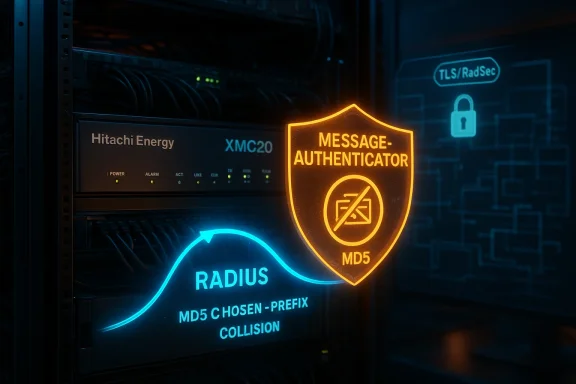
Hitachi Energy has confirmed that certain XMC20 multiservice communication platforms are exposed to a high‑severity RADIUS protocol forgery—tracked as CVE‑2024‑3596—when the devices are configured to use remote RADIUS authentication, and it is urging operators to enable RADIUS Message‑Authenticator verification immediately and apply vendor updates where available. s://nvd.nist.gov/vuln/detail/CVE-2024-3596)
Background
RADIUS (Remote Authentication Dial‑In User Service) is one of the oldest and most widely deployed AAA protocols for VPNs, Wi‑Fi, NAC (network access control), and a host of edge authentication services. The standard RADIUS Response Authenticator relies on an MD5‑based construction defined in RFC 2865; it was never designed to resist modern chosen‑prefix collision attacks against MD5. Researchers demonstrated practical chosen‑prefix MD5 collisions for real‑world protocols, and those weaknesses were weaponized against RADIUS response validation in 2024, producing CVE‑2024‑3596.Why this matters: an attacker with local network access (an on‑path or adjacent‑segment position) can intercept a legitimate RADIUS server reply—say, an Access‑Reject—and, by exploiting an MD5 chosen‑prefix collision, replace it with a forged Access‑Accept that still validates against the original Response Authenticator. That breaks authentication integrity and can lead to unauthorized network access, session tampering, or denial of service. Multiple independent trackers and vendors assigned high severity to the flaw because of its practical impact on authentication flows.
What Hitachi Energy is saying now
Hitachi Energy’s coordinated advisories and its PSIRT guidance identify affected product families and recommend immediate mitigations: enable the RADIUS Message‑Authenticator attribute in both the device and the RADIUS server, and apply vendor firmware updates where provided. The vendor’s short‑term remediation guidance mirrors industry practice: Message‑Authenticator enforcement stops the class of MD5 forgeries used in the attack, because it uses an HMAC construction that covers the whole packet and shared secret in a way not susceptible to the same chosen‑prefix collision technique.Key vendor recommendations summarized from Hitachi’s coordination materials:
age‑Authenticator** verification on the XMC20 and on the RADIUS server.
- If firmware updates are published for your XMC20 builthe vendor‑recommended upgrade per change control.
- If upgrade is temporarily impossible, segment and isolate RADIUS/management traffic and restrict trusted, hardened networks.
Technical analysis: how the forgery works and why Message‑Authenticator helps
The vulnerable primitive: MD5 Response Authenticator
RADIUS’s Response Authenticator is computed as MD5(Code | ID | Length | RequestAuthenticator | Attributes | Secret). That design once met practical needs, but MD5’s collision resistance has been broken for many years. Chosen‑prefix collision attacks take that further: an attacker can construct two different messages sharing the same MD5 digest by choosing different prefixes and carefully building colliding suffixes. For RADIUS, that enables an attacker to transform an Access‑Reject into an apparently valid Access‑Accept while preserving the original Response Authenticator value.Attack prerequisites and realistic constraints
This is not an unauthenticated Internet‑wide remote zero‑click exploit. Practical exploitation generally requires:- Layer‑2 or adjacent‑network access (same Wi‑Fi, compromised switch, provisioning network) so the attacker can observe and inject RADIUS responses.
- The ability to observe or influence attributes of the RADIUS exchange to craft colliding prefixes (some implementations and deployments make this easier than others).
- Sufficient compute to generate the chosen‑prefix collision; real‑world demonstrations show this is feasible in minutes on modern hardware for the RADIUS packet sizes involved.
Why Message‑Authenticator stops the forgery
The RADIUS Message‑Authenticator attribute (defined in RFC 2869 / RFC 3579) places an HMAC‑MD5 over the entire packet and the shared secret in a way that cannot be trivially coerced into a chosen‑prefix collision because the HMAC construction uses the secret as part of the keyed hash input. In practice, enforcing Message‑Authenticator requires the client and server to both send/validate the attribute; that means an attacker cannot produce a forged reply that satisfies both the legacy Response Authenticator and the Message‑Authenticator without knowing the shared secret. For that reason vendors (including Hitachi) and server maintainers converged on enabling Message‑Authenticator as the fastest, least disruptive operational mitigation.Which XMC20 versions are impacted — and what to check now
Hitachi’s advisory materials (the vendor coordination packages distributed with CISA/CSAF entries and internal advisories) indicate that XMC20 instances configured to use remote RADIUS authentication can be impacted by the CVE‑2024‑3596 RADIUS forgery, depending on firmware build and whether Message‑Authenticator enforcement is enabled. The vendor has published device‑specific commands and MIB controls to enable Message‑Authenticator checking; operators must confirm both ends of the RADIUS exchange are configured to use and verify the attribute.Operational checklist — what to check on every XMC20 in your estate:
- Does the device use RADIUS for authentication (VPN, management, Wi‑Fi, or Afic forgery vector may not apply — but review related advisories for other XMC20 issues.
- If yes, is the RADIUS peer exchanging the Message‑Authenticator attribute and does the XMC20 enforce it? If not, enable enforcement immediately (use the vendor CLI/MIB per advisory).
- Confirm RADIUS server(s) accept Message‑Authenticator and will reject reslidate. Update freeRADIUS or vendor RADIUS implementations as needed.
- Inventory firmware versions and compare to Hitachi’s fixed firmware guidance; schedule upgrades via normal change control where updates are published.
Step‑by‑step mitigation and verification (prescriptive)
Below is a practicallan you can follow now. Adopt it into your change control and maintenance windows where necessary.- Immediate triage (within hours)
- Inventory devices that use RADIUS for authentication: recoare, management IP, and RADIUS peers.
- For any XMC20 that uses RADIUS, verify whether Message‑Authenticator enforcement is enabled on both the device and RADIUS server. If either side does not enforce it, enable enforcement now.
- Short window remediation (24–72 hours)
- Confirm the RADIUS server implementation (freeRADIUS, vendor appliance, cloud service) supports Message‑Authenticator enforcement anf necessary.
- Where enabling Message‑Authenticator causes interoperability issues, isolate the affected device(s) to VLAN and restrict RADIUS to a hardened jump host.
- Medium‑term hardening (1–4 weeks)
- Schedule vendor firmware upgrades for XMC20 builds identified as fixed by Hitachi (follow vendor bulletin guidance). Test in staging before mass rollout.
- Where possible, transition RADIUS transport to TLS (RadSec / RADIUS over TLS) or adopt EAP‑TLS for o remove UDP MD5 integrity primitives altogether.
- Defensive posture and monitoring (ongoing)
- Segment and firewall management and RADIUS traffic; whitelist only authorized RADIUS peers.
- Enable logging and anomaly detection for RADIUS responses, watch for unexpected Access‑Accept events or duplicate responses. Consider integrating RADIUS logs into SIEM/OT monitoring systems.
Strengths of the vendor guidance — and the gaps
Strengths
- Hitachi’s guidance aligns with industry best practice: requiring Message‑Authenticator verification is the fastest and most pragmatic mitigation that preserves legacy RADIUS while addressing the immediate cryptographic weakness. Multiple vendors independently issued similich reinforces its practicality.
- The vendor supplied CLI and MIB examples for enabling Message‑Authenticator on affected product families, enabling operators to enact the mitigation quickly without waiting for disruptive firmware upgrades.
Gaps and residual risks
- Enforcing Message‑Authenticator requires RADIUS client (the XMC20) and the RADIUS server must support and verify the attribute. In heterogeneous estates, server upgrades or client updates may be needed, and until both sides align there remains residual risk.
- The mitigation is a configuration hardening, not a cryptographic modernization. MD5 remains present in RADIUS legacy fields; longer term, network operators should migrate sensitive authentication flows to encrypted transports (RadSec or TLS) or modern EAP methods. Vendors should prioritize protocol modernization rather than configuration band‑aids.
- Some XMC20 firmware lines and related Hitachi products have multiple, overlapping advisories (path traversal, certificate validation, other CVEs). An asset may be vulnerable in more than one way; patch programs must be comprehensive and coordinated.
Realistic threat scenarios and operational impact
- Unauthorized access to control or network management planes: a forged Access‑Accept could grant an attacker access to VPN endpoints or management interfaces, letting them pivot into OT systems. The downstream impact in transport or energy networks can be severe.
- Denial of service for legitimate users: attackers can forge Access‑Rejects to block operators or engineers from logging in to essential systems, disrupting maintenance windows or emergency responses.
- Bypass or subversion of multi‑factor flows: altering Access‑Challenge/Response sequences could interfere with interactive second‑factor mechanisms or misdirect authentication tokens.
Cross‑referencing and verification
Multiple independent sources corroborate the technical root cause and the efficacy of Message‑Authenticator enforcement:- National vulnerability databases and vendor advisories document CVE‑2024‑3596 as an MD5 chosen‑prefix collision against RADIUS Response Authenticator.
- Major networking vendors and product advisories explain the attack mechanics and list enabling Message‑Authenticator or migrating to TLS as primary mitigations.
- Hitachi’s coordination materials and vendor‑level advisories explicitly recommend enabling Message‑Authenticator and provands and MIB names for affected models.
Practical considerations for OT/ICS teams
- Change‑control discipline: schedule configuration changes (Message‑Authenticator enablement) via your established maintenance windows, test on a non‑production unit first, and prepare rollbacks. Document everything.
- Interoperability tests: enable Message‑Authenticator r and validate client compatibility. If a legacy client cannot be updated, place it on an isolated management VLAN rather than relaxing server enforcement.
- Defense‑in‑depth: use network segmentation, allow‑listing, bastion hosts, and strict firewall policies to reduce the number of hosts that can exchange RADIUS traffic with XMC20 devices. Logging and SIEM/OT monitoring should flag atypical RADIUS responses.
- Long‑term roadmap: plan migrations to RadSec/RADIUS‑over‑TLS or to mutual‑TLS EAP methods where feasible. This removes UDP MD5 from the equation and provides cryptographic integrity and confidentiality guarantees native to TLS.
Conclusion
CVE‑2024‑3596 exposed a systemic weakness in the way legacy RADIUS used MD5 to guard response integrity. For organizations operating Hitachi Energy XMC20 devices that use remote RADIUS authentication, the immediate, vendor‑endorsed action is clear: enable RADIUS Message‑Authenticator on both devices and RADIUS servers now, verify interoperability, and patch firmware per Hitachi’s guidance when updates are available. These steps neutralize the practical forgery vector and buy crucial time to implement more robust, modern authentication transports.The vulnerability is a timely reminder: cryptographic primitives that were once ubiquitous—MD5 included—should not be treated as permanent defenses. In OT environments especially, operational constraints and long device lifecycles make coordinated, pragmatic mitigations the priority; however, long‑term protocol modernization and strict network segmentation remain the enduring answers to prevent this class of attack from recurring.
Stay methodical: inventory, enable Message‑Authenticator, isolate any non‑compliant peers, schedule tested firmware upgrades, and monitor RADIUS telemetry. For XMC20 operators in energy, rail, and transport networks, these steps should be treated as a security imperative rather than a discretionary hardening task.
Source: CISA Hitachi Energy XMC20 | CISA
