

Microsoft’s public mapping for CVE-2024-39484 correctly flags Azure Linux as a product that “includes this open‑source library and is therefore potentially affected,” but that carefully worded statement is a product‑scoped inventory attestation — not a technical guarantee that no other Microsoft product, image, or kernel artifact could contain the same vulnerable code.
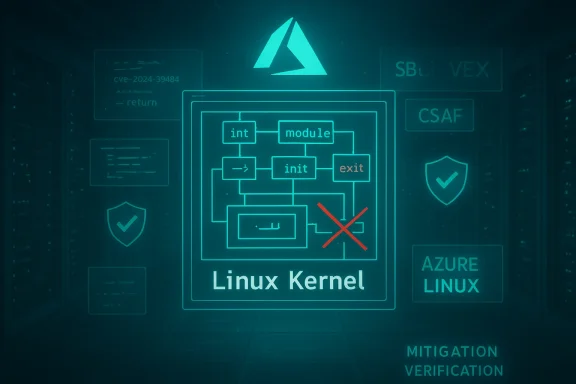
CVE‑2024‑39484 is a Linux kernel defect in the MMC DaVinci driver family. The problem arises because the driver’s cleanup callback (the driver’s remove function) was declared with the kernel’s exit attribute, which lets build systems strip the function out when the driver is compiled into the kernel rather than built as a loadable module. If the remove function is discarded, unbinding the device at runtime — through sysfs, hotplug, or similar mechanisms — will remove the driver without executing its cleanup path, producing resource leaks and potential stability or availability issues. This change was fixed upstream by removing the exit annotation so the remove callback is retained regardless of build configuration.
The kernel‑level nature of this CVE matters for the inventory question. The vulnerable code is upstream in the Linux kernel tree; whether a given downstream product is affected depends on which kernel source version it ships and how that kernel was configured and packaged. Independent distribution trackers have recorded the issue and its fix, and vendors have rolled the upstream commit into their kernel packages.
Why this matters practically:
However, there are operational risk points and residual blind spots worth calling out:
By combining vendor attestations with artifact‑level checks and rapid patching, organizations can move from uncertainty to control — and that’s the practical outcome everyone should be aiming for now.
Source: MSRC Security Update Guide - Microsoft Security Response Center
 Background / Overview
CVE‑2024‑39484 is a Linux kernel defect in the MMC DaVinci driver family. The problem arises because the driver’s cleanup callback (the driver’s remove function) was declared with the kernel’s exit attribute, which lets build systems strip the function out when the driver is compiled into the kernel rather than built as a loadable module. If the remove function is discarded, unbinding the device at runtime — through sysfs, hotplug, or similar mechanisms — will remove the driver without executing its cleanup path, producing resource leaks and potential stability or availability issues. This change was fixed upstream by removing the exit annotation so the remove callback is retained regardless of build configuration.The kernel‑level nature of this CVE matters for the inventory question. The vulnerable code is upstream in the Linux kernel tree; whether a given downstream product is affected depends on which kernel source version it ships and how that kernel was configured and packaged. Independent distribution trackers have recorded the issue and its fix, and vendors have rolled the upstream commit into their kernel packages.
What Microsoft actually said — and why the phrasing matters
Microsoft’s Security Response Center (MSRC) entries for a set of Linux kernel CVEs have adopted a standardized FAQ paragraph: “Azure Linux includes this open‑source library and is therefore potentially affected by this vulnerability.” That language signals two things simultaneously:- It confirms Microsoft performed an inventory check for the Azure Linux product family and found the upstream component mapped to the CVE. That makes Azure Linux images a known, confirmed carrier and gives customers a clear, authoritative remediation signal.
- It does not say “only Azure Linux” or “no other Microsoft product is affected.” The wording is deliberately scoped to a product — and MSRC has committed to expanding its machine‑readable CSAF/VEX attestations over time and to update CVE mappings if other Microsoft products are discovered to ship the same component.
Why Azure Linux is the first (and naturally obvious) place to flag this CVE
There are practical reasons MSRC begins with Azure Linux when publishing attestations for many open‑source CVEs:- Azure Linux is Microsoft’s curated Linux distribution and the product most directly endor distro packages; it presents a clear, bounded surface for inventory checks.
- The Azure Linux build and packaging pipeline is under Microsoft’s control, so Microsoft can relatively quickly answer “does this image include that upstream file/driver?” and publish a VEX/CSAF attestation.
- From a customer perspective, Azure Linux users need an authoritative signal so they can patch and mitigate immediately, which is exactly what the MSRC line provides for the product family.
Technical anatomy of CVE‑2024‑39484 (what happened in the driver)
The __exit macro and why it matters
In the Linux kernel build system, the exit annotation marks functions that are only needed when a driver is built as a loadable module. The build system places such functions into a special section that can be discarded when a driver is built into the main kernel binary. For a driver’s remove callback, however, discarding the function while the driver structure still references it is incorrect: the kernel relies on that remove function for runtime cleanup when devices are unbound. The mismatch produces a modpost warning and, more importantly, a real‑world logic hole where cleanup does not execute. The upstream fix was to stop marking the remove function with exit, ensuring it’s compiled into the kernel image in all configurations.Real‑world impact profile
- Primary technical consequence: resource leaks (memory, DMA mappings, IRQs, device state) when a DaVinci MMC device is unbound without the remove callback running.
- Practical outcomes: over time, leaked resources can degrade system stability and availability, especially on long‑running embedded or IoT systems that frequently hotplug/unbind devices. The issue is not, on its face, a remote code execution or direct privilege escalation bug, but leaked resources can be weaponized for denial‑of‑service in some scenarios. Distributors and security trackers have rated the issue in the medium severity range (CVSS 5.5) because the principal impact is availability.
So — is Azure Linux the only Microsoft product that contains the vulnerable code?
Short answer: No — not necessarily. Longer, operationally useful answer: Microsoft has publicly attested that Azure Linux includes the implicated upstream kernel component and is therefore potentially affected, and that attestation is authoritative for Azure Linux images; but because the vulnerable code is upsy* Microsoft artifact that ships a Linux kernel built from the same upstream commit range and configuration could also include the driver and therefore be potentially affected until Microsoft or another party explicitly inventories and attests otherwise. ([archive.p/2025.12.07-194621/https%3A/msrc.microsoft.com/update-guide/vulnerability/CVE-2024-26914)Why this matters practically:
- Microsoft ships many kernel‑bearing artifacts beyond Azure Linux: WSL2 kernel builds, curated Marketplace VM images, linux‑azure kernel packages, container base images, appliance images, and possibly internal images used by managed services. Each of those artifacts may be built from a different kernel tree and with different CONFIG flags; presence or absence of CONFIG_MMC_DAVINCI (or the precise driver files) is a per‑artifact question.
- Because MSRC’s wording is product‑scoped, security teams should use it as an actionable yes for Azure Linux and as a trigger to inventory other Microsoft artifacts they run. Treat un‑attested Microsoft artifacts as “not yet checked” rather than “not affected.”
How to verify whether a given Microsoft artifact you run is affected
If your environment uses any Microsoft‑supplied images, appliances, or kernels, follow this practical verification checklist:- Identify Microsoft artifacts in use:
- WSL2 kernels distributed by Microsoft.
- Marketplace VM images and vendor images used in Azure subscriptions.
- Linux kernel packages included in any Microsoft container base images.
- Any Microsoft‑distributed appliance, firmware bundle, or downloadable kernel binary.
- For images you can run, inspect at runtime:
- Check for the driver under /sys/bus/platform/drivers or search for “davinci” in the running kernel source tree or /proc/modules.
- If you can read the running kernel’s config (e.g., /proc/config.gz), search for CONFIG_MMC_DAVINCI or equivalent flags.
- Search the kernel tree installed rs/mmc/host/davinci_mmc.c or the davinci driver filename.
- For binary packages:
- Use the vendor’s SBOM, VEX/CSAF attestations, or package manifest to locate whether the kernel package version includes the upstream commit or contains the davinci driver.
- If no SBOM is available, use offline inspection tools against the image or package to search for the string “davinci” or the driver object.
- For WSL2:
- Microsoft publishes WSL2 kernel sources and builds; inspect the published kernel source or the WSL kernel binary used in your tenant to verify whether the driver is present and how it’s configured.
- If an artifact is immutable (managed appliance, closed image) and you cannot inspect it, treat it as unknown and contact Microsoft support or rely on Microsoft’s VEX/CSAF updates as they are published.
- Look for kernel warnings like the modpost message referencing section mismatch; that was the upstream symptom flagged by compile‑time checks.
- Search for the symbol or driver filename inside the kernel image or package. If the driver is absent entirely, the artifact is not affected; if present and built‑in, check whether the remove function is compiled in (this typically requires source build inspection).
Recommended remediation and mitigation steps
- Prioritize updates for Azure Linux images immediately, per MSRC’s attestation. Microsoft’s attestation gives Azure Linux operators a direct, short path to remediation: update the Azure Linux kernels or images as Microsoft publishes the patched packages.
- For other Microsoft artifacts you run (WSL2, Marketplace images, linux‑azure kernels): run the verification checklist above. If the driver is present, treat the artifact as in‑scope and apply the equivalent upstream patch or vendor patch as soon as it becomes available.
- If patching is temporarily impossible, mitigate the operational pathways that trigger unbinds or hotplug events for the DaVinci MMC device class (practical mitigations depend on the environment — for some embedded systems, disabling hotplug or avoiding runtime unbinds may limit exposure).
- Where possible, reboot to a patched kernel image after applying fixes; if the fix involved a patch to a built‑in driver, the kernel must be rebuilt or vendor‑supplied kernel packages must be updated and installed.
- Maintain inventory hygiene: collect SBOMs and VEX/CSAF attestations (Microsoft started publishing VEX/CSAF attestations beginning with Azure Linux) and use them to reduce blind spots. MSRC’s transparency initiative will make machine‑readable attestations more broadly available over tiF checks into your patch‑management pipeline.
Why vendor attestations alone are not the wanalysis)
Microsoft’s approach — inventory the most exposed product (Azure Linux), publish an attestation, and expand VEX/CSAF over time — is a clear and pragmatic transparency improvement. It both reduces the noise for Azure Linux customers and provides machine‑readable siooling. That is a notable strength, and it aligns with emerging industry best practices for supply‑chain transparency.However, there are operational risk points and residual blind spots worth calling out:
- Attestations are only as useful as the artifacts they cover. Microsoft’s attestation is authoritative for the product it names; it cannot certify the contents of images or kernels it arge vendors ship many artifacts — each is a separate inventory problem. Treating a single attestation as a global statement is a dangerous shortcut.
- Kernel features and drivers are conditional on build configuration. Two artifacts can be built from the same upstream commit and yet differ in whether a driver is present or built as a module vs built‑in. That makes per‑artifact inspection necessary for accurate risk assessment.
- Machine‑readable attestations improve speed, but they do not eliminate the need for inde In environments with strict compliance needs, organizations should combine vendor VEX/CSAF attestations with internal SBOMs, runtime scans, and boot‑time checks.
Practical playbook for security teams (step‑by‑step)
- Treat Microsoft’s attestation for Azure Linux as your highest‑priority action item: identify Azure Linux images and patch them first.
- Run the verification checklist across all Microsoft artifacts in your environment (WSL2, Marketplace images, linux‑azure kernels, container images).
- For any artifact you control, apply the upstream patch or vendor kernel update and reboot where necessary. Confirm the patched kernel no longer contains the vulnerable code path.
- If you operate immutable or managed appliances, open a support ticket with Microsoft and request either an explicit VEX/CSAF attestation for that artifact or an indication of when the artifact will be inventoried. Use the vendor’s published VEX/CSAF as the canonical source when it becomes available.
- Update detection rules and monitoring to flag modpost compile warnings or the presence of the davinci driver in kernels that you did not expect to contain it. (cve.news)
Final assessment: what organizations need to do now
- Azure Linux customers: act now. Microsoft has attested Azure Linux as a carrier; apply vendor updates or follow Microsoft’s published guidance.
- Operators of other Microsoft artifacts: assume uncertainty and verify. Do not assume “no news” equals “no issue.” Inventory and inspect every Microsoft kernel image or binary in your environment.
- Security teams: integrate VEX/CSAF, SBOMs, and automated image scanning into your patching workflows so that the next vendor attestation can be correlated and acted on immediately. Microsoft’s VEX rollout for Azure Linux is a positive step; adopt tooling that consumes those attestations as they are published.
Closing thoughts
CVE‑2024‑39484 is a tidy example of how a small kernel build‑time attribute can produce non‑obvious runtime consequences. Microsoft’s decision to publish product‑scoped attestations starting with Azure Linux gives customers a fast, authoritative signal — but it is not a universal guarantee. The operational reality for defenders is simple: treat the MSRC attestation as an authoritative yes for Azure Linux, and then do the work to verify every other Microsoft image and artifact you run. That verification — using SBOMs, VEX/CSAF, runtime inspection, and vendor engagement — is the only reliable way to close the remaining blind spots.By combining vendor attestations with artifact‑level checks and rapid patching, organizations can move from uncertainty to control — and that’s the practical outcome everyone should be aiming for now.
Source: MSRC Security Update Guide - Microsoft Security Response Center
