

Das U-Boot's DHCP code contains a subtle but dangerous buffer overread that has been tracked as CVE-2024-42040: an attacker on the local or adjacent network can feed crafted DHCP responses that cause net/bootp.c to copy memory beyond the received packet, leaking between 4 and 32 bytes of host memory depending on which DHCP option is later used and transmitted. This problem is present in U-Boot code tracing back to the initial 2002 revision and has been publicly disclosed, analyzed, and cataloged by multiple vendors and security teams.
U-Boot (Das U-Boot) is the universal boot loader used in countless embedded devices, appliances, network gear, and custom SoCs. Its DHCP/BOOTP client code lives in net/bootp.c and implements minimal DHCP parsing to obtain network boot parameters. During a security review, researchers at SCHUTZWERK found that some vendor‑option parsing code — specifically the functions invoked when the VENDOR_MAGIC signature is present in the vendor field — calculates and walks buffer boundaries incorrectly and then copies option payloads without proper bounds checks. The result: a buffer overread that can read memory immediately following the received packet and, because those parsed values are later used or echoed in network traffic (hostname, gateway, DNS server IPs, etc.), leak that memory back to the attacker.
Why this matters in practice:
Important technical specifics verified in multiple trackers:
A measured operational note: while this vulnerability is not a remote code execution (RCE) by itself, the ability to observe runtime memory from the bootloader is a powerful primitive for attackers targeting high-value embedded infrastructure.
This incident reinforces several broader lessons:
In closing, CVE-2024-42040 is an important, remediable vulnerability: it exposes a critical operational surface in U-Boot’s DHCP handling that can leak memory to an adjacent attacker. The vulnerability has been responsibly disclosed, documented, and fixed upstream; the immediate, non‑technical work for device makers and operators is to get patches into product images and to reduce exposure on provisioning networks until that work is complete. For defenders, this is a timely reminder that the boot path deserves the same threat modeling and patch discipline applied to operating-system and application code.
Source: MSRC Security Update Guide - Microsoft Security Response Center
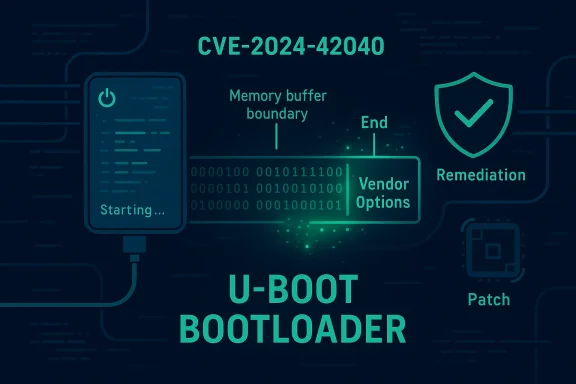 Background / Overview
U-Boot (Das U-Boot) is the universal boot loader used in countless embedded devices, appliances, network gear, and custom SoCs. Its DHCP/BOOTP client code lives in net/bootp.c and implements minimal DHCP parsing to obtain network boot parameters. During a security review, researchers at SCHUTZWERK found that some vendor‑option parsing code — specifically the functions invoked when the VENDOR_MAGIC signature is present in the vendor field — calculates and walks buffer boundaries incorrectly and then copies option payloads without proper bounds checks. The result: a buffer overread that can read memory immediately following the received packet and, because those parsed values are later used or echoed in network traffic (hostname, gateway, DNS server IPs, etc.), leak that memory back to the attacker.Why this matters in practice:
- Bootloaders run very early in device startup where firmware or OS-level protections (like strong process isolation) are not in place. Leaks at this layer can expose firmware state, stack data, or pointers that make later attacks easier.
- Devices using network boot or receiving DHCP offers from untrusted networks are exposed to an on‑path or adjacent attacker that can respond faster than a legitimate DHCP server.
- Embedded devices often have limited update channels, long lifecycles, and are used in sensitive infrastructure; a U-Boot issue has wide ripple effects across many product lines and supply chains.
The technical root cause—what exactly goes wrong
At a high level, CVE-2024-42040 is a classic buffer overread caused by three cooperating mistakes in net/bootp.c:- The handler checks for the VENDOR_MAGIC signature but passes the total packet length into vendor-processing routines instead of computing the remaining vendor buffer size, which means later pointer arithmetic uses an overly generous end boundary.
- A loop in bootp_process_vendor advances a pointer (ext) searching for option markers without verifying it stays within the actual vendor-region limit; because the end is miscomputed, ext can run past the vendor-buffer and into adjacent memory.
- When a non-zero option is found, bootp_process_vendor_field reads the option type from ext[0] and length from ext[1] and proceeds to copy ext+2 into destination variables (gateway, DNS, hostname, etc.) without validating that ext+1 and ext+2 lie within the packet frame or that the declared length is sane relative to the remaining bytes.
Important technical specifics verified in multiple trackers:
- Memory leak size depends on which field is used: gateway/DNS options yield ~4 bytes, hostname can expose ~32 bytes, and under some degenerate zero‑filled vendor payloads the parsing loop can continue and expose more structured memory if specific byte sequences appear.
Scope: which devices and versions are affected
This is a vulnerability in the upstream U-Boot code (the DENX project). The advisory and subsequent vendor tracking indicate the flaw has existed since U-Boot’s initial 2002 revision and therefore touches many downstream builds and product images that incorporate vulnerable net/bootp.c code. The practical exposure depends on product configuration:- Devices that include the DHCP client code path in their U-Boot build and actually send DHCP requests during boot are exposed.
- Devices booting in networks where an attacker can respond to DHCP requests (local networks, adjacent networks, untrusted Wi‑Fi/LANs) are the realistic threat surface.
- Systems that never enable network boot or that compile U-Boot without the relevant DHCP/VENDOR option code are not affected.
Exploitability and real-world impact
Exploitability profile- Attack vector: Adjacent/Local — attacker must be on the broadcast domain and able to respond to DHCP requests faster than the legitimate DHCP server, or sit in a position to inject a forged DHCP OFFER/ACK.
- Privileges: None required — the attacker only needs network access, not credentials on the device.
- Complexity: Low to moderate — crafting DHCP responses is straightforward; the main challenge is timing (race) and ensuring the option parsing path is reached during boot.
- Impact: Confidentiality (information disclosure) — direct leak of small amounts of memory (4–32 bytes commonly); secondary impacts are possible if leaked bytes reveal pointers or secrets that allow a subsequent exploit chain.
- Small, deterministic leaks can reveal kernel or firmware pointers, configuration data, or cryptographic nonces that defeat address space layout randomization or bootstrap trust.
- In embedded devices, leaked memory may include device-specific secrets or pointers that reveal firmware layout, aiding targeted exploitation later in the chain.
A measured operational note: while this vulnerability is not a remote code execution (RCE) by itself, the ability to observe runtime memory from the bootloader is a powerful primitive for attackers targeting high-value embedded infrastructure.
Detection and forensic signals
Detecting active exploitation at the network level is possible but not foolproof:- Look for unexpected DHCP offer/ACK messages during boot that originate from non‑standard MAC addresses or multiple fast replies after a boot request.
- Packet captures collected from the network during device boot can prove whether a malicious DHCP OFFER was received.
- On-device logs (if U-Boot logging is enabled or captured via serial console) may show unusual DHCP option contents being set; many embedded devices do not persist such logs unless a serial or debug console is used.
- Enable serial console capture for representative devices during provisioning and during early-boot troubleshooting.
- Correlate packet captures with device boot times to detect suspicious DHCP offer races.
- If feasible, instrument boot images in staging to reject or log vendor options that look malformed before they reach production assets.
Mitigation and remediation guidance
Short-term mitigations (while you plan upgrades)- Isolate provisioning networks: ensure devices that perform network boot or DHCP during provisioning are on a trusted, controlled VLAN where unauthorized DHCP servers cannot answer.
- Disable network boot where not required: if devices don't need DHCP at boot, disable or restrict the U-Boot DHCP/BOOTP client in customized builds.
- Use network access controls: block or rate-limit DHCP responses from unexpected subnets/hosts in the provisioning network.
- Upstream disclosure and downstream trackers indicate a patch was produced and included in later U-Boot releases; vendor and package sources list fixed builds or recommend upgrading to U-Boot versions in the 2026.01 series (Snyk flags 2026.01-rc1 or later as containing a fix). Embedded distribution manifests also list "u-boot: fix CVE-2024-42040" in recent 2026‑era images. Operators should update to the patched upstream release or to a vendor-supplied image that explicitly lists the CVE as resolved.
- Inventory: identify devices that use U-Boot with DHCP and record U-Boot versions and build-time configuration for net/bootp.c usage.
- Isolate: move provisioning and management interfaces onto a protected management VLAN until devices can be upgraded.
- Patch: obtain vendor images or rebuild U-Boot from a patched upstream tag (or apply the targeted patch from the advisory into your in-house U-Boot tree) and test in staging.
- Validate: boot a test device in a controlled lab and confirm malformed DHCP offers no longer cause out-of-bounds parsing or produce unexpected option contents.
- Deploy: schedule controlled rollouts and maintain serial console capture for initial devices to ensure no regression in boot behavior.
- Many embedded vendors ship customized U-Boot trees and may not expose a straightforward update path. If you are a device manufacturer, incorporate the upstream patch into your vendor tree and push firmware updates to customers.
- For device fleets managed by third parties or OEMs, insist on CVE-tracking and firmware update commitments; where vendors decline to patch, isolate those devices on trusted networks.
What the patch does (high-level)
The upstream patch is straightforward and defensive:- Compute the vendor buffer end using the actual vendor buffer size (packet length minus headers) rather than the total packet length.
- Ensure the search loop that advances ext cannot move past the vendor buffer boundary.
- In bootp_process_vendor_field, validate ext+1 and ext+2 and ensure any declared length is within the bounds of the vendor buffer before copying into destination structures.
These changes remove the out‑of‑bounds read window and make copying operations guarded and predictable. The SCHUTZWERK advisory prescribes precisely such fixes; downstream maintainers implemented defensive bounds checks accordingly.
Risk assessment and critical analysis
Strengths of the disclosure and fixes- The advisory is clear, reproducible, and includes precise code-level diagnosis and mitigation steps; that transparency helps downstream integrators create safe patches quickly.
- The fix is small and non-invasive: it corrects buffer length calculations and adds boundary checks rather than redesigning interfaces, which makes backporting and vendor integration feasible even for conservative product teams.
- Multiple independent trackers and commercial scanners (Ubuntu, Snyk, Wiz, Debian trackers) documented the CVE and propagated remediation guidance, helping reach a broad OEM audience.
- Update lag: U-Boot is embedded across thousands of products; many devices have slow or no update channels, meaning vulnerable images will persist in the wild for months or years. Distributors that package upstream U-Boot (Linux distributions, Yocto layers, vendor BSPs) may lag in integrating the fix. Operators should assume long tail exposure and plan for network isolation where devices can’t be patched.
- Limited immediate telemetry: because this runs at bootloader time, common security telemetry systems (endpoint agents, EDR) won’t capture exploit attempts. Detection depends on network packet captures and serial consoles that many organizations do not collect systematically.
- Secondary chaining: although the bug itself leaks small memory chunks, in the hands of a skilled adversary a targeted leak (for example, a leaked pointer or MAC) can enable more powerful follow-on attacks. History shows that small, deterministic information leaks frequently become the critical first stage in multi-step exploit chains. Kernel and firmware advisories contain analogous cases where pointer leaks defeated mitigations — a cautionary parallel for defenders.
- High priority for devices that perform network boot in hostile or semi-trusted networks (factory / field provisioning, remote branches, shared Wi‑Fi).
- Medium priority for fixed-installation appliances that still receive network-based configuration at boot but are behind trust boundaries.
- Low priority for devices that never use DHCP in U‑Boot or where the bootloader has network features compiled out — but verify by inspecting build configs.
Responsible disclosure and timeline
SCHUTZWERK responsibly disclosed the issue and published SCHUTZWERK-SA-2024-004, which contains technical details and a suggested mitigation. Public advisories and vendor trackers collected this disclosure and assigned CVE-2024-42040. Downstream vendors and integrators published advisories or updated manifests to mark the fix; some embedded Linux distributions and Yocto manifests list the CVE and the inclusion of the remediation in 2026-era U-Boot releases or vendor images.What device makers and integrators must do now
- OEMs and BSP maintainers: integrate the upstream fix into your product-specific U-Boot tree immediately, rebuild images, and provide firmware updates to customers. If you cannot release a signed update quickly, provide clear mitigations (network isolation, provisioning guidance) and timelines to your customers.
- Fleet operators: inventory devices, identify which models use U-Boot DHCP, isolate provisioning networks, and prioritize firmware updates for exposed devices.
- System integrators and DevOps teams: for testbeds and CI images that include U-Boot, update base images and test boot flows to ensure the patch does not interfere with legitimate vendor options used in your environment.
- Confirm whether your device U-Boot build includes net/bootp.c vendor option parsing.
- If yes, schedule an immediate firmware update path or isolate affected devices.
- Use serial console captures during upgrade to validate that DHCP option parsing behaves correctly.
- Track vendor advisories and confirm the exact upstream commit or U-Boot release you applied contains the fix.
Final thoughts — wider lessons for embedded security
CVE-2024-42040 is a textbook illustration of how small parsing errors in early-boot code can have outsized security consequences. The bug is neither exotic nor conceptually complex — it’s a bounds-calculation and copying mistake — but in the bootloader context the implications are magnified by long device lifecycles, opaque update paths, and lack of runtime protections.This incident reinforces several broader lessons:
- Treat boot-time code reviews and fuzzing as first-class security activities; sanitizers and careful manual review of packet-handling code find real, exploitable bugs.
- Design provisioning networks assuming that an attacker may try to respond faster than a legitimate service; use authenticated or isolated provisioning protocols where possible.
- Push for transparent CVE tracking in embedded stacks and demand firmware update roadmaps from OEMs.
In closing, CVE-2024-42040 is an important, remediable vulnerability: it exposes a critical operational surface in U-Boot’s DHCP handling that can leak memory to an adjacent attacker. The vulnerability has been responsibly disclosed, documented, and fixed upstream; the immediate, non‑technical work for device makers and operators is to get patches into product images and to reduce exposure on provisioning networks until that work is complete. For defenders, this is a timely reminder that the boot path deserves the same threat modeling and patch discipline applied to operating-system and application code.
Source: MSRC Security Update Guide - Microsoft Security Response Center
