

The Linux kernel patch for CVE-2024-42069 fixes a small but meaningful bug in the Microsoft-authored MANA network driver — a double-free in an error handling path — and while Microsoft’s public attestations name Azure Linux as a confirmed carrier of the affected component, that attestation is product‑scoped and does not prove other Microsoft-distributed Linux kernels and images are free of the same upstream code. In short: Azure Linux is the only Microsoft product Microsoft has publicly attested (via its CSAF/VEX rollout) to include the component in question, but it is not the only possible Microsoft carrier. Organizations should treat Azure Linux attestations as authoritative for that product, and treat every other Microsoft-supplied kernel, image or appliance as “unverified” until scanned, inventoried or explicitly attested.
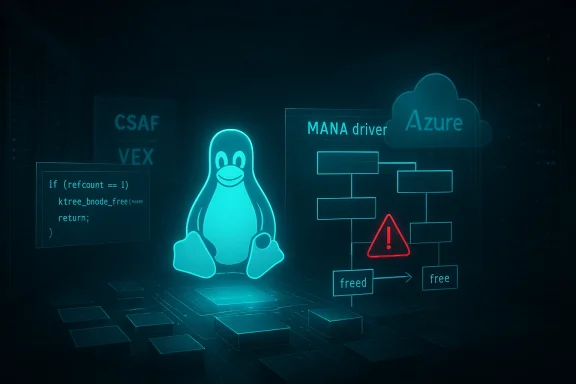
CVE-2024-42069 is a Linux-kernel vulnerability described as “net: mana: Fix possible double free in error handling path.” The flaw appears in the MANA driver (Microsoft Azure Network Adapter) and stems from incorrect memory handling when auxiliary_device_add() fails and cleanup code calls adev_release which invokes kfree(madev) — leading to the possibility that the kernel will free the same memory twice. The practical impact recorded in vendor advisories is denial-of-service (availability impact) and the NVD/CVSS baseline rates this as a medium severity issue (CVSS v3.1 ~5.5), with an attack vector of local access and a low complexity exploit path.
MANA is an upstream Linux kernel driver tree that Microsoft contributed for Azure network devices; it lives in drivers/net/ethernet/microsoft/mana and has been part of kernel releases where Microsoft added Azure‑specific network and RDMA support. Because the code is upstreamed, any Linux kernel build that includes the affected commit range and enables the MANA driver could carry the vulnerability.
Microsoft’s transparency program for third‑party open‑source components — which moved to publish machine‑readable CSAF and VEX attestations beginning in October 2025 — began with a focused, phased approach that first inventories the Azure Linux distribution (the company’s published Linux distro lineage). In Microsoft’s public advisory language the typical FAQ statement is: “Azure Linux includes this open-source library and is therefore potentially affected… If impact to additional products is identified, we will update the CVE to reflect this.” That sentence is precise in scope: it confirms Azure Linux after inventory, but it does not say other Microsoft products cannot or do not include the same upstream component.
Concrete examples security teams should check:
However, that messaging must be interpreted properly: it is an inventory result for Azure Linux, not an exclusivity guarantee across all Microsoft artifacts. The kernel code in question — the MANA driver — is upstream and can appear wherever Microsoft’s kernel source or builds are used. For security teams that run other Microsoft-supplied kernels (WSL, linux-azure, marketplace images), the prudent course is to verify artifact contents, apply patches or rebuild images, and treat Microsoft’s VEX as one reliable data point among the artifact-level evidence required to declare systems safe.
Transparency is necessary and welcome. So is skepticism: trust the VEX attestation for the product it names, but verify the rest. In practice that means scanning images, checking kernel configs, applying vendor patches and, where appropriate, rebuilding and redeploying kernels — the same hygiene that turns a published fix into effective risk reduction.
Source: MSRC Security Update Guide - Microsoft Security Response Center
 Background / Overview
CVE-2024-42069 is a Linux-kernel vulnerability described as “net: mana: Fix possible double free in error handling path.” The flaw appears in the MANA driver (Microsoft Azure Network Adapter) and stems from incorrect memory handling when auxiliary_device_add() fails and cleanup code calls adev_release which invokes kfree(madev) — leading to the possibility that the kernel will free the same memory twice. The practical impact recorded in vendor advisories is denial-of-service (availability impact) and the NVD/CVSS baseline rates this as a medium severity issue (CVSS v3.1 ~5.5), with an attack vector of local access and a low complexity exploit path.MANA is an upstream Linux kernel driver tree that Microsoft contributed for Azure network devices; it lives in drivers/net/ethernet/microsoft/mana and has been part of kernel releases where Microsoft added Azure‑specific network and RDMA support. Because the code is upstreamed, any Linux kernel build that includes the affected commit range and enables the MANA driver could carry the vulnerability.
Microsoft’s transparency program for third‑party open‑source components — which moved to publish machine‑readable CSAF and VEX attestations beginning in October 2025 — began with a focused, phased approach that first inventories the Azure Linux distribution (the company’s published Linux distro lineage). In Microsoft’s public advisory language the typical FAQ statement is: “Azure Linux includes this open-source library and is therefore potentially affected… If impact to additional products is identified, we will update the CVE to reflect this.” That sentence is precise in scope: it confirms Azure Linux after inventory, but it does not say other Microsoft products cannot or do not include the same upstream component.
What the bug is — technical, concise
- The fault is a double free in the MANA driver error path.
- The sequence: auxiliary_device_add() returns an error → auxiliary_device_uninit() calls cleanup → adev_release calls kfree(madev) → the error handling path may call kfree(madev) again.
- The fix is straightforward: ensure madev is set to NULL after the first kfree, or otherwise prevent the second free.
- Real‑world consequence: a user with local capability to trigger the faulty path can likely cause a kernel crash (DoS). Memory-corruption exploitation beyond DoS is theoretically possible for some double-free cases, but for this specific bug public threat reporting and vendor advisories primarily categorize the impact as availability/denial-of-service.
Who is affected (short answer)
- Upstream: Linux kernel versions that included the MANA driver commit range are in scope; multiple distro advisories map the affected commits to specific kernel package versions.
- Downstream: Any distribution or product shipping a kernel build that contains the vulnerable source and compiles/ships the MANA driver (either built‑in or as a loadable module) is potentially affected.
- Microsoft: Azure Linux — the Microsoft-published Linux distribution — is the one product Microsoft has publicly attested to include the affected open-source components. That attestation is actionable for Azure Linux customers.
- Not necessarily limited to Azure Linux: other Microsoft artifacts that ship Linux kernels — for example the linux-azure kernels used in Azure VMs, Microsoft‑distributed WSL (Windows Subsystem for Linux) kernels, Marketplace images, or custom appliance kernels — are plausible carriers and must be treated as unverified until inventory/attestation shows otherwise.
The Microsoft attestation: what it actually means
Microsoft’s CSAF/VEX rollout introduced machine‑readable attestations that state, per product, whether a product is Not Affected, Under Investigation, Known Affected, or Fixed for a vulnerability. Starting with Azure Linux as the initial product to be fully inventoried, Microsoft’s public messaging explains:- Azure Linux was inventoried and is a confirmed carrier for certain upstream open‑source components; VEX files issued for Azure Linux reflect that authoritative result.
- Microsoft will expand VEX attestations to other products over time, and will update CVE mappings if other Microsoft products are found to ship the component.
- The attestation is product‑scoped and evidence‑driven — it is a positive signal for Azure Linux customers, but it does not provide a blanket “no other Microsoft product contains this” guarantee.
- The phased rollout means that lack of a VEX attestation for a Microsoft product is not the same as a negative attestation; it is an absence of inventory, and therefore a residual operational risk for customers who rely on other Microsoft images or kernel artifacts.
Why other Microsoft artifacts can matter
Microsoft ships multiple, independently-built Linux kernel artifacts:- Linux kernels built and packaged for Azure VMs (linux-azure).
- Azure Linux (the distro Microsoft publishes and supports).
- The WSL2 kernel binary and source that Microsoft publishes on GitHub and distributes to Windows clients.
- Marketplace VM images and specialized appliance kernels.
- Third‑party or partner images that may include Microsoft-published kernels.
Concrete examples security teams should check:
- Does the WSL kernel version distributed by Microsoft include drivers/net/ethernet/microsoft/mana in its source tree, and if so, what kernel version is it built from?
- Do Azure Marketplace images include linux-azure kernels that contain the MANA driver?
- Are your in‑house or partner images using Microsoft-published kernel packages?
Operational guidance: what you should do now
- Prioritize patching Azure Linux images. If Microsoft’s VEX/CSAF shows Azure Linux as Known Affected or Fixed, follow the update guidance for Azure Linux images and apply the fixed kernel packages.
- Inventory every Microsoft-supplied Linux kernel artifact in your environment:
- Export SBOMs or package lists for images and appliances.
- For WSL, check the WSL kernel version and source commits Microsoft publishes.
- For Azure VMs, check the linux-azure package/kernel version and vendor advisories.
- For each artifact, answer these questions:
- Which kernel version is in use?
- Does that kernel version include the MANA driver files (drivers/net/ethernet/microsoft/mana)?
- Was the MANA driver compiled in or available as a module?
- Use automated image scanning and kernel config checks:
- Scan container images, VM images and OS images for the presence of the vulnerable driver or matching package versions.
- Use kernel ABI and config scanning tools to detect whether drivers are present and enabled.
- If immediate patching is not possible:
- Limit local access on affected machines and enforce least privilege.
- Remove or disable components that trigger MANA initialisation where feasible (this may not be practical for cloud networking).
- Monitor for vendor advisories and adjust mitigations as fixes are released by your distro or Microsoft.
- Rebuild and redeploy: if you maintain AMIs, VM images, or containers that include an affected kernel, rebuild them from patched base images and replace running instances.
- Track Microsoft VEX/CSAF updates: subscribe to vendor attestations and CVE updates so you know when Microsoft extends attestations to other products.
Why Microsoft’s approach is both helpful and incomplete
Strengths:- Publishing CSAF and VEX machine‑readable attestations is a major win for customers. It reduces noisy triage work by telling customers, for specific Microsoft products, whether a CVE is relevant.
- Starting with Azure Linux made operational sense: it’s Microsoft’s published Linux distribution and therefore a natural first target for accurate inventory and attestations.
- The VEX/CSAF model supports automation — security teams can ingest attestations into their vulnerability management pipelines and close tickets for products attested Not Affected or Fixed.
- The phased rollout leaves an early blind spot: until Microsoft finishes inventory for other products, customers must treat those products as unverified. That creates a window where security teams must do additional artifact-level verification.
- The machine-readable attestation reduces noise but requires trust in inventory completeness; Microsoft’s statement that it will “update the CVE if impact to additional products is identified” is reactive by design — it does not proactively certify all Microsoft artifacts.
- Some Microsoft-distributed kernel artifacts are not centrally tracked the same way as Azure Linux. For example, Marketplace images, partner appliances, or in-house deployed WSL kernels may be overlooked unless customers perform explicit scans.
Exploitability and risk profile
- Attack vector: Local. The MANA double-free requires the attacker to be able to trigger the failing auxiliary_device_add() path locally or via a privileged mechanism that causes the cleanup path to run.
- Privileges required: Low privileges (local user) can be sufficient in some configurations, but not all. The actual exploitability depends on system configuration and workload specifics.
- Likely impact: Denial of Service (kernel crash). Public analysis by multiple vendors and OS distributors categorizes the primary impact as availability loss (DoS). While double frees in kernel code occasionally lead to more severe memory-corruption-based exploits, there is no broad public evidence of remote exploitation for CVE-2024-42069.
- CVSS baseline: Medium (≈5.5). That score reflects local attack vector, low complexity, and an availability-centric impact model.
What to tell executive leadership and IT ops
- For Azure Linux customers: Microsoft’s attestation and published fixes make the answer clear — update Azure Linux kernels per Microsoft guidance and confirm remediation via package versions or SBOM checks.
- For customers using other Microsoft artifacts: do not assume “not mentioned = not affected.” Conduct targeted inventory and scanning of the images and kernels distributed by Microsoft in your environment (WSL kernels, marketplace images, linux-azure packages, appliance images).
- For cloud-native teams: treat this like any kernel-level CVE — schedule maintenance windows to update kernel packages, rebuild images, and redeploy.
- For risk owners: this CVE is a medium‑severity local DoS class issue; remediation is straightforward where patching is possible, but the operational cost is in inventory and image rebuilds for complex environments.
Practical checklist (quick, copyable)
- [ ] Confirm whether your Azure Linux instances are at a patched kernel version.
- [ ] Scan WSL kernel binaries and the Microsoft WSL kernel source for the presence of drivers/net/ethernet/microsoft/mana and check kernel version.
- [ ] Scan Azure Marketplace images, custom AMIs, and other Microsoft-supplied images for affected kernel packages.
- [ ] Apply vendor-supplied kernel patches or update to fixed kernel package versions.
- [ ] Rebuild and redeploy VM and container images using fixed base images.
- [ ] If patching is delayed, reduce local user access and restrict execution paths that could trigger the MANA driver.
- [ ] Subscribe to and ingest Microsoft CSAF/VEX files and your distribution advisories into vulnerability management workflows.
Final analysis: Microsoft’s statement and your operational reality
Microsoft’s public statement — “One of the main benefits to our customers who choose to use the Azure Linux distro is the commitment to keep it up to date with the most recent and most secure versions of the open source libraries... We began publishing CSAF/VEX in October 2025. If impact to additional products is identified, we will update the CVE to reflect this.” — is accurate and helpful, and it signals an important shift toward machine‑readable transparency. It is an operationally useful attestation for Azure Linux, and it reduces triage and false positives for customers who run that distro.However, that messaging must be interpreted properly: it is an inventory result for Azure Linux, not an exclusivity guarantee across all Microsoft artifacts. The kernel code in question — the MANA driver — is upstream and can appear wherever Microsoft’s kernel source or builds are used. For security teams that run other Microsoft-supplied kernels (WSL, linux-azure, marketplace images), the prudent course is to verify artifact contents, apply patches or rebuild images, and treat Microsoft’s VEX as one reliable data point among the artifact-level evidence required to declare systems safe.
Transparency is necessary and welcome. So is skepticism: trust the VEX attestation for the product it names, but verify the rest. In practice that means scanning images, checking kernel configs, applying vendor patches and, where appropriate, rebuilding and redeploying kernels — the same hygiene that turns a published fix into effective risk reduction.
Source: MSRC Security Update Guide - Microsoft Security Response Center
