

The short, practical answer is: Microsoft’s public advisory for CVE-2025-22079 names Azure Linux as the Microsoft product that has been inspected and confirmed to include the vulnerable OCFS2 code, but that attestation is a product‑scoped inventory statement — it is not proof that other Microsoft artifacts cannot contain the same upstream code. Treat Azure Linux as a definite remediation priority, and treat other Microsoft-distributed kernel artifacts as unverified until you or Microsoft confirm them.
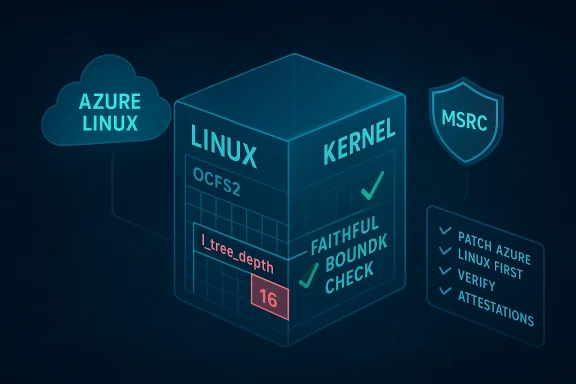
CVE-2025-22079 is a Linux kernel vulnerability in the OCFS2 file-system code where a 16‑bit on‑disk field (l_tree_depth, stored as __le16) can be larger than the compile-time maximum (OCFS2_MAX_PATH_DEPTH). That mismatch can allow an index to run out of bounds when a corrupted or maliciously crafted on-disk structure is read, producing potential kernel crashes or other availability problems. The issue was fixed upstream by adding a bounds check that validates l_tree_depth before use.
Multiple public trackers and distribution advisories have recorded the vulnerability, published fixed kernel versions or backports, and assigned a medium-to-high availability-oriented severity (CVSS and vendor scores vary by tracker). Ubuntu, Oracle Linux and distribution security teams have issued packages and errata that map the CVE to specific kernel package versions. Cross-checking at least two independent trackers (for example, NVD and an upstream distro advisory) is recommended when you build a remediation plan.
However, real-world limitations remain:
Every one of these steps — inventory, verification, patching, and automation of attestations — reduces the supply-chain blind spots that let kernel-level vulnerabilities propagate across images and services. CVE-2025-22079 is not an outlier in that regard; it is a reminder that vendor attestations are valuable triage signals but not a substitute for artifact-level verification and a well‑instrumented, automated vulnerability management program.
Source: MSRC Security Update Guide - Microsoft Security Response Center
 Background / Overview
CVE-2025-22079 is a Linux kernel vulnerability in the OCFS2 file-system code where a 16‑bit on‑disk field (l_tree_depth, stored as __le16) can be larger than the compile-time maximum (OCFS2_MAX_PATH_DEPTH). That mismatch can allow an index to run out of bounds when a corrupted or maliciously crafted on-disk structure is read, producing potential kernel crashes or other availability problems. The issue was fixed upstream by adding a bounds check that validates l_tree_depth before use.Multiple public trackers and distribution advisories have recorded the vulnerability, published fixed kernel versions or backports, and assigned a medium-to-high availability-oriented severity (CVSS and vendor scores vary by tracker). Ubuntu, Oracle Linux and distribution security teams have issued packages and errata that map the CVE to specific kernel package versions. Cross-checking at least two independent trackers (for example, NVD and an upstream distro advisory) is recommended when you build a remediation plan.
What Microsoft actually published — and why the wording matters
The MSRC FAQ line: what it says
On the MSRC (Microsoft Security Response Center) CVE entry for this and many kernel CVEs, Microsoft includes a short FAQ-style answer along the lines of: “Azure Linux includes this open-source library and is therefore potentially affected by this vulnerability. One of the main benefits ... is the commitment to keep it up to date ... Microsoft is committed to transparency ... we began publishing CSAF/VEX in October 2025 ... If impact to additional products is identified, we will update the CVE to reflect this.” That language is deliberate: it confirms Microsoft checked the Azure Linux product family and found the implicated upstream code there.Attestation vs exclusivity — the crucial distinction
uthoritative product-level attestation, not an exclusivity guarantee. In plain terms:- When MSRC says Azure Linux includes the library, it is saying Microsoft’s inventory work found the upstream code in the Azure Linux build outputs and thereare in-scope for remediation.
- That does not logically prove that no other Microsoft product, image, or kernel binary could include the same vulnerable upstream code. The absence of a VEX/CSAF attestation for Product B is absence of attestation, not proof of absence.
Technical anatomy of CVE-2025-22079 (brief)
What goes wrong
- The OCFS2 on-disk record includes a 16-bit field, l_tree_depth. The kernel code that parses on-disk blocks assumed the value would not exceed a compile-time constant OCFS2_MAX_PATH_DEPTH.
- A corrupted on-disk structure (or specially crafted disk image) can contain an invalid l_tree_depth value larger than the max, which can lead to array indexing beyond the allocated buffer and therefore out‑of‑bounds reads or writes.
- Upstream fix: add a defensive bounds check that rejects or sanitizes out-of-range l_tree_depth values when reading the structure, preventing the subsequent access.
Impact and exploitability
- The vulnerability is primarily an availability and robustness issue: the kernel can crash or behave unpredictably when it processes a corrupted on-disk structure. Many vendor advisories categorize the impact as denial‑of‑service or stability degradation rather than remote code execution.
- Triggering the issue typically requires access to the underlying block device: e.g., mounting a corrupted disk, exploiting a misprovisioned image, or otherwise controlling the on-disk content. That limits the remote attack surface but appreciably raises the risk in contexts where images or disks are supplied by untrusted sources (e.g., download marketplaces, multi-tenant uploadable images, or compromised provisioning pipelines).
Is Azure Linux the only Microsoft product that includes the library?
Short, careful answer
- Strictly speaking about Microsoft’s public statement at the time of publishing: Yes, Azure Linux is the only Microsoft product Microsoft has attested as including the implicated open-source component for CVE-2025-22079. That is what their FAQ text says.
- Operationally and defensively: No, Azure Linux is not necessarily the only Microsoft artifact that could include the vulnerable code. Any Microsoft product that ships a Linux kernel build (WSL2 kernel, Azure-tuned kernels for certain VM SKUs, Marketplace images, AKS node images, container base images, or internal appliance kernels) could include the same upstream commit rn scope until verified. You must verify each artifact individually.
Why that nuance is important for defenders
Microsoft’s product-level attestation is useful because it gives Azure Linux customers an authorifor remediation. But defenders should not stop there:- The same upstream kernel source can be built into many different artifacts. A single vulnerable kernel commit can propagate to multiple images or binaries through rebuilds, backports, or vendor packaging.
- Large estates commonly run a mixture of vendor images, marketplace images, and internal custom images. Each image is an independent artifact and must be verified. Assuming “not listed” equals “clean” is risky.
How to verify whether your Microsoft-distributed artifacts are affected
Below are practical, prioritized steps for system owners and security teams. These are operational checks — treat them as the checklisr publishes a product-scoped attestation.1. Identify Microsoft-provided artifacts in your estate
- Inventory VM images (Azure Marketplace, custom marketplace images), container base images pulled from Microsoft registries, AKS node images, WSL2 installations, and any Microsoft-supplied kernel packages.
- Don’t forget development and CI artifacts: build runners, developer VM images, and test harness images that may be used to seed production.
2. For each artifact, determine the kernel version and build provenance
- On a running Linux system: run
uname -ato get the kernel version and build tag. For Debian/Ubuntu-based images,dpkg -l | grep linux-imagemage-*helps map to distro advisories. For RPM-based systems,rpm -q kernelordnf info kernel` is useful. - For container images, inspect the image manifest or launch a container and query
/proc/versionor package manager metadata. - For WSL2, check the WSL kernel version via
wsl --statusor by opening a WSL shell and usinguname -r. WSL uses a Microsoft-maintained kernel image that can differ from distro kernels.
3. Compare kernel versions and configurations against vendor advisories
- Consult upstream and distribution advisories to determine which kernel commit range contains the fix. NVD and distribution security pages (Ubuntu, Debian, Oracle Linux) list the CVE and link to fixed package versions. Cross‑reference at least two independent sources (for example, NVD + the distribution advisory) to be confident about the mapping.
4. If the artifact is a Microsoft-provided image and unconfirmed, treat it as ‘unverified’ and take mitigation steps
- For Azure Linux ested by MSRC: apply Microsoft’s updated images or kernel packages as they publish them. Microsoft’s attestation makes these first in-line for remediation.
- For WSL2 or other Microsoft-published kernels: check whether Microsoft has published an updated WSL kernel or security note. If uncertain, apply local mitigations: unmount suspicious images, avoid mounting untrusted disks, and isolate workloads that process third‑party disk images.
Remediation and mitigations
Apply vendor patches where available
- Azure Linux: follow Microsoft’s update guidance and redeploy patched images and kernels immediately. The MSRC attestation makes Azure Linux the highest-priority Microsoft product to patch for this CVE.
- Distributions: apply the kernelby Ubuntu, Debian, Oracle Linux, RHEL, SUSE or your distro vendor which map CVE-2025-22079 to package updates. Fixed package versions and errata are listed in vendor bulletins.
Short-term mitigations if you cannot patch immediately
- Avoid mounting untrusted block devices or disk images on production hosts.
- Run validation tools that scan images for corrupted or malformed OCFS2 met them to production systems.
- Isolate hosts that process unknown images into restricted network segments to limit blast radius.
- Increase monitoring for kernel crash/oops events and set alerting for unusual mount or fsck activity.
Supply‑chain and transparency implications
Why CSAF/VEX matt a silver bullet
Microsoft’s commitment to publish machine-readable CSAF/VEX attestations (begun in October 2025) is a positive step toward scalable supply‑chain transparency: VEX provides structured, automatable statements like “Product X: Known Affected / Not Aigation / Fixed” for CVEs. That helps enterprise vulnerability management tools prioritize assets.However, real-world limitations remain:
- Vendors typically roll out attestations product-by-product; an initial attestation for Azure Linux does not mean the vendor has completed inventorying every binary or image. The phased approach is operationally sensible but leaves coverage gaps while it progresses.
- Attackers and defenders alike care about artifacts actually running in an environment, not product family names. Until every image and kernel binary is enumerated and attested, defenders must combine vendor attestations with internal discovery and scanning.
Prs to improve long-term posture
- Automate ingestion of VEX/CSAF attestations into your vulnerability management platform, and cross-reference vendor attestations with your asset inventory.
- Invest in artifact provenance: require SBOMs for images used in production, and verify image signatures prior to deployment.
- Make kernel-level patching part of your automated image rebuild/test pipeline so that fixed kernels are baked into new images quickly.
- Work with cloud providers and vendors to ask for per-artifact attestations (Marketplace images, WSL kernels, and managed node images) rather than relying solely on product-family statements.
Cross-checking and verification: what I checked for this article
To ensure accuracy and present an evidence-based assessment, I cross‑checked multiple independent sources:- The NVD entry for CVE-2025-22079 for the canonical CVE description and common metadata.
- Vendor/distribution advisories such as Ubuntu’s CVE page and the Oracle Linux CVE repository for status, severity, and errata mapping.
- Public CVE aggregation pages and distro trackers to confirm fixed kernel ranges and remediation guidance.
- Microsoft’s own MSRC wording for the CVE FAQ that explicitly states Azure Linux includes the open-source component and reiterates Microsoft’s October 2025 CSAF/VEX commitment; I used that wording as the basis fosoft attested (and what they did not assert).
- Independent analyses and community commentary (uploaded forum materials) that explain the practical difference between a product-level attestation and a statement of exclusivity; those analyses underscore how many Microsoft artifacts can carry identical upstream code and why artifact-level verification is necessary.
Risk analysis and final assessment
- Azure Linux: Confirmed in-scope by MSRC; treat as highest priority for remediation among Microsoft-shipped distro artifacts. Apply Microsoft’s updated Azure Linux images or kernel packages when released.
- Other Microsoft artifacts (WSL2, Marketplace images, AKS node images, containerbuilds): Potentially in-scope until you verify kernel version, configuration (whether OCFS2 support was compiled in), and whether Microsoft or the upstream vendor backported the fix. Do not assume they are unaffected simply because they’re not named in MSRC’s initial attestation.
- Overall exploitability: moderate and primarily availability-focused; requires access to or control of a block device/FS image to trigger corrupted OCFS2 metadata. Still, the practical blast radius is larger in environments that consume third‑party images or ak images from external parties.
Concrete checklist for operators (quick reference)
- If you run Azure Linux images: patch immediately per Microsoft guidance.
- Inventory Microsoft-sourced artifacts in your estate (WSL2 kernels, Azure Marketplace images, AKS node images, Microsoft container base images).
- For each artifact, verify kernel version and whether OCFS2 is enabled; if unsure, treat it as unverified.
- Apply distro or vendor kernel updates (Ubuntu, Debian, Oracle, RHEL/SUSE) that map CVE-2025-22079; rebuild and redeploy images as needed.
- If immediate patching is impossible, quarantine workloads that might mount third-party images and harden monitoring for kernel oops/crash symptoms.
- Ingest Microsoft CSAF/VEX attestations when available and reconcile them against your asset inventory.
Closing thoughts
Microsoft’s MSRC statement that “Azure Linux includes this open-source library and is therefore potentially affected” is an im attestation for Azure Linux customers — it tells those customers the vendor has found the problematic upstream component in that product and is committed to publish machine-readable attestations (CSAF/VEX). However, the statement is precisely that: a product‑scoped inventory attestation, not a universal exclusion for Microsoft’s entire portfolio. Until Microsoft expands its VEX coverage to enumerate every Microsoft artifact (or until you independently verify artifacts in your environment), the correct operational posture is: patch Azure Linux now, and audit and verify other Microsoft-distributed kernels and images as a matter of priority.Every one of these steps — inventory, verification, patching, and automation of attestations — reduces the supply-chain blind spots that let kernel-level vulnerabilities propagate across images and services. CVE-2025-22079 is not an outlier in that regard; it is a reminder that vendor attestations are valuable triage signals but not a substitute for artifact-level verification and a well‑instrumented, automated vulnerability management program.
Source: MSRC Security Update Guide - Microsoft Security Response Center
