

A small, narrowly targeted change in the Linux kernel’s RDMA resource‑tracking code — tracked as CVE‑2024‑42080 — removed a dangling reference that could lead to an invalid address access and, in some conditions, a kernel crash; Microsoft’s public advisory names Azure Linux as a product that “includes this open‑source library and is therefore potentially affected,” but that statement is an attestation of inventory for Azure Linux and should not be read as proof that no other Microsoft product can contain the same vulnerable code.
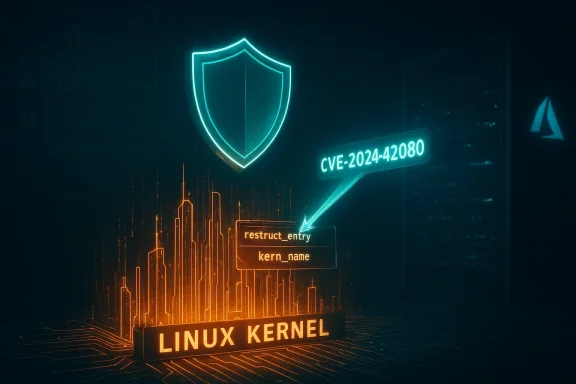
CVE‑2024‑42080 was assigned to a robustness bug in the Linux kernel RDMA subsystem’s restrack (resource‑tracking) component. The root cause was the use of a module‑name pointer (assigned from KBUILD_MODNAME) in a long‑lived restrack entry; if an RDMA‑related module was unloaded without cleaning up its restrack entries, the cleanup routine could dereference an address that no longer pointed to valid memory, producing an invalid access and a potential kernel panic. The vulnerability is classed as medium with a CVSS v3.1 base score of 5.5 and is primarily an availability (DoS/crash) risk rather than a confidentiality or integrity escalation.
The upstream patch removed the unnecessary kern_name bookkeeping entirely rather than attempt a fragile lifetime fix, eliminating the chance of a dangling pointer dereference during restrack cleanup. This is a typical upstream remediation for kernel bookkeeping mistakes: if a tracked field exists only for debugging or leak‑finding and its lifetime semantics are risky, removing the field improves robustness without changing intended functionality.
Put plainly:
Azure Linux is a known carrier — Microsoft has inventory‑checked Azure Linux and found that it includes the implicated open‑source component. That makes Azure Linux definitively in scope and a high priority for patching.
CVE‑2024‑42080 is technically modest — a correctness/robustness fix that removes a dangling pointer. Operationally, it highlights a larger truth about supply‑chain security and vendor attestations: a vendor‑published attestation that names a single product is useful and authoritative for that product, but it is not a substitute for artifact‑level verification across a diverse estate. For now, Azure Linux operators should patch immediately; operators running other Microsoft artifacts must verify those artifacts because they may also carry the same upstream code until Microsoft (or independent inspection) demonstrates otherwise.
Conclusion: treat Microsoft’s Azure Linux attestation as the starting gun, not the finish line — patch Azure Linux now, and inventory and verify every other Microsoft kernel artifact you run until attestations or SBOMs prove them safe.
Source: MSRC Security Update Guide - Microsoft Security Response Center
 Background / Overview
CVE‑2024‑42080 was assigned to a robustness bug in the Linux kernel RDMA subsystem’s restrack (resource‑tracking) component. The root cause was the use of a module‑name pointer (assigned from KBUILD_MODNAME) in a long‑lived restrack entry; if an RDMA‑related module was unloaded without cleaning up its restrack entries, the cleanup routine could dereference an address that no longer pointed to valid memory, producing an invalid access and a potential kernel panic. The vulnerability is classed as medium with a CVSS v3.1 base score of 5.5 and is primarily an availability (DoS/crash) risk rather than a confidentiality or integrity escalation.The upstream patch removed the unnecessary kern_name bookkeeping entirely rather than attempt a fragile lifetime fix, eliminating the chance of a dangling pointer dereference during restrack cleanup. This is a typical upstream remediation for kernel bookkeeping mistakes: if a tracked field exists only for debugging or leak‑finding and its lifetime semantics are risky, removing the field improves robustness without changing intended functionality.
What Microsoft actually said — and what that wording means
Microsoft’s Security Response Center (MSRC) pages for multiple kernel and open‑source CVEs have used a standard FAQ paragraph to answer the common customer question: “Is Azure Linux the only Microsoft product that includes this open‑source library and is therefore potentially affected by this vulnerability?” The answer Microsoft gives explains that Azure Linux is kept up to date and that Microsoft began publishing machine‑readable CSAF/VEX attestations starting in October 2025; it also states that Microsoft will update the CVE record if impact to additional products is identified. That FAQ language appears on several MSRC CVE pages and in Microsoft’s transparency blog about VEX.Put plainly:
Azure Linux is a known carrier — Microsoft has inventory‑checked Azure Linux and found that it includes the implicated open‑source component. That makes Azure Linux definitively in scope and a high priority for patching.
- Microsoft is not saying: “Only Azure Linux”. The wording carefully avoids exclusivity and promises to expand attestations if other Microsoft products are later found to ship the same component. That is an operational, not a technical, statement: it reflects the scope of Microsoft’s current inventory work.
Technical summary of the vulnerability
What the code did wrong
- The kernel tracked RDMA resources with a struct rdma_restrack_entry. One field, kern_name, was set to the compile‑time module name macro (KBUILD_MODNAME) when an RDMA Completion Queue (CQ) was created.
- If an RDMA‑based module exited (was unloaded) but its restrack entries were not removed, later calls to rdma_restrack_clean() would attempt to print or otherwise access entry->kern_name. Because the module’s memory or static data could be gone, that pointer could be invalid — a classic use after free / invalid pointer dereference in kernel space.
Why it matters
- Kernel code runs in the most privileged execution context on a Linux system. An invalid access in kernel space usually leads to an oops or panic and therefore to denial of service for the host or guest.
- The bug requires local conditions (module load/unload lifetimes with lingering restrack entries), so while it’s not trivially exploitable remotely, it is a real availability risk — particularly in environments where modules are loaded and removed frequently (development, testing, or dynamic driver management in cloud images).
How it was fixed upstream
- The upstream maintainers removed the kern_name bookkeeping from restrack entries — eliminating the pointer and removing the window where a stale pointer could be used. This is a defensive, minimal change that preserves normal RDMA functionality while removing the unsafe bookkeeping.
Who’s affected: distribution and kernel coverage
Multiple Linux distributors and the NVD list affected kernel version ranges, and several vendors published advisories and backported fixes into their supported kernels:- NVD and public advisories list vulnerable kernel ranges (e.g., certain 5.15, 5.16–6.1.x, 6.2–6.6.x, and 6.7–6.9.x ranges depending on backports and vendor trees). Administrators should consult vendor security advisories for the exact package versions patched in their environment.
- Vendors that published fixes or advisories include Ubuntu (security page), Amazon Linux (ALAS), Oracle Linux kernel advisories, and other distribution trackers; each packaged a vendor‑specific kernel update or backport. If you run a packaged distro kernel, prioritize the vendor kernel update rather than applying a mainline patch yourself.
- Check your kernel version(s) and mapping to vendor advisories.
- Inspect whether RDMA subsystems and specific RDMA drivers are enabled in your kernels (modules like ib_core, mlx5, etc.).n kernels, apply vendor security updates; for custom kernels, apply the upstream fix and rebuild.
Is Azure Linux the only Microsoft product that carries the vulnerable component?
Short answer: No — but with an operational caveat.- Microsoft has publicly attested that Azure Linux (Microsoft’s own Linux distribution for Azure) includes the upstream component that was mapped to the CVE. That attestation is authoritative for Azure Linux and obligates Azure Linux customers to treat the product as affected and to apply the updates Microsoft provides.
- However, the upstream code in question lives inside the common Linux kernel source tree. Any Microsoft product or artifact that ships a Linux kernel build — including but not limited to:
- WSL2 kernel images,
- Azure Marketplace VM images,
- custom kernel builds used inside specific Azure services or appliances,
- any Windows subsystem or appliance where Microsoft distributes a Linux‑based kernel binary —
could technically include the same vulnerable code depending on kernel version, backports, and configuration flags. Because MSRC’s FAQ is a product‑level inventory statement, it does not prove that other Microsoft products are free of the code.
Why the distinction matters to operators and defenders
- If you run Azure Linux images: treat the MSRC attestation as direct, actionable guidance — patch those images immediately per Microsoft’s Azure Linux update instructions. The MSRC note is the highest‑priority signal for Azure Linux operators.
- If you use other Microsoft‑provided images or artifacts (WSL, Marketplace images, vendor‑branded appliances): do not assume they are unaffected. Instead:
- Perform artifact‑level discovery: check SBOMs, image contents, package lists, and kernel versions of any Microsoft artifact you run.
- Request or wait for Microsoft’s VEX/CSAF attestations if you rely on vendor attestations; but do not delay local verification while you wait.
Practical mitigation and verification checklist
Use this checklist to find, assess, and remediate risk from CVE‑2024‑42080 in mixed environments:- Inventory and prioritize
- 1.) List all hosts and images running Linux kernels supplied by Microsoft (Azure Linux images, WSL2 kernels, Marketplace appliances, etc.).
- 2.) For each artifact, capture kernel version and vendor package release identifiers. Vendor advisory mappings will tell you whether your version is fixed.
- Verify presence of RDMA components
- 3.) On running systems: lsmod | grep -E 'rdma|ib_' to see whether RDMA modules are loaded. If modules aren’t present and aren’t used, exposure is lower; if they are used, prioritize patching.
- 4.) On images: check package manifests or kernel configuration (CONFIG_* flags) to confirm whether RDMA or specific drivers are compiled in.
- Patch and rebuild
- 5.) Apply vendor patches (recommended). Distributors like Ubuntu, Amazon Linux and Oracle published updates — install the vendor‑packaged kernel update for your release.
- 6.) For custom kernels, pick up the upstream commit that removed the unsafe kern_name bookkeeping, rebuild, and redeploy.
- Containment and compensating controls
- 7.) If immediate patching is impossible, limit local access le unload/load churn and restrict who can install/uninstall kernel modules. This reduces the chance of triggering the lifetime mismatch that causes the bug to appear.
- 8.) Monitor for kernel oops messages in system logs and set up alerting for kernel oops/panic signatures that could indicate related failures.
- Use SBOMs and VEX/CSAF
- 9.) Where possible, consume vendor SBOMs or the MSRC VEX/CSAF attestations to confirm which product artifacts Microsoft has inventoried and remediated. Microsoft’s VEX rollout is explicitly designed to reduce uncertainty about which Microsoft products include which open‑source components.
Risk analysis: strengths and potential gaps in Microsoft’s approach
Strengths
- Microsoft’s explicit attestation that Azure Linux includes the implicated open‑source component is useful — it gives a clear, vendor‑authoritative remediation signal to tens of thousands of Azure Linux users who otherwise must parse upstream CVE text and individual package changelogs. That clarity reduces time to patch for a focused product family.
- Microsoft’s move to publish machine‑readable CSAF and VEX attestations improves automation and reduces false positives ng tools; when widely adopted, VEX allows operators to expedite triage.
Potential gaps and risks
- The attestation is product‑scoped, not artifact‑exhaustive. Microsoft’s single‑product mapping leaves other Microsoft artifacts in customer environments ambiguous until they are inventoried and attested; that means customers running heterogeneous Microsoft images cannot rely solely on the single attestation to prove safety. This gap is explicitly acknowledged in Microsoft’s FAQ, but operators must still act on it.
- The underlying technical risk is kernel‑space; while the exploitability vector is local and the primary effect is availability, a kernel panic in a cloud VM or managed service can have outsized operational impact in production fleets and multi‑tenant environments. Because the fix is small but widespread, distributing patched kernels across cloud services and embedded images is operationally non‑trivial.
How to communicate this to stakeholders (recommended wording)
- For Azure Linux system owners: “Microsoft has attested that Azure Linux images include the RDMA restrack component implicated by CVE‑2024‑42080; apply Microsoft’s kernel updates for Azure Linux immediately and validate through your patch management pipeline.”
- For platform/CloudOps or security teams: “Treat otherernels (WSL2, Marketplace images, appliances) as unverified; perform artifact scans and request MSRC VEX/CSAF attestations for those product families where available. If the artifact contains RDMA drivercted kernel version, schedule remediation.”
What we could not verify and cautionary notes
- Microsoft’s MSRC pages and the archived FAQ make the attestation claim clearly for Azure Linux, but they do not publish a complete, global inventory of all Microsoft artifacts for every CVE. That absence is not an error — it’s a practical reality of large vendor operations — but it does mean that a blanket statement like “only Azure Linux is affected” cannot be supported from public evidence. If you need absolute assurance about a specific Microsoft artifact in your estate, you must either:
- request an explicit MSRC VEX/CSAF attestation for that product, or
- perform your own artifact‑level verification (SBOM, binary inspection, kernel config/version mapping).
- We could not find a Microsoft statement that exhaustively enumerates every Microsoft‑distributed kernel artifact and certifies them Not Affected for CVE‑2024‑42080; Microsoft’s published process for VEX/CSAF intends to address this over time, but timelines for full coverage vary by product family. Treat public attestations as authoritative for the product named, and treat anything not yet attested as “unverified” rather than automatically safe.
Final recommendations — a practical roadmap
- Immediatch all Azure Linux images and nodes in your estate per Microsoft guidance. Treat MSRC attestation as high priority.
- Short term (1–3 days): Inventory all Microsoft‑supplied images and kernels you run (WSL2, Marketplace, Azure outbound images). For each, determine kernel version, configuration, and whether RDMA modules are present.
- Medium term (1–2 weeks): Patch or rebuild any artifact found to contain the vulnerable kernel code. If vendor patches are not available, implement containment (module load restrictions, access controls) and schedule rebuilds.
- Ongoing: Consume Microsoft’s CSAF/VEX attestations as they become available and integrate them into your vulnerability triage pipeline so product‑level attestations reduce noise for the future.
CVE‑2024‑42080 is technically modest — a correctness/robustness fix that removes a dangling pointer. Operationally, it highlights a larger truth about supply‑chain security and vendor attestations: a vendor‑published attestation that names a single product is useful and authoritative for that product, but it is not a substitute for artifact‑level verification across a diverse estate. For now, Azure Linux operators should patch immediately; operators running other Microsoft artifacts must verify those artifacts because they may also carry the same upstream code until Microsoft (or independent inspection) demonstrates otherwise.
Conclusion: treat Microsoft’s Azure Linux attestation as the starting gun, not the finish line — patch Azure Linux now, and inventory and verify every other Microsoft kernel artifact you run until attestations or SBOMs prove them safe.
Source: MSRC Security Update Guide - Microsoft Security Response Center
