

Microsoft’s public advisory about CVE‑2024‑42118 names the vulnerable code in the Linux kernel’s AMD display stack — and it explicitly notes that Azure Linux includes the affected open‑source component and is therefore potentially affected — but that phrasing is a product‑scoped attestation, not a categorical guarantee that no other Microsoft product ships the same vulnerable code.
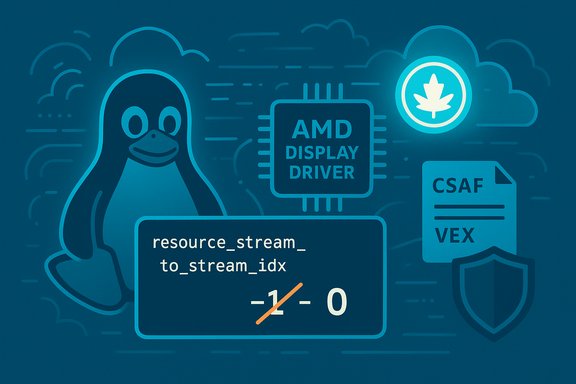
CVE‑2024‑42118 is a kernel‑level robustness defect in the AMD DRM display code (drm/amd/display). The root cause is straightforward: a helper function, resource_stream_to_stream_idx, can return –1 when it fails to find a stream index; that negative value is later used where a non‑negative array index is required. The upstream remedy is equally simple — avoid returning a negative index (ASSERT when the condition is unexpected and return zero instead) so the code cannot use –1 as an array index and risk an out‑of‑bounds access. Public vulnerability trackers list the flaw, the upstream fix, and the kernel stable commits that incorporate the change. This class of bug is an availability/robustness issue (kernel out‑of‑bounds / OVERRUN), with a local attack vector: an unprivileged process with access to DRM device nodes or components that exercise the display stack can provoke a kernel oops, driver reset, or host instability. It is not characterized as a remote code execution or privilege‑escalation defect in public advisories. Multiple distributors — Ubuntu, Debian, ALT, and others — have published advisories mapping fixed kernel package versions.
Treat Microsoft’s VEX/CSAF output as authoritative for Azure Linux and integrate it into your patch pipeline. For all other Microsoft provided artifacts (WSL kernels, Marketplace images, appliances, or partner images), perform artifact‑level verification (inspect kernel configs, module trees, or request SBOM/VEX attestations) rather than assuming safety because they are not yet listed. Use the practical checks and runbook above to triage and remediate quickly: inventory first, patch second, mitigate where necessary, and verify after reboot.
This is not a theoretical exercise: kernel driver robustness issues are exploitable as reliable denial‑of‑service primitives in realistic local‑access threat models, and the diversity of artifacts vendors ship means the only reliable way to know whether a specific image is affected is to inspect that image or wait for a vendor attest to say otherwise. Microsoft has committed to expanding its VEX coverage and to update CVE records when it identifies additional affected Microsoft products — a welcome transparency improvement — but until then, operators must be proactive and artifact‑centric in their response.
Source: MSRC Security Update Guide - Microsoft Security Response Center
 Background / Overview
CVE‑2024‑42118 is a kernel‑level robustness defect in the AMD DRM display code (drm/amd/display). The root cause is straightforward: a helper function, resource_stream_to_stream_idx, can return –1 when it fails to find a stream index; that negative value is later used where a non‑negative array index is required. The upstream remedy is equally simple — avoid returning a negative index (ASSERT when the condition is unexpected and return zero instead) so the code cannot use –1 as an array index and risk an out‑of‑bounds access. Public vulnerability trackers list the flaw, the upstream fix, and the kernel stable commits that incorporate the change. This class of bug is an availability/robustness issue (kernel out‑of‑bounds / OVERRUN), with a local attack vector: an unprivileged process with access to DRM device nodes or components that exercise the display stack can provoke a kernel oops, driver reset, or host instability. It is not characterized as a remote code execution or privilege‑escalation defect in public advisories. Multiple distributors — Ubuntu, Debian, ALT, and others — have published advisories mapping fixed kernel package versions. What Microsoft actually said — and what that wording means
Microsoft’s public MSRC/CVE entry for this CVE includes the text the user quoted: that Azure Linux includes the open‑source library and is therefore potentially affected, and that Microsoft began publishing machine‑readable CSAF/VEX attestations in October 2025 and will update CVE records if additional Microsoft products are identified as carrying the component. That commitment and timeline are publicly documented in Microsoft’s blog announcing their VEX rollout for Azure Linux. Why this matters: Microsoft’s statement is an authoritative, machine‑readable attestation for Azure Linux — it reflects the inventory work Microsoft completed for that product family and the resultant VEX/CSAF mapping. It is not a blanket technical assurance that every Microsoft image, kernel build, or appliance has been scanned and declared free of the component. The attestation is a snapshot of Microsoft’s inventory work and a promise to expand coverage; absence of a VEX entry for another Microsoft product is not proof that the product does not contain the vulnerable upstream code.Short answer to the user’s question
- Azure Linux is the only Microsoft product Microsoft has publicly attested to include the vulnerable open‑source component for CVE‑2024‑42118 at the time of the advisory.
- However, Azure Linux is not necessarily the only Microsoft product that could include the library — other Microsoft artifacts that ship a Linux kernel (for example, WSL2 kernels, Azure VM images, Marketplace appliances, or other Microsoft‑built kernel images) might include the same upstream driver depending on build configuration and kernel version. Determining whether any specific Microsoft SKU is affected requires per‑artifact verification (kernel config, module presence, or SBOM/VEX evidence).
Why the distinction (attested vs. exclusive) matters operationally
Large vendors ship many distinct artifacts: kernels, VM images, container images, Marketplace appliances, WSL kernels, device images, and agent binaries. Each artifact is built separately and can include different kernel configurations, modules, or even statically linked upstream code. Therefore:- A vulnerability that lives in the Linux kernel (drivers/gpu/drm/amd) will only impact an artifact that actually includes that driver and runs the vulnerable kernel revision.
- Microsoft’s VEX/CSAF attestations are a mechanism for declaring which Microsoft products and images contain a given third‑party component; the VEX rollout began with Azure Linux and will expand to other Microsoft products over time. Treat an attestation as definitive for the named product, and treat lack of attestation for other products as unverified, not as evidence of absence.
Technical verification — how to confirm whether a particular Microsoft artifact is affected
To move from uncertainty to certainty you must inspect the artifact itself. Here are pragmatic, operator‑level checks to determine whether a specific image or kernel includes the vulnerable AMD display code and whether it runs a kernel revision prior to the upstream fix.Quick on‑host checks (Linux / Azure VM / WSL2 distro)
- Check the running kernel release:
- uname -r
- Check whether the AMD GPU driver is present or loaded:
- lsmod | grep amdgpu || true
- find /lib/modules/$(uname -r) -type f -path '/drivers/gpu/drm/amd/' -print
- Inspect kernel config for amdgpu:
- zcat /proc/config.gz 2>/dev/null | egrep -i 'CONFIG_DRM_AMDGPU|CONFIG_DRM'
- grep -i CONFIG_DRM_AMDGPU /boot/config-$(uname -r) 2>/dev/null
- If you manage WSL2:
- From inside WSL: uname -r
- Confirm which WSL kernel binary you run (Microsoft publishes the WSL kernel sources and build info; custom WSL kernels are a separate artifact to check).
How to map kernel versions to the upstream fix
Upstream kernel commits that implement the remediation are the ground truth. Distribution advisories and OSV/NVD entries list the stable commit IDs and the kernel series that received backports. For example, major distributions have already mapped fixed package versions for their trees; operators should compare their kernel package to those advisories. Where uncertainty remains, inspecting the kernel source tree (or the module’s file header) for the exact commit or for the changed lines is the definitive check.Practical remediation and mitigations
The operational response is standard for kernel driver vulnerabilities:- Definitive fix: install the vendor/distribution kernel update that includes the upstream patch and reboot into the patched kernel.
- When immediate patching is impossible, mitigate exposure by tightening access to GPU device nodes:
- Restrict /dev/dri/* device permissions via udev rules or group membership changes so untrusted users and containers cannot access DRM devices.
- Avoid passing GPU device nodes into untrusted containers or guests (do not use --device=/dev/dri unless necessary).
- Isolate multi‑tenant or CI hosts that expose GPU access; migrate untrusted workloads off those hosts until patched.
- Detect: add kernel oops / amdgpu driver crash signatures to your monitoring, hunt for DRM‑related stack traces and repeated driver resets, and set alerts for suspicious kernel logs (dmesg, journalctl -k).
- Patch high‑risk multi‑tenant hosts, CI runners, and VDI servers first (these host untrusted workloads).
- Next, patch servers and desktops that load amdgpu and are part of critical systems.
- Finally, address developer machines and embedded devices; coordinate with vendors for OEM/backport timelines where you cannot apply your own kernel updates.
How Microsoft’s CSAF/VEX change the customer experience — and its limits
Microsoft’s move to publish machine‑readable VEX/CSAF attestations (announced October 22, 2025) is important: it gives customers a programmatic means to determine whether specific Microsoft product families (starting with Azure Linux) include given third‑party components and whether those components are attested as affected, fixed, or not affected. That reduces ambiguity for customers running Azure Linux images because the VEX files are authoritative for those images. Limitations and practical caveats:- The initial rollout covers Azure Linux first. Microsoft explicitly stated a phased approach and committed to expanding attestations to additional products as inventory processes complete. Until Microsoft extends VEX to other product families, operators must perform artifact‑level verification for other Microsoft images (WSL, Marketplace, appliances).
- Machine‑readable attestations are as good as the inventory behind them. Large vendors have thousands of artifacts; attestations are a snapshot of what has been processed and validated.
- Third‑party Marketplace images remain the publisher’s responsibility; they are not automatically covered by Microsoft’s Azure Linux attestations.
Evidence and cross‑verification (what I checked for this analysis)
To ensure accuracy and to cross‑reference the key claims, the following independent sources were reviewed:- NVD and distribution advisories summarizing CVE‑2024‑42118 and describing the technical fix (resource_stream_to_stream_idx should not return –1).
- Distribution advisories (Ubuntu, ALT Linux, Debian and others) that mapped fixed kernel package versions and linked to the upstream kernel commits that implement the change. These documents show the fix was merged into stable kernel trees and backported by distributors.
- Microsoft’s MSRC blog announcing the phased CSAF/VEX rollout for Azure Linux (October 22, 2025), documenting the intent to publish machine‑readable attestations and to expand coverage over time. That blog is the authoritative explanation of the VEX program and the timeline Microsoft published for it.
- Internal/aggregated analysis fragments (artifacted here for the reader) that explicitly point out the operational nuance: Microsoft’s phrasing is an attestation for Azure Linux and a commitment to update if other Microsoft products are later found to carry the component. These summaries reflect the same operational interpretation and recommended verification steps that vendors and distributions communicate to operators dealing with Linux kernel CVEs.
Risk analysis — strengths and potential blind spots
Notable strengths- The upstream fix is small and surgical: avoid returning a negative index and guard the array access. Small changes like this are low‑risk to backport and verify.
- Multiple distributors and vulnerability trackers have independently recorded the CVE and produced fixed package mappings; that convergence reduces ambiguity for operators about where to find patches.
- Microsoft’s VEX/CSAF adoption is a positive step: machine‑readable attestations reduce manual triage overhead for Azure Linux customers and enable automation.
- Attestation scope vs. artifact diversity: Microsoft’s initial attestations cover Azure Linux only; Microsoft ships many separate artifacts (WSL kernels, Marketplace images, appliance images) that may still contain the upstream code until each artifact is inventoried and attested. Absence of a VEX entry is not proof of absence. This is the single biggest residual hazard for customers who rely on vendor statements without artifact verification.
- The embedded/OEM long tail: vendor kernels and appliance images often lag upstream fixes. Many devices and firmware images use vendor‑provided kernels that do not receive the same rapid backports as mainstream distributions; these artifacts are the most likely to remain vulnerable for extended periods.
- Detection gaps: many production kernels are not built with developer sanitizers such as UBSAN enabled; some arithmetic or undefined‑behavior traces that surface in test builds may not appear in production, requiring operators to rely on indirect symptoms (repeated driver resets, pageflip timeouts, or kernel oops traces) to detect potentially related crashes.
A short runbook for Microsoft customers (inventory → triage → patch)
- Inventory
- Enumerate Microsoft‑provided artifacts you run: Azure VM images, Marketplace images, WSL kernels, vendor appliances.
- Pull VEX/CSAF attestations from Microsoft for Azure Linux and ingest them into patch automation.
- For WSL or custom images, inspect the kernel binary / kernel config or run the on‑host checks listed previously.
- Triage
- If an artifact includes the amdgpu driver and the kernel version is older than the fixed upstream commit, mark it as high priority.
- Prioritize multi‑tenant hosts, CI runners, and VDI servers.
- Patch
- Install vendor/distribution kernel updates that include the upstream commit.
- Reboot into the patched kernel.
- For OEM appliances that cannot be patched in‑place, contact the vendor for a backport or schedule a migration to unaffected hosts.
- Mitigate (if patching cannot be immediate)
- Restrict /dev/dri access with udev and group changes.
- Isolate or remove device passthrough for containers that do not require GPU access.
- Increase kernel oops and amdgpu crash monitoring.
- Verify
- Reproduce prior workload if safe (test only) and confirm the oops/trace no longer appears under the patched kernel.
- Monitor for recurring driver resets or pageflip timeouts for 24–72 hours post‑patching.
Final assessment and guidance
Microsoft’s public statement that Azure Linux includes the open‑source library and is therefore potentially affected is accurate and important: it gives Azure Linux customers an authoritative, machine‑readable signal they can automate against. However, that statement is product‑scoped. Operators must not conflate attested with exclusive — other Microsoft artifacts may also include the same upstream kernel component depending on how they were built and packaged.Treat Microsoft’s VEX/CSAF output as authoritative for Azure Linux and integrate it into your patch pipeline. For all other Microsoft provided artifacts (WSL kernels, Marketplace images, appliances, or partner images), perform artifact‑level verification (inspect kernel configs, module trees, or request SBOM/VEX attestations) rather than assuming safety because they are not yet listed. Use the practical checks and runbook above to triage and remediate quickly: inventory first, patch second, mitigate where necessary, and verify after reboot.
This is not a theoretical exercise: kernel driver robustness issues are exploitable as reliable denial‑of‑service primitives in realistic local‑access threat models, and the diversity of artifacts vendors ship means the only reliable way to know whether a specific image is affected is to inspect that image or wait for a vendor attest to say otherwise. Microsoft has committed to expanding its VEX coverage and to update CVE records when it identifies additional affected Microsoft products — a welcome transparency improvement — but until then, operators must be proactive and artifact‑centric in their response.
Source: MSRC Security Update Guide - Microsoft Security Response Center
