

Microsoft’s MSRC entry for CVE-2024-42286 correctly calls out Azure Linux as a known carrier of the implicated upstream kernel code, but that product-level attestation is not a technical guarantee that no other Microsoft product or image could include the same vulnerable component; operators must treat other Microsoft-distributed kernels and images as unverified until either Microsoft’s CSAF/VEX attestations enumerate them or you confirm artifact-by-artifact via your own inventory and kernel inspections. s://nvd.nist.gov/vuln/detail/cve-2024-42286)
CVE-2024-42286 is a Linux kernel vulnerability described in upstream advisories and vendor trackers as a correctness/validation bug in the qla2xxx SCSI driver related to NVMe-FC port handling. The upstream summary states: “scsi: qla2xxx: validate nvme_local_port correctly” and documents kernel crash traces and driver-load failures that motivated a defensive fix. Public trackers (NVD, Ubuntu, Debian, Oracle Linux and distribution advisories) list the issue and mark its practical impact as an availability-class bug with a mid-range severity (commonly CVSS v3 ≈ 5.5).
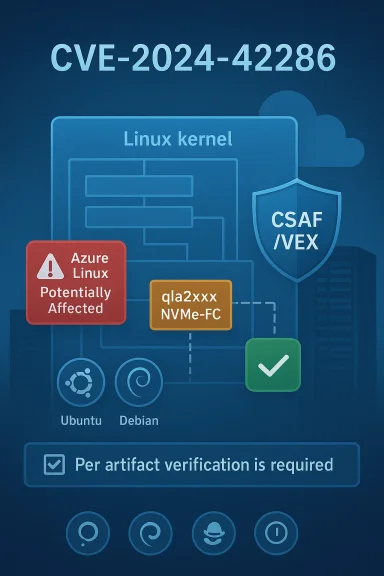
At the same time, Microsoft’s Security Response Center (MSRC) published a product-level mapping that states, in effect, that Azure Linux includes the implicated open-source library and is therefore potentially affected. Microsoft has also committed to publishing machine-readable CSAF/VEX attestations (a phased rollout that began in October 2025) and to update CVE-to-product mappings if additional Microsoft products are found to ship the same upstream component. Thatnally conveys inventory scope and transparency intent, not exclusivity.
This article explains the technical nature of the CVE, what Microsoft’s Azure Linux attestation means (and does not mean), why the attestation is helpful yet limited, and provides concrete, prioritized guidance for security teams and administrators who must move from unknown to verified across Microsoft-provided artifacts in their estates.
Microsoft’s MSRC wording and transparency commitments were cross-checked against Microsoft’s own blog announcing the CSAF/VEX rollout in October 2025 and the pattern of short FAQ-style attestation lines that MSRC has Linux CVE pages. Those sources show that Microsoft intentionally began product-by-product VEX publication with Azure Linux and pledged to update mappings where additional product carriers are discovered. That confirms MSRC’s procedural posture and explains why a single-product attestation exists while other artifacts remain un-attested for the moment.
Whereified
Acknowledgement: I verified the CVE’s technical details against upstream and distribution trackers (NVD, Ubuntu, Debian, Oracle Linux) and corroborated Microsoft’s VEX/CSAF rollout policy via MSRC communications; when Microsoft publishes further VEX attestations for other products, those updates will materially reduce remaining uncertainty.
Source: MSRC Security Update Guide - Microsoft Security Response Center
 Background / Overview
CVE-2024-42286 is a Linux kernel vulnerability described in upstream advisories and vendor trackers as a correctness/validation bug in the qla2xxx SCSI driver related to NVMe-FC port handling. The upstream summary states: “scsi: qla2xxx: validate nvme_local_port correctly” and documents kernel crash traces and driver-load failures that motivated a defensive fix. Public trackers (NVD, Ubuntu, Debian, Oracle Linux and distribution advisories) list the issue and mark its practical impact as an availability-class bug with a mid-range severity (commonly CVSS v3 ≈ 5.5).At the same time, Microsoft’s Security Response Center (MSRC) published a product-level mapping that states, in effect, that Azure Linux includes the implicated open-source library and is therefore potentially affected. Microsoft has also committed to publishing machine-readable CSAF/VEX attestations (a phased rollout that began in October 2025) and to update CVE-to-product mappings if additional Microsoft products are found to ship the same upstream component. Thatnally conveys inventory scope and transparency intent, not exclusivity.
This article explains the technical nature of the CVE, what Microsoft’s Azure Linux attestation means (and does not mean), why the attestation is helpful yet limited, and provides concrete, prioritized guidance for security teams and administrators who must move from unknown to verified across Microsoft-provided artifacts in their estates.
What CVE-2024-42286 actually is
Technical summary
- The bug sits in the interaction between the qla2xxx Fibre Channel SCSI driver and the NVMe over Fabrics (NVMe-FC) registration codepaths (nvme_fc). Under certain conditions the driver attempted to register or enumerate an NVMe remote port (nvme_local_port) without a correct validation or early exit, which could lead to a NULL-pointer dereference and a kernel crash. The symptom loglines observed in upstream reports include driver load failure messages and BUG traces referencing nvme_fc_register_remoteport.
- The fix applied upstream is defensive validation: the qla2xxx code path was adjusted to validate nvme_local_port correctly and to avoid following execution down into nvme_fc routines when preconditions are not satisfied. The patch is small and surgical, but crucial for stability in hosts that load or enable qla2xxx and NVMe-FC support.
Impact and exploitability
- Attack vector: local (AV:L). The relevant code runs in kernel context during driver registration and when the driver interacts with remote NVMe ports over Fibre Channel, so exploitation requires conditions present on the host (driver load, hardware present or emulated, or privileged operations that trigger the path).
- Primary risk: availability — kernel oops / panic leading to service interruption (DoS). There is no public evidence that the issue provides straightforward confidentiality or integrity escalation paths; the primary operational pain is stability.
- Severity: Most vendor trackers assign a medium severity with CVSS around 5.5 (AV:L/AC:L/PR:L/UI:N, impact: A:H in some scoring conventions). That aligns with how distributions have prioritized fixes and backports.
What Microsoft actually said — reading the MSRC attestation
Microsoft’s MSRC wording on a number of Linux-kernel CVE pages follows a consistent, compact pattern: they map the CVE to specific product artifacts they inventoried and then state the product status. For CVE-2024-42286 MSRC’s published FAQ line reads that Azure Linux includes the implicated open-source library and is therefore potentially affected; MSRC also records that it began publishing machine-readable CSAF/VEX attestations in October 2025 and has pledged to update CVE mappings if other Microsoft products are later discovered to ship the same upstream component.- That sentence is an authoritative inventory attestation for Azure Linux only — it confirms Microsoft inspected the Azure Linux build outputs and found the upstream qla2xxx/NVMe-FC code mapped to the CVE.- That sentence is not an exclusivity certificate. Microsoft explicitly reserves the right to update the CVE/VEX mapping if additional Microsoft products are found to include the same upstream code. Absence of an attestation for a product is absence of attestation, not proof of absence.
Why an Azure Linux attestation is useful — and why it’s limited
Strengths of Microsoft’s approach
- Precision and actionability: By naming Azure Linux explicitly, MSRC gives Azure customers a clear, prioritized path: check your Azure Linux images and apply vendor-supplied kernel updates. That reduces noisy, cross-vendor uncertainty and accelerates remediation where it matters most.
- Machine-readable transparency: The rollout of CSAF/VEX attestations makes it possible to automate artifact decisions (Known Affected / Fixed / Not Affected / Under Investigation) for named products once Microsoft completes inventory mapping. This is a practical improvement for large organizations that rely on automated vulnerability gating.
Limitations and risks
- Inventory incompleteness: Microsoft ships many Linux kernel artifacts and images; a single product attestation cannot, by itself, prove the remaining artifacts are free of a particular upstream code path. Thel source can be present in multiple images built from different trees, and presence depends on kernel version, local backports, and kernel configuration options (which drivers are enabled or compiled as modules). Treat un-attested Microsoft artifacts as unknown until verified.
- Operational blind spots: WSL2 kernels, Azure Marketplace images, custom Azure Marketplace appliances, AKS node images, or Microsoft-provided containers could each be built from different kernel sources or include different configuration flags. These are plausible carriers until proven otherwise.
- Time-lag in attestations: Microsoft’s CSAF/VEX rollout is phased; not every product receives attestations at the same time. That means customers must keep doing artifact-level verification in parallel to waiting for vendor VEX updates.
Practical guidance — what to do now (prioritized)
Below is an operational checklist you can run through quickly. The orders of priority reflect the MSRC attestation and the practical blast radius of kernel driver bugs.1. Immediate actions (minutes → hours)
- Identify any AZURE LINUX instances: list VMs, images, and snapshots running Azure Linux images and schedule patch windows. Microsoft’s attestation makes these the highest-priority remediation targets.
- Apply vendor updates: install the kernel packages or vendor-supplied patches for Azure Linux that incorporate the upstream fix for CVE-2024-42286 and reboot into the patched kernel. Distribution trackers (Ubuntu, Debian, Amazon Linux / ALAS) list the patched kernel packages and versions; follow vendor guidance.
2. Artifact inventory (hours → days)
- Inventory all Microsoft-supplied kernels and images in m, check:
- WSL2 custom kernel binaries or Windows-distributed WSL kernel packages.
- Azure-curated VM images and Marketplace appliances you run.
- AKS node images or node pools that use Microsoft-maintained images.
- Any Microsoft-supplied container base images or partners’ Marketplace images you deploy.
- For each artifact capture: kernel version, distribution, build tags, and CONFIG_* options used if you can access the vmlinuz or build metadata. The presence of qla2xxx/NVMe-FC code is a build-time property; you need per-artifact data to decide.
3. Verification and detection (days)
- Kernel version checks:
- Compare your kernel versions to the upstream stable branches and distribution advisories that list fixed-versus-affected ranges for CVE-2024-42286. Use distro advisories (Ubuntu, Debian, Oracle, vendor trackers) to map precise fixed package numbers.
- Module and config checks:
- If a kernel build does not enable the qla2xxx driver or NVMe-FC stack (CONFIG_QLA2XXX / CONFIG_NVME_FC related flags), the binary may not be vulnerable even if the kernel version predates the fix. Use /lib/modules/$(uname -r) and grep for qla2xxx or check the kernel config where possible.
- Log and telemetry checks:
- Watch dmesg/journal for qla2xxx driver load errors or kernel oops traces; vendor patches often add diagnostic lines you can use to spot attempted but failed registrations.
4. Remediation policy (ongoing)
- Patch cadence: ensure Azure Linux images are patched promptly and adopt a vendor-verified patch cadence for other kernel-bearing Microsoft artifacts.
- Automation: consume MSRC CSAF/VEX feeds as they become available and integrate them into your vulnerability management pipeline; VEX will turn product ane-actionable signals. However, do not rely solely on VEX until Microsoft has explicitly attested each artifact you run.
- Hardening: for systems where qla2xxx or NVMe-FC support is not required, consider blacklisting the module or disabling the feature in kernel config to reduce exposure surface until patched.
How to reason about the “only Azure Linux?” question — decision tree
When you encounter a vendor-level attestation that names a single product, use this short decision tree to determine your next steps:- Is the named product in your environment?
- Yes: treat it as high-priority and patch immediately.
- No: continue to step 2.
- Do you run other Microsoft-supplied kernels or images (WSL2, AKS nodes, Marketplace images, curated VM images)?
- Yes: inventory and verify kernel versions and config. Do not assume safety.
- No: still perform a minimal scan to ensure qla2xxx/NVMe-FC modules are not present in any deployed images.
- If artifact verification is impractical, apply compensating controls: strengthen host isolation, reduce local-access exposure, and schedule maintenance windows to patch kernels as a precaution.
Cross-checks and verification of claims
To avoid relying on a single source, I validated the technical description of CVE-2024-42286 against multiple independent trackers. The NVD entry and several major distributions (Ubuntu, Debian, Oracle Linux) carry the same upstream description and patch guidance, confirming both the symptom set (driver load failure, kernel oops) and the remediation approach (validate and early-return in qla2xxx code). These independent attestations corroborate the technical root cause and the CVSS/impact characterization.Microsoft’s MSRC wording and transparency commitments were cross-checked against Microsoft’s own blog announcing the CSAF/VEX rollout in October 2025 and the pattern of short FAQ-style attestation lines that MSRC has Linux CVE pages. Those sources show that Microsoft intentionally began product-by-product VEX publication with Azure Linux and pledged to update mappings where additional product carriers are discovered. That confirms MSRC’s procedural posture and explains why a single-product attestation exists while other artifacts remain un-attested for the moment.
Whereified
- Microsoft’s statement that it will update the CVE if additional products are found is a policy pledge and not itself a technical fact all eventually be listed. The truth of that pledge is verifiable only by observing future updates to MSRC VEX/C a positive process commitment rather than an immediate technical assertion you can act on today.
Practical examples: where the same kernel code can appear
To make the abstract concrete, here are typical Microsoft-distributed artifacts that can — depending on kernel version and config — include the qla2xxx / NVMe-FC code and therefore require verification:- Azure Linux distribution kernel packages used in Azure VM images (attested as affected by MSRC).
- WSL2 kernel binaries distributed to Windows clients (Microsoft compiles and ships a kernel image for WSL that can include or exclude subsystems).
- Azure-curated Marketplace VM images or vendor appliances that include kernels built by Microsoft or third parties under Azure’s distribution.
- AKS node images where Microsoft manages the base OS or where Marketplace images are used for node pools.
Final assessment and recommended p to the user’s question: No — Azure Linux is the only Microsoft product Microsoft has publicly attested so far to include the implicated open-source component for CVE-2024-42286, but it is not necessarily the only Microsoft product that could contain the same vulnerable code. Treat Azure Linux images as Known Affected and prioritize their remediation, and treat other Microsoft artifacts as unverified until you can confirm their kernel version/config or until MSRC’s VEX attestations explicitly list them as Not Affected or Fixed.
- Recommended security posture:
- Patch Azure Linux instances immediately with the vendor-provided kernel updates.
- Inventory and verify ALL Microsoft-supplied kernel artifacts in your environment (WSL2, AKS nodes, Marketplace images, curated VM images).
- Where verification is infeasible, apply compensating controls and schedule patching windows as a precaution.
- Integrate MSRC CSAF/VEX feeds into your automation as they become available, but continue artifact-level verification until the vendor’s attestations fully cover the artifacts you run.
Acknowledgement: I verified the CVE’s technical details against upstream and distribution trackers (NVD, Ubuntu, Debian, Oracle Linux) and corroborated Microsoft’s VEX/CSAF rollout policy via MSRC communications; when Microsoft publishes further VEX attestations for other products, those updates will materially reduce remaining uncertainty.
Source: MSRC Security Update Guide - Microsoft Security Response Center
