

Microsoft’s one-line answer on the CVE page — that “Azure Linux includes this open‑source library and is therefore potentially affected” — is factually correct for the Azure Linux product set Microsoft has inspected, but it is not a technical guarantee that no other Microsoft product could contain the same vulnerable kernel code; defenders must treat other Microsoft‑supplied Linux kernels and kernel‑based artifacts as unverified until Microsoft publishes explicit VEX/CSAF attestations or you verify them yourself. rview
CVE‑2024‑42288 is an upstream Linux kernel vulnerability recorded as a defect in the scsi qla2xxx driver. The fix addresses an incorrect dereference of the Init Control Block (ICB) that could cause memory corruption in affected kernel builds. The public CVE record lists the issue as published on August 17, 2024, with a CVSSv3.1 base score commonly reported around 5.5 (Medium) and the primary impact categorized as availability (local attack vector, low complexity). Independent distro trackers (Ubuntu, SUSE, Debian/OSV) and vulnerability databases reproduce the same technical summary and affected kernel ranges.
Why that matters: this is an in‑tree kernel driver issue. Whether a product is actually vulnerable depends on three concrete, verifiable facts for each kernel artifact:
Microsoft’s MSRC entry for many Linux kernel CVEs has adopted a short, inventory‑focused phrasing: “Azure Linux includes this open‑source library and is therefore potentially affected by this vulnerability.” That sentence is a product‑level attestation — Microsoft has inspected the Azure Linux distribution images / kernel builds and found the implicated upstream component there, so Azure Linux images are a confirmed carrier and should be remediated per Microsoft guidance. Microsoft has also said it began publishing machine‑readable CSAF/VEX attestations in October 2025 and will update CVE mappings if it discovers additional Microsoft products that ship the same upstream component.
Important nuance that often causes operational confusion: the attestation is authoritative for the product Microsoft names (Azure Linux), but it is not an exclusivity statement. In short:
Immediate recommended actions (condensed):
Source: MSRC Security Update Guide - Microsoft Security Response Center
CVE‑2024‑42288 is an upstream Linux kernel vulnerability recorded as a defect in the scsi qla2xxx driver. The fix addresses an incorrect dereference of the Init Control Block (ICB) that could cause memory corruption in affected kernel builds. The public CVE record lists the issue as published on August 17, 2024, with a CVSSv3.1 base score commonly reported around 5.5 (Medium) and the primary impact categorized as availability (local attack vector, low complexity). Independent distro trackers (Ubuntu, SUSE, Debian/OSV) and vulnerability databases reproduce the same technical summary and affected kernel ranges.
Why that matters: this is an in‑tree kernel driver issue. Whether a product is actually vulnerable depends on three concrete, verifiable facts for each kernel artifact:
- The kernel commit/version used to build the kernel (was the vulnerable commit present when the kernel snapshot was taken?).
- The kernel configuration used for that build (is the qla2xxx driver compiled in or available as a module?).
- Any vendor backports or local patches applied after the upstream fix (was the fix backported, or was the code modse three items determine the true blast radius more than the CVE text alone.
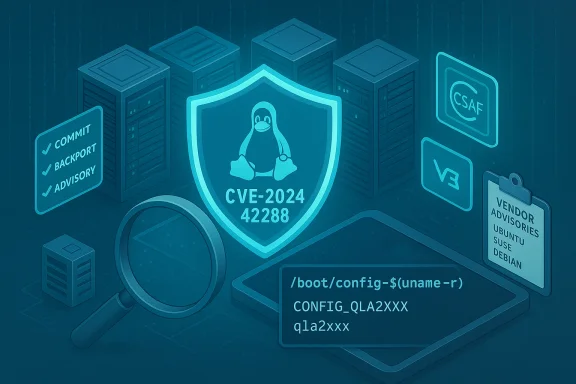 What Microsoft actually wrote — and what that phrasing means
Microsoft’s MSRC entry for many Linux kernel CVEs has adopted a short, inventory‑focused phrasing: “Azure Linux includes this open‑source library and is therefore potentially affected by this vulnerability.” That sentence is a product‑level attestation — Microsoft has inspected the Azure Linux distribution images / kernel builds and found the implicated upstream component there, so Azure Linux images are a confirmed carrier and should be remediated per Microsoft guidance. Microsoft has also said it began publishing machine‑readable CSAF/VEX attestations in October 2025 and will update CVE mappings if it discovers additional Microsoft products that ship the same upstream component.Important nuance that often causes operational confusion: the attestation is authoritative for the product Microsoft names (Azure Linux), but it is not an exclusivity statement. In short:
- Attested affected (what Microsoft said): Azure Linux has been examined and found to include the implicated component — treat Azure Linux as in‑scope.
- Not attested (what Microsoft did notnot assert that other Microsoft products are free of the component. Absence of a VEX/CSAF entry for Product B is not proof that Product B is safe.
Why Azure Linux being named doesn’t make it “the only” possible Microsoft carrier
Large vendors ship many different kernel artifacts, images and appliance binaries. The same upstream driver code can appear in multiple Microsoft artifacts depending on how and when those images were built. Examples of Microsoft artifacts that can — technically speaking — be carriers are:- The Azure Linux distro images (explicitly attested for the CVE in question).
- Curated Azure Marketplace VM images and Marketplace appliances that embedn kernel or a Microsoft‑tuned kernel.
- AKS node images and managed node pools (node OS images are separate artifacts and may be builtm trees).
- The WSL2 kernel Microsoft distributes to Windows clients (a Microsoft‑published kernel binary that may include many vers depending on the build configuration).
- Platform appliances, service‑specific kernels, and internal build artifacts that Microsoft uses to create container base images or VM imag a separately built artifact. Inclusion of a driver like qla2xxx is a build‑time decision and therefore must be checked on the artifact level — you canAzure Linux” from a single product attestation.
Cross‑checking the technical facts (what independent sources say)
To make defensive decisions you should cross‑verify the kernel fix and affected ranges across independent tracker documents the qla2xxx fix and its description for CVE‑2024‑42288 (Aug 17, 2024). This confirms the upstream description and the canonical CVE assignment.- Major distributions (Ubuntu, SUSE, Debian) published advisories listing the relevant kernel versions and point releases that incorporate the upstream fix; these distribution advisories are the operational source of truth when deciding whether a given image or package is patched.
- Vendor vulnerability databases and aggregators (OpenCVE, Enginsight, Rapid7, OSV) reproduce the same technical summary and provide the usual range of affected kernel series and fixed versions — use them to help map the upstream commit to distribution package names.
Practical guidance — What you should do now (prioritized checklist)
If the Azure Linux attestation or this CVE impacts systems you operate, follow this pragmatic, ordered checklist to move from uncertainty to verified posture:- Inventory Microsoft‑supplied Linux artifacts in your estate.
- Look for Azure Linux images, Marketplace VM images, AKS node images, Microsoft‑published container base images, WSL2 instances on developer machines, and any Microsoft appliances or agents that bundle kernel binaries.
- For every artifact, capture the kernel identity.
run uname -a and record the release string; inspect /boot/config-$(uname -r) or /proc/config.gz for driver configuration. - Images or packages: extract package metadata or kernel config files from the image. The kernel version and CONFIG_ flags determine whether qla2xxx is present.
- Map kernel versions to vendor advisories.
- Check the distribution oy to see if the kernel version is listed as vulnerable or fixed; rely on vendor package names and release notes rather than raw kernel numbers when possible. Use distro advisories (Ubuntu, SUSE, Debian), NVD/OSV entries, and vendor errata listings to confirm whether the fix has been applied.
- Prioritize patching for confirmed carriers.
- If an artifact is confirmed to include the vulnerable qla2xxx code and is listed vulnerable in vendor advisories, schedule and apply the vendor‑recommended kernel update or image replacement immediately. Azure Linux images named by Microsoft should be a first priority.
- Mitigate if you cannot patch immediately.
- Foo‑replace hosts, isolate the hosts, reduce local attacker surface, and apply workload placement mitigations. Document the risk and monitor for kernel oops or storage stack errors. Consider limiting direct access to the affected SCSI devices where feasible.
- Track Microsoft’s VEX/CSAF updates and request coverage if needed.
l attestation that other Microsoft artifacts (e.g., WSL2, AKS node images) are Not Affected, file a request through Microsoft support channels so those artifacts can be inventoried and added to the VEX/CSAF mapping when available. Microsoft has publicly committed to updating mappings as it discovers additional product impact. - For desktop fleets: don’t forget WSL2.
- WSL2 ships a kernel binary that Microsoft builds and distributes. If you manage developer desktops, include WSL instances in your inventory and patching plans rather than assuming only server images matter.
- Automate future checks.
- Where possible, automate inventory and verification with SBOMs, VEX/CSAF ingestion, or image scant “unverified” Microsoft artifacts into an explicit attestation state (Known Affected / Not Affected / Under Investigation).
Technical analysis: how exposure varies by build and configuration
Two points often under‑appreciated by operations teams:- Kernel inclusion in. A distribution kernel may include qla2xxx by default; an OEM or cloud vendor kernel may disable it or ship it as a module. Therefore, the mere presence of a Linux distribution or a Microsoft image does not automatically mean the qla2xxx code is present — you must verify the kernel config or module list.
- Vendors sometimes backport fixes into older kernel series rather than upgrading the kernel release. A patched kernel can exist under the same major/minor kernel string if thkport. That is why mapping vendor package names and advisory IDs (for example, the Ubuntu package release or SUSE kernel‑default package revision) is essential. Relying solely on upstream git commit hashes is necessary for developers but insufficient for operators.
Strengths and risks of Microsoft’s attestation approach
Strengths- Transparency where applied. Publishing CSAF/VEX attestations for Azure Linux is an important step toward machine‑consumable inventory statements that security automation and orchestration can use. Microsoft’s commitment to publish VEX/CSAF makes it easier for customers to automate remediation when the attestation exists.
- Operational clarity for the attested product. When Microsoft names a product as “includes the component and is therefore potentially affected,” cus have a clear, high‑confidence prioritization signal.
- Patch coverage lag across product families. Microsoft’s VEX/CSAF rollout is product‑by‑product; many Microsoft artifacts will remain un‑attested untpletes. This phased approach can create windows where customers assume “not named = not affected,” which is a dangerous assumption.
- Potential for mismatched expectations. Customers may misinterpret a single attestation as a global guarantee. The practical consequence is under‑patching of important artifacts such as WSL2 images that were not yet inventoried.
- Operational complexity in large estates. Large organizations that consume many Microsoft images, marketplace appliances, and developer devices need to treat each artifact as a verification unit — a nontrivial opesence of a VEX entry for an artifact should prompt artifact‑level verification rather than complacency.
Concluding assessment and recommendation
Short answer to the user’s central question: Microsoft’s published line for CVE‑2024‑42288 names Azure Linux as a product that includes the implicated upstream component and is therefor — that attestation is correct and actionable for Azure Linux customers. However, Azure Linux is not necessarily the only Microsoft product that could be affected; other Microsoft‑distributed kernel artifacts (WSL2 kernels, Azure image kernels, AKS node images, Marketplace appliances) could contain the same upstream code depending on kernel version and build configuration. Until Microsoft publishes explicit VEX/CSAF attestations for those artifacts or you verify the artifact’s kernel version/configuration yourself, treat them as unverified rather than proven safe.Immediate recommended actions (condensed):
- If you run Azure Linux images: treat them as in‑scope and apply Microsoft’s updates now.
- Inventory all Microsoft‑supplied Linux artifacts in your estate (including WSL2) and verify kernel versions/configs.
- Map kernel versions to vendor/distro advisories (NVD/Ubuntu/SUSE/OSV) and apply vendor fixes or image replacements. (nvd.nist.gov)
- If you require formal attestation for additional Microsoft artifacts, request VEX/CSAF coverage from Microsoo MSRC CVE mappings; don’t assume absence of a mapping equals absence of exposure.
Source: MSRC Security Update Guide - Microsoft Security Response Center
