

A null-pointer bug in the Linux kernel’s Direct Rendering Manager (DRM) client code — tracked as CVE‑2024‑43894 — is small in code size but broad in potential reach because the affected component lives in the upstream kernel tree and is reused across many Linux artifacts. Microsoft’s public advisory currently calls out the Azure Linux distribution as the product that “includes this open‑source library and is therefore potentially affected,” but that wording is a product‑scoped attestation rather than a blanket statement that no other Microsoft‑distributed artifacts could contain the vulnerable code. This article explains what the vulnerability is, why Microsoft’s Azure Linux attestation matters, the realistic blast radius across Microsoft’s ecosystem (WSL kernels, Azure VM images, AKS nodes, Marketplace appliances), and precise, actionable steps system owners should take now to detect, triage, and remediate exposure.
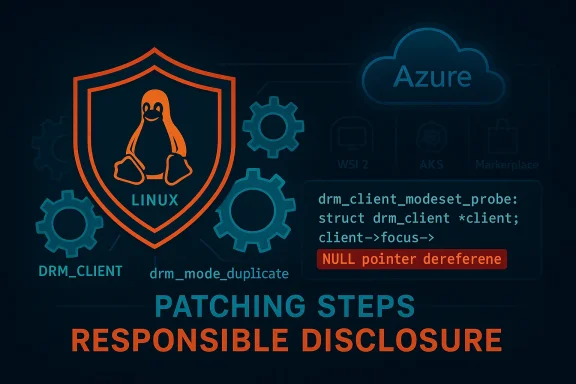
The vulnerability exists in the Linux kernel’s DRM client helper code, specifically in the function drm_client_modeset_probe(). The function calls drm_mode_duplicate() and assigns its return to a pointer without checking whether the allocation succeeded. If drm_mode_duplicate() fails and returns NULL, subsequent dereference of the pointer can crash the kernel — a classic NULL pointer dereference (CWE‑476) that results in a denial‑of‑service (DoS) condition for the host.
This class of bug does not, in its normal form, yield arbitrary code execution; it causes an availability impact — a kernel oops or panic — when triggered. That said, in multi‑tenant environments or on systems where local users or containers have access to graphics device interfaces, repeated or crafted triggering of the failure can be used as a disruptive attack vector.
Why this particular fix matters operationally is twofold:
This is why Microsoft’s attestation that Azure Linux includes the component is important: it tells Azure Linux customers the product was inspected and found to contain the upstream code and therefore needs the applicable fix. But for other Microsoft artifacts (for example, the kernel Microsoft ships as part of WSL2, kernels used on some Azure VM SKUs, or images in the Azure Marketplace), the presence of the vulnerable code has to be validated per artifact.
Operationally, that means:
CVE‑2024‑43894 is a reminder that small, localized code defects in upstream open‑source projects can have outsized operational effects when those projects are embedded deeply in distributed software artifacts. Microsoft’s statement that Azure Linux includes the affected component is a valuable and authoritative attestation for that product, but it is not a categorical statement about every Microsoft artifact that might ship a Linux kernel. Security teams should treat Microsoft’s attestation as actionable input for Azure Linux, and — for all other Microsoft‑distributed kernels and images — perform the artifact‑level checks and remediation steps outlined above until each product is explicitly attested or verified patched.
Source: MSRC Security Update Guide - Microsoft Security Response Center
 Background / Overview
The vulnerability exists in the Linux kernel’s DRM client helper code, specifically in the function drm_client_modeset_probe(). The function calls drm_mode_duplicate() and assigns its return to a pointer without checking whether the allocation succeeded. If drm_mode_duplicate() fails and returns NULL, subsequent dereference of the pointer can crash the kernel — a classic NULL pointer dereference (CWE‑476) that results in a denial‑of‑service (DoS) condition for the host.This class of bug does not, in its normal form, yield arbitrary code execution; it causes an availability impact — a kernel oops or panic — when triggered. That said, in multi‑tenant environments or on systems where local users or containers have access to graphics device interfaces, repeated or crafted triggering of the failure can be used as a disruptive attack vector.
Why this particular fix matters operationally is twofold:
- The DRM codebase is widely reused across kernel builds and distributions; whether any given product is actually affected depends not on source alone but on which kernel versions and build‑time CONFIG options were used when the kernel was compiled.
- Microsoft has published a product‑level statement (an attestation) that Azure Linux includes the implicated open‑source component and is therefore potentially affected; that is authoritative for Azure Linux but not an exhaustive inventory for all Microsoft products that ship Linux kernels.
What Microsoft said — and what that wording actually means
Microsoft’s public note around this and similar kernel CVEs explains the company’s product attestation approach: they publish CSAF/VEX‑style attestations for the Azure Linux distribution and will update CVE entries if additional Microsoft products are identified as impacted. The key points to understand in Microsoft’s wording:- “Azure Linux is the only Microsoft product that includes this open‑source library and is therefore potentially affected” is a current attestation, not an immutable technical claim.
- An attestation is a statement of fact for a specific product after Microsoft inspected the product and its build artifacts; it is not proof that no other Microsoft artifact could include the same upstream source.
- Microsoft’s rollout of machine‑readable transparency artifacts (CSAF/VEX) began in late 2024 and expanded in October 2025; they started by publishing attestations for Azure Linux first and will widen coverage over time.
Technical context: why inclusion is artifact‑specific
The Linux kernel is not a simple “one binary fits all” library. Whether a particular kernel binary contains a given source file’s functionality depends on three independent factors:- The kernel version / commit range used to build the binary — upstream fixes are merged into specific stable branches at specific commits and dates.
- The kernel configuration (.config) chosen at build time — many features and drivers are optional and can be built-in, compiled as modules, or omitted entirely (CONFIG_* symbols).
- Vendor packaging and backports — distributors and vendors sometimes backport fixes into older stable branches or ship their own kernel tuning packages.
This is why Microsoft’s attestation that Azure Linux includes the component is important: it tells Azure Linux customers the product was inspected and found to contain the upstream code and therefore needs the applicable fix. But for other Microsoft artifacts (for example, the kernel Microsoft ships as part of WSL2, kernels used on some Azure VM SKUs, or images in the Azure Marketplace), the presence of the vulnerable code has to be validated per artifact.
Which Microsoft artifacts could plausibly include the vulnerable DRM code?
Consider the main Microsoft‑distributed artifacts that ship or embed Linux kernels. Each must be checked individually.- Azure Linux distribution (explicitly attested): Microsoft has declared Azure Linux is a product that includes the implicated open‑source component. If you run Azure Linux nodes, treat them as in-scope and patch according to Microsoft guidance.
- Windows Subsystem for Linux (WSL2) kernels: Microsoft ships a Microsoft‑built Linux kernel image for WSL2. The WSL kernel often includes a subset of DRM and GPU support because WSLg and GPU passthrough require it. Whether the specific WSL binary you have contains the drm/client code depends on the kernel version and config used for that WSL kernel build.
- Azure Marketplace images and Azure VM kernels: Many Azure images run vendor kernels (Ubuntu, Debian, SUSE, etc.) or Azure‑tuned kernel packages. Some of those are Microsoft‑packaged kernel artifacts (linux‑azure / azure‑tuned) and may be affected if they include the upstream code and predate the upstream fix.
- AKS node images and managed offerings: Managed Kubernetes nodes are built from images and kernels supplied to the cluster; if the node image uses a kernel that includes the vulnerable DRM code, the nodes may be affected.
- Microsoft‑curated appliances and partner Marketplace offerings: Appliances that embed a kernel may contain the vulnerable code depending on how they were built.
- Custom kernels customers compile and load into Microsoft services: If you provide your own kernel image (for WSL or Azure VM), you control whether the code is present by way of your kernel build config and version.
Practical detection: how to verify whether a host contains the vulnerable code
These checks go from quick and non‑disruptive to more thorough. Use the steps that match your environment and risk profile.- Identify the kernel version
- Run: uname -r
- Compare the released kernel version to known affected branches. The vulnerability was fixed upstream and backported to multiple stable branches; if your kernel predates the backport, further checks are required.
- Look for kernel symbols (fast, reliable runtime check)
- Run: grep -w drm_client_modeset_probe /proc/kallsyms || true
- If the symbol appears in /proc/kallsyms, the kernel contains the function and therefore the code is present in that binary. If /proc/kallsyms is not available or stripped, this check may not work.
- Inspect the running kernel configuration
- Run: zcat /proc/config.gz | grep -i drm || zcat /proc/config.gz | sed -n '1,200p' (if /proc/config.gz exists)
- Or check: cat /boot/config-$(uname -r) | grep -i drm
- Look for CONFIG_DRM and related options; if DRM is disabled entirely, the drm client code will not be present. Note that symbols are often enabled through generic DRM options rather than a single CONFIG_DRM_CLIENT flag — absence requires careful interpretation.
- Check for DRM device nodes and modules
- Run: lsmod | grep drm
- Run: ls -l /dev/dri
- Presence of DRM modules or device nodes indicates DRM subsystem is active on the host; if those are present and the kernel version is in a vulnerable range, treat the host as higher priority to verify.
- For WSL2 instances
- Inside WSL: zcat /proc/config.gz | grep -i drm and uname -r
- If you use the Microsoft‑supplied WSL kernel, check whether your WSL release is up to date (Windows updates, wsl --update), or, if you use a custom kernel image, verify the custom kernel config and version.
- For cloud images and offline analysis
- Boot a representative image and run steps 1–4. If you cannot boot the image, unpack the image contents and inspect /boot/config‑* files or the packaged kernel modules to see if drm/client files or the relevant symbol exist.
- Fleet scanning
- Automate the above checks across fleet using scripts that query uname, /proc/kallsyms, and /proc/config.gz (or fallback to /boot/config-$(uname -r)). Flag any host where the kernel version and symbol presence indicate potential exposure.
Triage and mitigation guidance
If a host is identified as potentially affected, take the following prioritized actions.- Patch first — apply vendor updates
- The recommended fix is to install a kernel update that includes the upstream patch or a vendor backport. For Azure Linux instances, apply Microsoft’s posted updates as soon as they are available. For vendor images (Ubuntu, Debian, RHEL, SLES), apply the vendor security update that addresses the kernel stable branch you run.
- For WSL2 on Windows: update WSL via the standard Microsoft update mechanisms (wsl --update or Windows Update) if you run the Microsoft‑supplied kernel. If you run a custom WSL kernel, rebuild it with the upstream fix and replace the kernel image used by WSL.
- If patching is not immediately possible, apply compensating controls
- Limit access to GPU device nodes and graphics device interfaces:
- Restrict group membership (prevent unprivileged users from being in video, render or equivalent groups).
- Remove /dev/dri device access for untrusted containers and unprivileged users.
- For multi‑tenant cloud hosts, ensure containers and guest VMs cannot access host device nodes.
- Harden workload placement:
- Avoid co‑locating untrusted workloads on hosts where unpatched DRM code is present.
- Move sensitive workloads to patched hosts or to images built from vendor kernels that contain the fix.
- For WSL and developer machines
- If you run WSL with the default Microsoft kernel, keep WSL up to date.
- If you intentionally enable GPU passthrough or use WSLg, monitor the WSL kernel release notes and update promptly.
- Verify remediation success
- After patching, re-run the runtime symbol check (grep drm_client_modeset_probe /proc/kallsyms) and confirm the patched kernel version is loaded across your fleet.
- Make sure any emergency workarounds you applied (e.g., revoking device access) are still in place until the patch is confirmed deployed.
Risk assessment and operational impact
- Exploitability: requires local access. The vulnerability is a NULL pointer dereference — in most practical scenarios the attacker needs some level of local access (unprivileged user, container privileges, or access to the graphics device) to trigger the code path.
- Impact: Denial of service — kernel oops/panic causing system crash, service interruption, or node reboot. In multi‑tenant or containerized environments this can be a high‑impact availability issue.
- Likelihood: Moderate in contexts where untrusted users have access to GPU device nodes (for example, GPU‑enabled cloud nodes, shared developer workstations, or container hosts with device passthrough). Low for hardened systems that restrict device access.
- Long‑term concern: Because DRM code is present in many kernels and because distribution builds differ, this kind of bug can persist across diverse artifacts until every kernel vendor backports the fix. That makes careful inventory and automated checks essential.
Why Microsoft’s attestation practice matters — and what to do about it
Microsoft’s CSAF/VEX attestation approach is a positive step: it gives customers per‑product machine‑readable statements about whether a given product contains the implicated upstream component and whether Microsoft considers it affected. That reduces noise for Azure Linux customers and helps automation. But the attestation is product‑scoped and phased: the fact that Microsoft has attested Azure Linux does not imply other Microsoft kernel artifacts (WSL, certain Azure images, appliances) were checked or are unaffected.Operationally, that means:
- If you run Azure Linux: treat Microsoft’s attestation as an authoritative call to action and patch promptly.
- If you run other Microsoft artifacts (WSL, AKS nodes, Marketplace appliances, custom kernels on Azure): do not assume safety; run the detection checks described above.
- If you need vendor affirmation for other Microsoft products, request or monitor Microsoft’s CSAF/VEX outputs and product pages — Microsoft has stated it will update CVE pages and VEX attestations when additional products are identified.
Practical checklist for administrators (quick reference)
- Inventory: compile a list of machines and images that run Linux kernels you control or that Microsoft distributes into your environment (Azure VMs, AKS nodes, WSL hosts, Marketplace appliances).
- Detect:
- Run uname -r on representative hosts.
- Search /proc/kallsyms for drm_client_modeset_probe.
- Inspect /boot/config-$(uname -r) or /proc/config.gz for DRM-related config.
- Prioritize:
- Highest priority: hosts that expose GPU device nodes (/dev/dri) to untrusted users, shared developer workstations, container hosts with device passthrough.
- Medium priority: hosts without /dev/dri but running affected kernel versions where DRM might still be compiled in.
- Patch:
- Apply vendor or Microsoft kernel updates.
- For WSL: run wsl --update or follow Microsoft’s guidance for kernel updates.
- For custom kernels: incorporate the upstream patch or upgrade to a fixed upstream/stable branch and rebuild.
- Validate:
- Confirm patched kernel is running and symbol no longer present (or that your kernel version is beyond the patched commit).
- Revoke any temporary device access policies only after verification.
- Monitor: subscribe to vendor advisories, Microsoft CSAF/VEX attestations, and mainstream distribution security trackers to learn about backports and additional affected artifacts.
Closing analysis: strengths and residual risks
The positive takeaways here are clear:- The bug is small, well understood, and fixed upstream with minimal code changes; this typically means maintainers can and will backport the fix quickly across stable branches.
- Microsoft’s decision to publish per‑product attestations for Azure Linux and to adopt machine‑readable VEX/CSAF artifacts increases clarity for customers and reduces the manual effort of mapping CVEs to Microsoft products.
- Detection at runtime is feasible and simple: checking /proc/kallsyms and kernel config exposes whether the function is present in a kernel build.
- The primary risk is inventory drift: many organizations run mixtures of vendor kernels, cloud images, WSL kernels, and custom builds. Without automated checks, some artifacts may remain unverified.
- Microsoft’s initial attestation program is phased. Until attestations cover all Microsoft artifacts that ship kernels, customers must independently verify non‑attested items.
- Remediation complexity can vary: while cloud image vendors and major distributions will typically push kernel updates quickly, some custom images or appliances may require manual rebuilds and redeployments.
CVE‑2024‑43894 is a reminder that small, localized code defects in upstream open‑source projects can have outsized operational effects when those projects are embedded deeply in distributed software artifacts. Microsoft’s statement that Azure Linux includes the affected component is a valuable and authoritative attestation for that product, but it is not a categorical statement about every Microsoft artifact that might ship a Linux kernel. Security teams should treat Microsoft’s attestation as actionable input for Azure Linux, and — for all other Microsoft‑distributed kernels and images — perform the artifact‑level checks and remediation steps outlined above until each product is explicitly attested or verified patched.
Source: MSRC Security Update Guide - Microsoft Security Response Center
