

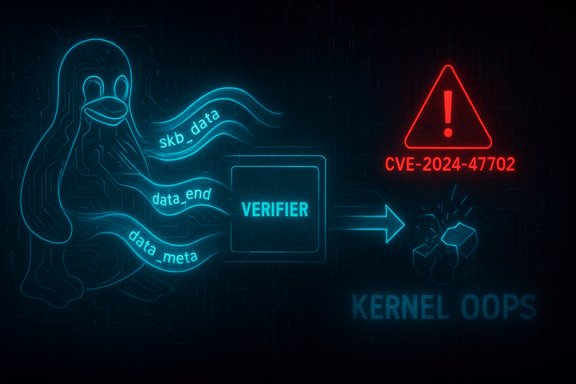
A subtle mismatch between how the Linux BPF verifier handles 32-bit loads from packet context and how those values are later represented in generated code has been assigned CVE‑2024‑47702 — a medium‑severity bug that can cause kernel verification failures and runtime crashes when eBPF programs access __sk_buff packet pointers (data / data_end / data_meta). The defect stems from sign‑extension of 32‑bit context fields during verifier conversion and has been reported by multiple vendors and trackers; operators should treat this as an availability risk (kernel OOPS / DoS) and apply vendor kernel updates or mitigations without delay.
eBPF (extended Berkeley Packet Filter) is now central to Linux networking, observability, and security stacks. BPF programs frequently read packet buffer pointers exposed through the __sk_buff context (commonly referenced as skb->data, skb->data_end, and skb->data_meta). These fields are exposed to userland via an ABI and are critical for safe packet parsing: the verifier enforces pointer ranges so that BPF programs cannot read past packet boundaries.
CVE‑2024‑47702 describes a verifier conversion problem where a 32‑bit signed load from those UAPI fields is subsequently converted into a wider representation that the verifier treats as a packet pointer. Because the conversion path permitted a sign‑extension step in the generated instruction stream, a valid verifier pass could nevertheless produce code that later becomes an invalid pointer at runtime — producing a crash when the kernel attempts to dereference it. Multiple vulnerability trackers and distribution advisories summarize the same root cause and reproduction notes.
In the problematic path reported by syzbot and reproduced in vendor writeups, the final code after conversion included an explicit sign‑extension (cast to signed 32‑bit and then placed into a 64‑bit register) — an operation that can produce a negative high‑half if the 32‑bit value's sign bit is set. A negative high‑half, when interpreted as a kernel pointer, can point to an invalid address and cause a paging fault when dereferenced. The NVD description reproduces the instruction sequence and explains how a pattern like:
r2 = (s32 )(r1 + 76) / load __sk_buff->data /
r3 = (u32 )(r1 + 80) / load __sk_buff->data_end /
r0 = r2
r0 += 8
if r3 > r0 goto +1
can be transformed through convert_ctx_accesses into:
r2 = (u64 )(r1 + 208)
r2 = (s32)r2
r3 = (u64 )(r1 + 80)
r0 = r2
r0 += 8
if r3 > r0 goto pc+1
— where the
In this case, a change in the code path (recorded in commit 1f1e864b6555, which attempted to handle context member accesses more generically) allowed a signed 32‑bit load to slip through the conversion without being normalized to an unsigned, zero‑extended pointer representation. That mismatch produced a legal verifier‑level program that nonetheless generated unsafe runtime code. Multiple vendor advisories and community writeups reproduce and document this sequence.
Operators should prioritize inventory, apply vendor kernel updates, and harden BPF loading policies (disable unprivileged BPF where practical) while patches propagate. Monitor kernel logs for verifier warnings and OOPS patterns, preserve crash artifacts for triage, and validate remediated package changelogs before declaring systems safe. Treat kernel faults as high‑priority operational events: patching and rebooting remains the most reliable defense.
If you need a concise checklist tailored to a specific distribution (Ubuntu, RHEL, SUSE, ALAS) or a one‑page runbook for patching and verification in a hybrid cloud environment, produce your inventory list and I will draft a step‑by‑step remediation plan referencing the vendor package names and reboot windows.
Source: MSRC Security Update Guide - Microsoft Security Response Center
 Background / Overview
eBPF (extended Berkeley Packet Filter) is now central to Linux networking, observability, and security stacks. BPF programs frequently read packet buffer pointers exposed through the __sk_buff context (commonly referenced as skb->data, skb->data_end, and skb->data_meta). These fields are exposed to userland via an ABI and are critical for safe packet parsing: the verifier enforces pointer ranges so that BPF programs cannot read past packet boundaries.CVE‑2024‑47702 describes a verifier conversion problem where a 32‑bit signed load from those UAPI fields is subsequently converted into a wider representation that the verifier treats as a packet pointer. Because the conversion path permitted a sign‑extension step in the generated instruction stream, a valid verifier pass could nevertheless produce code that later becomes an invalid pointer at runtime — producing a crash when the kernel attempts to dereference it. Multiple vulnerability trackers and distribution advisories summarize the same root cause and reproduction notes.
What went wrong — a technical deep dive
The root cause: sign‑extension of 32‑bit loads
At compile/verify time, a BPF program that reads skb->data may be represented as a 32‑bit load in the verifier's intermediate representation (for example, because the underlying UAPI field is a 32‑bit integer). When the verifier converts the high-level access into the internal packet‑pointer model it must ensure the register's value is treated as a packet pointer (a special pointer class the verifier restricts from arbitrary arithmetic).In the problematic path reported by syzbot and reproduced in vendor writeups, the final code after conversion included an explicit sign‑extension (cast to signed 32‑bit and then placed into a 64‑bit register) — an operation that can produce a negative high‑half if the 32‑bit value's sign bit is set. A negative high‑half, when interpreted as a kernel pointer, can point to an invalid address and cause a paging fault when dereferenced. The NVD description reproduces the instruction sequence and explains how a pattern like:
r2 = (s32 )(r1 + 76) / load __sk_buff->data /
r3 = (u32 )(r1 + 80) / load __sk_buff->data_end /
r0 = r2
r0 += 8
if r3 > r0 goto +1
can be transformed through convert_ctx_accesses into:
r2 = (u64 )(r1 + 208)
r2 = (s32)r2
r3 = (u64 )(r1 + 80)
r0 = r2
r0 += 8
if r3 > r0 goto pc+1
— where the
r2 = (s32)r2 step is the dangerous sign‑extension that breaks the packet pointer invariant. Why the verifier allowed it
The verifier's job is to prove safety properties ahead of execution and to canonicalize context accesses into pointer-like registers. The conversion step that maps UAPI offsets to internal register semantics must recognize when loads represent packet pointers and avoid transformations (shifts, sign-extensions) that violate pointer constraints.In this case, a change in the code path (recorded in commit 1f1e864b6555, which attempted to handle context member accesses more generically) allowed a signed 32‑bit load to slip through the conversion without being normalized to an unsigned, zero‑extended pointer representation. That mismatch produced a legal verifier‑level program that nonetheless generated unsafe runtime code. Multiple vendor advisories and community writeups reproduce and document this sequence.
Practical impact and threat model
- Primary impact: Availability (Denial of Service). The observable result is typically a kernel WARN/OOPS or panic when the corrupted pointer is dereferenced, taking down the affected host or at least a kernel subsystem. Public CVSS mappings give CVE‑2024‑47702 a base score of 5.5 (Medium) with the Availability impact set to High in many vendor reports.
- Attack vector: Local. An attacker must be able to load or cause the kernel to load BPF programs that exercise the specific context access pattern. In many systems that capability is gated (unprivileged_bpf_disabled, CAP_BPF, CAP_SYS_ADMIN), but some developer machines, permissive containers, or misconfigured shared hosts may permit it.
- Privileges: typically low‑privileged local process if the host allows unprivileged BPF loads; otherwise, attacker requires elevated capabilities to load BPF programs.
- Confidentiality / integrity: Not directly affected by the bug as disclosed; there is no public evidence this defect by itself enables arbitrary code execution or privilege escalation. However, kernel faults are valuable primitives and could be chained in complex attacks if an attacker already has local footholds.
- Multi‑tenant or cloud hosts where tenant workloads or containers can submit BPF programs.
- Systems running eBPF‑heavy stacks (Cilium, XDP, Falco, security/observability agents).
- Developer or CI runners that permit unprivileged BPF loads for convenience.
Vendor responses, advisories and timelines
Major Linux distributions and vulnerability trackers have recorded the CVE and prepared fixes or advisories:- NVD (National Vulnerability Database) documents the defect and the conversion pattern that leads to invalid pointers.
- Ubuntu published an advisory with CVSS and status mapping; Ubuntu lists this as a medium‑priority kernel issue and tracks fixed package rollouts.
- SUSE, Red Hat and other enterprise maintainers have mapped the upstream commit to their kernel packages and published mitigation guidance; SUSE and Red Hat advisories mirror the upstream explanation and remediation steps.
- Cloud vendors / image maintainers (Amazon / ALAS) annotate the CVE in their feeds and show whether Amazon Linux images are affected. Operators using cloud images should consult the vendor-specific advisory and swap to patched images where available.
Detection and hunting guidance
Because the defect manifests as a runtime pointer fault, hunting and detection focus on kernel logs and BPF verifier messages:- Watch kernel logs (dmesg / journalctl -k) for OOPS/panic traces and messages referencing packet pointer checks or verifier warnings. A common symptom is an instruction fetch or page-fault while handling an skb pointer.
- Search for verifier warnings or rejected BPF loads around the time of the crash (strings containing “verifier bug” or context‑access conversion failures).
- Correlate kernel OOPS with recent BPF program loads or attachment events — bpftool can show recent program attachments and types.
- On multi‑tenant hosts, filter for processes or containers that recently loaded eBPF programs; in CI or developer environments, high frequency of BPF load activity increases exposure.
Recommended remediation and mitigations
The definitive remediation is to install vendor or upstream kernels that include the fix for commit 1f1e864b6555 (or the corresponding stable backports) and reboot. In parallel, apply the following practical mitigations for systems that cannot be patched immediately:- Immediate mitigation steps:
- Set kernel.unprivileged_bpf_disabled = 1 to prevent unprivileged users from invoking the bpf syscall where appropriate. This reduces the exposure on multi‑user and shared hosts.
- Restrict capability grants: ensure only trusted users/groups hold CAP_BPF and CAP_SYS_ADMIN.
- Temporarily delay deployment of new or untrusted eBPF‑based tooling (Cilium, XDP programs, Falco) until hosts are patched.
- For cloud images: replace or upgrade instance images with vendor‑supplied patched images where in‑place kernel updates are not possible or practical.
- Patching playbook (recommended rollout):
- Inventory: identify systems running kernels with BPF enabled and determine whether unprivileged BPF loading is allowed (grep /proc/sys/kernel/unprivileged_bpf_disabled; check kernel config for CONFIG_BPF).
- Map: use your distribution vendor advisory to map the CVE to package versions and locate fixed kernel packages.
- Pilot: boot a representative test host into the patched kernel; exercise eBPF workloads to check for regressions.
- Staged rollout: roll out patches in waves (pilot → staging → production) and monitor kernel telemetry during and after each wave.
- Validate: confirm package changelogs reference the upstream fix and monitor for absence of prior OOPS signatures.
Why this matters: risk analysis and caveats
Strengths of the upstream fix
The upstream kernel changes addressing CVE‑2024‑47702 are targeted: they ensure context member accesses are converted and canonicalized without introducing prohibited sign‑extension steps for packet pointers. This surgical approach is typical for verifier correctness fixes and makes backporting to stable kernel trees feasible for distributors.Remaining risks and long tail
- Distribution / vendor lag: embedded devices, IoT appliances, vendor kernels, and bespoke cloud images often lag upstream. These artifact‑level differences mean some hosts can remain vulnerable long after mainstream distributions ship fixes. For high‑assurance deployments, validate each kernel package changelog or vendor advisory before declaring a node remediated.
- Configuration variance: systems that allow unprivileged eBPF loading remain more exposed. Developers and administrators who relax BPF policies for convenience should plan compensating controls or expedited patching.
- Exploit chaining: while there is no public evidence that CVE‑2024‑47702 has been used to achieve arbitrary code execution, kernel crashes are powerful primitives. Operators should treat any kernel fault seriously and patch promptly even if current impact is availability‑only.
What is not (yet) proven
There are no authoritative public reports of in‑the‑wild exploitation that escalates this defect into a remote RCE or privilege escalation vector at the time of disclosure. That absence of evidence is not a guarantee of safety; the prudent operational stance is to patch and harden quickly. Vendors and security trackers echo this cautious posture.For Windows and mixed‑estate operators
Even though this is a Linux kernel issue, Windows administrators should care for several practical reasons:- Hybrid estates commonly run Linux guests, containers, WSL2 instances, and cloud images that rely on the Linux kernel; a vulnerable guest or container can crash and disrupt cross‑platform services.
- For WSL2 users, Microsoft maintains the kernel binary used by WSL; check the WSL kernel update path or published WSL kernel releases and apply updates where advised. If relying on Azure or vendor images, verify the vendor‑specific advisory for patched images and reboot the affected VMs.
- Monitoring and centralization of kernel telemetry on Windows‑hosted logging/monitoring systems helps capture crash artifacts from Linux guests before reboots erase evidence.
Detection checklist and short playbook (quick reference)
- Inventory servers and VMs that:
- Run kernels with CONFIG_BPF and related options enabled.
- Expose eBPF tooling or allow unprivileged BPF loads.
- Patch plan:
- Locate vendor advisory and fixed kernel package for your distribution.
- Schedule test reboots for pilot hosts and validate BPF workloads.
- Roll out patched kernels across production nodes.
- Short‑term mitigations:
- Set kernel.unprivileged_bpf_disabled = 1.
- Remove CAP_BPF from untrusted accounts.
- Freeze deployment of new/untrusted BPF programs until patches are applied.
- Hunting signals:
- Kernel OOPS traces referencing packet pointer dereferences.
- Verifier warnings mentioning ctx access conversion or “(s32)” sign‑extension operations.
- Rejected BPF loads and sudden increases in bpf-related kernel WARN messages.
Conclusion
CVE‑2024‑47702 is a classic example of how tiny semantic mismatches in the BPF verifier and conversion pipeline lead to outsized operational risk. The bug does not, by itself, appear to enable confidentiality or integrity breaches — its primary danger is availability: kernel OOPS and host crashes triggered by sign‑extended packet pointer accesses. The fix is straightforward in principle (ensure the verifier converts context member accesses without unsafe sign‑extensions) and has been backported and packaged by vendors; the operational challenge is closing the long tail of artefacts, images, and embedded kernels that may remain vulnerable.Operators should prioritize inventory, apply vendor kernel updates, and harden BPF loading policies (disable unprivileged BPF where practical) while patches propagate. Monitor kernel logs for verifier warnings and OOPS patterns, preserve crash artifacts for triage, and validate remediated package changelogs before declaring systems safe. Treat kernel faults as high‑priority operational events: patching and rebooting remains the most reliable defense.
If you need a concise checklist tailored to a specific distribution (Ubuntu, RHEL, SUSE, ALAS) or a one‑page runbook for patching and verification in a hybrid cloud environment, produce your inventory list and I will draft a step‑by‑step remediation plan referencing the vendor package names and reboot windows.
Source: MSRC Security Update Guide - Microsoft Security Response Center
