

The vulnerability tracked as CVE‑2024‑4775 — a missing iterator stop condition in Firefox’s built‑in profiler that could produce invalid memory access when WebAssembly frames are present — is real, it was fixed in Firefox 126, and it is unlikely to be a broad cross‑vendor “library in every Linux distro” problem; but the specific question you asked — whether Azure Linux is the only Microsoft product that includes the open‑source component and is therefore potentially affected — cannot be answered with a simple yes/no without a short inventory lesson: Microsoft’s published wording naming Azure Linux is an authoritative, product‑scoped attestation for Azure Linux only, not a technical proof that no other Microsoft artifact contains the same upstream code.
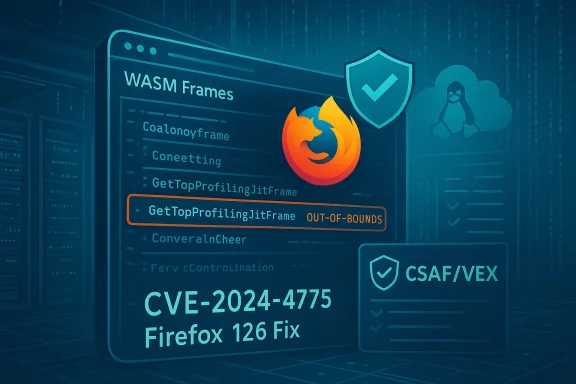
CVE‑2024‑4775 is a Firefox security issue disclosed by Mozilla in the security advisory for Firefox 126. The bug arises from a missing stop condition in the profiler’s iterator when handling WebAssembly (WASM) frames; when the profiler is active and WASM frames are present on the stack, the iterator could iterate past its intended end and cause invalid memory access or undefined behavior. The issue is specific to Firefox versions before 126 and only manifests when the built‑in profiler is running. Mozilla lists this as one of several memory‑safety and implementation bugs fixed in Firefox 126.
Security trackers and vulnerability databases summarized the technical root cause more tersely: the profiler’s JSJitProfilingFrameIterator failed to mark itself as done() on a Wasm‑to‑JSJit transition, confusing higher‑level callers and enabling an out‑of‑bounds access in GetTopProfilingJitFrame. The practical upshot for defenders is straightforward: update Firefox to v126 or later, and if you run builds or environments where the profiler runs (for debugging, telemetry, or developer tooling), treat those hosting systems as potentially at risk until Firefox is updated.
Across many MSRC update‑guide entries you’ll see a recurring FAQ paragraph: “Is Azure Linux the only Microsoft product that includes this open‑source library and is therefore potentially affected by this vulnerability? … One of the mainmmitment to keep it up to date … we began publishing CSAF/VEX in October 2025. If impact to additional products is identified, we will update the CVE to reflect this.” That text is a procedural/communicative template Microsoft uses to explain that an attestation names the product it has checked, and promises updates if additional product families are discovered to ship the same code. The wording explains Microsoft’s scope at the time of publication, not the cross‑product technical facts. ([archive.ph](https://archive.ph/2025.12.07-21324...guide/vulnerability/CVE-2025-5916?utm_plainly: when MSRC says “Azure Linux includes the open‑source library and is therefore potentially affected,” it means Microsoft has completed an inventory for Azure Linux and found the upstream component in those Azure Linux artifacts. It does not logically prove that other Microsoft products or images do not include the same upstream source file, binary module, or library — each product or image must be inventoried independently. This is the distinction between an attestation (a statement of what Microsoft has verified) and an exclusion (a statement that something does not appear anywhere else).
Precise answer (authoritative): If Microsoft’s MSRC entry for this CVE explicitly lists Azure Linux as “includes this open‑source library and is therefore potentially affected,” then Azure Linux is the only Microsoft product Microsoft has publicly attested to include the component right now. That attestation is authoritative for Azure Linux images and is actionable for Azure Linux customers. However, that attestation does not prove that no other Microsoft product or image includes the same upstream file or compiled code — you must wait for Microsoft to expand VEX/CSAF mappings to other product families or independently inspect the other artifacts you operate.
Important context for this specific CVE: CVE‑2024‑4775 targets Firefox’s profiler. If Microsoft’s public mapping flagged Azure Linux as including the “open‑source library” for this CVE, that could mean Azure Linux is shipping a package that contains the affected Firefox component (for example, a firefox package or a packaged embedding of that code). But in most environments where this CVE matters, the direct risk is to systems that run Firefox or an embedding of Firefox code and have the profiler enabled. For general server images that don’t ship Firefox or a browser runtime, the practical exposure is low. Always check the actual inventory for the artifact you run.
Source: MSRC Security Update Guide - Microsoft Security Response Center
 Background / Overview
CVE‑2024‑4775 is a Firefox security issue disclosed by Mozilla in the security advisory for Firefox 126. The bug arises from a missing stop condition in the profiler’s iterator when handling WebAssembly (WASM) frames; when the profiler is active and WASM frames are present on the stack, the iterator could iterate past its intended end and cause invalid memory access or undefined behavior. The issue is specific to Firefox versions before 126 and only manifests when the built‑in profiler is running. Mozilla lists this as one of several memory‑safety and implementation bugs fixed in Firefox 126.Security trackers and vulnerability databases summarized the technical root cause more tersely: the profiler’s JSJitProfilingFrameIterator failed to mark itself as done() on a Wasm‑to‑JSJit transition, confusing higher‑level callers and enabling an out‑of‑bounds access in GetTopProfilingJitFrame. The practical upshot for defenders is straightforward: update Firefox to v126 or later, and if you run builds or environments where the profiler runs (for debugging, telemetry, or developer tooling), treat those hosting systems as potentially at risk until Firefox is updated.
What Microsoft actually said — and why the wording matters
Microsoft’s Security Response Center (MSRC) has adopted a machine‑readable attestation model (CSAF/VEX) to communicate product‑level status for third‑party CVEs. In blog posts describing this program, Microsoft explains that it will publish VEX/CSAF attestations that label named Microsoft product families as Known Affected, Not Affected, Under Investigation, or Fixed, starting with Azure Linux and expanding coverage over time. That process is deliberate: it delivers a deterministic, machine‑consumable signal for a specific product family once Microsoft completes its internal inventory for that family.Across many MSRC update‑guide entries you’ll see a recurring FAQ paragraph: “Is Azure Linux the only Microsoft product that includes this open‑source library and is therefore potentially affected by this vulnerability? … One of the mainmmitment to keep it up to date … we began publishing CSAF/VEX in October 2025. If impact to additional products is identified, we will update the CVE to reflect this.” That text is a procedural/communicative template Microsoft uses to explain that an attestation names the product it has checked, and promises updates if additional product families are discovered to ship the same code. The wording explains Microsoft’s scope at the time of publication, not the cross‑product technical facts. ([archive.ph](https://archive.ph/2025.12.07-21324...guide/vulnerability/CVE-2025-5916?utm_plainly: when MSRC says “Azure Linux includes the open‑source library and is therefore potentially affected,” it means Microsoft has completed an inventory for Azure Linux and found the upstream component in those Azure Linux artifacts. It does not logically prove that other Microsoft products or images do not include the same upstream source file, binary module, or library — each product or image must be inventoried independently. This is the distinction between an attestation (a statement of what Microsoft has verified) and an exclusion (a statement that something does not appear anywhere else).
Technical reality: why “includes this library” is an artifact‑level property
The presence of a particular open‑source source file or compiled module is an artifact‑level property determined by build choices. Even for kernel code or portable libraries, whether a distribution or image includes the vulnerable chunk depends on:- exact upstream commit versions and whether the vendor backported or trimmed commits;
- build configuration and compile‑time flags (for kernels: CONFIG_* options that enable/disable drivers);
- packaging decisions (built‑in vs module vs not compiled at all);
- distribution packaging (which packages are includege, container base layer, or product SKU).
Answering the direct question: Is Azure Linux the only Microsoft product that includes the library and is therefore potentially affected by CVE‑2024‑4775?
Short answer (practical): No — not necessarily. Azure Linux may be the only Microsoft product Microsoft has publicly attested to include the implicated component at the time they published the advisory, but that is an inventory status, not a gy across all Microsoft products.Precise answer (authoritative): If Microsoft’s MSRC entry for this CVE explicitly lists Azure Linux as “includes this open‑source library and is therefore potentially affected,” then Azure Linux is the only Microsoft product Microsoft has publicly attested to include the component right now. That attestation is authoritative for Azure Linux images and is actionable for Azure Linux customers. However, that attestation does not prove that no other Microsoft product or image includes the same upstream file or compiled code — you must wait for Microsoft to expand VEX/CSAF mappings to other product families or independently inspect the other artifacts you operate.
Important context for this specific CVE: CVE‑2024‑4775 targets Firefox’s profiler. If Microsoft’s public mapping flagged Azure Linux as including the “open‑source library” for this CVE, that could mean Azure Linux is shipping a package that contains the affected Firefox component (for example, a firefox package or a packaged embedding of that code). But in most environments where this CVE matters, the direct risk is to systems that run Firefox or an embedding of Firefox code and have the profiler enabled. For general server images that don’t ship Firefox or a browser runtime, the practical exposure is low. Always check the actual inventory for the artifact you run.
How to validate where the vulnerable component actually exists — step‑by‑step
If you need to confirm whether any Microsoft product or image you run includes the implicated code, follow this checklist:- Check the MSRC update‑guide and VEX/CSAF mapping for the specific CVE.
- MSRC’s update pages include product‑level status entries and VEX/CSAF outputs; look for a Known‑Affected / Fixed / Not‑Affected assertion for the product in question. Microsoft’s VEX program started rolling out in October 2025 and those attestations should be available on MSRC pages or via the CSAF/VEX feeds.
- If you run Azure Linux images, treat Microsoft’s attestation as authoritative and follow Microsoft’s remediation guidance for those images. Microsoft’s Azure Linux CVE lifecycle and package updates are managed in their update guide and image repositories.
- Inventory your other Microsoft artifacts:
- For WSL or linux‑azure kernel images: query the kernel version and configuration used in the build; check the kernel’s config for the relevant subsystem or driver.
- For Marketplace VM images or AKS node images: inspect installed packages (for Debian/Ubuntu/Alpine/RPM families) and check whether a firefox package, runtime, or a compiled-in component is present.
- For managed services or appliances: request the SBOM / VEX attestation from the vendor or the Microsoft product team.
- Use SBOM and image scanning tools on your artifacts:
- Generate SBOMs with tools like syft / in‑house SBOM generation (note: choose the tool your organization trusts).
- Run filesystem/package scans: examples — rpm -qa | grep -i firefox ; dpkg -l | grep -i firefox ; apk info | grep -i firefox. Search for binaries or shared objects that indicate Mozilla code.
- For container images: run a container scanner against your images and check for the vulnerable package/version.
- For endpoints and desktops: check browser versions and update them:
- Firefox versions < 126 are affected; update to 126+.
- Confirm whether any managed images or automation systems install or embed older Firefox builds.
- If you find the component in an artifact you operate, apply the vendor‑recommended patch or update the package. If that artifact is a Microsoft product that has not yet been attested as affected, open a support request asking Microsoft to confirm and, if affected, update the VEX/CSAF mapping.
Practical remediation and mitigation guidance for CVE‑2024‑4775
- Update Firefox: the simplest and highest‑value action is to upgrade Firefox to v126 or later on any system that runs the browser. The bug is fixed in Firefox 126.
- Disable the profiler where possible: the vulnerability requires the profiler to be active for the bug to trigger. Systems that enable automatic profiling or developer tooling in production should consider disabling the profiler until the browser is patched.
- For managed images (Azure Linux, Marketplace images, custom images): apply the vendor’s package updates as soon as Microsoft (or the distribution) releases patched packages. If MSRC attests Azure Linux as affected, Azure Linux customers should follow the Microsoft remediation path for that distro.
- Scan images and endpoints: use your vulnerability scanners and SBOM workflows to identify any artifacts shipping pre‑126 Firefox. For packaged endpoints, scan installed packages; for containers, scan layers; for VM images, boot a test instance and run package queries.
- Ask for VEX/CSAF if you need it: where Microsoft’s public attestation is ambiguoou run, request a machine‑readable attestation or SBOM from the Microsoft product team or from your support channels. Microsoft has committed to publish VEX/CSAF results and to update them as more products are inventoried.
Threat and risk analysis — who should really worry?
- Attack vector: local. The vulnerability is only exploitable when the profiler runs, and it is most relevant to systems where untrusted local code can cause profiler activity or where profiling of untrusted code is enabled.
- Impact: low to medium in practical terms. The vulnerability is a memory‑safety issue that can cause undefined behavior and potentially limited memory disclosure or integrity effects in some circumstances, but the attacker model is constrained. Vulnerability trackers rate CVE‑2024‑4775 at a moderate/low severity and show low EPSS/exploit likelihood.
- Likelihood of cross‑product Microsoft exposure: low for server images that do not ship browser runtimes, but potentially higher for desktop or desktop‑variant images or any Microsoft artifact that deliberately packages Mozilla code. Because Microsoft’s VEX rollout began with Azure Linux (a kernel/distribution attestation effort), many unrelated browser CVEs will not apply to Azure Linux unless Azure Linux actually ships the affected browser component; that’s why artifact verification matters.
What to watch for from Microsoft and Mozilla
- Microsoft: watch for updated VEX/CSAF attestations on the MSRC upd specific CVE. If Microsoft finds more products that ship the implicated component, they will update the CVE mapping and the machine‑readable attestations accordingly. Customers who rely on Microsoft products should consume MSRC’s VEX feed or the Security Update Guide for authoritative product mappings.
- Mozilla: watch for security advisories and release notes. For CVE‑2024‑4775 Mozilla documented the fix in the Firefox 126 advisory; that advisory is the canonical technical record for the flaw and its fix.
- Your organization: verify your artifacts. Don’t assume a Microsoft attestation about Azure Linux answers the question for other Microsoft SKUs you may run (WSL, linux‑azure kernels, Marketplace images, appliance images). If the CVE impacts you, escalate to your vendor support or the Microsoft support path asking for product‑specific attestations.
Why defenders stilr own verification
Two complementary facts make in‑house verification essential:- Vendor attestation coverage is phased. Major vendors often roll out inventory attestations incrementally (Microsoft started with Azure Linux). The absence of a mapping for Product X is not proof that Product X is safe — it often means Product X’s inventory hasn’t yet been completed and published.
- Build‑time differences change exposure. The same upstream source file can be present in one build and absent in another depending on configuration choices. Treat each product artifact as a distinct asset to be inventoried. This is the operational reason Microsoft’s wording is intentionally scoped to the as validated.
Quick operational checklist (for SOC / Ops teams)
- Step 1: Inventory browsers and runtimes across endpoints and images. Search for firefox package versions < 126.
- Step 2: For each asset that runs Firefox or embeds Mozilla code, patch to Firefox 126+ immediately or disable the profiler.
- Step 3: For Azure Linux customers, follow MSRC/Azure Linux remediation instructions if Microsoft attests Azure Linux is affected; apply image or package updates Microsoft publishes.
- Step 4: For other Microsoft artifacts you run, generate SBOMs and run scans; if you find the vulnerable component, open a support ticket with Microsoft and request a VEX/CSAF update for the product family.
- Step 5: Subscribe to MSRC feeds and Mozilla advisories for real‑time updates.
Final assessment and recommended stance
- Microsoft’s public statement that “Azure Linux includes this open‑source library and is therefore potentially affected” is an authoritative attestation for Azure Linux images and means Azure Linux customers should treat those images as in‑scope. It is not evidence that no other Microsoft product includes the same code.
- For CVE‑2024‑4775 specifically, the primary mitigation is to update Firefox to v126 or later and to disable the profiler where it runs in production; the exposure window is limited to environments that actually run affected Firefox builds with the profiler enabled.
- Operationally, treat Microsoft’s VEX/CSAF attestations as a high‑fidelity signal for the specific product they name, but do not substitute a lack of attestation for a true inventory check. If your environment includes other Microsoft artifacts (WSL, Marketplace images, custom appliances), perform per‑artifact verification and request machine‑readable attestations where needed.
Source: MSRC Security Update Guide - Microsoft Security Response Center
