

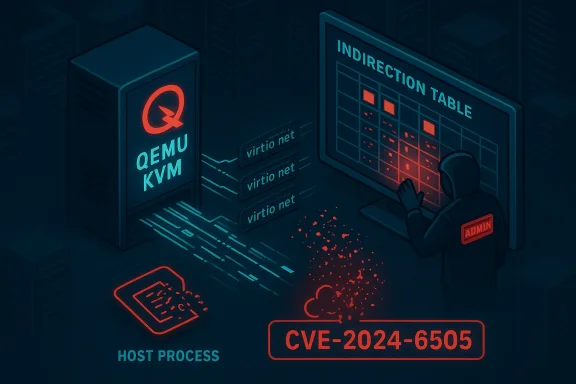
A subtle bug in QEMU’s virtio-net RSS implementation has been quietly remaking risk calculations for operators who run multi‑tenant or untrusted virtual machines: when RSS (Receive Side Scaling) is enabled for the virtio‑net device, an attacker with elevated privileges inside the guest can manipulate the RSS indirection table and force a host‑side index out‑of‑bounds access that crashes the qemu‑kvm process. The vulnerability, tracked as CVE‑2024‑6505, is availability‑first: confidentiality and integrity impacts are not reported, but denial‑of‑service conditions that take down guest hosts — sustained or persistent while exploitation continues — are real and practical in production environments.
CVE‑2024‑6505 targets the virtio‑net device emulation in QEMU when the software RSS feature is active. RSS uses an indirections table to map incoming packets across receive queues; the implementation in affected QEMU versions allowed a privileged guest to supply an indirections table with values that exceed expected bounds. The result is a queue index out‑of‑bounds access that can lead to heap corruption or a host process crash. Vendors and vulnerability trackers have assigned a CVSS v3.1 base score of 6.8 (Medium) and note the availability impact as High, with Privileges Required: High and Attack Complexity: Low in reported assessments.
This is not a classical remote code execution bug; it is primarily an availability risk: an attacker with administrative rights inside a guest — or a compromised guest operator account — can cause repeated host VM exits or full qemu‑kvm crashes. For multi‑tenant hosts or cloud environments, that can translate into service interruptions, broken orchestration, or cascades of failures if supervisors or control planes depend on those machines remaining available. Community discussions and operators’ posts about QEMU‑related host DoS bugs show how such issues propagate in real world stacks and underscore the operational attention they demand. tters: a practical risk model
Distribution maintainers and security teams have published advisories and provided fixed packages; status may vary by vendor and package version, so you must consult your distribution’s QEMU/qemu‑kvm package advisory and patch notes. For context, community and distro trackers indicate the vulnerability was recorded on 5 July 2024 and assigned the CVE identifier CVE‑2024‑6505; vendors have since released updates and, for environments that cannot update immediately, recommended mitigations. Multiple independent vulnerability databases and distro advisories corroborate the vulnerability description and severity.
Operators who need an immediate operational signal — for example, whether a host’s qemu process is running a vulnerable build — should check the installed QEMU package version against their vendor’s fixed package lists and verify whether RSS is enabled on affected guests.
Memory safety bugs in virtualization stacks are particularly dangerous because they cross the guest‑to‑host boundary. Even when a vulnerability does not yield immediate code execution, the stability and availability consequences are significant: a heap corruption may cause a crash at any later point, and repeated exploitation can be used as a denial‑of‑service lever.
From a secure‑coding perspective, this class of bug highlights several perennial failings:
Community and operator threads discussing QEMU host DoS patterns and mitigation practices provide additional operational context and real‑world anecdotes about the cost and timing of rollouts. Those conversations — across forums and security trackers — are useful for planning both mitigation and staged patching.
CVE‑2024‑6505 is an operational signal: patch quickly, but plan for measured rollouts and performance testing before re‑enabling feature sets such as in‑QEMU RSS in production environments.
Source: MSRC Security Update Guide - Microsoft Security Response Center
 Background / Overview
CVE‑2024‑6505 targets the virtio‑net device emulation in QEMU when the software RSS feature is active. RSS uses an indirections table to map incoming packets across receive queues; the implementation in affected QEMU versions allowed a privileged guest to supply an indirections table with values that exceed expected bounds. The result is a queue index out‑of‑bounds access that can lead to heap corruption or a host process crash. Vendors and vulnerability trackers have assigned a CVSS v3.1 base score of 6.8 (Medium) and note the availability impact as High, with Privileges Required: High and Attack Complexity: Low in reported assessments.This is not a classical remote code execution bug; it is primarily an availability risk: an attacker with administrative rights inside a guest — or a compromised guest operator account — can cause repeated host VM exits or full qemu‑kvm crashes. For multi‑tenant hosts or cloud environments, that can translate into service interruptions, broken orchestration, or cascades of failures if supervisors or control planes depend on those machines remaining available. Community discussions and operators’ posts about QEMU‑related host DoS bugs show how such issues propagate in real world stacks and underscore the operational attention they demand. tters: a practical risk model
The attack surface and prerequisites
- The vulnerable code path is activated when RSS is enabled on a virtio‑net interface. RSS is used to scale packet processing across multiple queues and vCPUs.
- Attackers need elevated privileges inside the guest (for example root or administrator) to configure the RSS indirections table to malicious values. Unprivileged guests cannot trivially exercise this vector.
- The attack vector is effectively network‑borne in that RSS relates to packet steering, but exploitation requires guest‑side privileges to set RSS parameters or otherwise manipulate the indirections table.
The impact model
- Successful exploitation causes the qemu‑kvm process hosting the VM to crash, producing a host‑side denial of service affecting all VMs on that qemu instance and potentially affecting services that rely on the VM lifecycle (orchestration tools, monitoring, backup tasks).
- Because the bug concerns index validation and heap access, risk of memory corruption exists, but public reporting and vendor analysis to date emphasize crash/DoS as the primary consequence.
- The vulnerability is therefore most dangerous for multi‑tenant hypervisors, hosting providers, CI runners, and any environment where guests are not fully trusted. Single‑tenant private deployments are less exposed if guest administrative roles remain tightly controlled.
What’s affected (versions and vendors)
Vendors and tracking services consistently list the flaw as present in upstream QEMU releases that include the in‑QEMU (software) RSS implementation introduced around the 5.x–9.x era. Public advisories and distro trackers have reported that QEMU versions from early RSS support through releases prior to the fix are impacted, with various distributions releasing patched qemu packages on their timelines.Distribution maintainers and security teams have published advisories and provided fixed packages; status may vary by vendor and package version, so you must consult your distribution’s QEMU/qemu‑kvm package advisory and patch notes. For context, community and distro trackers indicate the vulnerability was recorded on 5 July 2024 and assigned the CVE identifier CVE‑2024‑6505; vendors have since released updates and, for environments that cannot update immediately, recommended mitigations. Multiple independent vulnerability databases and distro advisories corroborate the vulnerability description and severity.
Operators who need an immediate operational signal — for example, whether a host’s qemu process is running a vulnerable build — should check the installed QEMU package version against their vendor’s fixed package lists and verify whether RSS is enabled on affected guests.
Recommended mitigations (short‑term and long‑term)
Because the vulnerability requires RSS to be enabled, the most straightforward and immediate mitigations are operationally simple and effective.Short‑term (immediate) mitigations
- Disable in‑QEMU software RSS on affected VMs:
- If you start VMs with qemu command line, add the option:
-device virtio-net-pci,rss=off - If you manage VMs with libvirt, set the interface’s RSS property to disabled in the domain XML or via your management tooling.
- Disabling RSS removes the vulnerable code path for in‑QEMU RSS steering and is an effective stopgap until patched binaries are available.
- Restrict guest privileges and harden administrative accounts:
- Enforce the principle of least privilege inside guests: disallow unnecessary administrative access, use bastion hosts for management, and enforce multifactor authentication for guest administrators.
- Monitor for unusual ethtool or netlink activity inside guests (the operations used to configure RSS).
- Isolate untrusted workloads:
- Run untrusted or customer‑supplied workloads in separate hosts or strong isolation domains where qemu crashes will have limited blast radius.
- Consider limiting guest networking to virtual switches that drop management/control plane traffic if possible.
- Monitoring and automated recovery:
- Add monitoring rules to detect qemu‑kvm process crashes, core dumps, and libvirt domain state changes. Configure systemd or your orchestration framework to restart qemu processes only after controlled checks.
- Maintain alerting that differentiates between expected reboots and repeated unexplained qemu crashes.
Long‑term (patching and system hardening)
- Apply vendor fixes as soon as they are available for your distribution. Security teams have released patched qemu/qemu‑kvm packages; apply them in a staged rollout with verification.
- Keep hypervisor stacks current — regular patching reduces whole classes of memory‑safety bugs.
- Implement stronger guest isolation controls (SELinux, AppArmor, seccomp for qemu processes where possible).
- Review libvirt/qemu configurations to ensure features like in‑QEMU RSS are only enabled when operationally needed and understood.
- Adopt runtime security tooling that can quickly detect and notify on suspicious guest activity that could lead to such exploits.
How to confirm whether a VM is vulnerable
- Check whether your installed QEMU package version predates the vendor fix. Distribution security advisories list the fixed package versions; if your package is older than the fixed release for your distro, treat hosts as vulnerable.
- Verify whether RSS is enabled for a domain:
- Inspect the qemu command line used to start the instance (libvirt logs for domain creation will often show the effective qemu args).
- For libvirt‑managed domains, inspect the domain XML for an interface property indicating RSS is enabled (the libvirt domain XML schema provides an rss element and the virtio interface supports an rss attribute in modern libvirt versions).
- Inside the guest, privileged users can query RSS state or set RSS parameters using ethtool or appropriate netlink tools; however, presence of tools inside the guest is not a reliable indicator for host‑side RSS mode because RSS may be provided by userland or kernel features coordinated across the host–guest interface.
Detection and response guidance
- Watch for repeated qemu‑kvm crashes, core dumps, or libvirt domain failures. These are the most direct indicators of attempts to exploit the vulnerability.
- Correlate qemu failures with guest side logs and with any suspicious privileged user activity inside guests (e.g., repeated ethtool RSS configuration changes, loading of custom network drivers, or new management tooling).
- Treat clustered or orchestrated qemu crashes as a potential targeted attack if multiple guests on the same host show synchronized failures.
- After applying mitigation (e.g., disabling RSS or applying a patch), verify by:
- Starting isolated test VMs and exercising RSS configuration operations under controlled conditions.
- Observing that qemu no longer enters a crash loop when guests attempt to set atypical RSS indirection table values.
Operational trade‑offs and caveats
- Disabling RSS reduces attack surface but may reduce network throughput or increase CPU contention on busy hosts. RSS exists to spread receive processing across CPUs; turning it off can concentrate packet handling and degrade performance for high‑throughput VMs.
- The exploit requires high privileges inside the guest; if guests are tightly controlled and guest admin access is rare, the effective risk is lower. However, multi‑tenant and cloud uses — where guest images may be user‑supplied — change that calculus.
- Many vendors have patched on different timelines. Some distributions accepted upstream fixes and backported into stable package channels; others required operators to upgrade QEMU major versions. Plan maintenance windows accordingly.
- In some managed virtualization stacks, in‑QEMU RSS is only enabled when explicit configuration or certain backends are used; review your stack’s documentation before toggling RSS globally.
Technical e‑oriented)
At a high level, RSS requires an indirection table of entries that map hash outputs to queue indices. The vulnerable code path failed to properly validate values coming from the guest for the size or contents of that table before using them as queue indices. If an attacker sets entries that reference queues beyond the number available (or crafts counts that lead to integer overflows), the host code uses those invalid indices when accessing queue data structures — producing an index out‑of‑bounds read or write into heap memory.Memory safety bugs in virtualization stacks are particularly dangerous because they cross the guest‑to‑host boundary. Even when a vulnerability does not yield immediate code execution, the stability and availability consequences are significant: a heap corruption may cause a crash at any later point, and repeated exploitation can be used as a denial‑of‑service lever.
From a secure‑coding perspective, this class of bug highlights several perennial failings:
- Insufficient input validation at the device boundary.
- Trusting guest‑supplied sizes and indices without canonical host constraints.
- Complex feature surface (RSS interacts with vCPUs, vhost/tap backends, and guest drivers) that increases the likelihood of edge cases.
Prioritization guidance for defenders
- Inventory: Identify hypervisors that run QEMU/qemu‑kvm and determine package versions across the fleet.
- Exposure: Flag hosts that host untrusted/tenant workloads or that allow guest administrative access.
- Mitigate: For vulnerable hosts where patching is not immediately possible, disable RSS at the qemu/libvirt level.
- Patch: Test and deploy vendor QEMU/qemu‑kvm updates in staged waves; validate in test tenants before production rollout.
- Hardening: Add configuration guardrails so RSS is not enabled by default for new VMs unless explicitly required and tested.
What vendors and tracking services are saying
Multiple upstream and downstream resources catalog the issue and recommend the same operational mitigations: apply qemu‑kvm patches or disable RSS until you can. Public vulnerability trackers list the problem as an out‑of‑bounds read (CWE‑125) that results in a host‑side crash when abused. Vendor bulletins and distribution advisories have pushed fixes on separate schedules; consult your distribution’s security advisory for the precise fixed package version for your platform.Community and operator threads discussing QEMU host DoS patterns and mitigation practices provide additional operational context and real‑world anecdotes about the cost and timing of rollouts. Those conversations — across forums and security trackers — are useful for planning both mitigation and staged patching.
Final assessment and recommendaiingful availability issue for virtualization operators. It is not an invitation to broad surveillance or data theft; rather, it is a practical host‑crash vector that amplifies risk in multi‑tenant and untrusted environments. The good news is that the vulnerability has straightforward mitigations:
- Disable RSS where you cannot immediately patch.
- Patch QEMU/qemu‑kvm and related packages promptly when vendor packages are available.
- Restrict guest administrative privileges and isolate untrusted guests to reduce the chance of exploitation.
- Monitor for qemu crashes and unusual guest network configuration activity.
CVE‑2024‑6505 is an operational signal: patch quickly, but plan for measured rollouts and performance testing before re‑enabling feature sets such as in‑QEMU RSS in production environments.
Source: MSRC Security Update Guide - Microsoft Security Response Center
