

The PHP pgsql extension’s escaping logic failed a simple but critical safety check: it didn't always verify whether the PostgreSQL client library reported an error when escaping identifiers and strings. The result, tracked as CVE-2025-1735, is an availability- and stability-focused vulnerability that can cause crashes and, under specific conditions, enable injection-like behavior when applications rely on the extension’s escaping as a defense. Multiple vendors and distribution advisories confirmed the defect and shipped patched PHP builds; operators who use PHP with Postgres should treat this as an operational priority and follow the mitigation checklist below.
PHP exposes PostgreSQL functionality through the pgsql and PDO_PGSQL extensions. Those extensions rely on the upstream PostgreSQL client library to perform quoting and escaping of user-supplied values when applications use convenience functions to build SQL fragments. In a correctly implemented flow, the client library signals encoding, memory, or other failures (often via error returns or NULL pointers), and the wrapper code must check those signals before using the returned pointer or string.
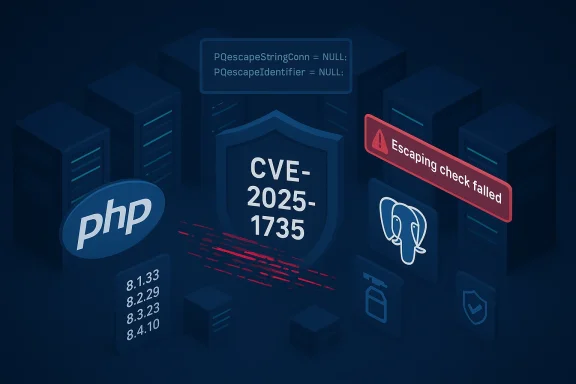
CVE-2025-1735 arises from two inter-related implementation mistakes in PHP’s pgsql and pdo_pgsql layers: failing to pass or inspect error parameters to the escaping call (for example, not passing an error pointer to PQescapeStringConn()) and failing to check whether PQescapeIdentifier() returned NULL before using its result. Those omissions mean that when the server or client library rejects an input as invalid, PHP could either continue with an invalid pointer—causing crashes—or treat an unescaped/partially-escaped string as if it had been safely quoted, creating injection-risk scenarios in specific call flows. Multiple vulnerability trackers and vendor advisories document these root causes and the patched release numbers.
If your stack uses PHP + PostgreSQL in production, prioritize the update and verification steps above: the cost of waiting is measured in availability and incident response time—two things no ops team wants to spend when a trivial defensive check would have avoided them.
Source: MSRC Security Update Guide - Microsoft Security Response Center
 Background / Overview
PHP exposes PostgreSQL functionality through the pgsql and PDO_PGSQL extensions. Those extensions rely on the upstream PostgreSQL client library to perform quoting and escaping of user-supplied values when applications use convenience functions to build SQL fragments. In a correctly implemented flow, the client library signals encoding, memory, or other failures (often via error returns or NULL pointers), and the wrapper code must check those signals before using the returned pointer or string.CVE-2025-1735 arises from two inter-related implementation mistakes in PHP’s pgsql and pdo_pgsql layers: failing to pass or inspect error parameters to the escaping call (for example, not passing an error pointer to PQescapeStringConn()) and failing to check whether PQescapeIdentifier() returned NULL before using its result. Those omissions mean that when the server or client library rejects an input as invalid, PHP could either continue with an invalid pointer—causing crashes—or treat an unescaped/partially-escaped string as if it had been safely quoted, creating injection-risk scenarios in specific call flows. Multiple vulnerability trackers and vendor advisories document these root causes and the patched release numbers.
What exactly went wrong (technical anatomy)
The unsafe call pattern
At the C layer, safe escaping requires two things:- Passing the correct error/return parameters to the PostgreSQL client functions so they can signal failure.
- Validating the returned pointer or buffer before using it.
- Calls to PQescapeStringConn() were invoked without forwarding an error-status output parameter, which prevents the routine from communicating why a string could not be escaped (for example, due to encoding problems or invalid input).
- Calls to PQescapeIdentifier() were used directly without checking whether the function returned NULL, the documented return value that indicates failure.
Availability-first impact profile
The most immediate and credible outcome across vendor analyses is availability impact. When unverified returns are dereferenced or used by PHP’s internal routines, processes can segfault or experience other fatal errors. Because PHP is commonly embedded in web servers (FPM, mod_php, etc.) or worker processes, a single malformed input (or an attacker repeatedly supplying malformed inputs) can crash workers and cause sustained service outages for web applications that use the affected pgsql APIs. Most trackers therefore assign a high availability impact while downgrading confidentiality and integrity impacts for typical usage patterns.Affected versions and vendor responses
- Affected PHP releases (per upstream advisories and package trackers): 8.1. prior to 8.1.33, 8.2. prior to 8.2.29, 8.3. prior to 8.3.23, and 8.4. prior to 8.4.10. Multiple distributors and release notes map the fix to these releases.
- Vendor and distribution advisories: Red Hat, Ubuntu, Oracle Linux, SUSE, and other packagers integrated fixes and backports into their PHP packages and errata. Some vendors assigned CVSS values that differ slightly—industry scorers did not reach a single consensus number—so check your distribution advisory for the packaged CVSS value your operations teams use for prioritization.
- Patch availability: The PHP project shipped patched point releases (for example, php-8.1.33, php-8.2.29, php-8.3.23 and corresponding 8.4 updates). Major distributions published coordinated errata referencing the CVE and the fixed package names. Operators should upgrade to the patched minor releases or install vendor backports.
How severe is it? Scoring, exploitability, and real-world risk
Divergent severity assessments
Different vulnerability aggregators assigned slightly different base scores:- NIST / some vendors reported a medium-range base score around 5.9 (CVSS v3.1) with High availability impact in the vector.
- Other aggregators produced a higher 7.5 (High) score reflecting an alternative threat model and broader operational impact.
Exploitability in the wild
- Attack vector: Network (an attacker may only need to submit crafted input to a web endpoint that uses the vulnerable escaping logic).
- Privileges required: None in most realistic web-facing setups.
- Complexity: Moderate to High depending on the exact usage of the escaping functions within the application. If the application uses prepared statements correctly and avoids manual string concatenation, the risk of injection is much lower; if the application constructs SQL fragments using the pgsql escaping helpers, the window for impact is larger.
Practical mitigation and remediation checklist
Apply these steps immediately in the order shown; each step reduces risk quickly and helps you regain operational control.- Inventory first
- Identify all PHP runtimes and images: track versions for PHP 8.1/8.2/8.3/8.4 and note the exact package release numbers.
- Identify binaries and containers that bundle PHP (including vendor appliances and static images). Rebuilt binaries may carry vulnerable code even if the host package is patched.
- Patch (primary remediation)
- Upgrade to the patched PHP releases provided by upstream or your vendor: 8.1.33 / 8.2.29 / 8.3.23 / the corresponding 8.4 update. If your distribution offers a backport, apply the vendor-supplied package instead of compiling locally unless you can guarantee correctness.
- If you cannot patch immediately, apply temporary mitigations
- Avoid using PGSQL escape helpers in ad-hoc SQL construction; prefer parameterized prepared statements (the single most effective mitigation).
- Add request-size and input validation filters at the application or WAF layer to reduce the chance of a crafted string reaching vulnerable code paths.
- Where feasible, isolate PHP workers under process supervisors that perform restarts and rate-limit crash loops to preserve availability while patches are scheduled.
- Update PostgreSQL client libraries where applicable
- Some advisories note that behavior depends on the version of the libpq client library. Ensure your system-level PostgreSQL client packages are current per your OS vendor guidance. Zend and distribution advisories call out this dependency explicitly.
- Validate and test post-patch
- Reproduce the application flows that use pgsql escaping in a lab environment and confirm processes no longer crash on previously problematic inputs.
- For containerized environments, rebuild base images and redeploy updated containers rather than relying on in-container upgrades that are often transient.
Detection and monitoring: what to look for
- Crash signatures and logs: watch for segfaults, worker process exits, and PHP-FPM child terminations in a tight pattern. These crashes often leave crash dumps or core files and error traces in system logs.
- Application-level errors: failing database calls followed by NULL-reference traces or warnings tied to pgsql escaping functions are indicators of attempted exploitation or accidental triggers.
- Unusual request patterns: rapid sequences of inputs that target endpoints known to construct SQL fragments from user input deserve attention; correlate with WAF logs and rate-limiting triggers.
- Package version checks: run automated scans for installed PHP versions and package hashes across hosts and images; confirm that your reported version numbers match the known vulnerable/minor release ranges. Ubuntu, Red Hat, Oracle, and SUSE advisories include fixed package names and versions to match against.
Packaging and supply-chain caveats (why “patching” can be more than APT/YUM)
This CVE underscores recurring supply-chain nuances:- Static builds and vendor appliances: If a vendor or a build pipeline statically linked an old PHP runtime (or embedded it into a packaged appliance), simply patching the host OS will not fix the binary inside the appliance. Those artifacts require a rebuild and redeployment.
- Distribution backports vs upstream releases: Some enterprise distributions offer backported fixes inside an unchanged minor release number; others require the upstream minor release to be installed. Consult your distribution advisory and errata to understand whether your package contains the fix. Oracle Linux, Ubuntu, SUSE, and CloudLinux advisories provide per-distribution mapping.
- Client library dependencies: The behavior of PQescape* functions depends on installed libpq versions. Older systems that never updated PostgreSQL client packages can still have gaps even after PHP is updated unless the client library interface the extension relies on matches expected semantics. Zend’s advisory and several packagers explicitly call out that operators should check both PHP and libpq versions.
Coding and operational best practices to reduce similar future risk
- Prefer parameterized queries / prepared statements at the application layer rather than relying on escape helpers. This is the single most robust defense against SQL injection and related escape errors.
- Sanitize and validate inputs explicitly. Even where a driver provides escaping, treat that mechanism as a convenience and not a guaranteed replacement for input validation.
- Fail-safe on lower-level failures: wrappers that call into external libraries should always check return values and error indicators from the called library before using returned objects or pointers.
- Use fuzzing and negative-testing in CI: add mutation tests for database interaction code that intentionally feed encoding edge-cases and overly large or specially encoded strings to reveal unguarded paths.
- Maintain a software bill of materials (SBOM) and track both runtime libraries and compiled artifacts so you can quickly identify where vulnerable code may reside in compiled or containerized images.
Incident response: if you detect crashes or suspect exploitation
- Immediately isolate affected endpoints: redirect traffic away from impacted workers and place endpoints behind stricter rate limits or temporary deny rules.
- Collect crash artifacts: core dumps, backtraces, PHP error logs, and binary symbols will help vendors reproduce and validate the root cause.
- Apply the patch in a test environment and validate the fix with previously failing inputs before a wide rollout.
- Consider an emergency redeploy of replaced containers or rebuilt images where static builds are present; treat vendor appliances similarly—coordinate with vendors for remediated firmware or images.
- Monitor for follow-on indicators: attackers who successfully cause persistent DoS conditions may probe other endpoints or attempt lateral movements; check for correlated events across logs.
Why this matters to WindowsForum readers and sysadmins
Many PHP applications are multi-platform: while the issue is in PHP’s pgsql extension (language-level code), real-world exposure spans containers, Linux-hosted web servers, cloud platform images, vendor appliances, and CI-built artifacts. Administrators and DevOps teams responsible for web stacks must therefore treat this as more than a single-package upgrade task:- If your fleet includes containers, images, or appliance vendors that deliver prebuilt PHP, you must verify each artifact’s PHP and libpq content and, where necessary, rebuild or request updated vendor images.
- Service availability is often the most important metric for web application owners; a few crashed PHP workers can lead to 503 storms or slow recovery during high traffic windows, leading to real customer impact.
- The vulnerability is a reminder that low-level error checks (return-value checks and NULL checks) remain fundamental safety practices and that human-readable advisories and vendor errata must be read carefully to understand whether your specific environment (prepared statements vs ad-hoc escaping, static links, etc.) is truly protected.
Notable strengths of the response — and remaining risks
What went right
- Coordinated fixes: The PHP project released patched point versions quickly, and major distributors produced matching packages or backports. That coordination reduced the window of long-term exposure for many users.
- Clear vendor advisories: Distributors documented the impacted package versions and offered guidance for remediation. Several also called out supply-chain considerations and the need to rebuild static images.
Risks and unresolved operational friction
- Variation in scoring and messaging: Different trackers reported differing CVSS values and exploitability assessments, which can confuse prioritization if teams rely on a single feed for decision-making. Always consult your vendor’s package advisory alongside third-party databases.
- Embedded/static artifacts: The biggest residual risk is assets that are not centrally managed—embedded appliances, static container images, and vendor-supplied binary packages that are not frequently rebuilt. Those require extra inventory work and coordination.
- Potential dependency mismatches: If your application relies on older libpq behavior or a non-standard client library, patching PHP alone may not be sufficient. Verify both PHP and its underlying client library stack.
Quick checklist (actionable one-page)
- Inventory: List all PHP runtimes, containers, and appliances by version and build method.
- Patch: Upgrade PHP to the patched minor release for your branch (8.1.33 / 8.2.29 / 8.3.23 / patched 8.4 release). Apply vendor updates or backports.
- Validate: Reproduce failing inputs in a lab; confirm no crashes and that escaping helpers return expected values.
- Harden: Convert string-building code to prepared statements; add input validation; limit exposure via WAF and rate limits.
- Rebuild images: For containers and static binaries, rebuild base images with patched runtimes and redeploy.
- Monitor: Alert on segfaults, PHP-FPM child deaths, and repeated database error patterns.
Conclusion
CVE-2025-1735 is not an exotic exploitation chain; it’s an operationally meaningful failure to check error returns from the PostgreSQL client API. Its immediate danger is service disruption: crashes and repeated denial-of-service conditions are the most likely outcomes, and the potential for injection-like behavior elevates the need for patching in applications that still build SQL strings by hand. The PHP project and major distributors issued timely fixes, but the real work for defenders is practical: inventory your PHP artifacts, update both the PHP runtime and relevant client libraries, rebuild images where necessary, and harden application code to rely on prepared statements rather than on escaping helpers.If your stack uses PHP + PostgreSQL in production, prioritize the update and verification steps above: the cost of waiting is measured in availability and incident response time—two things no ops team wants to spend when a trivial defensive check would have avoided them.
Source: MSRC Security Update Guide - Microsoft Security Response Center
