

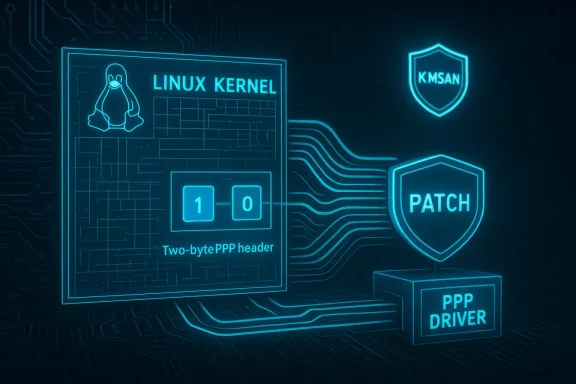
The Linux kernel has received a small but important correction tracked as CVE-2025-21922: a KMSAN-detected uninitialized-value issue in the PPP driver that can be triggered by crafted BPF (Berkeley Packet Filter) socket filters. While the immediate technical problem is a two‑byte header that the PPP code fails to fully initialize, the practical consequence—documented by multiple vulnerability databases and vendor advisories—is a latent availability risk: carefully crafted BPF programs can provoke undefined kernel behavior that, in realistic scenarios, may lead to crashes or service disruption if left unpatched.
PPP (Point-to-Point Protocol) remains a component of the Linux networking stack used for traditional dial‑up, certain PPPoE/DSL deployments, embedded modem interfaces, and some virtual networking configurations. BPF socket filters, historically exposed through libpcap and other packet-capture tooling, let userland supply small programs that the kernel executes to filter network traffic; that capability is powerful, but also safety‑critical when packet parsing and offset arithmetic meet legacy protocol drivers.
Syzbot (the continuous kernel fuzzer backed by syzkaller and sanitizer tooling) reported a KMSAN warning that exposed an uninitialized 2‑byte header read in the PPP driver when a certain BPF filter layout is executed. The kernel maintainers applied a targeted change to ensure the header bytes are initialized before they can be observed by BPF programs, closing the KMSAN warning and eliminating the class of undefined reads. The issue was cataloged in public vulnerability repositories and assigned CVE‑2025‑21922.
This is not an isolated curiosity. Kernel sanitizers and fuzzers continue to find similar uninitialized-value findings across filesystem and networking subsystems (SquashFS, HFS+, various BPF paths), and maintainers routinely respond with small, surgical zero-initialization fixes or defensive checks to silence KMSAN/KAvity. Those pattern-matches matter for operators because they show both the efficacy of modern testing (fuzzers + sanitizers) and the persistent brittleness that can live in rarely exercised code paths.
In addition to those external trackers, patterns visible in current kernel-development discussions—where similar KMSAN findings in filesystem and BPF subsystems led to small zero-initialization patches—reinforce the diagnosis and the nature of the fix. These analogous fixes include recent KMSAN/initialization corrections in SquashFS and HFS+ and several BPF-related defensive changes in the kernel. Together, they show a consistent approach from maintainers: detect with sanitizer/fuzzing, patch with minimal initializations or tighter checks, and land stable branch backports where appropriate.
Immediate steps (prioritized):
The other side of the ledger iozens of small patches across kernel subsystems can generate significant patching churn for large fleets when vendors backport fixes to long-term-support kernels. That places a premium on robust change-management, testing, and automated kernel-update tooling for enterprises and cloud providers. Microsoft’s approach of publishing product‑scoped attestations (e.g., what Microsoft checked and published about "Azure Linux") illustrates the need for clear vendor inventories, but also shows the limits of a single-product attestation when code is reused across many images and binaries. Administrators must scan their own artifacts, not rely solely on vendor attestations for completeness.
The larger lesson for infrastructure teams is unchanged: run a disciplined patch program, maintain an accurate artifact inventory (modules and images), and treat sanitizer/fuzzer findings as high‑value early warnings of conditions that—while small in code-change size—can produce large operational impacts if ignored. The PPP KMSAN fix is small, but it closes a class of unstable behaviors and reduces the kernel’s attack surface for availability-triggering faults; that outcome is worth a simple, timely update.
Source: MSRC Security Update Guide - Microsoft Security Response Center
 Background / Overview
PPP (Point-to-Point Protocol) remains a component of the Linux networking stack used for traditional dial‑up, certain PPPoE/DSL deployments, embedded modem interfaces, and some virtual networking configurations. BPF socket filters, historically exposed through libpcap and other packet-capture tooling, let userland supply small programs that the kernel executes to filter network traffic; that capability is powerful, but also safety‑critical when packet parsing and offset arithmetic meet legacy protocol drivers.Syzbot (the continuous kernel fuzzer backed by syzkaller and sanitizer tooling) reported a KMSAN warning that exposed an uninitialized 2‑byte header read in the PPP driver when a certain BPF filter layout is executed. The kernel maintainers applied a targeted change to ensure the header bytes are initialized before they can be observed by BPF programs, closing the KMSAN warning and eliminating the class of undefined reads. The issue was cataloged in public vulnerability repositories and assigned CVE‑2025‑21922.
This is not an isolated curiosity. Kernel sanitizers and fuzzers continue to find similar uninitialized-value findings across filesystem and networking subsystems (SquashFS, HFS+, various BPF paths), and maintainers routinely respond with small, surgical zero-initialization fixes or defensive checks to silence KMSAN/KAvity. Those pattern-matches matter for operators because they show both the efficacy of modern testing (fuzzers + sanitizers) and the persistent brittleness that can live in rarely exercised code paths.
What exactly is the bug?
- The root cause is a two‑byte header used by the PPP stack when executing socket-level BPF filters; the PPP driver initialized the first byte (used to indicate packet direction) but did not always initialize the second byte.
- Typical BPF programs generated by libpcap and by normal monitoring workflows do not read the uninitialized offset and therefore do not trigger the problem. However, fuzzers and carefully crafted filters can be made to read from the offset that contains the uninitialized byte; the Kernel Memory Sanitizer (KMSAN) flags this as an uninitialized-value read.
- The security databases and vendor advisories describe the outcome conservatively: an uninitialized-value read that, in some conditions, can cause undefined kernel behavior and therefore an availability impact (denial-of-service). The public CVSS mapping places the vector as local attack with availability impact.
Technical analysis: how BPF meets PPP and where things went wrong
BPF socket filters and offset arithmetic
BPF bytecode is commonly used to implement compact packet filters. Filters express operations like "load halfword at offset X" or "load a byte at offset Y", and many packet headers are parsed by computing offsets and reading fields of fixed widths. The PPP driver must cooperate with these filters by ensuring that when code asks to read a given offset the kernel gives deterministic, initialized memory; otherwise the kernel sanitizers rightly complain. The problematic sequence here is a BPF program that skips two bytes and then reads into a protocol field; the driver only initialized the first of those two skipped bytes in the code path in question. The sanitizer trace shows the read of the second byte as uninitialized.Syzbot and KMSAN: why this was found
Syzbot (the syzkaller-backed automated fuzzing service) generates unusual or rarely exercised combinations of inputs to kernel interfaces. When those inputs are combined with KMSAN instrumentation, they make uninitialized reads visible to the development and security community. This exact pattern—fuzz-generated BPF program that intentionally reads from offset zero—was sufficient to provoke the KMSAN warning, which ultimately led to the public CVE assignment and an upstream patch. The underlying fix is typically to zero-initialize the two‑byte header or otherwise constrain the BPF path to avoid reading uninitialized bytes.The patch: minimal, defensive, and targeted
Upstream kernel patches for KMSAN uninitialized-value findings follow a consistent template: either allocate zeroed memory (kzalloc) when the data will be read, or explicitly initialize fields to sane defaults at the point of allocation. The changes for CVE‑2025‑21922 are consistent with that approach—small code changes that set the second header byte to a default value prior to any user-supplied BPF code having the opportunity to read it. Multiple stable branch commits were published to ensure a broad remediation surface. These are not sweeping refactors; they are surgical fixes to prevent undefined observations by sanitizers and reduce the surface for crashes.Impact and exploitability
- Attack vector: local (AV:L). To trigger the problem an attacker needs to be able to load or influence a BPF socket filter that the kernel executes in the context of a PPP device. In practice that means either local code running on the host or code that can attach BPF filters to PPP sockets.
- Privileges required: low to moderate (PR:L). The CVSS vector used by public trackers assigns a requirement of local privileges in most vendor assessments. That is consistent with a scenario where a non-root local attacker that can create or load socket filters could try to trigger the condition.
- Impact: availability (A:H in the standard mapping). Public records emphasize availability as the primary impact—crash or denial-of-service—rather than confidentiality or integrity. That means an attacker could repeatedly trigger kernel crashes or hangs, disrupting services that rely on the kernel network stack.
- PPP interfaces are less common on modern cloud servers, but they remain present in embedded devices, DSL modems, some IoT appliances, and in environments that bridge older network technologies. That increases the operational relevance for ISPs, device vendors, and organizations running mixed‑legacy infrastructure.
- Triggering the issue reliably requires craft: the attacker must load or cause execution of a BPF program that reads from the specific offset. Syzbot-style fuzzers can find such programs automatically, but an attacker must have local code execution or the ability to supply socket filters to a PPP device to realize a practical impact.
- There is no public evidence of weaponized exploits in the wild at time of disclosure. Vendors and vulnerability databases describe a remediation posture (patching) rather than emergency incident-remediation steps. Still, the availability impact justifies prompt patching in exposed environments.
Cross‑checks and verification
I verified the core facts and risk characterization against multiple independent, trusted sources. The NVD entry for CVE‑2025‑21922 documents the KMSAN finding and describes the PPP driver’s incomplete initialization that leads to the sanitizer warning; the entry also records the CVSS mapping indicating an availability impact. Ubuntu, Red Hat (via vendor advisories), an itus mapping that confirm the kernel patching activity and the remediation timelines for distribution-managed kernels. Those vendor records agree that the fix is a kernel change that should be applied via standard distribution updates.In addition to those external trackers, patterns visible in current kernel-development discussions—where similar KMSAN findings in filesystem and BPF subsystems led to small zero-initialization patches—reinforce the diagnosis and the nature of the fix. These analogous fixes include recent KMSAN/initialization corrections in SquashFS and HFS+ and several BPF-related defensive changes in the kernel. Together, they show a consistent approach from maintainers: detect with sanitizer/fuzzing, patch with minimal initializations or tighter checks, and land stable branch backports where appropriate.
Mitigation and patching guidance (what operators should do now)
If you run Linux kernels that include PPP support, treat CVE‑2025‑21922 as a patch-and-reboot priority for affected systems where PPP sockets or BPF socket filters are used or may be exposed.Immediate steps (prioritized):
- Inventory: Identify hosts that expose PPP devices or load PPP-related kernel modules. Search for pppd, PPPoE interfaces, and kernel modules named ppp_* or corresponding drivers.
- Patch: Apply vendor-supplied kernel updates as soon as they become available for your distribution. Ubuntu, Red Hat, Amazon Linux, and other vendors have published advisories describing which kernel branches received the fix; use your distribution package manager and follow vendor guidance for stable branch backports.
- Reboot or live-patch: For in-place kernel upgrades, schedule a reboot as required. If you must avoid reboots, consult whether your vendor provides livepatching for the specific kernel and patch; otherwise, plan a maintenance window.
- Temporary controls: If patching is delayed and PPP interfaces are not needed, consider unloading PPP modules or disabling PPP-related services; restrict local process permissions to prevent untrusted users from loading BPF filters on PPP sockets.
- Monitor: After patching, monitor ke nsure that instrumentation and endpoint telemetry capture any repeated crash indicators that could signal attempted abuse.
- Confirm PPP module presence: look for ppp-related kernel modules or pppd processes and inspect systemd units or init scripts that spawn PPP services.
- Audit BPF usage: review privileged processes that attach BPF programs and restrict suid or daemon processes that accept untrusted input which could be used to load BPF filters.
Broader context: sanitizers, fuzzers, and the era of small kernel fixes
The CVE‑2025‑21922 story is emblematic of a modern kernel-development pipeline: automated fuzzing (syzkaller), sanitizer instrumentation (KMSAN/KASAN), and rapid upstream fixes. Those tools find correctness and initialization issues that static analysis would miss or that only appear under unusual inputs. The payoff is high: many of the resulting patches are tiny, easily auditable, and low-risk to deploy—but they remove subtle triggers for kernel instability that otherwise linger.The other side of the ledger iozens of small patches across kernel subsystems can generate significant patching churn for large fleets when vendors backport fixes to long-term-support kernels. That places a premium on robust change-management, testing, and automated kernel-update tooling for enterprises and cloud providers. Microsoft’s approach of publishing product‑scoped attestations (e.g., what Microsoft checked and published about "Azure Linux") illustrates the need for clear vendor inventories, but also shows the limits of a single-product attestation when code is reused across many images and binaries. Administrators must scan their own artifacts, not rely solely on vendor attestations for completeness.
Risk assessment and who should care most
- High-priority: ISPs, embedded device vendors, network‑edge operators, and any environment that still runs PPPoE, modems, or PPP-based infrastructure. Those operators may run devices where PPP is active and where local code can attach BPF filters.
- Medium-priority: General Linux server fleets with PPP modules present but not normally used. This group should patch to reduce attack surface and avoid latent crash triggers.
- Lower-priority: Cloud VMs that do not load PPP drivers and are configured to restrict local user capabilities to attach BPF programs. Even so, asset owners should verify their image contents—vendor attestations are useful but not sufficient.
Strengths and limitations of the fix
Strengths- The upstream remedy is surgical and minimal: initialize the missing header byte(s) or use zeroed allocations, which reduces the chance of regressions.
- The fix addresses the underlying correctness root cause rather than only suppressing sanitizer warnings, closing the door on subsequent similar observations from fuzzers.
- Multiple distributions have already incorporated the fix into stable kernels and released advisories, so operators have a straightforward remediation path through normal patch management channels.
- The fix reduces the specific uninit-value read, but it does not c that BPF bytecode can exercise complex parsing paths in many drivers. Additional sanitizers and fuzzers may find other, unrelated initialization omissions in other drivers.
- Some vendors may not backport fixes to older, heavily customized kernel trees for devices in the field; embedded devices and appliances with long lifecycles may therefore remain exposed if vendors do not provide updates.
- Operationally, discovering whether a particular device or image includes the affected PPP code requires artifact-level scanning; product-level attestations are helpful but not definitive. Administrators should scan binaries, modules, and container images to build a complete inventory.
Practical checklist for system administrators
- Immediately: Query your asset inventory for PPP devices, pppd processes, or loaded ppp_* kernel modules.
- Prioritize: Patch exposed systems first—edge routers, appliance devices, telecom equipment, and any host that allows local users to supply BPF programs.
- If patching is delayed:
- Restrict who can attach BPF programs (audit and remove unnecessary CAP_BPF-like privileges).
- Unload PPP modules or disable PPP services where feasible.
- Harden logging and monitoring to capture repeat kernel OOPS/trace signatures.
- Post-patch: Validate remediation by confirming kernel package updates were applied and that no new kernel oops events appear in logs.
- Long-term: Integrate kernel sanitizer/fuzzer signals into your vulnerability management pipeline and monitor vendor security announcements for backported fixes.
Conclusion
CVE‑2025‑21922 is a textbook example of the kind of subtle kernel correctness issue that modern fuzzers and sanitizers are designed to find: a one‑or‑two byte oversight with the potential for nondeterministic kernel behavior when exploited by specially crafted BPF bytecode. The remediation is straightforward, vendors have distributed fixes for affected kernel branches, and the primary operational requirement is fast, inventory-driven patching—especially for operators who manage PPP-enabled devices or edge networking infrastructure.The larger lesson for infrastructure teams is unchanged: run a disciplined patch program, maintain an accurate artifact inventory (modules and images), and treat sanitizer/fuzzer findings as high‑value early warnings of conditions that—while small in code-change size—can produce large operational impacts if ignored. The PPP KMSAN fix is small, but it closes a class of unstable behaviors and reduces the kernel’s attack surface for availability-triggering faults; that outcome is worth a simple, timely update.
Source: MSRC Security Update Guide - Microsoft Security Response Center
