

A subtle bounds-checking gap in the Linux NVMe over TCP path has been assigned CVE-2025-21927 and fixed upstream: a missing validation of the PDU header length in nvme_tcp_recv_pdu can allow a malformed target to trigger a header-digest routine that reads and writes past the allocated buffer, producing kernel memory corruption and potentially crashing the host.
NVMe over Fabrics (NVMe-oF) has become a mainstream option for high-performance storage in datacenters, and NVMe over TCP (nvme‑tcp) is the transport that brings NVMe semantics over standard TCP/IP. Like any protocol that accepts structured PDUs (Protocol Data Units) from a peer, the nvme‑tcp implementation must treat all header fields as untrusted input and enforce consistent bounds checks before acting on length fields or indexing into buffers.
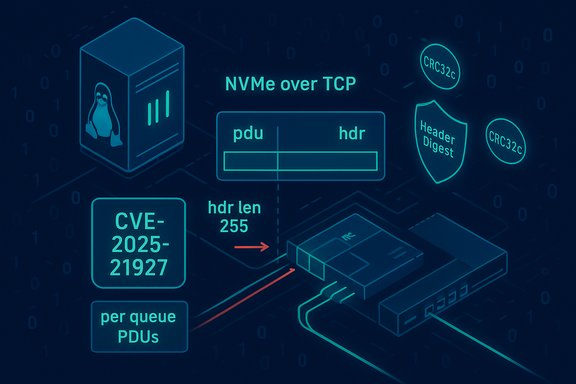
CVE‑2025‑21927 arises because nvme_tcp_recv_pdu failed to assert that the header length field (hdr->hlen) is within the expected range for the PDU type being received. When header digests are enabled, the kernel calls nvme_tcp_verify_hdgst after copying the PDU into a receive buffer; if hdr->hlen is an intentionally malformed value (for example 255), the digest verification code can index past the end of the allocated PDU buffer and overwrite adjacent memory with the computed digest — an out‑of‑bounds write that can corrupt kernel state and destabilize the host. This behavior is documented in the upstream kernel advisories and summarized in public vulnerability trackers.
The upstream fix is focused, low‑risk, and already present in the kernel stable trees and distribution advisories. The practical action for operators is unambiguous: verify whether your kernels include the upstream commit, apply vendor kernel updates, and reboot to eliminate exposure. Where immediate patching is unfeasible, reduce exposure by isolating NVMe‑TCP traffic and avoiding the header‑digest negotiation path until patches are deployed. Although public reporting highlights availability as the primary impact, all kernel memory‑corruption defects deserve urgent remediation because of the potential for escalation in complex exploit chains.
Evidence and patch references are available in the public vulnerability trackers and distribution advisories; administrators should confirm remediation by matching package changelogs or upstream commit IDs before declaring systems remediated.
Source: MSRC Security Update Guide - Microsoft Security Response Center
 Background
NVMe over Fabrics (NVMe-oF) has become a mainstream option for high-performance storage in datacenters, and NVMe over TCP (nvme‑tcp) is the transport that brings NVMe semantics over standard TCP/IP. Like any protocol that accepts structured PDUs (Protocol Data Units) from a peer, the nvme‑tcp implementation must treat all header fields as untrusted input and enforce consistent bounds checks before acting on length fields or indexing into buffers.CVE‑2025‑21927 arises because nvme_tcp_recv_pdu failed to assert that the header length field (hdr->hlen) is within the expected range for the PDU type being received. When header digests are enabled, the kernel calls nvme_tcp_verify_hdgst after copying the PDU into a receive buffer; if hdr->hlen is an intentionally malformed value (for example 255), the digest verification code can index past the end of the allocated PDU buffer and overwrite adjacent memory with the computed digest — an out‑of‑bounds write that can corrupt kernel state and destabilize the host. This behavior is documented in the upstream kernel advisories and summarized in public vulnerability trackers.
What the fix changes (technical overview)
The upstream remedial approach is straightforward and defensive:- nvme_tcp_recv_pdu now validates the header length against the expected size for the PDU type and rejects PDUs that advertise an unexpected header length.
- The header‑digest verification path (nvme_tcp_verify_hdgst and related helpers) has been hardened so that it no longer performs digest computation or memory access when the header length is out of range.
- In parallel, several related commits modernize the digest calculation code (switching to crc32c helpers, using skb_*_crc32c datagram iter helpers), reducing the chance of incorrect manual pointer arithmetic and making the code paths easier to reason about.
Exactly what went wrong
At a glance the vulnerable flow looks like this:- The kernel receives a TCP segment that contains an NVMe‑TCP PDU.
- nvme_tcp_recv_pdu copies bytes into a per‑queue PDU buffer and uses hdr->hlen (header length) to locate the header digest field if header digests are enabled.
- Because hdr->hlen was never checked to ensure it is the expected size for that PDU type, a malicious or malformed target can set hdr->hlen to a large value.
- nvme_tcp_verify_hdgst computes the expected digest then writes it at pdu + hdr->hlen (or reads the received digest from that location). If hdr->hlen exceeds the actual allocation, that read/write touches memory past the buffer and corrupts kernel data structures.
Scope: which kernels and distributions are affected
Public vulnerability trackers and distro advisories have mapped the vulnerable code and the patched commits into concrete kernel ranges and package advisories. The general picture assembled from multiple sources is:- The bug affects a broad set of mainstream kernels in the 5.x and 6.x series; several trackers list vulnerable version ranges starting around 5.0 and extending to pre‑patch versions of 6.13/6.14 depending on the specific stable branch. Upstream stable commits are the authoritative reference.
- Distributions have shipped fixes at different times. Ubuntu, Debian, Red Hat, Amazon Linux and other major vendors published advisories or included backports in kernel updates after the upstream fix appeared. Operators should consult their vendor's security advisory for exact package versions and patches that include the upstream commit(s).
- Several vulnerability trackers list CVSS v3 base scores in the high/important range (around 7.8) driven by the impact on confidentiality/integrity/availability when the digest verification path is enabled and reachable. This CVSS scoring reflects the potential for high‑impact consequences (data corruption, host crash), even if exploitation requires specific configuration (header digests enabled) or local/peer access.
Practical impact — what an attacker can achieve
The primary operational consequence for CVE‑2025‑21927 is availability. The exploit primitive is a kernel memory corruption triggered by malformed PDUs; depending on where the corruption lands this can cause:- Immediate kernel oops and panic → host crash and service outages.
- Partial memory corruption that causes repeated instability, kernel panics, or data-plane failures that persist until the host is manually recovered.
- In worst‑case, an attacker who can reliably position a crafted PDU so that the corruption overlaps attacker-controlled or sensitive kernel structures could attempt to escalate the impact — but there is no widely-reported proof that this specific bug leads to remote code execution in the wild. Public advisories emphasize a DoS/availability impact as the primary operational risk.
- The bug is triggered by peer PDUs and is therefore reachable over networks that accept NVMe‑TCP connections. That makes shared hosting, cloud targets, and multi‑tenant storage fabrics more interesting for an attacker because an adversarial endpoint or a malicious tenant can send crafted PDUs to a vulnerable initiator.
- In many deployments header digests are optional and disabled by default; the vulnerable code path is only exploitable when header digests are in use. However, some initiators or management frameworks (libnvme, SPDK, vendor drivers) expose switches to enable both header and data digest verification for integrity; if a target alternately misconfigures a controller or an initiator negotiates digest features, hosts can be exposed. Trackers and upstream notes explicitly call out the header-digest condition as the functional trigger.
Who should prioritize patching
Patch priority should be driven by exposure and role:- High priority: storage servers, hypervisor hosts, cloud compute nodes, multi‑tenant build/test hosts, and any system that accepts NVMe‑TCP connections from untrusted peers. These systems either host critical workload data or are reachable by potentially untrusted tenants.
- Medium priority: developer workstations that use NVMe‑TCP to access test storage, or systems that accept NVMe‑TCP from a known but not fully trusted network segment (for example a lab or staging environment).
- Lower priority: systems that do not run the nvme‑tcp driver, have no NVMe‑TCP initiators or targets configured, or have header digests explicitly disabled in their NVMe stacks.
Remediation and mitigation options
- Install vendor/distribution kernel updates that include the upstream fix and reboot.
- This is the definitive remediation. Confirm the package changelog or vendor advisory explicitly references CVE‑2025‑21927 or the upstream commit IDs before marking a host remediated. Multiple distros have published advisories and fixed packages; check your vendor’s security tracker for exact versions.
- If immediate patching is impossible, apply short‑term mitigations (workarounds) while you plan a patch:
- Avoid accepting NVMe‑TCP connections from untrusted networks. Place initiators/hosts behind administrative networks or VLANs and restrict access with firewall rules.
- Where feasible, disable header digests on the initiator side (or avoid negotiating it), since the vulnerability is exercised when header digests are enabled and a malformed header length is processed. Note: disabling digests reduces protocol integrity checks and may be unacceptable in some high‑integrity environments; treat this as a temporary and contextual mitigation, and test interoperability before changing production configs. Libnvme/SPDK and other NVMe stacks expose options such as hdr_digest / hdgst to control these features.
- Isolate or harden hosts that provide NVMe‑TCP endpoints: implement strict access controls, limit who can mount or create NVMe sessions, and restrict which peers are reachable at the network layer.
- For cloud operators and multi‑tenant providers:
- Treat this as a high‑priority kernel patch for hosts that host untrusted code or accept external NVMe‑TCP connections from tenants. Apply vendor updates rapidly and coordinate with tenants if reboots are required.
- Use host isolation (cgroups, network namespaces) and tenancy controls to reduce the blast radius until patches are deployed.
- Monitoring and detection:
- Collect and centralize kernel logs (dmesg/journald) and hunt for oops/panic traces referencing nvme_tcp, nvme_tcp_recv_pdu, nvme_tcp_verify_hdgst, header digest errors, or unexpected PDU lengths.
- Enable crashdump capture (kdump) on critical hosts to retain evidence if a crash occurs; kernel auto‑reboots erase transient logs that are often needed for root cause analysis. Vulnerability writeups emphasize collecting kernel backtraces and kdump vmcores when crashes occur.
How to verify a host is patched
- Confirm the running kernel package contains the upstream commit(s):
- For packaged kernels, check the kernel package changelog or vendor security advisory for explicit mention of CVE‑2025‑21927 or the upstream commit IDs (the kernel commit IDs were referenced in public tracker pages and in upstream stable logs).
- If you build kernels from source, search your tree for the patched functions and the added header-length validation check, or verify the presence of the upstream commit by ID.
- After installing the fixed package, reboot and validate:
- Re-run test scenarios that previously could exercise NVMe‑TCP (in a lab) and ensure no header digest failures or panic traces are observed.
- Monitor for kernel oopses over a post‑patch monitoring window. Multiple writeups stress that the fix is small and low‑risk, but you should still validate in a staging cohort before broad production rollout.
Critical analysis: strengths of the upstream response and remaining caveats
Strengths- The upstream patch is small and focused: adding explicit validation is conservative and lowers regression risk. The change follows a common best practice — don't trust header lengths — and does not involve large-scale redesign.
- Kernel maintainers also replaced fragile manual digest code paths with standard crc32c helpers and skb‑based helpers, which reduces the surface area for manual pointer errors and is easier to audit.
- Multiple distributions and vendors have packaged and released backports, making remediation available for a wide range of supported kernels and enterprise environments.
- Vendor lag: many embedded appliances, vendor‑supplied kernels and long‑lifecycle images do not receive immediate backports. Those images may remain exposed until the vendor produces a fixed package or customers apply a vetted custom backport. The long tail of embedded devices is a recurring operational risk for kernel fixes.
- Attackability depends on configuration: header digests must be enabled (or negotiated) for the vulnerable code path to be reachable. Some announces emphasize this as the key exploitation predicate; however, operators should not treat that as a reason to delay patching — configuration can shift, and negotiated features may be enabled automatically by some stacks.
- Proof of remote code execution: currently available public reports classify the issue primarily as a memory‑corruption/DoS risk. Claims that this leads to reliable remote code execution should be treated as unverified until a public proof‑of‑concept or in‑the‑wild exploitation report appears. Nevertheless, kernel memory corruption is serious and merits urgent remediation due to the potential for complex exploit chains.
Operational checklist for sysadmins and SREs (concise)
- Inventory: identify hosts that run NVMe‑TCP (check kernel config / modules: lsmod | grep nvme; search for nvme_tcp in your kernel image). Capture uname -r and package metadata.
- Check vendor advisories: locate your distro's security advisory and confirm the fixed package version or backport ID.
- Patch and reboot: schedule and install the vendor-supplied kernel update that includes the upstream commit; reboot into the patched kernel.
- If immediate patching is impossible:
- Restrict NVMe‑TCP traffic to trusted networks.
- Consider disabling hdr_digest negotiation on initiators where operationally acceptable.
- Monitor: centralize kernel logs, enable kdump, and hunt for nvme_tcp-related oops or header digest errors post-deployment.
Conclusion
CVE‑2025‑21927 is a classic example of a small validation gap producing outsized operational pain in kernel code: an unchecked header length in the NVMe‑TCP PDU path allowed a header digest routine to read or write past the allocated buffer, creating a kernel memory‑corruption primitive that can crash hosts and cause sustained availability loss.The upstream fix is focused, low‑risk, and already present in the kernel stable trees and distribution advisories. The practical action for operators is unambiguous: verify whether your kernels include the upstream commit, apply vendor kernel updates, and reboot to eliminate exposure. Where immediate patching is unfeasible, reduce exposure by isolating NVMe‑TCP traffic and avoiding the header‑digest negotiation path until patches are deployed. Although public reporting highlights availability as the primary impact, all kernel memory‑corruption defects deserve urgent remediation because of the potential for escalation in complex exploit chains.
Evidence and patch references are available in the public vulnerability trackers and distribution advisories; administrators should confirm remediation by matching package changelogs or upstream commit IDs before declaring systems remediated.
Source: MSRC Security Update Guide - Microsoft Security Response Center
