

NVIDIA’s Container Toolkit contains a critical initialization-hook vulnerability that allows an attacker to execute arbitrary code with elevated privileges on the host, creating a realistic path to container escape, full node compromise, and broad operational impact for GPU-enabled clusters and AI workloads. (nvidia.custhelp.com)
The flaw tracked as CVE‑2025‑23266 was disclosed in July 2025 and has been assigned a high-to-critical severity rating by multiple trackers (CVSS v3.1 base ≈ 9.0 in public reporting). The vulnerability exists in specific OCI hooks used by the NVIDIA Container Toolkit during container initialization; those hooks can be influenced by container-supplied environment variables and other inputs before the runtime finishes isolating the container. That ordering and insufficient input sanitization produce an untrusted search path / environment variable handling weakness (CWE‑426) that attackers can leverage to load malicious code into an elevated context. (nvidia.custhelp.com)
Affected components and remediation snapshots published by NVIDIA and mirrored in vendor advisories show the toolkit was patched in the July 2025 updates; the recommended fixed release is nvidia-container-toolkit v1.17.8 and corresponding GPU Operator releases were updated to versions in the 25.3.x stream. Operators are urged to upgrade immediately and—if immediate patching is impractical—apply the documented mitigations such as disabling the CUDA compat hook used by the vulnerable logic. (nvidia.custhelp.com)
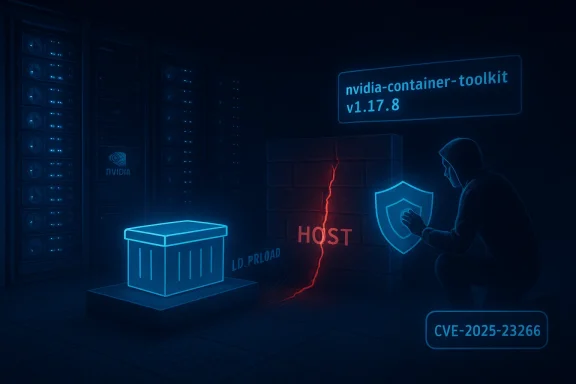
Multiple independent write-ups and advisory summaries describe the same practical exploitation chain: a crafted image sets a permissive environment (for example LD_PRELOAD pointing to a library copied into the container) and the NVIDIA hook, invoked under privileged context on the host, honors that environment before privilege-dropping or chrooting. The result is execution of the attacker library with host-level privileges. Several security teams published a minimal PoC pattern demonstrating how a few Dockerfile lines make the attack practical on vulnerable nodes. (kodemsecurity.com)
Microsoft, cloud providers, and managed Kubernetes vendors published variant-specific guidance where the toolkit is embedded in managed images or node pools; operators using managed node images should verify whether their provider updated those images or pushed patched node images. Enterprise operators should treat vendor attestations as authoritative for those product lines but must still run artifact-level scans for other images and builds in their estate. This nuance around vendor attestation vs. artifact verification is an important operational point documented across multiple advisories and security discussions. (alibabacloud.com)
Treat this CVE as a priority in any environment that schedules untrusted or third‑party GPU containers. Patch the toolkit and operator images first, apply mitigations if needed, and then close the loop with hardening (image provenance, admission controls, and rebuilds) so a single vulnerable image cannot yield a catastrophic host compromise. (nvidia.custhelp.com)
Source: MSRC Security Update Guide - Microsoft Security Response Center
 Background / Overview
The flaw tracked as CVE‑2025‑23266 was disclosed in July 2025 and has been assigned a high-to-critical severity rating by multiple trackers (CVSS v3.1 base ≈ 9.0 in public reporting). The vulnerability exists in specific OCI hooks used by the NVIDIA Container Toolkit during container initialization; those hooks can be influenced by container-supplied environment variables and other inputs before the runtime finishes isolating the container. That ordering and insufficient input sanitization produce an untrusted search path / environment variable handling weakness (CWE‑426) that attackers can leverage to load malicious code into an elevated context. (nvidia.custhelp.com)Affected components and remediation snapshots published by NVIDIA and mirrored in vendor advisories show the toolkit was patched in the July 2025 updates; the recommended fixed release is nvidia-container-toolkit v1.17.8 and corresponding GPU Operator releases were updated to versions in the 25.3.x stream. Operators are urged to upgrade immediately and—if immediate patching is impractical—apply the documented mitigations such as disabling the CUDA compat hook used by the vulnerable logic. (nvidia.custhelp.com)
Why this matters now
GPU nodes are no longer niche: they host model training, inference, and an expanding array of multi‑tenant workloads. A vulnerability that permits code execution on the host from a container image undermines the core security boundary of modern cloud-native deployments.- Containers are a primary delivery vehicle for untrusted or third‑party AI workloads. A malicious or tampered image can be scheduled into a GPU node and trigger the flawed hook during startup. (alibabacloud.com)
- Many Kubernetes clusters use NVIDIA’s GPU Operator or the Container Toolkit to inject device libraries and helpers into containers—precisely the code paths that the vulnerability touches. Compromise of one GPU node can yield host control and lateral movement opportunities across cluster services. (docs.nvidia.com)
- The vulnerability is especially consequential in multi‑tenant or shared environments (public clouds, managed clusters, CI runners) where an unprivileged tenant may run images pushed by an external party. When the attacker need only supply a crafted image to achieve an elevation-of-privilege chain, the operational risk is high. (alibabacloud.com)
Technical analysis
What precisely is wrong
At its core, CVE‑2025‑23266 is a hook-time trust and environment-handling flaw: the toolkit’screateContainer/initialization hooks use environment variables or search paths that can be set by the container image or startup configuration. Because the hook runs before the runtime completes full namespace and capability isolation, a crafted image can set values such as LD_PRELOAD or influence which binaries/libraries the hook executes, causing the host-side hook to load attacker-controlled code. This behavior maps to an untrusted search path / environment injection class of weaknesses. (security.snyk.io)Multiple independent write-ups and advisory summaries describe the same practical exploitation chain: a crafted image sets a permissive environment (for example LD_PRELOAD pointing to a library copied into the container) and the NVIDIA hook, invoked under privileged context on the host, honors that environment before privilege-dropping or chrooting. The result is execution of the attacker library with host-level privileges. Several security teams published a minimal PoC pattern demonstrating how a few Dockerfile lines make the attack practical on vulnerable nodes. (kodemsecurity.com)
Attack vector and prerequisites
- Attacker ability: The adversary must be able to supply and cause execution of a container image on the target GPU node—this can be through a public registry, CI artifact, or tenant workload. No prior kernel bug or host compromise is required. (alibabacloud.com)
- Privileges required at exploit time: Low inside the container. The critical factor is that the image runs on a host that uses the vulnerable toolkit versions and default feature flags that enable the hook behavior. No interactive user input or high-privilege credentials are needed beyond the ability to deploy a container image. (security.snyk.io)
- Impact scope: Local container → host. Because exploitation yields code execution in the host context, it allows privilege escalation to root on the host, data access, tampering, and persistent denial of service. Attackers can also use this foothold to harvest secrets, exfiltrate models, or pivot to cluster control planes. (zerodayinitiative.com)
PoC and practical exploit notes
Several security write‑ups and vendor advisories show how simple the PoC can be in practice. A typical pattern:- FROM an NVIDIA base image (common in ML stacks).
- ENV LD_PRELOAD=/tmp/libescape.so
- COPY libescape.so /tmp/
Affected software and versions
Cross‑checked public advisories (vendor advisory + ecosystem trackers) consistently identify the vulnerable range and patched releases:- NVIDIA Container Toolkit: all versions up to and including 1.17.7 are affected; 1.17.8 is the fix release. (nvidia.custhelp.com)
- NVIDIA GPU Operator and related components were also updated in the same timeframe; GPU Operator and auxiliary packages (k8s device plugin, MIG Manager) received updated tags in the 25.3.x and 0.17.x/0.12.x lines respectively—vendors published Helm arguments to force the secure toolkit image versions. (nvidia.custhelp.com)
- Environments using the Container Device Interface (CDI) mode are noted to have a narrower footprint for the most severe aspect of the flaw, but other hooks remain relevant for many deployments. Operators should assume exposure until the toolkit and operator are updated. (nvidia.custhelp.com)
Mitigation, detection, and remediation
Immediate (0–24 hours)
- Patch: upgrade to nvidia-container-toolkit v1.17.8 and the updated GPU Operator / device plugin releases as provided by NVIDIA and by your distribution vendor. This is the only long-term fix. (nvidia.custhelp.com)
- Temporary mitigation: disable the specific hook that injects container CUDA compatibility libraries. Set the feature flag to disable the hook in the toolkit’s config (for example, set features.disable-cuda-compat-lib-hook = true in /etc/nvidia-container-toolkit/config.toml) until you can deploy patches. For GPU Operator users, pass the corresponding Helm values to force the non-vulnerable toolkit image or to disable the feature in operator-managed installs. These are stopgap mitigations and should not replace patching. (nvidia.custhelp.com)
- Block risky images: temporarily block or disallow images that set LD_PRELOAD, LD_LIBRARY_PATH, or other runtime-shaping environment variables in registries or admission controllers. Consider admission controls that reject images with suspicious environment variables or with runtime hooks defined. (kodemsecurity.com)
Short-term (1–7 days)
- Inventory hosts: locate every node running the NVIDIA Container Toolkit (use package metadata, image tags, and node labels). For Kubernetes: list nodes with GPU taints/labels and check installed toolkit image versions. (alibabacloud.com)
- Rebuild images: do not rely on switching the toolkit alone—rebuild and redeploy any images you control that were built on vulnerable base images, especially if they baked in device libraries or relied on GPU base images. Base-image updates do not retroactively patch derived images. (alibabacloud.com)
- Increase monitoring: hunt for suspicious container images that set dangerous env vars; monitor host logs for unexpected invocation of toolkit hooks, for new root shells, or for anomalous modifications of system files immediately after container startup events. (cyberpress.org)
Medium-term (weeks)
- Harden admission control: add OPA/Gatekeeper/Admission Webhook rules to block images carrying potentially dangerous environment variables or to deny containers that request host-level capabilities unnecessary for their function. Implement strict image provenance checks (image signing and SBOM enforcement). (kodemsecurity.com)
- Least privilege for GPU workloads: avoid granting broad host access or additional capabilities to GPU pods; use device plugins and CDI in a minimal configuration and avoid exposing hostPaths or privileged containers unless required. (alibabacloud.com)
- Incident response plans: for environments where untrusted images can be run, prepare a playbook to isolate impacted nodes, collect forensic artifacts (container images, host logs, toolkits’ logs), and redeploy node pools after rebuilds with patched images. (alibabacloud.com)
Detection and indicators of compromise (IoCs)
Key signs to look for on nodes:- Containers that set LD_PRELOAD or other library-preload environment variables at startup. Admission or runtime logs showing these env vars in new pods are a strong signal. (kodemsecurity.com)
- Unexpected invocation of host-side toolkit hook processes (look for calls to the toolkit binaries or to helper scripts immediately prior to container process start). Host audit logs and container runtime logs (containerd/dockerd) will show these sequences. (docs.nvidia.com)
- New or unusual processes running as root spawned shortly after pod creation events, or unexpected writable files in host locations (e.g., /tmp artifacts being used by root processes). (cyberpress.org)
Risk assessment and realistic threat model
This vulnerability is not theoretical. Multiple security vendors and coordinated-disclosure programs published advisories and proof-of-concept patterns shortly after disclosure, and the underlying attack requires only the ability to schedule a container on a vulnerable node—something that is commonly possible in multi-tenant clouds, shared CI infrastructure, or permissive dev/test clusters. The realistic threat model includes:- Malicious images (supply-chain or public images) pushed to registries and later scheduled. (kodemsecurity.com)
- Insider misuse or misconfigured CI pipelines that allow untrusted or third‑party images to run on GPU nodes. (alibabacloud.com)
- Targeted attackers who obtain credentials to deploy a pod (even a low-privilege pod) can escalate to host control on vulnerable nodes. (zerodayinitiative.com)
Vendor response and coordination
NVIDIA published a security bulletin and updated its toolkit and operator images; the vendor also documented the mitigation flag and Helm options to deploy safe versions via the GPU Operator. Independent third‑party trackers (Snyk, GitHub Advisory database, ZDI) triangulated the vendor advisory and published independent advisories that confirm both the technical root cause (untrusted search path / environment handling) and the patched versions. That cross-vendor corroboration strengthens confidence that the mapping of affected versions to fixed versions is accurate. (nvidia.custhelp.com)Microsoft, cloud providers, and managed Kubernetes vendors published variant-specific guidance where the toolkit is embedded in managed images or node pools; operators using managed node images should verify whether their provider updated those images or pushed patched node images. Enterprise operators should treat vendor attestations as authoritative for those product lines but must still run artifact-level scans for other images and builds in their estate. This nuance around vendor attestation vs. artifact verification is an important operational point documented across multiple advisories and security discussions. (alibabacloud.com)
Critical analysis — strengths, weaknesses, and residual risks
Strengths in the response
- Rapid coordinated disclosure and vendor patching reduced the public exposure window; NVIDIA produced an explicit mitigation flag and release notes. Independent trackers and security vendors corroborated the technical root cause and fixed versions quickly. This combination is the ideal pattern for high‑urgency CVEs. (nvidia.custhelp.com)
- The fix is surgical: disable or sanitize the problematic behavior in the hook before execution or remove honoring untrusted environment variables—this reduces regression risk and supports rapid backports. (nvidia.custhelp.com)
Weaknesses and operational concerns
- The vulnerability’s exploitability against widely deployed cloud images and operator-managed clusters makes the practical blast radius large. Many organizations run GPU images built from NVIDIA bases or use the GPU Operator; the presence of vulnerable toolkit versions in those supply chains means inventory and rebuild work is non-trivial. (alibabacloud.com)
- Temporary mitigations (disabling the hook) are useful but incomplete: they may break legitimate workflows that relied on the previous behavior, and they leave platforms in a different but non-ideal state until full upgrades and testing complete. (rewterz.com)
- Artifact proliferation (many derived images, internal CI artifacts, and third‑party appliance images) complicates blanket remediation. Upgrading the toolkit on nodes does not retroactively fix images or statically linked binaries that may still rely on unsafe runtime behaviors. A disciplined rebuild policy is necessary. (alibabacloud.com)
Residual risks to watch
- Unpatched or misconfigured clusters, especially those that accept third‑party images without strict admission control, remain at high risk.
- Managed or marketplace images may lag vendor updates; assume any Microsoft or third‑party image is unverified until you confirm the image tag or vendor attestation. (Vendor attestations are helpful, but artifact-level verification is the only definitive check.)
Practical checklist for operators (quick action plan)
- Inventory: list all GPU nodes, GPU Operator versions, and toolkit image tags. Prioritize public cloud and multi‑tenant nodes. (alibabacloud.com)
- Patch: upgrade toolkit to v1.17.8 (or vendor distro package) and update GPU Operator/device plugin images to the vendor-supplied secure tags. Reboot or drain/replace nodes per your update policy. (nvidia.custhelp.com)
- Mitigate (if you cannot patch immediately): set features.disable-cuda-compat-lib-hook = true in /etc/nvidia-container-toolkit/config.toml or apply Helm flags to the operator. Document and time-box this mitigation. (nvidia.custhelp.com)
- Enforce image policies: add admission rules to reject images that set LD_PRELOAD/LD_LIBRARY_PATH or that declare unusual runtime hooks; require SBOMs and provenance for images that will run on GPU nodes. (kodemsecurity.com)
- Rebuild images: rebuild any derived images to ensure they are based on patched base images and do not embed unsafe host expectations. (alibabacloud.com)
- Monitor: hunt for the IoCs listed above, and be ready to isolate any node showing signs of exploitation. (cyberpress.org)
Conclusion
CVE‑2025‑23266 is a high‑impact, practical vulnerability that breaks a fundamental trust boundary in GPU-enabled container stacks. The exploit path is simple, the affected code is widespread where GPUs are used, and the consequences range from data theft to full host takeover. Fortunately, vendor fixes and mitigations exist and were distributed promptly; however, real safety depends on operational execution—inventorying affected artifacts, patching nodes and operator stacks, rebuilding derived images, and tightening admission controls for GPU workloads.Treat this CVE as a priority in any environment that schedules untrusted or third‑party GPU containers. Patch the toolkit and operator images first, apply mitigations if needed, and then close the loop with hardening (image provenance, admission controls, and rebuilds) so a single vulnerable image cannot yield a catastrophic host compromise. (nvidia.custhelp.com)
Source: MSRC Security Update Guide - Microsoft Security Response Center
