

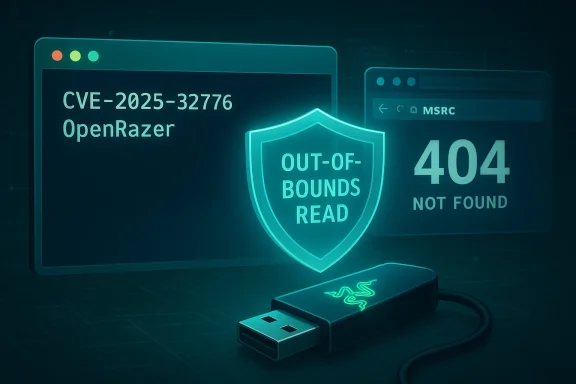
When you tried to visit Microsoft’s Security Update Guide at the CVE address you supplied, the page returned no usable advisory — and that empty result appears to be because the identifier you used (CVE‑2026‑32776) does not map to a Microsoft product advisory. What does exist, however, is a closely related and fully tracked vulnerability: CVE‑2025‑32776, an out‑of‑bounds read in the OpenRazer driver that was disclosed in April 2025 and patched in OpenRazer 3.10.2. This article unpacks the mismatch, confirms the technical facts from multiple independent trackers, assesses impact and exploitability, and gives clear remediation, detection, and risk‑management guidance for Windows and Linux administrators alike. (msrc.microsoft.com)
OpenRazer is an open‑source project that provides kernel drivers and user‑space daemons to control lighting and other device features for Razer peripherals on GNU/Linux systems. In April 2025 a vulnerability affecting how OpenRazer handled custom frame data — the matrix_custom_frame interface — was assigned CVE‑2025‑32776. The flaw allowed a local, low‑privileged user to cause the driver to read more bytes than supplied by user space, producing an out‑of‑bounds read and the possibility of sensitive data leakage or other downstream effects. The project patched the issue in release 3.10.2.
A likely source of confusion — and the reason you saw a “page not found” on Microsoft’s site — is that Microsoft’s Security Update Guide (MSRC) catalogs vulnerabilities that affect Microsoft products and related vendor advisories. It is not a comprehensive public registry for every CVE across the ecosystem. An MSRC page built around an identifier that does not correspond to a Microsoft advisory will often return no entry. In short: MSRC returning “not found” for CVE‑2026‑32776 is consistent with the site not having an entry for that year/ID; the correct, published CVE for the OpenRazer issue is CVE‑2025‑32776, which is tracked by NVD, OSV/Ubuntu, Snyk and multiple distribution advisories. (msrc.microsoft.com)
(For context about typical Microsoft patch cadence and how it publishes Microsoft product vulnerabilities, see the vendor’s monthly rollups and Patch Tuesday summaries; MSRC is primarily populated when Microsoft issues updates that affect its own stack.)
Source: MSRC Security Update Guide - Microsoft Security Response Center
 Background / Overview
OpenRazer is an open‑source project that provides kernel drivers and user‑space daemons to control lighting and other device features for Razer peripherals on GNU/Linux systems. In April 2025 a vulnerability affecting how OpenRazer handled custom frame data — the matrix_custom_frame interface — was assigned CVE‑2025‑32776. The flaw allowed a local, low‑privileged user to cause the driver to read more bytes than supplied by user space, producing an out‑of‑bounds read and the possibility of sensitive data leakage or other downstream effects. The project patched the issue in release 3.10.2.A likely source of confusion — and the reason you saw a “page not found” on Microsoft’s site — is that Microsoft’s Security Update Guide (MSRC) catalogs vulnerabilities that affect Microsoft products and related vendor advisories. It is not a comprehensive public registry for every CVE across the ecosystem. An MSRC page built around an identifier that does not correspond to a Microsoft advisory will often return no entry. In short: MSRC returning “not found” for CVE‑2026‑32776 is consistent with the site not having an entry for that year/ID; the correct, published CVE for the OpenRazer issue is CVE‑2025‑32776, which is tracked by NVD, OSV/Ubuntu, Snyk and multiple distribution advisories. (msrc.microsoft.com)
Why the year and ID matter (and how mistakes happen)
CVE identifiers are year‑scoped: CVE‑YYYY‑NNNNN. A single digit change in the year produces a different identifier that may not exist or may point to a different CNA (CVE Numbering Authority). Public trackers, package managers, and vendor security pages usually use the exact CVE string. Common reasons for an MSRC 404 on a CVE URL include:- A typographical error in the CVE year (e.g., 2026 instead of 2025).
- The CVE belongs to a non‑Microsoft product and Microsoft has not indexed it in MSRC.
- The MSRC URL renderer may require JavaScript or serve an application shell that shows an application message rather than a simple static page (a technical limitation rather than an indication the CVE does not exist).
What CVE‑2025‑32776 actually is — technical summary
Short technical description
- Vulnerability class: CWE‑125: Out‑of‑bounds Read.
- Affected component: openrazer (kernel driver + user‑space daemon), specifically the code handling the
matrix_custom_frameinterface. - Root cause: improper bounds/length handling — an integer/size mismatch allowed the kernel driver to read more data than was provided by user space and then assemble RGB arguments that get sent to the USB device.
- Attack vector: Local (requires ability to write to the driver’s interface / device file).
- Privileges required: Low (local non‑root user privileges sufficient in practice for many Linux setups).
- Reported/published: April 15, 2025; patched in OpenRazer 3.10.2.
CVSS and impact metrics
The published CVSS v3.1 vector is AV:L/AC:L/PR:L/UI:N/S:U/C:H/I:N/A:N, which yields a Medium base score (NVD reports 5.5). The vector indicates a local attack with low complexity, limited required privileges, and high confidentiality impact but no integrity or availability impact in the common assessment. This reflects a realistic threat model: an attacker who can run code or write crafted data to the kernel interface can cause memory reads that might leak kernel or user memory fragments into device arguments.How the bug is implemented (developer summary)
Published commit notes and the project advisory indicate the fix changed the type of a length variable (from an 8‑bit or otherwise restricted type to a size‑sized type) and hardened parameter checking so invalid or truncated custom frames are not copied into the RGB buffer. That combination eliminates the integer overflow/underflow and prevents reads beyond the supplied user buffer. The project’s own advisory and the related commits are the canonical technical artifacts for the fix.Who and what is affected
- Systems running the OpenRazer kernel driver and user‑space daemon prior to 3.10.2.
- Linux distributions that package OpenRazer and shipped affected versions (Debian, Ubuntu, upstream distro packages).
- Any multi‑user Linux hosts where untrusted users have local device access or are permitted to write to the relevant device nodes for Razer peripherals.
- Environments with shared consoles, compute pods, or workstations where low‑privilege user accounts can run code or interact with attached USB devices in unconfined ways.
Exploitability and real‑world risk
Exploitation prerequisites
- Local access — the attacker must be able to run on the target host or drop data onto the openrazer device interface.
- Device presence — the host must have a Razer device or the driver installed with the matrix_custom_frame interface exposed.
- Write permissions — the attacker needs permission to write to the device node or to the driver interface (often requiring only low privileges on desktop machines).
- Users run untrusted code (shared desktops, CI runners).
- Containers are misconfigured and host device nodes are exposed to containerized workloads.
- Thin client labs or university machines allow users to plug in and interact with USB devices.
Likelihood of active exploitation
Public trackers (NVD, EPSS) and distribution advisories show a low EPSS/exploit prediction for this CVE — it is not recorded as a widely weaponized or mass‑exploited flaw. That said, the vulnerability can be used for local data extraction or to support chaining into privilege escalation if other weaknesses exist. The main operational risk is lateral privilege escalation and data leakage on multi‑user Linux systems.Mitigation and patching — what to do now
The vulnerability has an upstream fix. Prioritize remediation as follows:- Upgrade OpenRazer to 3.10.2 or later on any system that runs the project or packages derived from it. This is the definitive fix and eliminates the out‑of‑bounds read.
- If you manage Linux distributions, apply the vendor/distro security update packages (Debian, Ubuntu and others published advisories and backports). Check your distro’s security tracker for the corrected package versions.
- If you cannot immediately patch:
- Remove or blacklist the OpenRazer kernel module from systems where it is not required.
- Restrict device node permissions so untrusted local users cannot write to the affected device interface.
- Implement container hardening: do not bind mount host device nodes into containers or apply strict device cgroup policies.
- Monitor for suspicious local activity — unexpected writes to device nodes, unusual processes opening USB devices, or kernel logs pointing to driver exceptions (see Detection & Hunting below).
- For environments using Windows as the management platform: remember this is a Linux driver vulnerability. Windows hosts are not directly affected unless a Linux subsystem or VM with OpenRazer is present. Microsoft’s MSRC listings will not contain third‑party Linux driver CVEs in the same way distro trackers will; use upstream project advisories and distro security feeds for Linux driver fixes. (msrc.microsoft.com)
Detection, hunting, and incident response
What to look for
- Processes or users writing to the OpenRazer device nodes (commonly under /dev or via sysfs interfaces). Unexpected writes from low‑privilege accounts should be flagged.
- Kernel warnings or oops messages referencing the OpenRazer driver or matrix_custom_frame handling.
- Newly installed or updated openrazer packages concurrent with suspicious logins or job runs.
- Container images or CI jobs that mount /dev or expose host USB devices to build/test containers.
Practical detection queries (Linux)
- List device nodes and check ownership:
- sudo ls -l /dev | grep -i razer
- Audit writes to the device node with auditd (example):
- sudo auditctl -w /dev/<openrazer_device> -p w -k openrazer_write
- Search kernel logs for driver traces:
- sudo journalctl -k | grep -i openrazer
Incident response
- If exploitation is suspected, isolate the host and preserve memory and kernel logs for analysis.
- Capture a list of loaded modules and the OpenRazer version:
- zer
- dpkg -l | grep openrazer (Debian/Ubuntu) or rpm -qa | grep openrazer (RPM distros)
- Apply the upstream or distribution patch, then reboot to ensure the corrected module is loaded.
- Rotate credentials and review local scheduled jobs or services for persistence mechanisms if local write access was present.
Why Microsoft’s MSRC returned “not found” (technical and process explanation)
Microsoft’s Security Update Guide focuses on product advisories that affect Microsoft software and cloud services. It is not a comprehensive aggregator of every CVE across the ecosystem. When you request an MSRC page for an identifier that:- Is outside Microsoft’s product scope, or
- Is mis‑typed (e.g., wrong year),
(For context about typical Microsoft patch cadence and how it publishes Microsoft product vulnerabilities, see the vendor’s monthly rollups and Patch Tuesday summaries; MSRC is primarily populated when Microsoft issues updates that affect its own stack.)
Cross‑reference verification (what I checked and with whom)
To avoid second‑hand errors I cross‑checked the key claims with multiple independent sources:- The NVD entry for CVE‑2025‑32776 (CVE record, description and CVSS statement).
- OSV / Ubuntu security notice and canonical metadata for the CVE (distribution patch tracking).
- Vendor and community vulnerability aggregators (Snyk, CVEDetails, cvefeed, CVE‑OSV records) that reference the OpenRazer GitHub advisory and the upstream commit that corrected the bounds handling.
- The upstream project advisory and commits (as referenced by NVD/OSV), which show the precise fix (type change and parameter validation). These developer artifacts are the authoritative code‑level patch.
Practical guidance for enterprise teams
- Inventory: Use your asset management tools to find any hosts that have openrazer installed or where Razer device drivers were packaged. Many endpoints on corporate desks are unlikely to have the driver, but developer workstations, gaming rigs in R&D labs, and bring‑your‑own devices may. Prioritize remediation by exposure and privilege level.
- Patch policy: Apply the upstream OpenRazer 3.10.2 patch or the vendor/distro security package as soon as your testing windows allow. For high‑risk shared hosts, patch immediately and consider temporarily restricting access to USB devices.
- Least privilege: Ensure that local user accounts do not have write permission to device nodes unless explicitly required. Device node permissions are a cheap and effective protection layer for local‑access vulnerabilities.
- Container hardening: Do not mount host device nodes into untrusted containers. Use device cgroups and seccomp to limit device visibility for container workloads.
- Monitoring: Add audit rules for writes to kernel device files and integrate alerts into your SIEM for any write activity originating from non‑privileged users.
Strengths, limitations, and residual risks
Strengths of the fix and advisory
- The upstream fix is straightforward and surgical: change of the row length type and improved parameter validation, which addresses the core out‑of‑bounds condition.
- Patches were published promptly and distribution maintainers (Debian, Ubuntu and others) shipped corrected packages. That means remediation is broadly available through standard update channels.
Limitations and residual risk
- The attack remains local: if attackers already have local code execution they have a broader threat picture. This CVE does not create a new remote network entry point, but it can be useful in local privilege‑escalation chains or as a data‑exfiltration primitive.
- Detection post‑fact is nontrivial: out‑of‑bounds reads do not always create obvious logs unless the driver emits kernel warnings or device behavior is anomalous.
- Supply‑chain and derivative packaging: forks or downstream packaging that backported vulnerable code may remain unpatched if maintainers missed the advisory, so verifying package versions across fleets is essential.
Action checklist (prioritized)
- Inventory systems for openrazer installations and Razer device presence.
- Immediately upgrade OpenRazer to 3.10.2 or apply distro security updates where available.
- If immediate patching is not possible, revoke write permissions to the driver device node and remove/unload the module where feasible.
- Add audit rules to detect writes to the matrix_custom_frame interface and monitor kernel logs for driver exceptions.
- Validate container policies to ensure no host device nodes are exposed to untrusted containers.
- Reassess local privilege separation policies on multi‑user systems and shared endpoints.
Final assessment and takeaways
- The MSRC “not found” message for CVE‑2026‑32776 is not evidence of a concealed or missing vulnerability; it is a symptom of either a mistyped CVE identifier or MSRC’s product scope limitations. The correct and published vulnerability is CVE‑2025‑32776, targeting the OpenRazer project. (msrc.microsoft.com)
- CVE‑2025‑32776 is a local out‑of‑bounds read with Medium CVSS severity (5.5) that was fixed in OpenRazer 3.10.2. Multiple independent sources confirm the description, CVSS vector, and the upstream code fixes; distributions released security updates soon after disclosure.
- Operationally, this is a classic example of a driver bug that is easy to patch upstream but can persist in environments where end‑user or developer machines are neglected. The recommended response is straightforward: inventory, patch, and enforce least privilege on device access.
Source: MSRC Security Update Guide - Microsoft Security Response Center
