

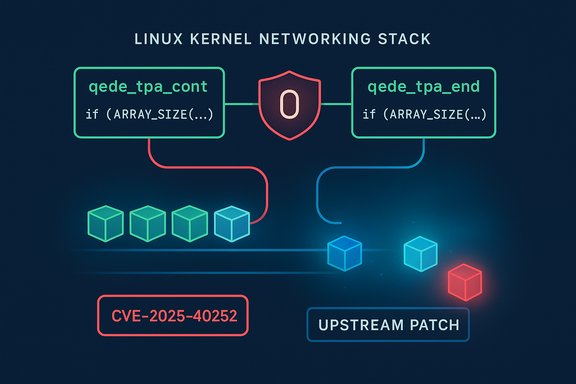
A small but important Linux kernel networking bug — tracked as CVE‑2025‑40252 — was fixed upstream after a static-analysis finding showed a potential out‑of‑bounds read in the QLogic QEDE driver. The vulnerable code lived in two packet-aggregation helper routines, qede_tpa_cont and qede_tpa_end, where loops iterated over a fixed-size length array using only a zero-length terminator as the stop condition; if that terminator was absent or malformed the loop could run past the end of the array. Upstream maintainers closed the gap by introducing an explicit bounds check (using ARRAY_SIZE and the fix has been merged into the stable kernel stream.
Background / Overview
The QEDE driver is QLogic’s Ethernet driver present in many Linux kernels and used by network adapters from that vendor. The recently published CVE entry describes a straightforward logic weakness: loops that iterate over an internal per‑completion length list (cqe->len_list[]) treat a zero-length entry as the only sign to stop scanning, instead of also enforcing the array’s allocated bounds. In practice, this can yield an out‑of‑bounds read (CWE‑125) when the terminator is absent or corrupted; the kernel code was patched to check array length explicitly. The CVE record and the patch notes attribute the find to the Linux Verification Center (linuxtesting.org) using SVACE static-analysis tooling. Technical bulletin pages and vulnerability trackers list the issue as published on December 4, 2025, with the primary remediation being the upstream kernel commit(s) that add the ARRAY_SIZE guard in drivers/net/ethernet/qlogic/qede/qede_fp.c. At the time of writing, the NVD record for CVE‑2025‑40252 was still marked “awaiting analysis,” while third‑party trackers and commercial scanners have already incorporated the CVE and the upstream references.What went wrong — a technical deep dive
How the vulnerable loop behaved
The QEDE fast‑path code receives completion queue entries (CQEs) from the adapter hardware. Each CQE in this path contains a compact array of per-segment lengths (len_list[]) and code that walks that array to process the received packet segments. The original loop used a zero‑length element as a sentinel to terminate iteration rather than checking the array bounds explicitly.That design relies on the device/firmware always populating a valid sentinel. If the sentinel is missing — for example due to malformed input, mis-synchronization between hardware and driver, or a corrupted descriptor — the loop could continue past the allocated array and read adjacent memory. The bug is an out‑of‑bounds read rather than a write, meaning it can crash or leak kernel memory adjacent to the array but does not directly overwrite kernel memory on its own.
The fix: explicit bounds checking
Upstream's patch is small and surgical: the loop conditions in both qede_tpa_cont and qede_tpa_end were extended to stop when the index reaches ARRAY_SIZE(cqe->len_list) in addition to the existing zero-length termination check. The patch also adds the appropriate include for array_size. In short, the defensive check converts an implicit sentinel assumption into a two‑pronged guard — sentinel OR bound — eliminating the path that can read past the array. This change was submitted to the kernel netdev mailing list and merged into the stable tree.Severity, exploitability and practical impact
- Primary impact: availability (kernel oops/panic) and information disclosure (small kernel memory leak). An out‑of‑bounds read generally enables crashes or limited information disclosure rather than reliable arbitrary code execution, although complex exploit chains can sometimes bootstrap further primitives.
- Attack vector: local by default — an unprivileged local process or a guest/tenant that can interact with the driver or cause the driver to process crafted input is the most straightforward trigger. However, the practical exposure depends on how the driver is used in a given environment (see “Who should care” below).
- Privilege required: low in many scenarios. A local user or container that can interact with network stack or trigger packet handling flows may be sufficient.
- RCE likelihood: low for the read alone. Public advisories and upstream descriptions do not describe a working remote code‑execution exploit for this CVE as of publication; there is no widely published proof‑of‑concept. Treat claims of immediate RCE as unverified unless corroborated by a reproducible exploit.
- Scoring and telemetry: NVD had not yet published an enriched analysis when the fix was merged; commercial scanners (Tenable) published their own CVSS assessments (Tenable lists a CVSSv3 rating in the high‑to‑medium band and a very low EPSS). These differences are common during the initial window and underline the need to prioritize based on exposure rather than a single numerical score.
Who should care (affected environments)
- Operators of network appliances and virtual appliances using QLogic hardware or the QEDE driver should prioritize this fix.
- Cloud and multi‑tenant hosts or CI/build infrastructure that attach guest VMs or containers to physical or emulated NICs using this driver: local attack primitives are valuable in multi‑tenant contexts.
- Edge routers, NFV dataplanes, and embedded appliances that run Linux kernels with QEDE enabled — especially vendor‑supplied images that may lag upstream merges.
- Developers and testers who run custom kernels or build kernel modules against specific trees: verify whether your kernel contains the upstream commits referenced by the CVE metadata.
How to verify the fix and patch your systems
The definitive remediation is to run a kernel that includes the upstream commit(s) that implement the ARRAY_SIZE guard. Multiple independent trackers and the kernel commit log point to concrete stable commits; operators should ensure their packaged kernels include those commits or upgrade to vendor-provided kernel packages that list the fix.Practical verification steps:
- Identify affected hosts: capture uname -r and check whether the running kernel contains the QEDE driver (drivers/net/ethernet/qlogic/qede).
- Check for the upstream commit: for custom-built kernels, run git log --grep with the fix commit IDs referenced in public advisories (the CNAs and advisory pages list the commits). For packaged kernels, consult distribution changelogs for kernel packages that map to CVE‑2025‑40252.
- Apply vendor/distro kernel updates that explicitly reference the CVE or the upstream stable commits and then reboot into the patched kernel. Reboots are required because kernel-level fixes only take effect after a restart.
- Isolate hosts that terminate untrusted network traffic or run multi‑tenant workloads.
- Limit untrusted local code execution and enforce container isolation where possible.
- In some environments, unloading or blacklisting the QEDE module can be a stopgap but may disrupt networking on devices that require it; evaluate operational impact before removing modules.
Detection and hunting — what to look for
Because this is an out‑of‑bounds read, the most likely operational signals are kernel logs and stability anomalies rather than clear network signatures:- Search kernel logs (dmesg, journalctl -k) for unusual oops traces, KASAN reports or other messages that correlate to QEDE or qede_fp.c call sites.
- Monitor for repeated crashes or reboots on hosts that handle high packet rates or operate hardware offload features (GRO/GSO/GRO coalescing) — those fast paths often exercise code that interacts with per‑segment length lists.
- If you have kernel crashdump or vmcore capture capability, preserve artifacts for offline analysis; crashes from memory out‑of‑bounds reads may be intermittent and lost on reboot.
Why this matters operationally (risk analysis)
Even though the immediate technical risk from an out‑of‑bounds read is less dramatic than a write/overflow, there are several reasons to treat this as a priority for certain environments:- Availability risk: kernel crashes and oopses can cause host instability — a single VM or container host crash in a production cluster can trigger failover and operational disruption.
- Information leakage risk: over‑reads can expose fragments of kernel heap memory. While that leakage is often noisy and partial, leaked kernel pointers and memory fragments can help attackers bypass mitigations such as ASLR in follow‑on exploits.
- Multi‑tenant attractiveness: in shared environments, local primitives that require low privileges become high‑value to attackers seeking lateral movement or privilege escalation.
- Patch‑tail risk: vendor‑supplied appliances and OEM kernels often lag upstream; they form the long tail where vulnerabilities persist longer than mainstream distribution images. Verify vendor mappings for firmware and appliance images rather than assuming they were automatically patched.
Patch management checklist (operational playbook)
- Inventory: identify hosts with QEDE driver present and capture running kernel versions (uname -r).
- Map: check distro/vendor advisories and kernel changelogs for CVE‑2025‑40252 or the upstream stable commits listed in advisories.
- Test: stage patched kernels in a pilot ring that reflects real workload patterns, focusing on networking I/O and performance tests.
- Deploy: roll out patched kernels in waves, prioritize multi‑tenant and edge devices, and plan reboots during maintenance windows.
- Verify: after reboot, confirm the kernel version and absence of related oopses in logs.
- Communicate: for appliances and vendor software, obtain confirmed vendor timelines if they supply images — do not assume vendor images are patched unless vendor confirms.
Cross‑reference and corroboration
Multiple independent sources corroborate the same technical summary and the same remediation approach:- The CVE metadata and Git references (CNA / MITRE record) describe the exact loop termination issue and list the kernel commit references and affected file path.
- The kernel netdev mailing list / patch thread and the associated patch text show the submitted correction (ARRAY_SIZE guard and small diff in qede_fp.c). That patch is the upstream artifact containing the precise changes.
- Vulnerability trackers (NVD, CVE aggregators and commercial scanners) have indexed the CVE and vary slightly on timing and scoring while referencing the same upstream commits. NVD may still be awaiting enrichment while other vendors have published an initial CVSS/EPSS assessment. These discrepancies are typical in the immediate disclosure window and show the value of validating vendor package changelogs rather than relying solely on a single index.
Strengths of the upstream response — and residual risks
Strengths:- The upstream patch is small and surgical — a minimal, low‑risk change that is easy to backport and validate. Small diffs reduce regression probability and speed vendor adoption.
- The issue was found via static verification tooling (SVACE at the Linux Verification Center), showing value in formal and automated analysis across kernel namespaces.
- Vendor lag / image drift. Firmware, embedded devices, and vendor kernels that ship with older trees will be slower to receive backports. Operators must verify vendor images explicitly.
- Detection gaps. Out‑of‑bounds reads do not always leave obvious forensic traces; crashes can be transient and logs noisy. Rapid collection of kernel logs and crashdumps is recommended when investigating instability.
- Exploit uncertainty. There is no public PoC converting this read into a remote RCE as of publication, but that absence isn't a proof of safety; local read primitives can enable follow‑on exploit chains in the right conditions. Treat the lack of PoC as a temporary state of knowledge.
Practical advice for WindowsForum readers and mixed‑estate admins
- If you run Linux VMs, containers, or appliances inside your Windows‑centric infrastructure, treat this as a Linux kernel stability and information‑disclosure fix: inventory those Linux images and prioritize images that touch physical NICs, offload, or use vendor-supplied drivers.
- For virtualized environments (Hyper‑V, VMware, KVM), confirm which guest images or host drivers include the QEDE driver and apply updates at the correct layer (guest kernel vs hypervisor host). Kernel oops in a guest can still create operational headaches for the Windows‑side management stack.
- For appliances and network gear, contact vendors for a confirmed remediation timeline; do not assume appliances will auto‑receive the upstream commit. In many commercial appliances, firmware updates are the only path to remediate kernel-level driver issues.
Conclusion
CVE‑2025‑40252 is a representative example of how small logic assumptions in kernel networking fast paths can create safety gaps: a missing sentinel combined with an absent bound check leads to an out‑of‑bounds read. The upstream response was appropriate — a concise, low‑risk change that prevents out‑of‑bounds access by adding an explicit ARRAY_SIZE bound check in qede_tpa_cont and qede_tpa_end. Operators should prioritize patching systems where the QEDE driver is present, focus on multi‑tenant and appliance images first, verify vendor mappings for firmware, and collect kernel logs and crash artifacts when investigating related instability. Cross‑check vendor package changelogs and kernel commit presence before declaring hosts remediated.Source: MSRC Security Update Guide - Microsoft Security Response Center
