

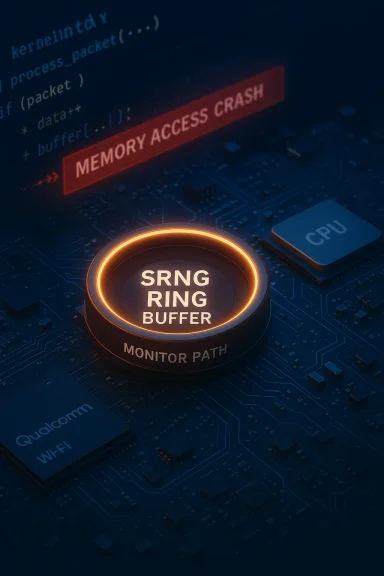
A subtle one-line mistake in the Linux kernel's ath12k Wi‑Fi driver has produced a high‑impact stability and availability flaw: CVE-2025-37944 allows the driver to fetch the wrong ring buffer entry in monitor‑path processing, triggering invalid memory access that can crash or corrupt systems using affected kernels and Qualcomm ath12k‑based hardware.
The ath12k driver implements support for Qualcomm's modern Wi‑Fi chipsets (notably QCN9274 and WCN7850 families) used in many laptops, embedded devices and some networking appliances. At the heart of the problem is the driver’s handling of SRNG (shared ring) descriptors — circular buffers used by host software and firmware to exchange received packet metadata and management events.
Rings in the Qualcomm HAL are direction‑aware: source rings and destination rings are processed with different helpers and pointer semantics. The Linux driver exposes HAL helpers named along the lines of
Multiple upstream vendor advisories and kernel‑stable commits documented the problem and its fix: the vulnerable call was replaced with the correct destination‑ring helper, eliminating the invalid fetch. The tracking entry for CVE-2025-37944 lists the issue as introduced in affected kernel lines and fixed in later stable commits and vendor kernels.
The bug in
The correct approach is twofold:
Source: MSRC Security Update Guide - Microsoft Security Response Center
 Background
The ath12k driver implements support for Qualcomm's modern Wi‑Fi chipsets (notably QCN9274 and WCN7850 families) used in many laptops, embedded devices and some networking appliances. At the heart of the problem is the driver’s handling of SRNG (shared ring) descriptors — circular buffers used by host software and firmware to exchange received packet metadata and management events.Rings in the Qualcomm HAL are direction‑aware: source rings and destination rings are processed with different helpers and pointer semantics. The Linux driver exposes HAL helpers named along the lines of
ath12k_hal_srng_src_get_next_entry() and ath12k_hal_srng_dst_get_next_entry() to iterate those rings. The vulnerable code called the source helper while processing a destination ring in ath12k_dp_mon_srng_process() (monitor ring processing). That mismatch breaks the expected pointer arithmetic/descriptor handling and can cause the driver to access invalid memory, producing crashes or data corruption.Multiple upstream vendor advisories and kernel‑stable commits documented the problem and its fix: the vulnerable call was replaced with the correct destination‑ring helper, eliminating the invalid fetch. The tracking entry for CVE-2025-37944 lists the issue as introduced in affected kernel lines and fixed in later stable commits and vendor kernels.
What exactly goes wrong (technical overview)
How SRNGs are supposed to work
- SRNGs are shared, circular descriptor lists between host and firmware; each descriptor represents a packet, buffer, or control object.
- Source rings (host → device) and destination rings (device → host) have different descriptor layout expectations and different index/state semantics.
- The HAL exposes separate accessors and locking patterns for reads/writes to avoid subtle off‑by‑one or endian errors when stepping through descriptors.
The bug in ath12k_dp_mon_srng_process()
ath12k_dp_mon_srng_process()is the monitor‑path loop that processes descriptors coming from the device (i.e., destination ring entries).- The code used the function intended for source rings when trying to fetch the next entry from the destination ring.
- This produces incorrect pointer calculations and index handling: either reading a descriptor at the wrong offset or interpreting descriptor words with the wrong interpretation.
- The practical result is invalid memory accesses (out‑of‑bounds reads/writes or dereferencing incorrectly computed pointers), which in kernel context yields crashes (kernel oops, panic) or memory corruption affecting kernel structures or other drivers.
Why this is serious
- Kernel memory corruption and out‑of‑bounds access are high‑risk: they can crash the host (denial of service) and, worst case, lead to arbitrary code execution if other conditions line up.
- The affected code runs in a networking driver used to process incoming packets and monitor events. A local process or a malformed interaction at the driver/firmware boundary can trigger the vulnerable path.
- The vulnerability was scored with elevated impact by several vendor CNAs (confidentiality/integrity/availability impacts flagged as substantial in some advisories). Exact CVSS values differ by CNA, but all mark the bug as important/high for availability and integrity.
Affected systems and scope
- The flaw is in the ath12k driver within the upstream Linux kernel and therefore affects distributions and devices shipping a kernel with the vulnerable commits.
- Vendor tracking (NVD and multiple Linux distribution advisories) marks affected ranges beginning with kernel series where the flawed code was introduced and ending where the stable kernel trees picked up the fix. In practice, this included many 6.x kernels published in early‑to‑mid 2025 until the vendor/maintainer patches were applied.
- Hardware tested in upstream reporting includes Qualcomm QCN9274 hw2.0 and WCN7850 hw2.0 lines. That does not mean other ath12k‑family chips are inherently immune — the code path exists for monitor destination rings across affected versions and may exercise similar logic on other silicon revisions.
- Exploitation feasibility is limited by the attack vector: the bug is a local kernel issue rather than a pure network‑accessible remote exploit in most assessments. That said, because the driver interacts with the Wi‑Fi hardware and processes input from firmware, creative attack chains could potentially escalate surface area beyond naïve local‑only assumptions. Treat this assumption carefully in exposed deployments.
Attack vector and practical risk
- Attack vector recorded by mainstream vulnerability databases is primarily local (the attacker must be able to run code or interact with the local system in ways that trigger the monitor ring processing). The attack complexity is low once local access is available.
- Real‑world exploitation in the wild was not publicly reported as of February 18, 2026. There were no authoritative public proofs‑of‑concept tied to active exploitation at that date in vendor advisories or major tracking services.
- Practical risks to enterprises and end users:
- Laptops, workstations or appliances with vulnerable kernels can be crashed remotely only in indirect scenarios (for example, if a remote user can cause the device to process crafted over‑the‑air frames combined with driver/firmware behaviors). The conservative posture is to assume possible denial of service in production Wi‑Fi environments.
- On multi‑user hosts (shared workstations, multi‑tenant systems, virtualization hosts using Wi‑Fi passthrough), local unprivileged users may have avenues to exercise the path and cause system instability.
- Embedded devices, IoT endpoints and headless appliances that rely on built‑in Wi‑Fi stacks are at higher operational risk because a crash can render them unreachable or require physical intervention.
How it was fixed
The upstream fix is surgical and straightforward: when processing the destination (monitor) SRNG, the code now calls the HAL helper designed for destination rings. Concretely:- The incorrect call to the source‑ring accessor was replaced with the destination‑ring accessor in
ath12k_dp_mon_srng_process(). - Accompanying patches in the same patch set restructured monitor ring processing to reduce duplicated logic and added additional safeguards for monitor descriptor handling and end‑reason parsing.
- Those patches were merged into upstream stable branches and subsequently propagated into vendor kernel trees (distribution updates).
Detection and hunting guidance
If you maintain Linux systems or are responsible for fleets that include ath12k hardware, here are practical steps to detect whether you are affected and to hunt for potential exploitation or instability tied to this issue.Check whether your kernel/drivers are affected
- Identify the running kernel: run
uname -rto get the kernel version. Compare the running kernel to vendor advisories or the upstream kernel commit ranges that vendors list as vulnerable. - Check whether the
ath12kdriver andath12k_pcimodule are loaded: runlsmod | grep ath12kormodinfo ath12k_pci. - Inspect dmesg and system logs for ath12k oopses or stack traces:
dmesg | grep -i ath12kand look for messages that include driver tracebacks, monitor ring errors or unexpected descriptor reports. - Distribution security advisories will enumerate package versions that include the fix; consult your vendor's kernel/changelog for the presence of the monitor ring patches.
Indicators of compromise or crash patterns
- Kernel oops/panic entries where the backtrace includes functions like
ath12k_dp_mon_srng_process, monitor SRNG accessors, or HAL srng helper functions. - Reproducible crashes when toggling Wi‑Fi modes (enabling monitor mode, starting an interface in monitor/promiscuous mode, or loading/unloading the module).
- Repeated memory corruption-like symptoms: corrupted network device state, unexplained kernel heap errors, or widespread instability that correlates to network driver load.
Live triage tips
- Enable dynamic kernel debugging and capture the exact backtrace before reboot: enable
dynamic_debugfor the module or increase the kernel log level temporarily. - If a crash is reproducible with an attached serial console or remote syslog, capture the full oops and investigate the address/offsets to confirm the SRNG descriptor path.
- Correlate crashes with activity: packet captures, firmware logs, or system processes that access wireless monitoring features.
Mitigation and recommended actions
For system administrators, IT security teams and device maintainers, the mitigation roadmap should be prioritized as follows.Immediate actions (do within hours)
- Patch: apply vendor patches or update to a kernel package that contains the upstream fix. This is the recommended path for production systems.
- If you cannot patch immediately, consider temporarily unloading or blacklisting the driver (accept the loss of Wi‑Fi) until a patched kernel is deployed:
- Unload the module: run with root:
modprobe -r ath12k_pci(module names may vary; verify withlsmodandmodinfo). - To make the change persistent, add
blacklist ath12k_pcito a modprobe config file under/etc/modprobe.d/. - Warning: unloading/blacklisting removes Wi‑Fi connectivity and may impact devices that rely on the driver — plan for temporary service interruption.
- Restrict local access: if the threat model includes untrusted local users, tighten local user privileges, disable untrusted user accounts, and restrict build or firmware interfaces which could be used to trigger the driver path.
Short‑term actions (next days)
- Deploy kernel updates across the fleet; stage updates in QA then roll to production. Coordinate with hardware vendors and test Wi‑Fi connectivity and functionality after the update.
- Monitor logs and ticketing systems for repeated crashes that correlate with wireless activity; escalate suspicious findings with captured kernel oops output to your kernel vendor or distribution security team.
- Notify end users of possible temporary Wi‑Fi interruptions if you must unload drivers in production; provide alternatives (wired access or mobile hotspots) where practical.
Medium‑term actions (weeks)
- Ensure your configuration management and patch pipelines include the latest kernel packages or backports for vendor kernels.
- For appliances and embedded systems: plan firmware and kernel maintenance windows. Appliance vendors should release patched firmware and kernels; coordinate with hardware vendors for microcode/firmware updates if required.
For developers and driver maintainers
- Add explicit unit test or CI checks that exercise ring accessor APIs in both source and destination modes to prevent a similar API misuse regression.
- Harden monitor‑path processing with additional sanity checks: validate descriptor indices and guard against inconsistent descriptor fields before use.
- Strengthen code review around HAL API usage: require direction‑specific helpers to be used semantically, and document expected conventions in the driver HAL interface.
Operational examples and checklist
- Emergency checklist for administrators:
- Identify hosts with ath12k hardware and running kernels in vulnerable ranges.
- If patching is immediately possible, schedule and apply the vendor kernel update.
- If patching is not immediately possible, unload and blacklist
ath12k_pciand document affected systems. - Capture logs and kernel oopses for later root cause validation.
- Re‑enable Wi‑Fi only after validating the patch resolves the issue in a test environment.
- Quick detection commands:
- Check kernel:
uname -r - See if ath12k modules are present:
lsmod | grep ath12k - Module info:
modinfo ath12k_pci - Review dmesg for driver errors:
dmesg | grep -i ath12k
Developer note: why a one‑line API mismatch is dangerous
This vulnerability illustrates an important principle in low‑level driver development: APIs that appear symmetric often have direction‑specific semantics. HAL helpers for ring buffers are not interchangeable because memory layout, ownership and index wrap semantics differ. The kernel runs with full privilege; an incorrect accessor on a driver that interacts with DMA and device buffers can silently read or write incorrect memory locations, with consequences far beyond a simple crash.The correct approach is twofold:
- Use the HAL functions that match the conceptual direction (source/destination) and be explicit in code about ownership transitions.
- Add defensive checks around descriptor values (sanity bounds checks) and minimize code duplication so a single, reviewed path handles ring traversal for a given direction.
Critical analysis — strengths and residual risks
Strengths of the upstream fix
- The fix is minimal, comprehensible and focused: replacing the wrong helper with the right one eliminates the root cause.
- The patch landed upstream and was picked up into stable trees and distribution kernels, showing good maintainership and response.
- Additional monitor‑path cleanups shipped alongside the fix, which reduces duplicated logic and the likelihood of future directional mistakes.
Residual and systemic risks
- Because the issue touches DMA and descriptor processing, even small variations in firmware, hardware revision, or driver configuration can produce different failure modes. Devices with custom vendor kernels or out‑of‑support appliances may not receive timely fixes.
- The attack surface of Wi‑Fi drivers is complex: a bug that initially looks like a local denial‑of‑service could be chained in certain contexts into more serious memory corruption leading to privilege escalation. While no public exploitation was reported as of February 18, 2026, sophisticated attackers can weaponize such primitives.
- The distribution of fixes is uneven: some enterprise appliances or older distributions may not backport the fix promptly, so operators must track vendor advisories carefully.
Final recommendations
- Treat CVE-2025-37944 as a high‑priority stability/availability vulnerability for affected systems. Prioritize kernel patches for any host that uses ath12k drivers and Qualcomm Wi‑Fi silicon.
- If you manage a mixed fleet, use an inventory scan to locate systems with ath12k hardware and schedule updates or temporary mitigations (blacklisting/unloading driver) as needed.
- For developers: enforce direction‑aware HAL usage in code review and expand tests to prevent similar API misuse in the future.
- For security teams: include Wi‑Fi/device‑driver CVEs in baseline patching and ensure that embedded appliances and IoT devices are tracked for vendor firmware updates.
- Finally, maintain proactive logging and crash capture for kernel oopses: timely telemetry is the best way to detect a lingering or evolving issue should attackers try to exploit memory‑corruption primitives in device drivers.
Source: MSRC Security Update Guide - Microsoft Security Response Center
