

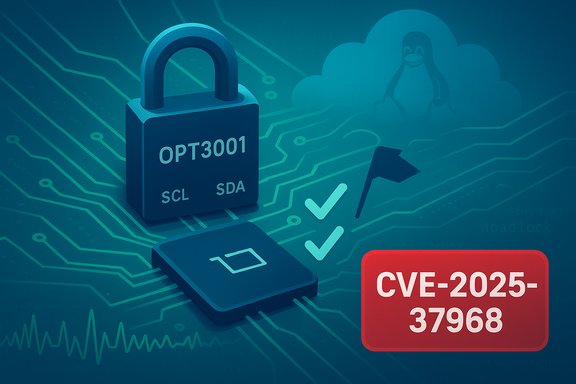
A recently assigned vulnerability, CVE-2025-37968, stems from a subtle race-condition bug inside the Linux kernel driver for Texas Instruments’ OPT3001 ambient‑light sensor (driver: drivers/iio/light/opt3001.c). The flaw can cause a kernel‑level deadlock when the driver's threaded IRQ path reads and then re‑reads a shared flag while taking and releasing a mutex; under rare timing windows the mutex is never released and the kernel can hang. Microsoft’s Security Response Center has published a product‑level attestation that the Azure Linux distribution includes the affected open‑source component and is therefore potentially affected, and Microsoft has reiterated that it will expand its machine‑readable VEX/CSAF attestations to other products if further impact is discovered. This article explains the bug, its practical impact, why Microsoft’s Azure Linux attestation is not equivalent to a global guarantee that other Microsoft artifacts are unaffected, and what organizations should do now to identify and mitigate exposure across their Microsoft and mixed Linux‑based footprints.
The OPT3001 is a small I2C ambient‑light sensor produced by Texas Instruments and supported in mainline Linux by the opt3001 driver under the Industrial I/O (IIO) subsystem. The driver may be built into kernels or compiled as a module (module name: opt3001). The vulnerability is a correctness/race issue inside the driver’s interrupt handling routine. Concretely, the threaded IRQ handler evaluates a shared boolean-like flag twice: once to decide whether to lock a mutex, and again later to decide whether to unlock it. A time‑of‑check/time‑of‑use (TOCTOU) race can allow that flag to change between the two checks so that the unlock path is skipped while the lock path executed — leaving the mutex permanently locked and effectively hanging the kernel or triggering a hard lockup in the affected thread path.
The nature of the bug makes the impact primarily an availability problem (local Denial‑of‑Service) rather than a confidentiality or integrity breach. The problem is fixed in upstream Linux by altering the IRQ handler to read the flag into a local variable and reuse that stable snapshot for both the lock and the unlock decision, removing the TOCTOU window.
Key, verifiable technical points:
Immediate mitigations (fast, low‑risk):
However, the phased rollout and product‑scoped nature of VEX create a short‑term operational gap: customers who rely solely on vendor‑level attestations may incorrectly assume the absence of an attestation equals absence of the vulnerable code in other product artifacts. That is not the case. Microsoft’s commitment to update the CVE/VEX mapping if other products are found to include the component is useful, but it puts the onus on Microsoft to complete inventories and on customers to perform artifact‑level verification in the meantime.
The model is strong for products Microsoft has already inventoried; it is weaker for environments that integrate multiple Microsoft artifacts (WSL, Marketplace images, linux‑azure kernels, device firmware) where the attestation set is incomplete. The operational recommendation for defenders remains unchanged: treat product attestations as authoritative for the products they cover, but do not substitute them for artifact‑level scanning and SBOM verification across the broader estate.
Operationally:
Source: MSRC Security Update Guide - Microsoft Security Response Center
 Background / Overview
The OPT3001 is a small I2C ambient‑light sensor produced by Texas Instruments and supported in mainline Linux by the opt3001 driver under the Industrial I/O (IIO) subsystem. The driver may be built into kernels or compiled as a module (module name: opt3001). The vulnerability is a correctness/race issue inside the driver’s interrupt handling routine. Concretely, the threaded IRQ handler evaluates a shared boolean-like flag twice: once to decide whether to lock a mutex, and again later to decide whether to unlock it. A time‑of‑check/time‑of‑use (TOCTOU) race can allow that flag to change between the two checks so that the unlock path is skipped while the lock path executed — leaving the mutex permanently locked and effectively hanging the kernel or triggering a hard lockup in the affected thread path.The nature of the bug makes the impact primarily an availability problem (local Denial‑of‑Service) rather than a confidentiality or integrity breach. The problem is fixed in upstream Linux by altering the IRQ handler to read the flag into a local variable and reuse that stable snapshot for both the lock and the unlock decision, removing the TOCTOU window.
Key, verifiable technical points:
- The faulty code path is in drivers/iio/light/opt3001.c and affects kernels that include that driver.
- The failure mode is a kernel deadlock (mutex not released), not remote code execution.
- The upstream fix changes the threaded IRQ behavior to consult a single snapshot of the flag, preventing the race.
Why Microsoft’s statement matters — and what it does not mean
Microsoft’s public advisory and the MSRC update for CVE‑2025‑37968 contain two linked assertions:- Microsoft has completed an inventory for the Azure Linux distribution and has attested that Azure Linux includes the implicated open‑source component and is therefore potentially affected.
- Microsoft has started publishing machine‑readable CSAF/VEX attestations (the pilot began in October 2025) and will expand those product‑level attestations to other Microsoft product families as their inventory work completes; if additional Microsoft products are later found to include the component, Microsoft will update the VEX/CSAF mapping and the CVE metadata.
- The Azure Linux attestation is an authoritative, machine‑readable statement: Microsoft has confirmed the component appears in Azure Linux images and that customers running those images should treat them as potentially affected.
- Microsoft’s transparency move gives organizations a reliable signal they can automate: when Microsoft says “Azure Linux includes this library,” Azure Linux customers can act on that signal without re‑inventing the inventory process.
- The attestation is product‑scoped; it is not a proof that other Microsoft artifacts or product families do not include the same vulnerable code. Absence of an attestation for a different Microsoft product is not proof of absence of the code in that product.
- Microsoft explicitly reserves the right to update CVE mappings as more product inventories are completed. In other words, Azure Linux is the only Microsoft product currently mapped to the component, but that could change.
Technical impact and exploitability
What the vulnerability can and cannot do
- The bug creates a kernel deadlock when the specific driver’s threaded IRQ path runs into the TOCTOU condition. Deadlocks in kernel code can manifest as a hung driver thread, frozen devices, or broader kernel instability; in multi‑tenant or embedded environments these symptoms can escalate into service outages or node failures.
- There is no indication the issue enables arbitrary code execution, privilege escalation, or direct information disclosure. The vulnerability’s practical security impact is availability (DoS).
- The vulnerability requires the opt3001 driver to be present and active. Systems that never build or load the opt3001 module are not exposed.
Attack surface and likely exposure scenarios
- Embedded Linux devices that physically include an OPT3001 sensor (I2C bus present, driver enabled) — e.g., IoT endpoints, industrial sensors, or consumer devices — are the most natural exposure path.
- Virtual machines or cloud instances that use a kernel image containing the opt3001 module and that also expose device paths (or run privileged code that can trigger the IRQ path) could be impacted.
- Workstations or servers running Linux kernels with the opt3001 module compiled in or available for load are potentially affected; however, typical server hardware rarely exposes I2C ambient‑light sensors, so practical exposure on standard server fleets may be low unless a vendor image explicitly includes the device or module.
- Windows desktops running WSL2 use a Microsoft‑supplied Linux kernel image. Whether those WSL images include the opt3001 driver depends on the kernel configuration used by the WSL build. A kernel built without CONFIG_OPT3001 is not affected. Therefore, WSL customers should confirm the WSL kernel config or the modules present in their particular WSL image.
Exploitability score and CVSS context
- Public vulnerability trackers and mainstream distribution advisories characterize the issue as a local availability problem of moderate severity. Where distribution advisories map the vulnerability to a CVSS vector, it is typically scored as an authenticated local vector with availability impact (i.e., local access required to trigger the condition).
- For most organizations, the highest‑risk contexts are devices with the OPT3001 hardware present, or cloud/edge images that include the module and permit the necessary operations to trigger the driver IRQ path.
Which Microsoft products might include the driver?
Microsoft’s Azure Linux distribution is the only Microsoft‑distributed product currently mapped to the vulnerable upstream component in the VEX/CSAF pilot — this is the explicit attestation Microsoft published. However, a careful inventory reveals multiple places where Microsoft maintains or distributes Linux kernel artifacts that could include the same upstream driver, depending on kernel configuration and packaging:- Windows Subsystem for Linux (WSL2): Microsoft publishes the WSL2 kernel sources and prebuilt kernel images. The WSL kernel’s configuration is not identical to upstream default kernels; many sensors and low‑level modules are disabled in typical WSL configs. Whether a given WSL kernel includes CONFIG_OPT3001 depends on the specific WSL kernel release and configuration. Customers who use the default Microsoft WSL kernel should check the published WSL kernel release and configurations. Custom WSL kernels supplied by customers will need local verification.
- Azure Marketplace images and published VM images: Marketplace publisher images and some Azure VM images ship kernel packages or use distribution kernels. If those images are based on Linux distributions that include the opt3001 module in their kernel packages (or make it available as a module), they may carry the vulnerable driver.
- Microsoft‑built cloud kernels (e.g., linux‑azure builds): Some Azure services use cloud‑tuned kernels; these are distinct artifacts from Azure Linux but may contain overlapping upstream driver code depending on configuration and kernel version.
- Management agents, telemetry images, or appliance-style offerings: Any Microsoft product that bundles a Linux userland and kernel artifacts should be inventoried; the presence of the opt3001 source file in upstream trees does not imply every Microsoft kernel includes it.
- Azure Sphere and Azure RTOS: These are different product families. Azure Sphere and Azure RTOS are not typical Linux kernels; exposure from these products is unlikely due to differing code bases, but any claim requires verification against the product's SBOM and kernel provenance.
How to determine whether your Microsoft‑supplied artifacts are affected
Performing an inventory and proving absence of a vulnerable component requires artifact‑level checks. The following practical steps help organizations determine exposure across Microsoft products in their environments.- Obtain the machine‑readable VEX/CSAF files Microsoft has published and inspect the product mappings. The Azure Linux attestation is a starting point; watch for updates.
- For each Microsoft artifact you operate (WSL kernels, Azure Marketplace images, custom VM images, on‑prem images supplied by Microsoft or OEMs):
- Inspect the kernel package or modules folder (e.g., /lib/modules/$(uname -r)/kernel/drivers/iio/light) for an opt3001.ko or for the source file in the build tree.
- Check the kernel configuration used to build the kernel (the config is often available under /proc/config.gz or shipped as /boot/config-<version>) and search for CONFIG_OPT3001.
- If you manage WSL fleets:
- Review the WSL kernel version and configuration shipped to your endpoints. The default Microsoft WSL kernel is published on GitHub; verify whether the published config enables the opt3001 driver.
- If users or administrators deploy custom WSL kernels, verify those custom kernels for CONFIG_OPT3001 or the presence of the module.
- For Azure VM images:
- If the VM image is an official distribution kernel, use the distribution’s advisory and package metadata to determine whether the running kernel contains the fixed commit or a fixed package version.
- For Marketplace or vendor images, request the SBOM or ask the publisher for a VEX attestation.
- For embedded and IoT devices:
- Query the device tree or platform hardware inventory to identify the presence of an OPT3001 sensor (e.g., check for device tree bindings ti,opt3001).
- Check vendor firmware and kernel images for the module or driver source.
Mitigation and remediation guidance
If the opt3001 driver is present in your environment, use this prioritized remediation approach.Immediate mitigations (fast, low‑risk):
- Unload the module if possible: If the opt3001 module is built as a loadable kernel module, remove it from running systems where the sensor is not needed: 1) determine the module name (opt3001), 2) run modprobe -r opt3001 or rmmod opt3001. This avoids loading the buggy code path until a patched kernel can be applied.
- Blacklist the module: Add a blacklist entry to /etc/modprobe.d/ (e.g., echo "blacklist opt3001" > /etc/modprobe.d/opt3001-blacklist.conf) to prevent automatic loading across reboots.
- Reduce privileges to local unprivileged processes: Where feasible, restrict local access to the device nodes that could trigger the driver; use standard Linux DACs and udev rules to limit who can open /dev or sysfs entries used by the driver.
- Apply vendor or distribution kernel updates containing the upstream fix. Most mainstream distributions have issued kernel updates that include the opt3001 fix; update to the patched kernel package versions provided by your distribution vendor and reboot into the fixed kernel.
- For Azure Linux customers, apply the distribution updates Microsoft provides for Azure Linux; Microsoft has said the distribution will be kept up to date with secure versions and publishes VEX attestations for those updates.
- For organizations using live‑patch services (e.g., kpatch, Canonical Livepatch), check whether a live‑patch is available that addresses the opt3001 fix. If available, apply to reduce downtime while planning full kernel upgrades.
- Implement per‑artifact SBOM and provenance checks for Microsoft‑supplied kernels and images. Rely on machine‑readable attestations (VEX/CSAF) where they exist.
- Integrate kernel module scanning into CI/CD and image‑build pipelines to catch unsafe drivers before deployment.
- Use configuration management to ensure WSL kernel configs used in enterprise images are audited and hardened; avoid shipping unnecessary sensor drivers in kernels for VM/desktop platforms.
- For Azure Marketplace publishers and image consumers, require SBOM/VEX attestations as part of image publishing and procurement contracts.
Practical checklist for IT teams (ranked)
- Confirm whether any deployed systems (Azure Linux, VMs, WSL instances, IoT devices) contain the opt3001 module or driver source.
- If present and the device does not require the sensor, unload and blacklist the module immediately.
- Plan and schedule kernel updates to patched versions from your OS vendor or from Microsoft for Azure Linux/WSL kernels.
- For WSL endpoints, verify whether the default Microsoft WSL kernel configuration in use enables CONFIG_OPT3001; if uncertain, require custom config verification or deploy a housekeeping script that checks modules at startup.
- For Azure Marketplace images or vendor‑built images, request an SBOM or VEX attestation; if the publisher cannot provide one, treat the image as needing per‑artifact verification.
- Update internal security‑automation rules to treat the Azure Linux VEX attestation as a canonical signal and to watch for further Microsoft VEX updates mapping the component to additional product families.
Strengths and potential weaknesses in Microsoft’s approach
Microsoft’s decision to publish machine‑readable CSAF and VEX attestations, and to start with Azure Linux, offers genuine operational benefits: customers can automate ingestion of attestations, reduce false positives, and act quickly on a high‑fidelity product mapping. Publishing the Azure Linux attestation gives immediate clarity to a major product family and sets a transparent precedent for future product mappings.However, the phased rollout and product‑scoped nature of VEX create a short‑term operational gap: customers who rely solely on vendor‑level attestations may incorrectly assume the absence of an attestation equals absence of the vulnerable code in other product artifacts. That is not the case. Microsoft’s commitment to update the CVE/VEX mapping if other products are found to include the component is useful, but it puts the onus on Microsoft to complete inventories and on customers to perform artifact‑level verification in the meantime.
The model is strong for products Microsoft has already inventoried; it is weaker for environments that integrate multiple Microsoft artifacts (WSL, Marketplace images, linux‑azure kernels, device firmware) where the attestation set is incomplete. The operational recommendation for defenders remains unchanged: treat product attestations as authoritative for the products they cover, but do not substitute them for artifact‑level scanning and SBOM verification across the broader estate.
Final assessment
CVE‑2025‑37968 is a correctness defect in the Linux OPT3001 light‑sensor driver that can cause a kernel deadlock and availability loss. Microsoft has publicly attested that Azure Linux includes the affected component and will continue to publish VEX/CSAF attestations to expand coverage over time. That attestation is authoritative and actionable for Azure Linux customers, but it should not be read as a universal guarantee that no other Microsoft product contains the vulnerable driver.Operationally:
- Treat the Azure Linux VEX attestation as a call to action if Azure Linux is in use.
- Perform artifact‑level scanning and configuration checks for all other Microsoft‑supplied kernels and images in use (WSL kernels, Marketplace images, cloud‑tuned kernels, embedded devices).
- Apply distribution or vendor kernel updates that include the upstream fix; if updating immediately is infeasible, unload/blacklist the module as a practical stopgap.
Source: MSRC Security Update Guide - Microsoft Security Response Center
