

Microsoft’s public advisory for CVE-2025-38022 makes a precise, limited claim: Azure Linux includes the implicated open‑source kernel code and is therefore potentially affected — and Microsoft says it will expand its machine‑readable CSAF/VEX attestations if other Microsoft products are later found to ship the same upstream component.
CVE-2025-38022 is a Linux kernel RDMA‑stack bug described upstream as “RDMA/core: Fix ‘KASAN: slab‑use‑after‑free Read in ib_register_device’ problem.” The failure is a kernel use‑after‑free detected by KASAN in the InfiniBand/RDMA registration path (call trace through
Why this nuance matters:
Operationally: prioritize patching Azure Linux images now, scan and triage all other Microsoft artifacts in your estate, and apply vendor kernel updates or temporary mitigations where immediate patching isn’t possible. Monitor kernel logs for KASAN and
CVE details and vendor advisories referenced in this analysis are available in public vulnerability trackers and vendor pages; administrators should consult the relevant NVD and distribution advisories for package‑level mapping, and consume Microsoft’s CSAF/VEX outputs for authoritative product‑level attestations.
Source: MSRC Security Update Guide - Microsoft Security Response Center
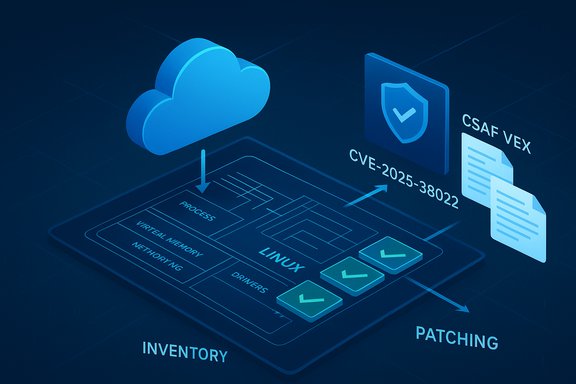 Background / Overview
CVE-2025-38022 is a Linux kernel RDMA‑stack bug described upstream as “RDMA/core: Fix ‘KASAN: slab‑use‑after‑free Read in ib_register_device’ problem.” The failure is a kernel use‑after‑free detected by KASAN in the InfiniBand/RDMA registration path (call trace through ib_register_device) and is rooted in an object‑lifetime/race condition that can cause slab‑use‑after‑free warnings, kernel oopses, and service instability under the right conditions. Public vulnerability repositories and vendor trackers list the issue and the upstream fix; the entry in the NVD summarizes the same technical trace. This is primarily an availability and stability risk: KASAN traces and kernel WARNs indicate dangerous lifetime handling in the RDMA driver path. Exploitability for remote code execution is not demonstrated in public disclosures; however, kernel use‑after‑free bugs are serious because they can — with additional primitives and platform‑specific techniques — become escalation or reliability vectors. Multiple distribution and cloud vendors have cataloged the CVE and issued or prepared patches. What Microsoft actually said — a careful reading
Microsoft’s MSRC listing for this CVE contains two tightly worded elements:- An attestation for Azure Linux that the distribution “includes this open‑source library and is therefore potentially affected.”
- A procedural commitment that Microsoft began publishing machine‑readable CSAF/VEX attestations in October 2025 and will update the CVE/VEX mapping if additional Microsoft products are identified as carriers of the upstream component.
Is Azure Linux the only Microsoft product that could be affected?
Short answer (operational): No — not necessarily. Microsoft has publicly attested that Azure Linux is a carrier of the implicated code and therefore must be prioritized for patching by Azure Linux customers. However, that attestation is product‑scoped, not exclusive, and absence of a VEX/CSAF attestation for another Microsoft product is not proof that the product is safe. Microsoft’s VEX rollout started with Azure Linux as a pragmatic first target; other Microsoft artifacts remain subject to inventory and verification.Why this nuance matters:
- Kernel code inclusion is an artifact build‑time property. Two Microsoft kernel binaries can include different subsystems depending on the kernel configuration flags (CONFIG_*) and packaging choices used when building each kernel image. A driver that is present in one kernel build may be absent or compiled as a module in another.
- Microsoft produces multiple Linux or Linux‑related artifacts that could plausibly carry the same code: Azure Linux images, linux‑azure kernels used for some VM families, the WSL2 kernel distributed with Windows, curated Marketplace/partner images, AKS node images, and vendor appliances. Each artifact must be checked independently until a VEX/CSAF attestation says otherwise.
- Microsoft’s public VEX practice intentionally focuses on clarity and automation for customers; it reduces noise by authoritatively declaring the presence or absence of a component only after the vendor has completed the inventory for that product family. It does not replace the need for operators to verify other Microsoft artifacts running in their estates.
Evidence and independent corroboration
The technical details of CVE-2025-38022 and the assertion that Azure Linux contains the vulnerable kernel code are corroborated by independent sources:- NVD and mainstream vulnerability trackers record the KASAN call trace and the general RDMA/ib_register_device root cause. These sources list the vulnerability and note its remediation in upstream kernel trees.
- Multiple Linux distribution and cloud advisories (Oracle, Amazon Linux, and vendor trackers) list CVE-2025-38022, describe the impact/score, and indicate patching/backport status for various kernel branches. That confirms the vulnerability was broadly recognized in the kernel community and distributed by several vendors.
- Microsoft’s MSRC blog and CSAF/VEX rollout announcement document the company’s decision to publish machine‑readable VEX attestations beginning with Azure Linux (October 2025). That blog explains why Microsoft publishes product‑scoped attestations and how operators should interpret them.
- Independent analyst writeups and operational guidance (internal analyses and community security posts) repeatedly make the same distinction: Azure Linux is the only Microsoft product attested so far, but other Microsoft artifacts should be validated on an artifact‑by‑artifact basis.
Practical implications for IT teams and administrators
If your infrastructure runs Microsoft artifacts, take the following prioritized actions now. These are practical, operational steps that map directly to the technical and product‑scope realities described above.1. Inventory: locate all places where a Linux kernel could carry RDMA code
- Inventory all VMs and images that use Microsoft‑published artifacts: Azure Linux VMs, Azure Marketplace images, AKS nodes, and partner appliances. Azure Linux is already attested — treat those images as confirmed carriers.
- Inventory WSL2 installations on Windows endpoints. The WSL2 kernel is a separate Microsoft kernel binary and may include or omit RDMA subsystems depending on build configuration; check WSL kernel versions and module lists.
- Inventory on‑prem and cloud hosts that use vendor kernels (Linux distributions, custom kernels) and RDMA hardware (Mellanox/NVIDIA ConnectX family). Those kernels are independently maintained and may or may not have the upstream fix.
2. Detect: what to look for
- Search kernel logs (journalctl -k, dmesg) for KASAN traces, WARNs, and the specific call chain around
ib_register_deviceand RDMA/ib device registration. Kernel WARNs that match the upstream trace are a strong indicator of the problematic code path being exercised. - For hosts with RDMA/NIC hardware, check whether RDMA drivers are loaded:
lsmod | egrep 'mlx5|ib_mad|ib_core|rxe|siw'and inspectmodinfo <module>when present. If modules are present, the artifact may be exposed.
3. Patch and mitigate
- Apply vendor or Microsoft updates where available. For Azure Linux customers, apply Microsoft’s Azure Linux kernel update and follow MSRC guidance; the Azure Linux VEX/CSAF attestation signals that Microsoft will provide a fixed kernel in that product family.
- For other Linux distributions, apply distribution vendor kernel updates that incorporate the upstream fix or a backport (Ubuntu, RHEL, SUSE, Oracle, Amazon Linux have published or staged fixes).
- If you cannot patch immediately and RDMA is not required, consider disabling the RDMA modules (e.g.,
modprobe -r mlx5_core mlx5_ib) or otherwise isolating RDMA hosts from untrusted workloads until updates are available. This is a pragmatic temporary mitigation.
4. For Windows/WSL customers
- WSL2 users who rely on Microsoft’s shipped WSL kernel should check the kernel version and module composition of the WSL kernel in their Windows build; if the kernel includes RDMA code, follow Microsoft’s guidance for updating WSL kernel packages or Windows updates that include a refreshed WSL kernel. If you run a custom WSL kernel, rebuild with upstream patches applied.
Verification checklist and hunting commands
Use these quick commands and checks to triage hosts and images:- Kernel version: uname -r
- Module presence: lsmod | egrep 'mlx5|ib_|rxe|siw'
- Module path/info: modinfo mlx5_core (or the relevant module)
- Kernel logs: journalctl -k --no-pager | egrep -i 'KASAN|ib_register_device|slab-use-after-free|mlx5'
- If you find KASAN traces or the specific WARN patterns in logs, treat those hosts as high priority for remediation.
Risk analysis — strengths, gaps and operational risk
Strengths in Microsoft’s approach
- Authoritative, machine‑readable attestations (CSAF/VEX): Publishing VEX files for Azure Linux improves automation, reduces noisy false positives, and gives administrators a deterministic signal they can ingest into patch orchestration and vulnerability triage tools. Microsoft’s October 2025 VEX rollout is a real improvement in vendor transparency.
- Timely patching for Azure Linux: Because Azure Linux is Microsoft‑maintained, Microsoft can and will supply kernel updates for those images and publish VEX attestations that reflect fixed status. That is a practical security advantage for customers who run those specific images.
Gaps and residual risks
- Attestation ≠ exhaustive inventory: Microsoft’s VEX attestation for Azure Linux only confirms the inventory for that product family. Other Microsoft artifacts (WSL kernel, linux‑azure packages, Marketplace partner images) may or may not include the vulnerable code; those artifacts remain to be inventoried and attested. Absence of an attestation is not a guarantee of absence.
- Third‑party and custom kernels: Vendors and customers that ship or use vendor kernels, customized images, or forked kernel trees have their own patching cadence and are not covered by Microsoft’s VEX for Azure Linux. Those artifacts must be validated against distribution advisories.
- Windows driver divergence: Windows drivers that provide RDMA-like functionality (e.g., WinOF‑2 for Mellanox/NVIDIA) are separate projects and binary artifacts; Microsoft’s Linux CVE attestation does not automatically imply the same vulnerability exists in Windows drivers, but those Windows drivers must be assessed with vendor advisories.
Attack surface and exploitability nuance
- The primary attack surface here is local or tenant‑adjacent: actions that reach the RDMA/ib device registration and teardown paths. In multi‑tenant cloud environments or in hosts that allow untrusted processes to interact with RDMA verbs or netlink device registration, the risk is meaningful because a kernel oops can trigger VM/host instability. However, public reporting does not show a reliable remote code execution exploit for this CVE. Still, treat kernel UAFs seriously: they can be powerful building blocks for complex exploits in skilled hands.
Recommended policy for Microsoft customers (short, implementable)
- Prioritize patching of any Azure Linux images in your estate immediately using Microsoft’s published updates and VEX/CSAF guidance. Automate this where possible.
- Inventory and triage all other Microsoft‑distributed kernel artifacts in your environment (WSL2, linux‑azure kernels, Marketplace images). Treat them as unknown until you verify via MSRC attestations or vendor/package checks.
- For non‑Microsoft Linux distributions and vendor kernels, apply the vendor’s kernel updates that include the upstream fix or a backport. Confirm package changelogs and advisory mapping to CVE‑2025‑38022.
- If immediate patching is impossible, disable RDMA modules or isolate RDMA hosts from untrusted tenants/processes as an interim mitigation. Use central log aggregation to hunt for KASAN WARNs and take affected hosts offline for patching.
Unverifiable claims and cautionary notes
- Any claim that “Azure Linux is the only Microsoft product that contains this vulnerable code” is unverifiable as a universal negative unless Microsoft publishes attestations for every Microsoft artifact (which it has not done). The correct interpretation of Microsoft’s advisory is that Azure Linux is the only Microsoft product Microsoft has attested so far to include the component; the company will update attestations if additional products are found to ship it. Treat silence in the VEX/CSAF feed as “not yet attested,” not “guaranteed safe.”
- Vendor‑specific Windows drivers that implement RDMA functionality are separate codebases; Microsoft’s Linux‑kernel attestation does not imply a Windows‑side vulnerability, but those drivers should be checked against vendor advisories from NIC vendors (for example, NVIDIA/Mellanox). Do not conflate Linux kernel vulnerabilities with Windows driver status without explicit vendor guidance.
Final analysis and closing guidance
Microsoft’s public statement on CVE‑2025‑38022 is clear and useful: Azure Linux has been inventoried and identified as a product that includes the vulnerable upstream kernel component, and Microsoft has started publishing CSAF/VEX attestations to allow customers to automate triage and remediation. That is a positive step for transparency and operational security. However, the statement does not mean that other Microsoft products are categorically unaffected. The presence of vulnerable kernel code is an artifact‑level property that depends on the exact kernel build, configuration, and packaging used in each product artifact (WSL kernel, linux‑azure builds, Marketplace images, partner appliances). Until Microsoft publishes attestations for those artifacts or you verify them independently, treat them as unknown and follow the inventory/patching checklist laid out above.Operationally: prioritize patching Azure Linux images now, scan and triage all other Microsoft artifacts in your estate, and apply vendor kernel updates or temporary mitigations where immediate patching isn’t possible. Monitor kernel logs for KASAN and
ib_register_device traces, and keep an eye on MSRC’s VEX/CSAF feed for new attestations as Microsoft expands its inventory. CVE details and vendor advisories referenced in this analysis are available in public vulnerability trackers and vendor pages; administrators should consult the relevant NVD and distribution advisories for package‑level mapping, and consume Microsoft’s CSAF/VEX outputs for authoritative product‑level attestations.
Source: MSRC Security Update Guide - Microsoft Security Response Center
