

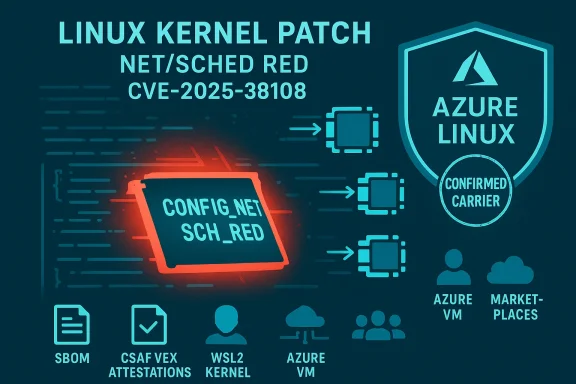
The Linux kernel patch that closed CVE-2025-38108 — a race in net_sched’s RED implementation (__red_change) — is a reminder that a named distributor’s attestation about a component is a valuable, product-scoped signal, not a universal proof that the component cannot appear elsewhere inside the same vendor’s ecosystem. Microsoft’s MSRC entry correctly identifies Azure Linux as a confirmed carrier for the upstream net/sched code and therefore a prioritized remediation target, but that statement is not the same as an exclusivity guarantee. Operators and security teams must treat Azure Linux as “known affected” while simultaneously testing and inventorying other Microsoft-supplied artifacts — especially any Microsoft-built or -shipped Linux kernels — until those artifacts are either attested as Not Affected or patched.
CVE-2025-38108 fixes a concurrency bug inside the Linux kernel’s net/sched subsystem — specifically the RED (Random Early Detection) queueing discipline. The defect is a race that can occur when RED’s change path and SFQ perturb timers interact badly across CPUs, allowing an attacker with the right local capabilities to drive scheduling state into an inconsistent condition (for example, underflowing a parent queue length). Upstream kernel maintainers applied corrective commits across multiple stable branches; distributors and cloud vendors have since mapped those fixes into kernel packages and advisories.
At a high level:
Interpretation checklist:
Conclusion
CVE-2025-38108 is a concrete example of why vendor attestations and machine-readable VEX/CSAF feeds are necessary but not sufficient for complete supply-chain risk management. Microsoft’s attestation that Azure Linux includes the vulnerable component is an authoritative and useful signal — use it. But don’t let it become a blind spot: verify every Microsoft-supplied kernel artifact in your estate, prioritize patches where Microsoft has attested presence, and apply containment measures (capability restrictions, monitoring) wherever immediate patching isn’t possible. The practical security posture for kernel-level CVEs is patch first, inventory everywhere, and harden the runtime surface while you deploy fixes.
Source: MSRC Security Update Guide - Microsoft Security Response Center
 Background / Overview
CVE-2025-38108 fixes a concurrency bug inside the Linux kernel’s net/sched subsystem — specifically the RED (Random Early Detection) queueing discipline. The defect is a race that can occur when RED’s change path and SFQ perturb timers interact badly across CPUs, allowing an attacker with the right local capabilities to drive scheduling state into an inconsistent condition (for example, underflowing a parent queue length). Upstream kernel maintainers applied corrective commits across multiple stable branches; distributors and cloud vendors have since mapped those fixes into kernel packages and advisories.At a high level:
- The bug is a kernel-level race condition in net/sched’s RED code path.
- The attack vector is local: exploitation requires local operations that exercise qdisc change/reconfiguration routines.
- Upstream fixes were merged into several stable kernel trees; distributors produced patched kernels and advisories accordingly.
- Microsoft’s public advisory for the CVE calls out Azure Linux as a product that “includes this open-source library and is therefore potentially affected,” and Microsoft has committed to publishing machine-readable CSAF/VEX attestations for Azure Linux and to expand that inventory work across other Microsoft products over time.
What Microsoft actually said — and what that wording means
Microsoft’s brief MSRC FAQ text accompanying several Linux kernel CVE entries has a recurring line: “Is Azure Linux the only Microsoft product that includes this open‑source library and is therefore potentially affected? … One of the main benefits to our customers who choose to use the Azure Linux distro is the commitment to keep it up to date … If impact to additional products is identified, we will update the CVE to reflect this.”Interpretation checklist:
- This is a product-level inventory statement: Microsoft has scanned the Azure Linux distribution build outputs and found the upstream kernel component implicated by the CVE. That makes Azure Linux an authoritative remediation priority.
- It is not an engineering claim that Microsoft has exhaustively scanned every Microsoft product, image, kernel build, or marketplace appliance. Absence of a VEX/CSAF attestation for another Microsoft artifact is absence of attestation, not proof of absence.
- Microsoft’s public commitment to expand VEX/CSAF attestations means that the attestation set will grow; in the interim, customers must combine vendor signals with their own artifact checks.
Why Azure Linux is singled out (operational context)
Microsoft’s decision to start VEX/CSAF attestations with Azure Linux is pragmatic and deliberate:- Azure Linux (the successor to CBL‑Mariner) is Microsoft’s published Linux distribution and a natural first candidate for a deterministic SBOM and VEX rollout.
- Publishing machine-readable attestations requires accurate mapping between CVEs and the exact component versions and build outputs inside a product; this inventory work is time-consuming when performed at vendor scale.
- By focusing on Azure Linux first, Microsoft can provide immediate value to the many customers who run Azure Linux images while building the processes and automation needed to expand attestations across other Microsoft-supplied artifacts.
Why Azure Linux is probably not the only Microsoft product that could include the vulnerable code
Two facts make the MSRC attestation necessary but not sufficient to claim exclusivity:- The vulnerable code is upstream Linux kernel code (net/sched/sch_red.c). Any build of the Linux kernel that includes the affected commit range and that is configured to include RED (CONFIG_NET_SCH_RED) may be vulnerable until patched.
- Microsoft distributes multiple, separate Linux artifacts — each is its own build which may include different kernel commits and configuration choices. Examples of plausible Microsoft artifacts that could carry the same upstream code are:
- Azure Linux (explicitly attested by MSRC) — confirmed carrier for now.
- Windows Subsystem for Linux (WSL2) kernel binary — Microsoft publishes a WSL kernel tree and a configuration used to build the WSL kernel. The WSL kernel configuration shows RED (sch_red) available as a module in standard WSL configurations, meaning the code path can exist in the WSL kernel build.
- CBL‑Mariner / Azure Linux lineage artifacts used internally or as container host OS images — Microsoft’s own base images historically share lineage and packages with Azure Linux.
- Azure VM kernels and linux‑azure variants that Azure Marketplace images or some SKU families use — these are separate kernel build artifacts.
- Marketplace appliances and partner images published in Azure Marketplace — publishers may ship kernels based on upstream code without Microsoft’s VEX attestations.
- Curated or Microsoft-built container host images, AKS node images, or managed host images where Microsoft supplies the host OS/kernel.
Technical evidence you should check (what to look for)
To determine whether a particular host or image is affected, examine three things: the kernel version, the kernel configuration, and the presence of the patch (or the stable kernel release that contains the fix).- Kernel version and fixed releases
- The upstream kernel project assigned CVE-2025-38108 and listed the stable releases that received the fix. The issue was introduced in older 5.x trees and fixes were applied to multiple stable branches. Notable fixed snapshots included releases in the 5.4, 5.10, 5.15, 6.1, 6.6 and later families. If your kernel is older than the fixed release in its respective stable tree (or if no vendor backport was applied), assume vulnerability until verified.
- Kernel configuration
- RED is controlled by the build-time option CONFIG_NET_SCH_RED (it can be compiled-in or built as a module 'sch_red'). If CONFIG_NET_SCH_RED is enabled (either 'y' or 'm'), the net/sched/sch_red.c code is present in the kernel image or available for loading as a module. Many distributions and standard WSL kernel configs enable RED as a module by default.
- Patch presence
- You can directly verify presence of the upstream fix by inspecting your kernel’s /boot or package changelogs, or by checking that the kernel package version corresponds to a vendor advisory that lists the CVE as fixed. When possible, use the vendor-supplied package advisory rather than relying solely on raw kernel version strings, because distributors sometimes backport fixes into earlier package versions.
- On a Linux VM or image:
- uname -r — get running kernel release.
- zcat /proc/config.gz or /boot/config-$(uname -r) — see the kernel config; look for CONFIG_NET_SCH_RED=y or =m.
- lsmod | grep sch_red and modinfo sch_red — check whether the module exists and is available.
- Check your distribution vendor’s CVE advisory or kernel changelog for the specific CVE to confirm the package you have installed includes the fix.
- On WSL2:
- The WSL2 kernel is a Microsoft-provided kernel binary; users can point WSL to a custom kernel via .wslconfig. Verify the built or shipped kernel configuration (Microsoft’s WSL repo and community-configs show RED enabled as a module in the standard WSL kernel configuration).
Evidence that other Microsoft artifacts may include the RED code
- The WSL2 kernel source and configuration used by Microsoft show NET_SCH_RED available as a module in typical WSL kernel configurations. That means the RED implementation (net/sched/sch_red.c) is present in the WSL kernel build outputs unless Microsoft explicitly stripped it or rebuilt without the feature for a particular WSL release.
- Microsoft’s public attestation is limited to Azure Linux because that product’s build outputs were part of the CSAF/VEX rollout; it is not an assertion that Microsoft searched every WSL, Marketplace, or AKS image.
Risk model — who is exposed and how hard is exploitation?
- Attack vector: local. Exploiting this race requires ability to perform qdisc reconfiguration or otherwise exercise the affected net/sched paths, which typically requires elevated or NET_ADMIN-like capabilities.
- Privileges required: low-to-moderate. The vulnerability is a kernel-level concurrency bug; in many cases, an unprivileged attacker in a misconfigured container environment or multi-tenant system could have sufficient capabilities to trigger qdisc changes.
- Impact: high for affected hosts. Race-induced corruption in queueing structures can produce kernel oopses, crashes, or other reliability failures. Some trackers assessed confidentiality/integrity impact as significant because kernel corruption can in theory be leveraged for more severe outcomes, although the primary practical impact is availability (kernel panic/denial-of-service).
- Exploitability: non-trivial. Races are timing-sensitive and require specific sequences. In practice, the exploitation complexity reduces in environments where tenant-level users have NET_ADMIN or where host kernels expose unresolved qdisc configuration interfaces to untrusted processes.
Concrete remediation steps (prioritized)
- Patch Azure Linux images first
- Apply the patches and kernel packages Microsoft published for Azure Linux immediately. The MSRC attestation makes Azure Linux a confirmed, high-priority remediation target.
- Inventory and assess other Microsoft artifacts you run
- Enumerate any hosts, VMs, container hosts, or client machines that ship Microsoft-supplied kernels:
- WSL2 instances on Windows clients (ask users whether they use the default WSL kernel or a custom one).
- Azure VM images and AKS node images (identify the kernel package installed).
- Marketplace appliances and curated VM images provided by Microsoft or third parties.
- On-premise systems that run Microsoft-provided images (for example, Azure Stack or Operator Nexus bare-metal that use Azure Linux).
- For each artifact, check kernel config and package advisories as described earlier.
- For WSL2 clients
- If your organization uses WSL2 widely, inventory which kernel versions are in use and whether the default WSL kernel or a custom kernel is set by users (.wslconfig).
- Push guidance to update Windows components or instruct users to switch to a patched WSL kernel (Microsoft publishes kernel updates for WSL in Windows updates and through the WSL GitHub source).
- Harden runtime policies
- Tighten container and host policies that grant NET_ADMIN, CAP_NET_ADMIN, or equivalent capabilities to untrusted code.
- Reduce attack surface by removing unnecessary kernel modules or features where practical (audit CONFIG_* features used by your kernels).
- Where you can’t patch immediately, consider limiting who can create or modify qdiscs and monitor kernel logs for repeated qdisc-related oops traces.
- Use automation and SBOM/VEX feeds
- Ingest vendor VEX/CSAF attestations into your vulnerability management and patch orchestration tooling. Use the explicit Azure Linux VEX entries to automate remediation for that product.
- For everything else, rely on the combination of:
- Vendor package advisories.
- Image metadata scanning (SBOMs, package lists).
- Runtime detection (uname -r, /boot/config, lsmod checks).
- Monitor and detect
- Watch for kernel oops and panic messages related to net/sched and RED. Reproducer traces for this class of CVE often leave distinctive stack traces; vendor advisories and kernel lists provide the canonical signatures you can use for alerting.
Operational checklist for defenders (quick-reference)
- Patch Azure Linux VMs and images as Microsoft recommends. Treat Azure Linux as “known affected”.
- Inventory:
- WSL2 on endpoints: record kernel version and config.
- AKS/VM/Marketplace images: verify kernel package and whether Microsoft supplied the kernel.
- Hosted container hosts: check host kernel config.
- Verify for each artifact:
- Is CONFIG_NET_SCH_RED=y or =m in the kernel config?
- Is the kernel package at or above the vendor’s patched version?
- Harden:
- Remove or restrict NET_ADMIN capabilities in containers.
- Limit who can manipulate qdiscs or network namespaces.
- Automate:
- Ingest Microsoft CSAF/VEX where available.
- Map CVE-2025-38108 to package names and orchestrate updates via your patch automation.
- If unable to patch immediately, mitigate with access restrictions and heightened monitoring.
Why absence of an MSRC attestation should not be comforting
Because Microsoft is rolling VEX/CSAF attestations out incrementally, an un-attested Microsoft artifact should be classed as unverified rather than not affected. Large vendors ship diverse artifacts — separate kernel builds, OEM or partner images, appliance VM images — and each build is a potentially different carrier of upstream code. Treat the Azure Linux attestation as a trusted signal for that product and proceed to verify other artifacts aggressively.Strengths and risks of Microsoft’s approach (analysis)
Strengths- The decision to publish VEX/CSAF attestations for Azure Linux is an important step toward transparency. It gives customers an authoritative, machine-readable signal for a product Microsoft actually ships and supports.
- A focused rollout allows Microsoft to produce high-quality attestations and avoid false claims, which reduces the noise in enterprise patching workflows.
- The phased rollout creates a window where other Microsoft-supplied artifacts remain un-attested. Customers that treat the presence of an Azure Linux attestation as the full universe of Microsoft exposure risk missing vulnerable Microsoft artifacts elsewhere.
- The practical burden of inventory falls back on enterprise defenders: you must scan WSL clients, Azure Marketplace images, AKS nodes, and custom host images in addition to applying vendor patches.
- The distinction between “product includes this library” and “product is fixed” is subtle but important. The VEX attestation indicates presence and potential affect; remediation still requires applying vendor-supplied patches or confirming the vendor’s “Fixed” status for the specific product build.
Bottom line and practical advice
- Microsoft is correct and transparent to call out Azure Linux as a product that includes the upstream net/sched component implicated by CVE-2025-38108. If you run Azure Linux, apply the vendor-supplied kernel updates without delay.
- However, Azure Linux is not necessarily the only Microsoft product that could contain the vulnerable net/sched code. Other Microsoft artifacts — notably the WSL2 kernel and any Microsoft-built Linux kernel images used in Azure VMs, AKS nodes, or Marketplace appliances — are plausible carriers depending on kernel versions and configuration flags.
- Your next steps: treat Azure Linux patching as first priority, then move fast to inventory and verify all Microsoft-supplied Linux kernels in your environment. Use kernel config checks, package advisory mappings, and runtime monitoring to turn “unknown” into “confirmed fixed” or “patched.”
Conclusion
CVE-2025-38108 is a concrete example of why vendor attestations and machine-readable VEX/CSAF feeds are necessary but not sufficient for complete supply-chain risk management. Microsoft’s attestation that Azure Linux includes the vulnerable component is an authoritative and useful signal — use it. But don’t let it become a blind spot: verify every Microsoft-supplied kernel artifact in your estate, prioritize patches where Microsoft has attested presence, and apply containment measures (capability restrictions, monitoring) wherever immediate patching isn’t possible. The practical security posture for kernel-level CVEs is patch first, inventory everywhere, and harden the runtime surface while you deploy fixes.
Source: MSRC Security Update Guide - Microsoft Security Response Center
