

Microsoft’s MSRC advisory that “Azure Linux includes this open‑source library and is therefore potentially affected” is accurate — but it is a product‑level attestation, not a universal guarantee that other Microsoft products are free of the same Linux kernel Bluetooth code implicated by CVE‑2025‑38118.
CVE‑2025‑38118 is a use‑after‑free (UAF) class vulnerability in the Linux kernel’s Bluetooth management code. The defect appears in the MGMT removal/completion paths — specifically the mgmt_remove_adv_monitor_complete logic in net/bluetooth/mgmt.c — where an asynchronous completion or delayed work can access a freed object, producing slab‑use‑after‑free traces under KASAN and, in production kernels, kernel oopses or crashes. Public vulnerability trackers and vendor advisories record the technical symptomology and show upstream patches that reorder cancellation and free operations to close the race. This is primarily an availability/stability issue: immediate, realistic impact is kernel crashes or worker thread failures on hosts that include the affected MGMT paths. While UAFs in kernel space can, in theory, be escalated into more severe primitives (memory corruption leading to privilege escalation or RCE), publicly available information at disclosure indicates no widely‑available proof‑of‑concept that converts this particular bug into a trivial remote code‑execution exploit. Treat it as a high‑priority stability bug for affected kernels and a medium‑to‑high operational priority for multi‑tenant or cloud hosts where a kernel crash has outsized impact.
Two operational takeaways flow directly from Microsoft’s wording:
Other operational risks include:
Administrators should act on the authoritative signals available today (vendor package advisories, Microsoft’s Azure Linux VEX, and distribution trackers) and treat the absence of a Microsoft VEX entry for other product families as “not yet validated.” Maintaining an image inventory, automating ingestion of CSAF/VEX, and applying kernel updates expeditiously will materially reduce risk from this and similar kernel correctness issues.
Source: MSRC Security Update Guide - Microsoft Security Response Center
 Background / Overview
CVE‑2025‑38118 is a use‑after‑free (UAF) class vulnerability in the Linux kernel’s Bluetooth management code. The defect appears in the MGMT removal/completion paths — specifically the mgmt_remove_adv_monitor_complete logic in net/bluetooth/mgmt.c — where an asynchronous completion or delayed work can access a freed object, producing slab‑use‑after‑free traces under KASAN and, in production kernels, kernel oopses or crashes. Public vulnerability trackers and vendor advisories record the technical symptomology and show upstream patches that reorder cancellation and free operations to close the race. This is primarily an availability/stability issue: immediate, realistic impact is kernel crashes or worker thread failures on hosts that include the affected MGMT paths. While UAFs in kernel space can, in theory, be escalated into more severe primitives (memory corruption leading to privilege escalation or RCE), publicly available information at disclosure indicates no widely‑available proof‑of‑concept that converts this particular bug into a trivial remote code‑execution exploit. Treat it as a high‑priority stability bug for affected kernels and a medium‑to‑high operational priority for multi‑tenant or cloud hosts where a kernel crash has outsized impact.Microsoft’s statement: what it actually says
Microsoft’s Security Response Center (MSRC) entry for CVE‑2025‑38118 states that Azure Linux includes the open‑source library and is therefore potentially affected, and notes Microsoft’s commitment to publish machine‑readable CSAF/VEX attestations (started with Azure Linux) and to update the CVE product mapping if additional Microsoft products are found to ship the implicated upstream component. That phrasing is intentional and procedural: it confirms Microsoft’s inventory work and attestation for a named product family rather than asserting that other Microsoft products were scanned and found clean.Two operational takeaways flow directly from Microsoft’s wording:
- For Azure Linux customers the statement is authoritative: Microsoft has identified the component inside that product family and therefore Azure Linux images should be treated as in‑scope for remediation.
- For any other Microsoft product or artifact, absence of a similar attestation equals “not yet attested,” not “not present.” Per‑artifact verification is required to establish whether a given Microsoft kernel image or appliance contains the vulnerable code.
Is Azure Linux the only Microsoft product that could be affected?
Short answer: No — Azure Linux is the only Microsoft product Microsoft has publicly attested so far to include the implicated Linux kernel code for this CVE, but other Microsoft‑distributed artifacts that ship Linux kernels could plausibly contain the same vulnerable code and should be validated on a per‑artifact basis.Why Azure Linux is called out
Azure Linux is Microsoft’s curated Linux distribution and set of kernel artifacts for Azure VM images. Because Microsoft builds, publishes and maintains those images, it was able to run inventory and supply a VEX/CSAF attestation mapping CVEs to product artifacts. That is why Azure Linux appears first in Microsoft’s attestation rollout. The attestation is valuable because it is machine‑readable and actionable for automation and large‑scale triage.Why other Microsoft artifacts may still be carriers
Any Microsoft product that ships or distributes a Linux kernel binary or image is a potential carrier of the same upstream code if all of the following conditions are true for that artifact:- The kernel version or stable branch used by that product predates the upstream fix.
- The kernel was built with the relevant Bluetooth MGMT code and configuration options enabled (kernel CONFIG flags influence which subsystems are compiled in).
- Microsoft’s build pipeline for that product did not already backport the fix.
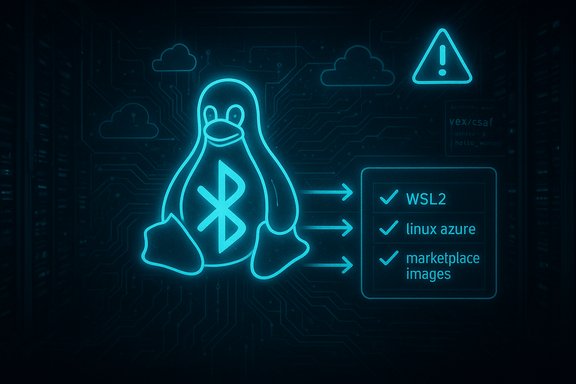
- The WSL2 kernel images Microsoft publishes for Windows Subsystem for Linux.
- linux‑azure kernels used in some Azure SKU images or Marketplace VM images.
- Microsoft‑curated Marketplace images or appliances where Microsoft or a partner built or repackaged a kernel.
- Any firmware or appliance images that include a Linux kernel (specialized IoT, internal test images, or partner devices).
Cross‑checking the technical record (independent confirmation)
Independent vendor trackers and distribution advisories corroborate the technical nature of CVE‑2025‑38118 and the remediation approach:- NVD’s CVE entry documents the MGMT UAF symptom and the upstream remediation.
- The Ubuntu security advisory records the CVE and tracks which kernel packages include the fix for their releases.
Operational guidance — who should act and how
The practical question for administrators and security teams is not theoretical exploitability but exposure: do your deployed images, kernels or devices include the vulnerable MGMT code? The following playbook is prioritized and actionable.Priority checklist (short, urgent steps)
- Inventory: Identify all Linux kernels and images in your environment. For each VM, appliance or endpoint that you control, run uname -r and record the distribution and kernel package. This is a fundamental first step.
- Map to vendor advisories: Check your distribution’s security tracker and vendor advisories for kernel updates that reference the CVE or the upstream commit. For Azure Linux customers, ingest Microsoft’s CSAF/VEX attestation for automation.
- Patch: If your kernel package is listed as vulnerable, install the vendor‑supplied kernel update and reboot into the patched kernel. This is the only full remediation.
- If you cannot patch immediately: temporarily disable Bluetooth components or blacklist kernel modules on hosts that do not need them (stop/mask the bluetooth service, modprobe -r bluetooth; add blacklist entries). Restrict access to the MGMT/Netlink interfaces so untrusted local users cannot submit MGMT commands.
Detection and hunting signals
- Kernel logs (dmesg, journalctl -k) with KASAN slab‑use‑after‑free traces referencing net/bluetooth/mgmt.c or mgmt_remove_adv_monitor_complete.
- Sudden kernel oopses or hung worker threads coincident with Bluetooth advertisement/monitor operations.
- Test harness failures in BlueZ mesh automation or stress tests that exercise advertising and monitor flows.
Practical verification for Microsoft artifacts
- For WSL2: run wsl --status and check the kernel binary/version used by your WSL2 distributions; if you rely on Microsoft’s published WSL2 kernel, confirm its package changelog or Microsoft’s VEX mapping for the kernel. If you use a custom WSL2 kernel, inspect the kernel source for net/bluetooth/mgmt.c and verify the fix.
- For Azure Marketplace and node images: ask the image vendor or publisher (or inspect the image yourself) for the kernel provenance and see whether Microsoft’s VEX attestation covers that specific image SKU. Do not assume the Azure Linux VEX applies to third‑party Marketplace images.
Risk model and long‑tail concerns
The most critical residual risk is the long tail: embedded devices, IoT gateways, specialized appliances and older Marketplace images often receive security backports slowly or never. Those devices may run kernels with the vulnerable code for years. The UAF’s most likely real‑world impact is denial‑of‑service (kernel panic or crash), but in high‑value targets the mere presence of a kernel UAF is a sufficiently serious primitive that defenders should prioritize patching.Other operational risks include:
- Multi‑tenant cloud hosts: a host kernel crash affects all tenants on that host and complicates incident response. Prioritize image updates for hosts orchestrating multiple tenants.
- Automated CI/CD pipelines and baked images: if your pipelines build custom images that embed kernel modules, those images can silently propagate the vulnerability; ensure your image build processes include CVE scanning and VEX/CSAF ingestion.
What Microsoft (and other vendors) should do — an editorial checklist
- Expand VEX/CSAF coverage quickly across additional Microsoft product families that ship Linux kernels: WSL2 kernels, linux‑azure builds, Marketplace images, AKS node images, and any appliance images that include Linux kernels. Microsoft has already started with Azure Linux; expanding the roll‑out reduces “unknowns” across the product catalog.
- For each attested product, publish a concise remediation mapping (package name / kernel version / fixed package number) and a simple verification method (uname -r plus package changelog line). This makes automated triage deterministic.
- Encourage partners and Marketplace publishers to provide SBOMs or their own VEX attestations for images that run in Azure, and clearly mark which images are Microsoft‑built versus third‑party.
Strengths and limitations of Microsoft’s current approach
Strengths:- Publishing VEX/CSAF for Azure Linux is an important transparency and automation step; it gives defenders a machine‑readable signal to triage and patch at scale.
- Microsoft’s commitment to update CVE mappings if additional products are found to ship the component is a clear procedural promise that reduces uncertainty over time.
- The rollout is phased; Azure Linux is the first product family. Until Microsoft attests more products, customers running other Microsoft artifacts must perform artifact‑level verification. Absence of an attestation is not evidence of absence.
- Kernel artifacts vary by build config and backports: even two Microsoft kernels with the same major version can differ in whether a given component is present or whether a fix was backported. Per‑artifact inspection is therefore still required.
Clear action plan for operators (concise)
- Immediately identify and patch Azure Linux images running in your Azure estate. Treat Microsoft’s Azure Linux VEX/CSAF as authoritative for those images.
- For WSL2, Marketplace images, AKS nodes, and any Microsoft‑provided images: perform per‑artifact verification (check kernel version, inspect kernel configuration or package changelog) rather than assuming they’re covered by the Azure Linux attestation.
- If you cannot patch: disable Bluetooth stack components, restrict access to MGMT/Netlink, and blacklist Bluetooth kernel modules on hosts that do not require them.
Closing analysis and final cautionary note
Microsoft’s MSRC clarification that Azure Linux includes the implicated open‑source component is exactly the type of product‑scoped transparency that customers need to act quickly. It should be read as a positive attestation for Azure Linux — not as definitive proof that no other Microsoft product carries the vulnerable Linux kernel code. The Linux kernel is an artifact that is included, configured and backported differently across builds; any Microsoft delivery that ships a Linux kernel binary or image must be validated individually.Administrators should act on the authoritative signals available today (vendor package advisories, Microsoft’s Azure Linux VEX, and distribution trackers) and treat the absence of a Microsoft VEX entry for other product families as “not yet validated.” Maintaining an image inventory, automating ingestion of CSAF/VEX, and applying kernel updates expeditiously will materially reduce risk from this and similar kernel correctness issues.
Source: MSRC Security Update Guide - Microsoft Security Response Center
