

The Linux kernel vulnerability tracked as CVE‑2025‑38161 — an RDMA/mlx5 bug that mishandles object rollback when a firmware command fails during Receive Queue (RQ) destruction — has prompted Microsoft to publish an attestation naming Azure Linux as a product that “includes this open‑source library and is therefore potentially affected.” That attestation is authoritative for Azure Linux, and Azure Linux operators should act immediately; however, the attestation does not mean Azure Linux is the only Microsoft product that could include the vulnerable mlx5 code. The practical security posture for enterprises is to treat Azure Linux as a confirmed carrier while performing artifact‑level verification across all Microsoft‑supplied kernels and images in their estate.
CVE‑2025‑38161 is an availability‑class kernel defect in the Mellanox/NVIDIA mlx5 RDMA driver family. During RQ destruction, if the firmware command used to tear down the hardware resource fails, upstream code historically cleaned some software resources regardless of that failure. That left the kernel state partially rolled forward and produced a possible use‑after‑free when subsequent destruction attempts ran against already‑freed resources, signalled by refcount underflow warnings and kernel oops traces. Upstream commits corrected the teardown path so the object is rolled back to its original state on firmware failure, eliminating the double‑destroy/UAF window.
This class of bug is primarily an availability risk: kernel warnings, oopses, or panics that interrupt service. It is not a documented remote code‑execution issue; exploitation requires local/adjacent conditions where the RDMA stack and its user interfaces are reachable and the vulnerable driver is present and loaded. Vendors and distribution trackers therefore classify risk based on both the kernel build and whether the host actually runs mlx5 hardware or exposes RDMA interfaces.
Important distinction: Microsoft’s attestation is a product‑scoped inventory result, not an exclusivity certificate. In plain English, it says “we looked at Azure Linux, and we found the upstream code mapped to this CVE.” It does not say “we looked at every Microsoft artifact and none other are affected.” Treat the attestation as high‑confidence positive evidence about Azure Linux — and treat lack of attestation for other Microsoft artifacts as “unverified” rather than “safe.”
Why that nuance matters in practice:
Nonetheless, the rollout leaves transient gaps in enterprise visibility. Microsoft’s initial VEX coverage is intentionally limited; until Microsoft inventories more artifact families, operators must perform artifact‑level verification for non‑attested Microsoft products. The risk is not theoretical: Microsoft ships a variety of Linux kernels and images (WSL2, linux‑azure, AKS nodes, Marketplace images) that are built differently and may or may not contain the same upstream component. Absence of attestation equals absence of evidence, not evidence of absence.
Operationally, the remaining friction points include:
CVE‑2025‑38161 highlights two enduring truths for modern infrastructure security: first, machine‑readable attestations like VEX materially improve enterprise decision‑making when they exist; second, a single attestation for one product does not replace the need for artifact‑level inventory and verification across a heterogeneous estate. For Azure Linux users this advisory is an actionable signal to patch; for everyone else it is a prompt to inventory, verify, and integrate Microsoft’s growing VEX outputs into automated vulnerability workflows.
Source: MSRC Security Update Guide - Microsoft Security Response Center
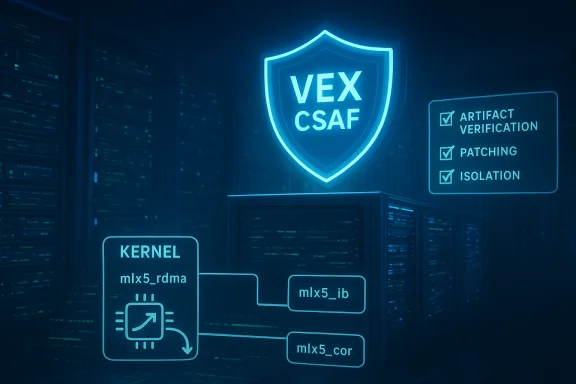 Background / Overview
CVE‑2025‑38161 is an availability‑class kernel defect in the Mellanox/NVIDIA mlx5 RDMA driver family. During RQ destruction, if the firmware command used to tear down the hardware resource fails, upstream code historically cleaned some software resources regardless of that failure. That left the kernel state partially rolled forward and produced a possible use‑after‑free when subsequent destruction attempts ran against already‑freed resources, signalled by refcount underflow warnings and kernel oops traces. Upstream commits corrected the teardown path so the object is rolled back to its original state on firmware failure, eliminating the double‑destroy/UAF window.This class of bug is primarily an availability risk: kernel warnings, oopses, or panics that interrupt service. It is not a documented remote code‑execution issue; exploitation requires local/adjacent conditions where the RDMA stack and its user interfaces are reachable and the vulnerable driver is present and loaded. Vendors and distribution trackers therefore classify risk based on both the kernel build and whether the host actually runs mlx5 hardware or exposes RDMA interfaces.
What Microsoft actually published (the VEX/CSAF attestation)
In October 2025 Microsoft began publishing machine‑readable CSAF/VEX attestations for third‑party CVEs, starting with the Azure Linux distribution (the rebranded CBL‑Mariner). These VEX files allow Microsoft to state, in machine‑consumable form, whether a given product is “Known Affected,” “Not Affected,” “Fixed,” or “Under Investigation.” For CVE‑2025‑38161 Microsoft’s public statement follows the now‑familiar pattern: it reports that Azure Linux includes this open‑source library and is therefore potentially affected and notes that Microsoft will update the CVE/VEX mapping if additional Microsoft products are found to ship the same upstream component. That published attestation is a concrete, actionable inventory statement for Azure Linux customers.Important distinction: Microsoft’s attestation is a product‑scoped inventory result, not an exclusivity certificate. In plain English, it says “we looked at Azure Linux, and we found the upstream code mapped to this CVE.” It does not say “we looked at every Microsoft artifact and none other are affected.” Treat the attestation as high‑confidence positive evidence about Azure Linux — and treat lack of attestation for other Microsoft artifacts as “unverified” rather than “safe.”
Technical analysis: what the bug does and why it matters
The bug in one paragraph
When the mlx5 driver attempts to destroy a Receive Queue (RQ), it first issues one or more firmware commands to the RNIC. If the firmware command fails late in the destruction path, the driver previously continued to free some software resources while leaving the hardware/firmware state inconsistent. If another destruction attempt occurred afterward, the kernel could dereference or free already‑freed objects, leading to a refcount underflow and a use‑after‑free kernel oops. The upstream patch restores correct rollback semantics on firmware failure and protects the object lifetime so a failed destroy does not leave the kernel in a half‑destroyed state.Why this is mostly an availability issue
The observable failure modes are kernel panics, oops traces, or spurious crashes; exploitation to cause confidentiality or integrity loss has not been shown. However, availability problems at kernel level are operationally severe: a production server that hosts network‑critical workloads or a virtualized node in a cloud cluster could lose service or require a reboot. Multi‑tenant clouds and environments exposing RDMA verbs to untrusted tenants are particularly sensitive because they enlarge the local attack surface and the set of actors that might generate tear‑down sequences.Patch scope and verification
Upstream maintainers applied a surgical fix that ensures rollback on firmware failure and strengthens reference counting semantics around RQ destruction. The correct verification step for an operator is to ensure their kernel package contains the upstream commit or vendor backport that implements this patch. Distributors vary in how they backport fixes into stable kernels, so the canonical check is vendor advisories and package changelogs or the presence of the upstream commit in the binary’s changelog.Is Azure Linux the only Microsoft product that includes the vulnerable library?
Short answer: No — Azure Linux is the only Microsoft product Microsoft has publicly attested so far as including the affected mlx5 component, but that does not prove it is the only Microsoft product that could contain the code. Microsoft’s attestation indicates a completed inventory check for Azure Linux and is authoritative for that product. It does not, however, guarantee that other Microsoft artifacts (WSL2 kernels, linux‑azure kernels, curated Marketplace or AKS node images, or other Microsoft‑distributed VM images) do not include the same upstream component; those artifacts remain unverified until Microsoft attests them or you inspect them locally.Why that nuance matters in practice:
- Microsoft ships multiple Linux kernel artifacts built from different source trees and build configurations. A vulnerable upstream file may be present in one artifact and absent in another depending on kernel version, module configuration, and vendor packaging choices.
- Many Microsoft‑owned images or appliances use kernels or modules not identical to Azure Linux’s build. WSL2 kernels, Azure VM images (
linux‑azure), AKS node images, Marketplace images, and other curated artifacts are separate build outputs and may or may not include mlx5. Treat each artifact as distinct. - Microsoft’s VEX rollout intentionally started with Azure Linux to provide a model and machine‑readable baseline; the phased approach means attestations will expand over time. A single attestation is a positive signal for Azure Linux customers — it is not a negative signal about the rest of Microsoft’s product portfolio.
Practical risk matrix for Microsoft customers
- If you run Azure Linux images: treat them as confirmed potentially affected per Microsoft’s VEX/CSAF attestation. Prioritize patching those instances immediately.
- If you run other Microsoft‑supplied kernels or images (WSL2,
linux‑azurekernels used by some VM SKUs, Marketplace images, AKS node images): assume unverified and perform artifact‑level verification (see checklist below). Do not assume safety because the product is not named in the attestation. - If you run non‑Microsoft distributions (Ubuntu, Debian, RHEL, SUSE, etc.) check vendor advisories and install the vendor‑packaged kernel updates if your distribution ships mlx5 and you run Mellanox hardware. Upstream/ distro trackers (NVD, vendor advisories) will list fixed package mappings.
- If you do not have mlx5 hardware or you have disabled RDMA/mlx5 modules: your exposure is significantly lower. The vulnerability requires the driver to be present and the code path to be reachable. Still, validate kernel module lists and runtime behavior because some kernels build mlx5 as a module that can be loaded later.
How to verify whether a Microsoft artifact in your environment is affected — a practical checklist
Below are prioritized, operational steps you can follow to move from “unknown” to “known” quickly.- Inventory artifacts
- Enumerate all Microsoft‑provided Linux artifacts in your estate: Azure Linux VM images, Marketplace VM images, AKS node images,
linux‑azurekernels, WSL2 kernels distributed by Microsoft, and any appliance images pulled from Microsoft sources. Treat each as a separate artifact for inventory purposes. - Ingest Microsoft CSAF/VEX
- Subscribe to Microsoft’s CSAF/VEX feeds and ingest them into your vulnerability management pipeline. VEX makes these product mappings machine‑readable and simplifies automation. Microsoft began publishing VEX in October 2025 and will expand coverage over time.
- Runtime verification (on each host)
- Check kernel modules: run lsmod or examine /proc/modules to see if mlx5_core or mlx5_ib is loaded.
- Check dmesg / journalctl: search for mlx5, refcount underflow, or related oops traces.
- Check udev/device inventory: confirm whether the host has Mellanox/NVIDIA ConnectX/BlueField RNICs (lspci | grep -i mlx5, or vendor‑specific tools).
- Confirm kernel version and vendor package: compare your kernel package changelog/commit list to vendor advisories and the upstream commit IDs that fixed CVE‑2025‑38161.
- Package-level verification
- For Azure Linux, consume Microsoft’s VEX entry and apply the kernel update Microsoft maps to the CVE. For other distributions, use distro vendor advisories (Ubuntu, SUSE, Red Hat, Amazon Linux) and install the recommended kernel package. If you maintain custom kernels, apply the upstream patch or backport it and rebuild.
- Isolate or restrict RDMA access (temporary mitigation)
- If you cannot patch immediately, remove RDMA device access from untrusted namespaces, restrict which users or containers can open RDMA verbs, or isolate susceptible hosts behind management VLANs/firewalls. These are stopgaps and do not fix the underlying kernel bug.
Detection: what to watch for in logs and monitoring
- Kernel logs: look for refcount_t: underflow warnings, stack traces referencing mlx5_core_put_rsc, mlx5_core_destroy_rq_tracked, mlx5_ib_destroy_wq and related functions. Those traces are the signature reported in upstream test cases and NVD entries.
- Module load/timeouts: repeated nxio or module unload failures related to mlx5 modules — especially during teardown — are indicators.
- Application symptoms: sudden RDMA resource failures, unexpected WQ (work queue) destruction errors in RDMA userland, or abrupt termination of RDMA sessions.
- Observability: keep kernel panic/oops alerting in place, aggregate dmesg/journal entries, and set alerts for signatures that indicate reference‑count underflow or repeated firmware command failures during RNIC teardown.
Enterprise recommendations and remediation priorities
- Immediate: Patch Azure Linux hosts first. Microsoft’s attestation is an authoritative inventory outcome for that product — treat it as a high‑priority signal and install the Microsoft‑provided kernel update for Azure Linux images.
- Short term (24–72 hours): Inventory all Microsoft kernels and images you run. Run the runtime checks above (lsmod, dmesg, lspci) and classify hosts into “affected (mlx5 loaded)”, “potentially affected (mlx5 present but not loaded)”, and “unaffected (no mlx5 code present)”.
- Medium term (1–4 weeks): Integrate Microsoft’s CSAF/VEX feeds into your vulnerability triage systems so that future attestations automatically update artifact status. Require SBOMs or attestations for Marketplace images and any Microsoft-provided image you consume in CI/CD.
- Long term: Adopt artifact-level controls and validation in your release pipelines: build reproducible images, validate kernel config and module lists as part of image signing, and demand VEX/CSAF attestations or equivalent SBOM evidence from image suppliers. This reduces the scale of manual inspections and improves patching confidence.
Critical analysis: strengths of Microsoft’s approach — and remaining gaps
Microsoft’s move to publish CSAF/VEX attestations is a major positive: it provides machine‑readable inventory statements, reduces noisy alerts, and gives Azure Linux customers a clear, automatable remediation path. Publishing VEX for Azure Linux first is sensible as a phased approach; it allows Microsoft to validate processes and partner integrations before scaling to other product families.Nonetheless, the rollout leaves transient gaps in enterprise visibility. Microsoft’s initial VEX coverage is intentionally limited; until Microsoft inventories more artifact families, operators must perform artifact‑level verification for non‑attested Microsoft products. The risk is not theoretical: Microsoft ships a variety of Linux kernels and images (WSL2, linux‑azure, AKS nodes, Marketplace images) that are built differently and may or may not contain the same upstream component. Absence of attestation equals absence of evidence, not evidence of absence.
Operationally, the remaining friction points include:
- The need to map vendor backports to package names across multiple distributions and kernel versions.
- The coordination burden for cloud operators who must patch kernels requiring reboots in large fleets.
- The dependency on vendors to publish clear package mappings and timelines for backports.
When to be concerned — real world scenarios that matter
- You run Azure Linux images attached to Mellanox/NVIDIA ConnectX or BlueField NICs and you expose RDMA verbs to untrusted tenants or guest VMs. This is the highest‑priority scenario.
- You operate AKS or Marketplace images derived from Microsoft artifacts that include RDMA stacks. Until you verify those images, treat them as unverified.
- You operate HPC clusters, NFV appliances, or multi‑tenant environments where RNIC firmware resets or teardown operations happen frequently. The more often teardown occurs, the higher the risk that an edge failure will trigger the rollback defect.
Final checklist (operational takeaways)
- Patch Azure Linux hosts now — Microsoft’s attestation and accompanying VEX entry makes Azure Linux an immediate remediation priority.
- Inventory Microsoft artifacts in your environment; treat all Microsoft‑distributed kernels/images as separate artifacts and verify them individually.
- Consume Microsoft CSAF/VEX feeds to automate decisions and watch for updates: Microsoft will update CVE mappings if additional Microsoft products are discovered to ship the same upstream component.
- Verify runtime exposure using lsmod, dmesg, lspci, and package changelogs. If mlx5 modules are present and your hosts have Mellanox hardware, apply vendor or upstream fixes promptly.
- Use short‑term mitigations (isolation, access controls for RDMA) only as stopgaps while you plan and execute kernel updates.
CVE‑2025‑38161 highlights two enduring truths for modern infrastructure security: first, machine‑readable attestations like VEX materially improve enterprise decision‑making when they exist; second, a single attestation for one product does not replace the need for artifact‑level inventory and verification across a heterogeneous estate. For Azure Linux users this advisory is an actionable signal to patch; for everyone else it is a prompt to inventory, verify, and integrate Microsoft’s growing VEX outputs into automated vulnerability workflows.
Source: MSRC Security Update Guide - Microsoft Security Response Center
