

Microsoft’s short public line — “Azure Linux includes this open‑source library and is therefore potentially affected by this vulnerability” — is accurate as a product‑level inventory attestation, but it is not a technical guarantee that no other Microsoft product could contain the vulnerable ATM subsystem code; until Microsoft publishes additional VEX/CSAF attestations or per‑artifact SBOMs, other Microsoft artifacts remain an operational unknown that defenders must verify. ps://www.microsoft.com/en-us/msrc/blog/2025/10/toward-greater-transparency-machine-readable-vulnerability-exploitability-xchange-for-azure-linux)
CVE‑2025‑38190 is a Linux kernel bug in the ATM (Asynchronous Transfer Mode) networking subsystem that was publicly recorded in mid‑2025 and is described in upstream commit messages and vulnerability trackers as: “atm: Revert atm_account_tx() if copy_from_iter_full() fails.” The practical symptom is a socket memory leak that can occur when a particular error path in vcc_sendmsg() fails to undo a prior accounting operation; the upstream patch factors the revert into an explicit helper and calls that helper on the failure path.
Independent trackers that aggregate CVE metadata rate the issue as medium (CVSS v3.1 ≈ 5.5) and list the attack vector as local (the bug is triggered by local operations inside the kernel ATM path rather than by a network‑delivered remote exploit). Distribution advisories (Debian, stable kernel backports) and multiple downstream feeds mapped the upstream fix into distro kernels and published errata.
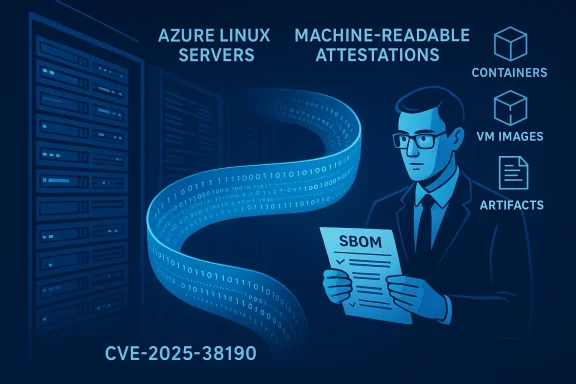
At the same time Microsoft’s Security Response Center (MSRC) has for several Linux‑related CVEs used the same concise product statement you quoted — explicitly saying that Azure Linux (the Microsoft‑maintained Linux distribution lineage) “includes this open‑source library and is therefore potentially affected,” and that Microsoft began publishing machine‑readable VEX/CSAF attestations in October 2025 to improve transparency. Microsoft also states it will update CVE entries if it identifies impact to additional Microsoft products. That combination — a product attestation plus a pledge to expand VEX coverage — is central to interpreting the MSRC line correctly.
Longer, operational answer: Azure Linux is the only Microsoft product Microsoft has publicly attested (so far) to include the implicated upstream component for this CVE. That attestation is e Linux images and kernels that Microsoft maintains, but it is not a technical guarantee that other Microsoft products, images, or binaries cannot include the same vulnerable code. Until Microsoft expands VEX/CSAF attestations or individual artifacts are inspected, other Microsoft artifacts should be treated as unknown and must be verified by defenders.
Why that nuance matters:
Every defense posture depends on accurate inventory. Microsoft’s public attestation gives Azure Linux users a concrete place to start; the prudent defender uses that as the first action item while simultaneously sweeping the estate for un‑attested Microsoft artifacts until the vendor’s VEX coverage catches up.
Source: MSRC Security Update Guide - Microsoft Security Response Center
 Background / Overview
CVE‑2025‑38190 is a Linux kernel bug in the ATM (Asynchronous Transfer Mode) networking subsystem that was publicly recorded in mid‑2025 and is described in upstream commit messages and vulnerability trackers as: “atm: Revert atm_account_tx() if copy_from_iter_full() fails.” The practical symptom is a socket memory leak that can occur when a particular error path in vcc_sendmsg() fails to undo a prior accounting operation; the upstream patch factors the revert into an explicit helper and calls that helper on the failure path.Independent trackers that aggregate CVE metadata rate the issue as medium (CVSS v3.1 ≈ 5.5) and list the attack vector as local (the bug is triggered by local operations inside the kernel ATM path rather than by a network‑delivered remote exploit). Distribution advisories (Debian, stable kernel backports) and multiple downstream feeds mapped the upstream fix into distro kernels and published errata.
At the same time Microsoft’s Security Response Center (MSRC) has for several Linux‑related CVEs used the same concise product statement you quoted — explicitly saying that Azure Linux (the Microsoft‑maintained Linux distribution lineage) “includes this open‑source library and is therefore potentially affected,” and that Microsoft began publishing machine‑readable VEX/CSAF attestations in October 2025 to improve transparency. Microsoft also states it will update CVE entries if it identifies impact to additional Microsoft products. That combination — a product attestation plus a pledge to expand VEX coverage — is central to interpreting the MSRC line correctly.
What the MSRC statement actually says — and what it does not
The literal meaning: an inventory attestation
When MSRC writes that phrase for a Linux/open‑source CVE, it reports the result of an inventory and maspecific product family: Azure Linux. In plain operational terms, Microsoft inspected the Azure Linux builds, packages, or kernels and found the upstream component that maps to the CVE, which makes Azure Linux a confirmed carrier and therefore in‑scope for remediation. That is authoritative for Azure Linux customers and is the immediate signal operators need to act.What the statement does not say: exclusivity
Crucially, the MSRC phrasing is not a x is the only Microsoft product that could include the code. Absence of a similar MSRC attestation for other Microsoft products is an absence of attestation, not a proof of absence. Microsoft’s VEX rollout is phased: the company started publishing attestations in October 2025 beginning with Azure Linux and has committed to expanding mappings over time. Until Microsoft lists additional products as “Known Affected,” “Not Affected,” or “Fixed” in VEX/CSAF, other Microsoft artifacts must be treated as unverified.Technical anatomy of CVE‑2025‑38190 (concise, verified)
- Root cause: vcc_sendmsg() calls atm_account_tx() to account for skb->truesize against sk->sk_wmem_alloc, but when copy_from_iter_full() fails the function failed to call the corresponding revert. This leaves the socket accounting in an inconsistent state and produces a socket leak. Upstream fix: introduce atm_return_tx() and call it on the failure path so the accounting is consistently reverted.
- Attack vector: Local. The vulnerability requires executing a particular kernel call path that triggers the failing copy_from_iter_full() branch. It is not described as remotely exploitable without a prior local foothold.
- Impact: Resource leak (socket memory), which can escalate to availability problems (exhausted sockets or memory) on hosts where the ATM path is exercised. Distribution security advisories mapped the upstream fix into kernel packages; operators should treat unpatched kernels as at‑risk for denial‑of‑service or stability problems under certain workloads.
Is Azure Linux the only Microsoft product that includes the library and is therefore potentially affected?
Short answer: No — not necessarily.Longer, operational answer: Azure Linux is the only Microsoft product Microsoft has publicly attested (so far) to include the implicated upstream component for this CVE. That attestation is e Linux images and kernels that Microsoft maintains, but it is not a technical guarantee that other Microsoft products, images, or binaries cannot include the same vulnerable code. Until Microsoft expands VEX/CSAF attestations or individual artifacts are inspected, other Microsoft artifacts should be treated as unknown and must be verified by defenders.
Why that nuance matters:
- Microsoft produces many Linux‑related artifacts beyond Azure Linux: Marketplace VM images, container base images, AKS node images, WSL2 kernel builds, edge/telemetry appliances, and agent binaries. Each artifact has its own build pipeline and configuration; the presence or absence of a specific upstream kernel code path is decided at build time. A per‑artifact inventory is therefore required to prove a negative.
- Microsoft also publishes developer toolchains and package ports (for example, vcpkg ports or internal packaging for service images) that can introduce upstream libraries into unexpected places. Even if Azure Linux is the first attested product, vendor‑supplied or third‑party images that Microsoft distributes via marketplaces or container hubs can still carry the vulnerable component if their maintainers included it.
- The MSRC VEX/CSAF commitment (started October 2025) is designed to reduce these blind spots over time by producing machine‑readable attestations that enumerate per‑product statuses (Known Affected, Not Affected, Under Investigation, Fixed). Until those attestations are complete, operators must perform artifact‑level validation.
Concrete evidence and independent corroboration
I cross‑checked the CVE technical description and remediation across multiple independent trackers and authoritative sources:- NVD and OpenCVE summarize the upstream commit and describe the fix and affected kernel paths. These sources confirm the technical description and the “local” attack vector classification.
- Vendor/security feeds (Wiz, cvefeed, PT Security/dBugs) capture the same symptom (socket leak) and list distribution advisories (Debian DLA/DSA entries) that map the patch into distro kernels. This corroboration shows downstream packaging has already been updated in many mainstream distros.
- Microsoft’s public messaging uses the inventory attestation language and points to the VEX/CSAF program as the mechanism for broader product mapping; Microsoft began publishing those attestations in October 2025. That is a process-level confirmation that Azure Linux will be the first Microsoft product family to receive machine‑readable, per‑CVE attestations.
Operational guidance — step‑by‑step for defenders and administrators
Whether you run Azure Linux or any Microsoft‑supplied artifacts, follow a practical, prioritized triage and remediation pipeline.1. Prioritize Azure Linux images (immediate)
- Check whether you run Azure Linux VM images, AKS node pools, or container bases that use Azure Linux/CBL‑Mariner builds. Microsoft has attested Azure Linux contains this upstream component — treat those images as in‑scope now and apply vendor updates.
- Apply the kernel/security updates published for the affected distribution: reboot hosts after the kernel package is upgraded or follow your vendor’s guidance for kernel livepatching if available. Confirm the kernel package versions match the distro advisory that lists the backported fix.
2. Inventory and discovery (concurrent)
- Search your environment for the ATM subsystem or for any references to the vulnerable kernel versions:
- Inspect kernel versions and build provenance for all Microsoft‑distributed images (Marketplace images, WSL2 kernels, curated base images).
- Scan container registries for images based on Azure Linux/CBL‑Mariner or for statically linked kernels that could carry the vulnerable code.
- Scan code repositories, CI artifacts, and vendor images for evidence of the vulnerable kernel commits or for packaged distro kernels that predate the distro security update.
- Use SBOMs (Software Bill of Materials), image‑scan tools, and package metadata queries to produce a list of images/artifacts that include the ATM code or the specific kernel versions affected. If you don’t have SBOMs, export package manifests and kernel version strings from running hosts.
3. Patch, rebuild, and redeploy
- For kernel packages: apply the vendor patches (upgraded package from your distro or Microsoft updates for Azure Linux), reboot or use supported livepatch mechanisms.
- For statically built or vendor‑embedded kernels: rebuild artifacts against patched upstream source, re‑sign/re‑release images, and redeploy.
- For container images: rebuild derived images from updated base images and push replacements to registries; rotate deployments to replace instances.
4. Rotate and validate where confidentiality or secrets were transported via affected paths
- CVE‑2025‑38190 is a resource‑leak / availability bug rather than an encryption failure; still, if you can’t determine exploitability window precisely for any given host, treat evidence of exploitation (unexpected crashes, socket scarcity, suspicious account changes) as cause to follow incident response playbooks. Collect forensic evidence (system logs, kernel oops traces, preserved images) before clearing systems.
5. Monitor MSRC VEX/CSAF and vendor advisories
- Watch for Microsoft to publish additional VEX attestations expanding product coverage beyond Azure Linux. When those appear, reconcile them with your inventory; if Microsoft declares other products “Known Affected,” pull the relevant artifacts into remediation workflows.
Detection, forensics, and indicators to hunt
Because the bug causes leaks and not a straightforward code execution primitive, detection is focused on behavioral and resource anomalies:- Monitor socket counts and memory usage on hosts that exercise ATM vcc_sendmsg() paths. Sudden growth in socket allocations or repeated kernel oops about memory/resource exhaustion in the ATM code path are red flags.
- Check kernel logs (dmesg, journald) for traces mentioning ATM, vcc_sendmsg(), or related stack traces. Distribution updates and CVE advisories sometimes list the failing function names that appear in oops logs.
- For long‑running hosts, look for repeated service restarts or OOM conditions tied to networking subsystems. If you identify suspicious patterns, preserve the kernel logs and obtain a memory image for forensic analysis before applying aggressive remediation.
Risk analysis: what threat actors can realistically do
- Realistic exploitability: low for remote, higher only in local‑access scenarios. The vulnerability is a deterministic logic bug that produces a leak; an attacker with local code execution or the ability to trigger kernel call paths could escalate denial‑of‑service scenarios by repeatedly triggering the path. Public advisories do not describe a remote, wormable exploit for this bug.
- Attack surface for ti‑tenant or co‑located environments where users can launch workloads that operate at kernel boundary (e.g., privileged container configurations, guest VMs with device passthrough) the impact is amplified; cloud operators should treat hosts running unpatched kernels as higher priority for mitigation.
- Likelihood of discovery in the wild: relatively low for wide, remote exploitation because the bug requires local triggering. However, targeted attackers with host access or malicious guest images could weaponize the defect to cause instability or service disruption. ([ap/app.opencve.io/cve/CVE-2025-38190)
Practical checklist for security teams (summary)
- Immediately patch Azure Linux images and nodes, and reboot or apply livepatches where available.
- Run a full SBOM‑driven inventory across your estate; flag any Microsoft‑supplied images that are unverified by VEX/CSAF.
- Rebuild and redeploy any statically linked or vendor‑embedded kernel artifacts after upgrading to a patched kernel source.
- Hunt for kernel logs and resource anomalies tied to ATM paths; preserve evidence if you suspect exploitation.
- Subscribe to MSRC VEX/CSAF updates and distribution advisories to detect when Microsoft expands attestations to additional products.
Notable strengths of Microsoft’s public approach — and the remaining risks
Strengths
- Authoritative, machine‑readable attestations: Microsoft’s move to publish CSAF/VEX data (starting October 2025) is a clear strength. Machine‑readable attestations allow automation and faster triage, reducing unnecessary patch churn for customers whose products are not carriers.
- Focused inventory attestation: Starting with Azure Linux — a Microsoft‑managed distribution — gives customers a concrete, actionable signal for what to prioritize first. It reduces ambiguity for Azure Linux operators and makes vendor remediation faster and more targeted.
Remaining risks and caveats
- Phased coverage leaves blind spots: Large vendors produce thousands of artifacts. A phased attestation program necessarily leaves many artifacts un‑attested at any given moment; defenders must assume “unknown” until proven otherwise. That operational gap is the main risk.
- Artifact provenance complexity: Marketplace images, partner appliances, and container images distributed through Microsoft channels may not be part of Microsoft’s initial attestations and therefore require independent verification. Developer toolchains and packaging can propagate upstream libraries into unexpected places.
- Detection difficulty for leaks: Memory/socket leaks are noisier and harder to attribute than code‑execution exploits; without good telemetry and logging, detecting exploitation (versus benign resource growth) can be challenging.
Final assessment and recommendation
- Is Azure Linux the only Microsoft product that includes the vulnerable open‑source component referenced in CVE‑2025‑38190? No — Azure Linux is the only Microsoft product Microsoft has publicly attested to include the component so far, but that attestation is product‑scoped and not an exhaustive denial that other Microsoft products or artifacts cannot include the same upstream code. Treat Azure Linux as confirmed in‑scope and other Microsoft artifacts as unverified until MSRC publishes additional VEX attestations or until artifact‑level inspection proves otherwise.
- Operationally: patch Azure Linux immediately, inventory all Microsoft‑distributed artifacts in your estate, and use SBOMs and image scanning to find other possible carriers. Prioritize rebuilding/redeploying statically linked or vendor‑embedded kernels, and monitor kernel logs and resource metrics for suspicious socket/memory leak behavior.
- For long‑term resilience: adopt automated SBOM generation in CI, require per‑artifact attestations where possible, and integrate VEX/CSAF into your vulnerability triage workflows so product‑scoped vendor attestations can reduce noise without hiding unknown‑artifact risk. Microsoft’s VEX rollout is an important step forward — use it — but do not treat it as a substitute for your own artifact verification.
Every defense posture depends on accurate inventory. Microsoft’s public attestation gives Azure Linux users a concrete place to start; the prudent defender uses that as the first action item while simultaneously sweeping the estate for un‑attested Microsoft artifacts until the vendor’s VEX coverage catches up.
Source: MSRC Security Update Guide - Microsoft Security Response Center
