

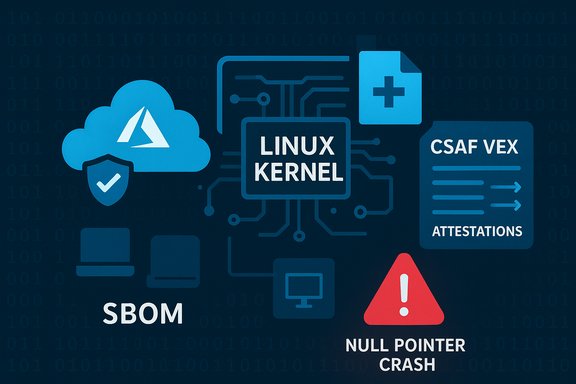
Microsoft’s short advisory that “Azure Linux includes this open‑source library and is therefore potentially affected” is accurate for the Azure Linux product family, but it is a product‑scoped attestation — not a categorical guarantee that no other Microsoft product can include the same vulnerable component.
Background / Overview
CVE-2025-38251 is a Linux kernel defect in the ATM subsystem (net/atm/clip.c) where clip_push can dereference a NULL skb when clip_devs is NULL, leading to a kernel crash. Upstream maintainers published fixes that add defensive checks; mainstream distributions (Ubuntu, Debian, Red Hat derivatives and others) listed the bug and remediation paths shortly after the kernel patch landed. Independent vulnerability databases and the Linux CVE announce list document the technical fix and the affected source file. Microsoft’s Security Response Center (MSRC) posted a concise product mapping for the CVE: Azure Linux includes this open‑source library and is therefore potentially affected by this vulnerability, and added that Microsoft began publishing machine‑readable CSAF/VEX attestations in October 2025 and will update the CVE if additional Microsoft products are identified. That short, deliberate phrasing is the starting point for this analysis.This article explains the operational meaning of Microsoft’s wording, verifies the technical facts using multiple independent sources, highlights the practical detection and mitigation steps administrators should take, and evaluates both the benefits and the latent risks of the vendor‑attestation model Microsoft is using.
What Microsoft’s wording actually means
Product‑scoped attestation, not universal exclusion
When Microsoft writes that a product “includes this open‑source library and is therefore potentially affected,” it is making a narrow inventory attestation for the named product family (Azure Linux). That attestation is authoritative and machine‑readable in Microsoft’s CSAF/VEX outputs: if you run Azure Linux images, treat Microsoft’s statement and published VEX/CSAF entry as the source of truth for those images.However, that same sentence does not imply Microsoft has scanned every other product, image, kernel build or binary it ships. Absence of an attestation for another Microsoft product is absence of attestation, not proof of absence. Microsoft explicitly stated it will update the CVE’s attestation if further product impact is identified, which confirms the statement is a current‑scope inventory result rather than a guarantee that other artifacts are clean.
Why vendors publish attestations by product family
Large vendors ship hundreds or thousands of distinct artifacts. Each artifact is the result of a separate build and packaging decision: kernel configuration flags, feature toggles, kernel version/backport choices, and packaging policies determine whether a specific source file (like net/atm/clip.c) appears in a given image or binary.To make attestations reliable and machine‑consumable, vendors commonly roll them out product‑by‑product. Microsoft started with Azure Linux as a logical first product to validate the CSAF/VEX pipeline and to provide deterministic automation signals for customers who run those particular images. This process speeds automation while preserving accuracy, but it also creates a temporary window where only the inventoried product(s) are explicitly represented.
Cross‑checking the technical facts
To verify the technical assertions and scope we cross‑referenced multiple independent sources:- The Linux kernel CVE announcement and commit history show the exact source file (net/atm/clip.c) and the upstream fix commits that prevent the NULL dereference. The upstream mailing list and kernel stable commit logs are authoritative for the exact lines changed and the remediation approach.
- Distribution advisories (Ubuntu, Debian and others) list CVE‑2025‑38251, classify its severity and recommend kernel updates; those pages confirm the issue is a kernel robustness/availability bug affecting particular kernel package versions on some distributions.
- NVD and other vulnerability databases consolidate the CVE record and associated metadata (timeline, CVE id, description and references), which corroborates the public timeline and technical summary.
Is Azure Linux the only Microsoft product that could be affected?
Short operational answer: No — Azure Linux is the only Microsoft product Microsoft has publicly attested to include the vulnerable component so far, but that attestation does not prove other Microsoft products are free of the same code. Any Microsoft artifact that ships a Linux kernel build containing the same source file and commit range — or that includes it via a backport — could, in principle, be a carrier until it is inventoried and declared otherwise.Concrete examples of other Microsoft artifacts that could include the kernel code
- WSL2 kernel images that Microsoft publishes and distributes to Windows users. These are distinct kernel artifacts that may be built from an upstream base; whether they include a given source file depends on build config and kernel version.
- linux‑azure kernels used in some Azure VM SKUs or specialized VM images — these are separate build pipelines and require their own inventory checks.
- Azure Marketplace images, partner appliances, or curated container images: third‑party and partner images hosted by Microsoft can embed their own kernels or binaries and are typically the responsibility of the image publisher; Microsoft’s Azure Linux attestation does not automatically cover those images.
- Internally built or statically linked binaries distributed within other Microsoft services that may embed kernel‑adjacent code or vendor‑provided kernels in appliances or devices. Those artifacts require artifact‑level inspection.
Why the distinction matters operationally
Treating Microsoft’s Azure Linux attestation as the only signal is risky for two main reasons:- Attestation lag: The product‑by‑product rollout means there is a time window where some Microsoft artifacts are inventoried and others are not. Relying solely on the attestation could leave unverified artifacts unattended.
- Artifact heterogeneity: Build-time configuration differences mean a vulnerable upstream file can be present in one Microsoft kernel build and absent in another, even within the same general product family. Static linking, backports, and vendor patches further complicate inference from one attested product to others.
Practical detection and verification checklist
Below is a prioritized checklist administrators and security teams can use to determine exposure and to remediate effectively.1. Start with known attested artifacts (Azure Linux)
- Confirm which Azure Linux images or kernel versions you run.
- Reconcile running kernel versions with the versions Microsoft lists in its VEX/CSAF output (or the MSRC advisory).
- Apply the vendor‑published kernel updates or rebuilds Microsoft supplies for Azure Linux images.
2. Inventory other Microsoft‑supplied artifacts
- Identify WSL2 kernels in use (corporate images, endpoints with custom kernels), and check whether the WSL kernel builds are based on upstream trees that predate the fix.
- Enumerate linux‑azure kernels and curated VM images (AKS node images, marketplace images) in use.
- Review Azure Marketplace appliances and partner images for embedded kernels or unpatched kernels.
3. Scan images and binaries automatically
- Use image scanner tooling to inspect container and VM images for vulnerable kernel packages or known vulnerable binaries. Image scanners should compute SBOMs and check packages against CVE feeds.
- For kernels shipped as binaries without package metadata, compare kernel version strings, compile‑time configs (if available), and module lists to the fixed upstream commits.
4. Search for statically‑linked or embedded copies
- Search file systems, images and artifacts for suspicious embedded kernel modules or copies of net/atm/clip.c (or compiled object signatures).
- For appliances or vendor images, request vendor SBOMs or attestations.
5. Prioritize remediation
- Patch or update Azure Linux images first (attested).
- Patch or replace affected kernels in WSL2, linux‑azure, marketplace images, or appliances as identified.
- Where patching is impossible, apply mitigating controls (restrict access to attack surfaces that trigger the kernel path, isolate VMs, and limit device/node privileges).
Remediation and mitigation strategies
- Apply vendor kernel updates where available. The upstream recommended remedy is to update to the latest kernel stable release that includes the clip_push fix; distributions produced patches and backports that should be applied according to each distro’s advisory.
- Reduce attack surface: Limit untrusted processes’ access to devices or kernel interfaces that can exercise the problematic code path (for example, limit access to networking subsystems where possible, segment tenants, apply RBAC and container restrictions).
- Use SBOM and binary provenance: Generate and collect SBOMs for images and appliances. SBOMs make precise artifact‑level inventory possible and help you determine whether a particular image includes a vulnerable kernel or component.
- Automate alerting on vendor attestations: Subscribe to vendor CSAF/VEX feeds and integrate them into your vulnerability management pipeline so you can map attestations to running images and trigger automated remediation workflows.
Strengths of Microsoft’s CSAF/VEX attestation approach
- Machine‑readable, deterministic mapping for named product artifacts improves automation and reduces false positives in triage.
- Starting with Azure Linux gives customers an immediate, authoritative signal for a major Microsoft‑maintained Linux distribution that many cloud customers use.
- Microsoft’s commitment to update CVE records if more products are found creates an auditable path for expanding coverage over time.
Risks and limitations of the attestation model
- Partial coverage during rollout: Until Microsoft inventories all relevant artifacts, customers cannot assume the absence of attestations implies their environment is safe.
- Dependence on vendor discovery: The process assumes the vendor’s inventory has found all carriers; undiscovered internal builds, partner images, or statically linked binaries can remain blind spots.
- SBOM and build provenance gaps: Without accurate SBOMs or compile‑time metadata, it can be difficult to conclude whether an un‑attested artifact actually contains the vulnerable code.
- Time to remediation: Even when a vendor attests a product is affected, customers still must patch and reboot systems (kernel bugs frequently require reboots), which can be operationally disruptive.
Recommended governance and process changes
To make the attestation model work within an enterprise’s security program, implement the following governance measures:- Require SBOMs from image publishers and partners for any image run in production. Track SBOM maturity as a supply‑chain risk metric.
- Integrate vendor CSAF/VEX feeds into vulnerability management tools and tie attestations to CI/CD and deployment pipelines so that image builds are automatically checked before promotion.
- Maintain an “artifact inventory” that lists the kernel variant, build provenance and compile options for each image or appliance in your estate. This inventory should be reconciled with vendor attestations regularly.
- Use runtime detection for kernel crashes and oops patterns; kernel oopses are the primary operational symptom of this class of bug. Proactive alerting on multi‑tenant hosts can reduce blast radius.
Final assessment and guidance
- Fact: Azure Linux is the only Microsoft product Microsoft has publicly attested to include the vulnerable ATM/clip code for CVE‑2025‑38251 at the time of their advisory. That attestation is authoritative for Azure Linux.
- Caveat: That attestation is not a universal exclusion. Other Microsoft artifacts (WSL2 kernels, linux‑azure kernels, Marketplace images, appliances or statically linked binaries) can still carry the same upstream code depending on build configuration and versioning. Administrators must verify those artifacts directly.
- Actionable priority list:
- Patch attested Azure Linux images immediately according to Microsoft guidance.
- Inventory and verify WSL kernels, linux‑azure kernels, Marketplace images and appliances in your environment.
- Use SBOMs and automated scanning to detect vulnerable kernel packages or embedded artifacts.
- Apply mitigating controls where immediate patching is impossible; plan for scheduled reboots after kernel updates.
- Rationale: The combination of Microsoft’s product‑scoped attestations and independent corroboration from kernel commit logs and distribution advisories gives security teams a reliable starting point — but not an exhaustive map — for triage. The correct operational posture is to treat Microsoft’s attestation as authoritative for the named product, and to perform artifact‑level verification for everything else.
Microsoft’s renewed investment in machine‑readable CSAF/VEX attestations is an important advance in vendor transparency, but it demands that customers pair vendor signals with their own artifact‑level inventory and SBOM practices. For CVE‑2025‑38251 the immediate imperative is clear: remediate Azure Linux instances now, and verify other Microsoft‑supplied artifacts as a high‑priority follow‑up.
Source: MSRC Security Update Guide - Microsoft Security Response Center
