

Microsoft’s MSRC entry for CVE‑2025‑37745 correctly identifies a Linux‑kernel fix — a deadlock avoidance change in hibernate_compressor_param_set — and explicitly states that Azure Linux “includes this open‑source library and is therefore potentially affected,” but that narrow phrasing is an attestation of inventory for Azure Linux only and does not prove that no other Microsoft product could include the same vulnerable kernel code.
CVE‑2025‑37745 is a Linux‑kernel patch that addresses a deadlock reported by syzbot in the kernel power/hibernate path. The upstream resolution changes hibernate_compressor_param_set to attempt a non‑blocking acquire (mutex_trylock) of system_transition_mutex and return -EBUSY when acquisition fails, avoiding the deadlock when callers hold param_lock and a concurrent system transition takes place. This is an availability/stability fix rather than a confidentiality or code‑execution weakness. Microsoft’s public statement about this CVE — the wording quoted by the user — comes from the company’s ongoing rollout of machine‑readable attestations (CSAF/VEX) that began with Azure Linux. Microsoft’s attestation model is intentionally product‑scoped: when the company says a product “includes this open‑source library and is therefore potentially affected,” it is reporting the result of an inventory check for that named product family, not issuing a universal claim about all Microsoft offerings. Microsoft has also said it will update CVE and VEX records if additional products are later identified as carriers.
Pragmatically: prioritize patching Azure Linux images immediately (they’re attested affected), and concurrently run a short verification sweep across other Microsoft artifacts in your environment. Treat vendor VEX/CSAF outputs as authoritative where they exist and as incomplete where they do not — and structure your remediation automation and inventory tooling accordingly.
Caveat: public vendor attestations and SBOMs are powerful automation primitives, but they are only as complete as the inventory that produced them. If you encounter artifacts where build provenance is missing or ambiguous, assume exposure until proven otherwise and apply conservative mitigations until you can validate or update the artifact with the fixed kernel.
Source: MSRC Security Update Guide - Microsoft Security Response Center
 Background / Overview
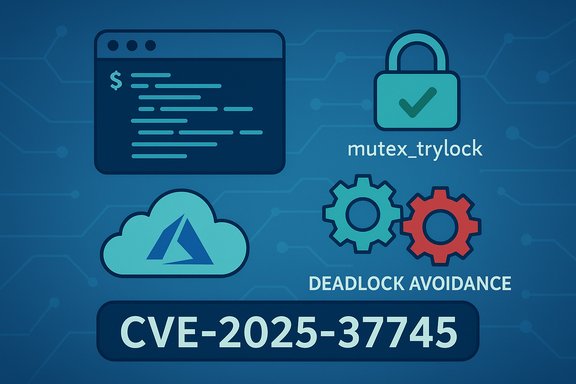
CVE‑2025‑37745 is a Linux‑kernel patch that addresses a deadlock reported by syzbot in the kernel power/hibernate path. The upstream resolution changes hibernate_compressor_param_set to attempt a non‑blocking acquire (mutex_trylock) of system_transition_mutex and return -EBUSY when acquisition fails, avoiding the deadlock when callers hold param_lock and a concurrent system transition takes place. This is an availability/stability fix rather than a confidentiality or code‑execution weakness. Microsoft’s public statement about this CVE — the wording quoted by the user — comes from the company’s ongoing rollout of machine‑readable attestations (CSAF/VEX) that began with Azure Linux. Microsoft’s attestation model is intentionally product‑scoped: when the company says a product “includes this open‑source library and is therefore potentially affected,” it is reporting the result of an inventory check for that named product family, not issuing a universal claim about all Microsoft offerings. Microsoft has also said it will update CVE and VEX records if additional products are later identified as carriers. What CVE‑2025‑37745 actually is — technical summary
- The defect: a deadlock involving the hibernate compressor parameter handler and the system suspend transition locking. Syzbot reproduced a lock interleaving where a userspace write to /sys/module/hibernate/parameters/compressor attempted to obtain system_transition_mutex while already holding param_lock, and concurrently a system suspend path attempted to acquire the same mutex, producing a potential system hang. The fix changes the setter to use mutex_trylock and return -EBUSY on failure so the userspace writer will not block and deadlock.
- Affected files and commits: upstream kernel trees point to changes in kernel/power/hibernate.c; the Linux kernel stable commits that contain the repair are published in the stable branch history and are referenced in public CVE announcements. Operators are advised to update to a kernel that contains those stable commits rather than attempting isolated cherry‑picks.
- Severity and impact: this is an availability issue (CVSS v3 around the mid‑range in many trackers), with the primary effect being a system deadlock or kernel hang when the right set of concurrent operations occur. It does not, in public advisories, indicate an elevation‑of‑privilege or remote code‑execution vector.
Microsoft’s wording: a careful reading
Microsoft’s sentence — that “Azure Linux includes this open‑source library and is therefore potentially affected” — must be parsed as a precise operational statement:- It is an authoritative attestation for Azure Linux only because Microsoft started its CSAF/VEX rollout with Azure Linux and used that product family to publish its first machine‑readable attestations. That means Azure Linux customers can treat Microsoft’s VEX/CSAF entry as the definitive, automatable signal for that product.
- It is not a categorical denial that other Microsoft‑branded artifacts do not contain the same upstream code. Microsoft explicitly commits to updating the CVE/VEX records if other products are later discovered to ship the component. The absence of a product in Microsoft’s published VEX data therefore means “not yet attested,” not “proven safe.”
- The practical intent of this phrasing is transparency and incremental inventory work: publish what has been validated today (Azure Linux) and expand that product mapping as automated SBOM and build‑provenance checks complete for other SKUs. This is a legitimate vendor practice and helps many customers automate triage — but it also imposes responsibility on operators to verify other artifacts in their estates.
Is Azure Linux the only Microsoft product that could be affected?
Short answer: No — Azure Linux is the only Microsoft product Microsoft has publicly attested as including the affected component at publication time, but it is not technically correct to assume it is the only Microsoft product that could include the vulnerable code. Why that nuance matters:- Microsoft ships many distinct Linux artifacts and kernel builds: Azure Linux images and kernels, the WSL2 kernel, linux‑azure kernel builds used for certain Azure image families, container base images built from CBL‑Mariner lineage, Marketplace VM images, and internal appliance/IoT images. Any of these artifacts can include or omit an upstream kernel source file depending on build configuration, kernel version, and module selection at build time. If a Microsoft artifact used a kernel revision and configuration that included the vulnerable hibernate code before it was fixed, that artifact could be a carrier.
- Microsoft’s VEX/CSAF attestation for Azure Linux is an operational milestone (authoritative for that product) but phased. The company deliberately started small to provide a deterministic signal for Azure Linux customers first; coverage for other products will follow as Microsoft completes inventory and provenance checks. That rollout approach explains why Azure Linux appears first in the published attestation set.
- In other words: attestation presence = known affected; attestation absence = not yet attested. Operators must treat the latter as subject to verification.
Which Microsoft artifacts are plausible carriers and why
Here are the Microsoft‑published artifacts and image families where the same upstream kernel code could plausibly appear:- Azure Linux (explicitly attested) — Microsoft has inventory‑checked and published VEX/CSAF attestations for Azure Linux; this product is the authoritative, in‑scope product for the CVE attestation as published. Act on these updates immediately if you run Azure Linux images.
- Windows Subsystem for Linux (WSL2) kernel — WSL2 runs a Microsoft‑packaged Linux kernel. The WSL2 kernel repository and its configuration are public; whether a particular WSL2 kernel build includes a given kernel code path depends on that kernel’s config and the upstream commit range used when the kernel was built. Many WSL instances run default Microsoft builds but customers can also run custom WSL kernels. Check the WSL kernel config or binary for the presence of the hibernate code and kernel version to be certain.
- CBL‑Mariner lineage and other Microsoft base images — Some Microsoft base images used in Azure infrastructure build on the same family of artifacts as Azure Linux; these may include similar kernel code depending on how the image is assembled. Microsoft’s initial attestation program specifically targeted the Azure Linux family (CBL‑Mariner lineage), which is why that product is the first listed in VEX outputs.
- Marketplace VM images and partner appliances — Many Marketplace or vendor appliance images are assembled from vendor inputs; they can embed older or custom kernels that include vulnerable code. These artifacts are not automatically covered by a single Microsoft product VEX file and therefore require host‑level verification.
- Custom or static builds — Any statically linked or custom‑compiled kernel binary built from vulnerable upstream code will remain a carrier until rebuilt with the patched source or patched binary. This includes containers that bundle kernel modules or boot artifacts.
How to verify whether a Microsoft artifact in your environment is affected
Verification requires artifact‑level checks. The following checklist gives the fastest, most reliable ways to detect exposure:- On physical hosts or VMs:
- Run uname -r and inspect /boot/config-$(uname -r) (or /proc/config.gz) to find kernel version and build configuration.
- Search the running kernel for the power/hibernate code path (look for kernel/power/hibernate.c in source tree mapping or for a module that references it).
- Check vendor changelogs / package changelogs for upstream commit references that map to the stable commits which fixed CVE‑2025‑37745.
- For WSL2:
- Compare the WSL kernel binary version against the WSL2‑Linux‑Kernel repository tags. If you run a custom WSL kernel, recompile with an upstream that includes the fix or update to the patched WSL kernel binary.
- For Azure and Marketplace images:
- Use image inventory and SBOMs where available; ingest Microsoft’s VEX/CSAF files into your automation to mark Azure Linux images as in scope. For Marketplace or partner images, request the vendor SBOM or check kernel version and configuration on the image directly.
- For containerized workloads:
- Containers generally rely on the host kernel; the remediation path is to patch the host kernel. If you ship containers with embedded kernel drivers (rare), rebuild those images with a patched kernel base.
- Detection:
- Instrument kernel oops/crash logs and audit writes to /sys/module/hibernate/parameters/compressor in environments where untrusted processes might write system attributes. Look for unusual kernel lockup traces around system_transition_mutex and param_lock.
Remediation and mitigation guidance
- Patch and reboot: The canonical remediation for CVE‑2025‑37745 is to run a kernel that includes the stable commits listed in the upstream CVE announcement. Update to your vendor’s fixed kernel package or to an upstream stable release that includes the repair, then reboot. This is the recommended, supported path.
- If you cannot patch immediately:
- Minimize exposure by controlling which processes can write to /sys/module/hibernate/parameters/compressor (restrict permissions, use seccomp or LSM rules).
- Avoid local user profiles or services that can register or manipulate ieee80211 devices concurrently with system suspend transitions.
- Add monitoring and automated remedial reboots for hosts that exhibit lockup symptoms to reduce operational downtime risk. These are mitigation steps — not replacements for the kernel fix.
- For managed cloud services:
- If you run Microsoft‑managed images or services (Azure VMs, AKS node images, etc., follow Microsoft’s published guidance for Azure Linux and any Microsoft service advisories. Use Microsoft’s VEX outputs for automation where available. However, for third‑party or Marketplace images you host, verify and patch the image provider’s kernel.
Evaluating Microsoft’s approach: strengths and residual risks
What Microsoft is doing right:- Machine‑readable attestations (CSAF/VEX) are a concrete productivity improvement for defenders: they provide deterministic, automatable signals that reduce noisy triage and speed prioritization for the Azure Linux family. This is a material step toward faster, less error‑prone response automation.
- Explicit, product‑scoped mapping avoids the ambiguity that historically forced administrators to guess whether a vendor had checked a specific product build. When Microsoft says Azure Linux is “known affected,” that is an actionable signal for those running Azure Linux images.
- Phased attestation leaves gaps: until Microsoft expands VEX attestations to other SKUs, customers running Microsoft‑packaged kernels (WSL2, some Marketplace images, linux‑azure kernels) must perform host‑level verification. The attestation does not automatically cover those artifacts and absence from VEX is not evidence of absence.
- Third‑party and custom images remain the operator’s responsibility: Marketplace appliances, partner images, and customer‑built images may embed kernels or binaries that are outside Microsoft’s VEX claim. Those must be inventoried and patched under the operator’s change control.
- Timing and cadence: VEX is only valuable if the vendor maintains it proactively. Microsoft has committed to updating CVE entries when additional products are identified as carriers, but customers must monitor VEX feeds and vendor advisories to capture those changes as they happen.
Practical checklist for WindowsForum readers and defenders (prioritized)
- Treat Azure Linux images as in scope and update them immediately when Microsoft publishes a patched image or kernel package. Automate VEX/CSAF ingestion so your tooling marks Azure Linux instances as requiring remediation.
- Inventory Microsoft‑supplied artifacts in your environment:
- List all Azure VMs, AKS nodes, Marketplace images, and WSL instances.
- For each, capture uname -r and kernel package/changelog data. If a kernel predates the fix commits, plan a patch/reboot.
- For WSL2 users:
- Confirm whether you are on the default Microsoft WSL kernel or a custom build. If default, check Microsoft’s WSL kernel releases; if custom, recompile or update your kernel with the fix.
- Apply mitigations where patching is delayed:
- Restrict writes to the hibernate parameter sysfs entry and isolate hosts where local users or low‑privileged services can perform such writes. Add detection rules for related kernel oops traces.
- Reconcile SBOMs and VEX:
- Ingest Microsoft VEX outputs for Azure Linux and track updates. But also maintain your own inventory for Marketplace and partner images — do not rely solely on vendor attestations.
Closing analysis — what to take away
Microsoft’s language in the MSRC advisory for CVE‑2025‑37745 is factually accurate and operationally helpful: Azure Linux is a known carrier and Microsoft has published a machine‑readable attestation that Azure Linux includes the affected open‑source kernel code. That attestation is an important automation signal for Azure Linux customers. However, that statement is not a universal safety guarantee for all Microsoft products. Absence of a VEX attestation for another Microsoft SKU does not prove absence of the vulnerable code; it simply indicates Microsoft has not yet published a product‑level mapping for that SKU. Operators who run Microsoft images beyond Azure Linux (WSL2, Marketplace images, CBL‑Mariner‑based hosts, or custom images) must therefore perform targeted, artifact‑level verification — specifically, checking kernel versions, kernel configs, and vendor changelogs — and patch or rebuild affected artifacts accordingly.Pragmatically: prioritize patching Azure Linux images immediately (they’re attested affected), and concurrently run a short verification sweep across other Microsoft artifacts in your environment. Treat vendor VEX/CSAF outputs as authoritative where they exist and as incomplete where they do not — and structure your remediation automation and inventory tooling accordingly.
Caveat: public vendor attestations and SBOMs are powerful automation primitives, but they are only as complete as the inventory that produced them. If you encounter artifacts where build provenance is missing or ambiguous, assume exposure until proven otherwise and apply conservative mitigations until you can validate or update the artifact with the fixed kernel.
Source: MSRC Security Update Guide - Microsoft Security Response Center
