

Microsoft’s MSRC line that “Azure Linux includes this open‑source library and is therefore potentially affected” is authoritative for Azure Linux — but it is not a blanket statement that no other Microsoft product can contain the same vulnerable kernel component; Azure Linux is simply the only Microsoft product Microsoft has publicly attested to include the code so far.
CVE‑2025‑38259 is a Linux kernel vulnerability in the ALSA ASoC codec driver for the WCD9335 family: the driver gets and enables regulator supplies during probe but fails to clean them up in some error or unbind paths, producing leaked memory and unbalanced regulator enable counts. Upstream maintainers fixed it by switching to a managed bulk regulator API (devm_regulator_bulk_get_enable, which both corrects the lifecycle and simplifies the code. Multiple distribution trackers and vendors recorded the issue and published status/fix information for packaged kernels; Debian, Ubuntu and SUSE public advisories show which packaged kernel streams were vulnerable and where fixes were applied. These vendor advisories indicate the defect is a kernel resource‑lifecycle bug with operational impact rather than an immediate remote compromise primitive.
Two points follow directly from Microsoft’s phrasing:
Independent mapping tools also show Microsoft registered Azure Linux kernel packages and their build identifiers against Microsoft’s product inventory in the CVE product records, which corroborates that Azure Linux builds contained the upstream kernel code that implements the wcd9335 driver.
Actionable checklist (condensed)
Source: MSRC Security Update Guide - Microsoft Security Response Center
 Background / Overview
CVE‑2025‑38259 is a Linux kernel vulnerability in the ALSA ASoC codec driver for the WCD9335 family: the driver gets and enables regulator supplies during probe but fails to clean them up in some error or unbind paths, producing leaked memory and unbalanced regulator enable counts. Upstream maintainers fixed it by switching to a managed bulk regulator API (devm_regulator_bulk_get_enable, which both corrects the lifecycle and simplifies the code. Multiple distribution trackers and vendors recorded the issue and published status/fix information for packaged kernels; Debian, Ubuntu and SUSE public advisories show which packaged kernel streams were vulnerable and where fixes were applied. These vendor advisories indicate the defect is a kernel resource‑lifecycle bug with operational impact rather than an immediate remote compromise primitive. What Microsoft actually said — parsing the MSRC statement
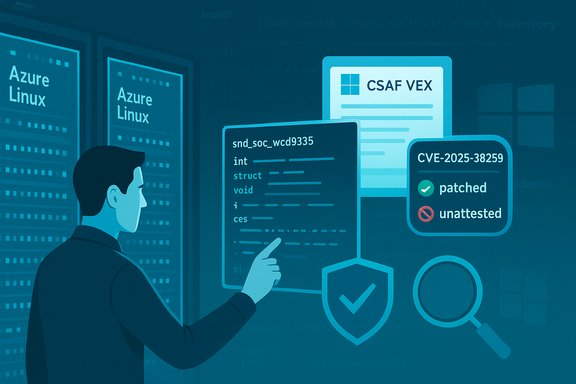
Microsoft published an attestation saying that Azure Linux “includes this open‑source library and is therefore potentially affected” and also said it has begun publishing machine‑readable CSAF/VEX attestations and will update CVE records if further Microsoft products are identified as carriers. That statement is a product‑scoped inventory attestation — it reports the result of Microsoft’s artifact inventory for Azure Linux at the time of publication.Two points follow directly from Microsoft’s phrasing:
- The attestation is authoritative for Azure Linux: Microsoft inspected the Azure Linux build artifacts and found the implicated kernel code. Treat Azure Linux images as in‑scope for triage and remediation.
- The attestation is not an assertion of exclusivity: Microsoft explicitly stated it will update the CVE/VEX mapping if additional Microsoft products are discovered to ship the component, meaning other Microsoft artifacts remain “not yet attested” rather than proven safe.
Why Microsoft started with Azure Linux
Microsoft’s CSAF/VEX rollout is phased and product‑by‑product. Azure Linux (CBL‑Mariner lineage / Azure Linux images) is a centrally built product family that Microsoft controls end‑to‑end, which makes it a natural first target for inventory and machine‑readable attestations. Product‑scoped attestations produce deterministic automation signals (known_affected / not_affected / under_investigation / fixed) that customers can consume. The Microsoft VEX approach therefore names Azure Linux first because Microsoft completed that inventory earlier than others.Independent mapping tools also show Microsoft registered Azure Linux kernel packages and their build identifiers against Microsoft’s product inventory in the CVE product records, which corroborates that Azure Linux builds contained the upstream kernel code that implements the wcd9335 driver.
Is Azure Linux the only Microsoft product that could be affected?
Short answer: No — not necessarily. Long answer: Azure Linux is the only Microsoft product Microsoft has publicly attested (via CSAF/VEX) as including the implicated upstream code for this CVE at the time of publication. That is authoritative and actionable for Azure Linux users. However, other Microsoft artifacts that ship or run Linux kernels may also include the same upstream driver depending on kernel version, applied backports, and kernel CONFIG_* build options. Those artifacts include (but are not limited to):- Windows Subsystem for Linux (WSL2) kernel builds and any custom kernels users deploy for WSL. WSL uses a Microsoft‑maintained kernel source tree and publishes prebuilt kernels; whether a given WSL kernel includes any specific SoC driver depends on the kernel config and build choices.
- linux‑azure / Azure‑tuned kernels packaged for specific VM SKUs or Marketplace images — some Azure VM images use vendor or Azure‑tuned kernels rather than the Azure Linux central image stream.
- Azure Marketplace VM images, partner appliances, and curated node images (AKS node images) that embed vendor kernels; these can carry upstream device drivers included by the image publisher.
- Any Microsoft‑published kernel package or machine image where the build configuration includes CONFIG_SND_SOC_WCD9335 (built‑in or as a module) and uses an upstream commit range predating the fix.
Evidence and cross‑checks
To avoid depending on a single source, the key claims above were cross‑checked against multiple public trackers:- The CVE technical description and the upstream fixes are summarized by NVD and OSV, confirming the code changes and the nature of the bug.
- Distribution trackers (Debian, Ubuntu, SUSE) list package statuses and fixed versions for the kernel streams used by their distributions; these map the upstream stable fixes to vendor package releases. That demonstrates the defect is present in some packaged kernels and that standard remediation is to install the vendor‑provided kernel update.
- Microsoft’s own CSAF/VEX attestation and accompanying guidance are reflected in the MSRC entry and in machine‑readable product mappings; independent CVE inventory aggregates (public CVE lists that index vendor attestations) show Azure Linux entries tied to Microsoft kernel builds.
Practical verification: how to check your Microsoft artifacts
Inventory and verification are the only reliable ways to confirm whether a particular host or image includes the vulnerable wcd9335 code. Below are practical checks, listed in priority order.- Confirm Microsoft’s attestation covers your images
- If you run official Azure Linux images, treat Microsoft’s attestation as authoritative and prioritize applying the Microsoft‑packaged kernel update for the azl3 kernels named in the VEX/CSAF mapping.
- Check kernel version and vendor package metadata
- On a running VM or host: uname -r; check package manager kernel package names and changelogs (dpkg -l / rpm -qa and dpkg -s or rpm -q --changelog).
- If the kernel version predates the vendor’s fixed release or is an upstream revision known to be vulnerable, the host is likely in scope. Use vendor advisories (Debian/Ubuntu/SUSE) for package → fix mappings.
- Detect presence of the driver or symbol
- If the driver is a loadable module:
- lsmod | grep snd_soc_wcd9335
- modinfo snd-soc-wcd9335
- ls /lib/modules/$(uname -r) | grep wcd9335
- If drivers are built‑in:
- zgrep CONFIG_SND_SOC_WCD9335 /proc/config.gz
- grep CONFIG_SND_SOC_WCD9335 /boot/config-$(uname -r)
- If the driver is present (module or built‑in) and the kernel is older than the fixed commits or vendor backport, treat the host as affected until patched.
- WSL / developer machines
- Inside WSL shell: uname -r; zgrep CONFIG_SND_SOC_WCD9335 /proc/config.gz
- Check the Microsoft WSL kernel mapping and the kernel tag used by your Windows build; if you run a custom WSL kernel, inspect the kernel config used for that build. WSL’s published kernel repo and release notes provide guidance on default config and module support.
- Marketplace images and appliances
- For any Marketplace VM image or partner appliance, boot a test instance and run the checks above. Marketplace publishers sometimes use their own kernel builds; don’t assume the Azure Linux attestation covers third‑party images.
- Automation and SCM
- Integrate Microsoft’s CSAF/VEX feed into your vulnerability management so future attestations and updates trigger automated reassessments. Microsoft committed to publish these machine‑readable attestations to make this automation possible.
Remediation guidance and priorities
- Highest priority: patch Azure Linux images first. Microsoft’s attestation makes Azure Linux the canonical starting point. Apply the Microsoft‑packaged kernel updates and reboot to activate the patched kernel.
- Second priority: inspect WSL hosts, AKS nodes, linux‑azure images and any Microsoft‑supplied kernels in your environment. If a WSL kernel or other Microsoft kernel image contains the driver and is older than the fixed commits, either update the kernel or rebuild with the fixed upstream commits.
- Where immediate patching is impossible, consider short‑term mitigations:
- Prevent the driver from probing (blacklist module or pass kernel parameter) if the driver is a module and your workflows do not require the hardware.
- Isolate high‑risk hosts and prioritize patch windows for production‑facing or multi‑tenant nodes.
- Monitor for out‑of‑memory or regulator enable/disable imbalance symptoms that could be caused by this driver leaking regulator enables.
Risk assessment: severity and exploitability
This defect is a resource‑lifecycle bug that causes leaked memory and unbalanced regulator enable counts. Distribution advisories classify it as medium severity for operational stability. Public trackers’ exploitability scoring indicates low probability of active exploitation in the wild for this particular defect; the principal risk is reliability/availability (driver instability, potential kernel warnings or resource exhaustion) rather than an immediate remote code execution vector. Operators should treat the issue as an availability/robustness risk that is remediated through standard kernel updates.Why absence of an attestation is not proof of absence
A vendor‑published VEX/CSAF attestation is an inventory result for named products. Because large vendors ship many independent artifacts (kernels, images, appliances), an attestation that explicitly names Azure Linux must be read as: “We checked Azure Linux and found the component.” It does not mean Microsoft has yet completed inventory for every kernel‑shipping product (WSL, linux‑azure builds, AKS node images, Marketplace appliances, etc.. Microsoft’s public messaging explicitly commits to update CVE/VEX entries if more products are identified, which is standard for a phased inventory approach. Treat un‑attested Microsoft artifacts as unverified — they require local verification rather than being assumed safe.What to expect next from vendors (including Microsoft)
- Microsoft will expand product coverage in its machine‑readable CSAF/VEX feed over time. When additional Microsoft products are found to ship the implicated upstream code, Microsoft will update the CVE/VEX mapping and publish remediation guidance for those artifacts.
- Distributions will continue to publish fixed kernel packages and backports; operators should apply those vendor packages in line with their patch cycles. Debian, Ubuntu, and SUSE advisories already list fixed package versions for affected kernel branches.
- Automated vulnerability management systems should ingest Microsoft’s CSAF/VEX feed and vendor advisories to keep mapping between CVE → product → artifact up to date.
Closing analysis and practical checklist
Microsoft’s plain language that “Azure Linux includes this open‑source library and is therefore potentially affected” is correct and actionable for Azure Linux customers; it is the single authoritative “yes” published so far. However, it is not a technical guarantee that other Microsoft‑distributed artifacts are unaffected — they must be inventoried and verified individually. Treat the MSRC attestation as a high‑confidence signal for Azure Linux and an invitation to perform artifact‑level checks across the rest of any estate that runs Microsoft‑distributed kernels or images.Actionable checklist (condensed)
- Patch Azure Linux images immediately with Microsoft’s kernel updates and reboot affected hosts.
- Inventory all Microsoft‑shipped Linux kernel artifacts in your environment (WSL kernels, linux‑azure kernels, Marketplace images, AKS node images). Compare kernel versions and configs against upstream fixes.
- Detect presence of the driver (modinfo / lsmod / /proc/config.gz) and mark instances where the target code is present and the kernel predates the fix.
- Automate CSAF/VEX ingestion so future Microsoft attestation changes trigger reassessments.
- Where patching is delayed, mitigate by blacklisting the module or isolating hosts, and monitor for driver/regulator-related kernel warnings.
Source: MSRC Security Update Guide - Microsoft Security Response Center
